In electrical and mechanical Engineering, a transient response or natural response is the reaction of a system
to a change from equilibrium (steady state). Over an infinitely long time of being unperturbed, the system again
returns to a steady state a either its original state or some new state.
In an electrical system, a simple example of transient response would be the output of a DC power supply when
it is turned on. The output voltage is initially 0 V, and sometime after being switched on, settles into some
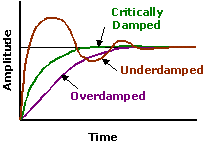
new voltage level. During the transition from 0 V to some new DC voltage level, the output voltage follows some
variation of the three waveforms illustrated below. An underdamped supply would allow the output voltage to swing
higher than the final voltage (a potentially destructive scenario). Overdamping would cause the output voltage
to take an excessively long time to reach the final value. A critically damped system allows the voltage to ramp
up as quickly as theoretically possible without ever overshooting the final steady state voltage level. Choosing
appropriate values of resistance, inductance, and capacitance allows the response to be tailored to the specific
need.
In a mechanical system, a simple example is a mass/spring/damper system. The transient response is the position
of the mass as the system returns to equilibrium after an initial force or a non zero initial condition. Think
of jumping on the bumper of a car and observing who the car moves when you get off. An over damped system results
in it being difficult to even get the car rocking. Under damped results in the car bouncing up and down many cycles
after you get off. Critically damped results in a smooth return to the neutral position.
| f(t) = A1*es1t + A2*es2t |
Over Damped - Roots of the characteristic equation are real and unique. |
| f(t) B1e-at cos (ω t) + B2e-at
sin (ω t) |
Under Damped - Roots of the characteristic equation are complex. |
| f(t) = D1te-at + D2e-at |
Critically Damped - Roots of the characteristic equation are equal and real. |
|