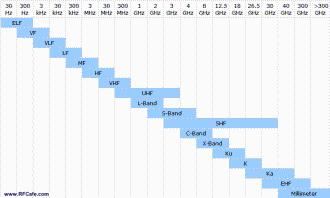
This chart shows the relative positions of the most common frequency
bands, and is not to scale.
ELF = Extremely Low Frequency
VF = Voice Frequency
VLF = Very Low Frequency
LF = Low Frequency
MF = Medium Frequency
HF = High Frequency
VHF = Very High Frequency
UHF = Ultra High Frequency
SHF = Super High Frequency
EHF = Extremely High Frequency
January 2022 Update:
In response to my solicitation for information on the origin of band letter designations,
a website visitor offered this:
I just looked at your web page that gives the names of the various RF bands,
and, in one place asked for any information on origins of the names. I have some
history on the band names that apply to UHF and above.
In the early days of radar (during WWII), the British and the U.S. researchers
at MIT chose, arbitrarily I believe, letter designations for radar frequencies.
The frequencies that were then possible to use for radio communication were just
called by their "meter range" names: HF, VHF and UHF. The new frequencies that were
then only used for deployable radar sets, and for new technology looking for even
shorter wavelength radars, were given letter designations. So, in the 1940s and
1950s, radar sets were identified as being UHF, L-Band, S-Band, C-Band, X-Band and
K-Band. Later they added Ku-Band - presumably for "K Upper," but I do not know.
Later these became expanded with additional names for segments of spectrum, usually
by the researchers or by their company marketing departments. I do not think the
letters had any relational meaning - possibly this was a mild security measure.
It seems unlikely that "Kurz" (German for "short") was any part of it since at the
time the Germans were the enemy.
But there was an entirely separate community that also named segments of this
same spectrum. This was the electronic warfare/electronic countermeasures
researchers, companies and their military operators, and development and procurement
agencies. They completely ignored "those radar guys" and invented their own spectrum
segment designations. These segments were designated by letters in alphabetic order;
starting with "A Band" at the low end and going upward with frequency. Some of the
designators on your web pages are derived from this naming set. The band letter
designators were physically implemented on the front panel band switches on ECM/ECCM
sets. At least that was the case for USAF sets where the Air Force "EWO" (Electronic
Warfare Officer) types used these letter designations exclusively and did not know
what anyone meant if they used the "radar" band designations.
The "decade meter range" names were generally understood by everyone, but were
treated as a broad generalization. The communications people were the custodians
and protectors of these designations. (ULF, VLF, LF, MF, HF, VHF, UHF, etc.)
The "radar" bands are presently called "radar
designations." The communications "decade/meter" names are called "the
ITU designations," and the electronic warfare (EW) band names are called "the
IEEE designations."
If you do a search on the origin of the designations for the various frequency
bands, what you will find that nobody really knows. I have seen some pretty bogus
explanations for how the band designation came to be, but I seriously doubt that
the letters were assigned in order to confuse the enemy during WWII, or that "X"
band was named for "cross," like in the cross hairs of precision targeting radars.
There is some logic in the upper and lower frequencies of the bands, however.
The "3x10n" frequencies derive from wavelength in meters. Recalling that
the speed of light in air is 300,000 km/s, that means a 1 meter wavelength translates
to a frequency of 300 MHz, 10 meters is 30 MHz, 100 meters is 3 MHz, etc.
At some point, some wise soul decided that it was time to start over at a single
digit for L-band at 1 GHz. The new regions are in octaves, except for 3 GHz, to
8 GHz. If anyone knows why 12.5, 18, and 26.5 GHz band edges were chosen, I would
appreciate your letting me know.
Regarding the Ku, K, and Ka bands, supposedly K was named after the German word
for "short," as in shortwave - Kurz. Ku is supposedly for K-under and Ka is supposedly
K-above. That, of course, is inconsistent since since the K, if is derives from
Kurz in wavelength, so K-under would be a lower (lesser) wavelength (hence higher
frequency) and K-above would be a longer (greater) wavelength (hence lower frequency).
Mostly likely, the certain origins are buried with their progenitors.
-
High Level Divisions in Frequency Band Designations:
- Extremely low-frequency (ELF) band: 30 Hz to 300 Hz (10 megameter
down to 1 megameter)
- Voice-frequency (VF) band: 300 Hz to 3 kHz (1 megameter to
100 kilometer)
- Very low-frequency (VLF) band: 3 kHz to 30 kHz (100 km to 10
km)
- Low-frequency (LF) band: 30 kHz to 300 kHz (10 km to 1 km)
- Medium-frequency (MF) band: 300 kHz to 3 MHz (1 km to 100 m)
- High-frequency (HF) band: 3 MHz to 30 MHz (100 m to 10 m)
- Very high-frequency (VHF) band: 30 MHz to 300 MHz (10 m down
to 1 m)
- Ultra high-frequency (UHF) band: 300 MHz to 3 GHz (1 m to 10
cm) - this is also referred to as the decimeter-wave (dm-wave) band
- Super high-frequency (SHF) band: 3 GHz to 30 GHz (1 cm to 1
cm)
- Extremely high-frequency (EHF) band: 30 GHz to 300 GHz (1 cm
down to 1 mm) - this is also referred to as the millimeter-wave (mm-wave) band
-
Widely Accepted Lettered Frequency Band Designations:
- L band: 1 GHz to 2 GHz (30 cm to 15 cm)
- S band: 2 GHz to 4 GHz (15 cm to 7.5 cm)
- C band: 4 GHz to 8 GHz (7.5 cm to 3.75 cm)
- X band: 8 GHz to 12 GHz (3.75 cm to 2.5 cm )
- Ku band: 12 GHz to 18 GHz (2.5 cm to 1.67 cm)
- K band: 18 GHz to 26.5 GHz (1.67 cm to 1.13 cm)
- Ka band: 26.5 GHz to 40 GHz (1.13 cm to 7.5 mm)
- Q band: 32 GHz to 50 GHz (9.38 mm to 6 mm)
- U band: 40 GHz to 60 GHz (7.5 mm to 5 mm)
- V band: 50 GHz to 75 GHz (6 mm to 4 mm)
- W band: 75 GHz to 100 GHz (4 mm to 3.33 mm)
-
Alternate Lettered Frequency Band (UHF, SHF, EHF) Designations:
- L band: 1.12 GHz to 1.7 GHz (26.8 cm to 17.6 cm)
- LS band: 1.7 GHz to 2.6 GHz (17.6 cm to 11.5 cm)
- S band: 2.6 GHz to 3.95 GHz (11.5 cm to 7.59 cm)
- C (G) band: 3.95 GHz to 5.85 GHz (7.59 cm to 5.13 cm)
- XN (J, XC) band: 5.85 GHz to 8.2 GHz (5.13 cm to 3.66 cm)
- XB (H, BL) band: 7.05 GHz to 10 GHz (4.26 cm to 3 cm)
- X band: 8.2 GHz to 12.4 GHz (3.66 cm to 2.42 cm)
- Ku (P) band: 12.4 GHz to 18 GHz (2.42 cm to 1.67 cm)
- K band: 18 GHz to 26.5 GHz (1.67 cm to 1.13 cm)
- V (R, Ka) band: 26.5 GHz to 40 GHz (1.13 cm to 7.5 mm)
- Q (V) band: 33 GHz to 50 GHz (9.09 mm to 6 mm)
- M (W) band: 50 GHz to 75 GHz (6 mm to 4 mm)
- E (Y) band: 60 GHz to 90 GHz (5 mm to 3.33 mm)
- F (N) band: 90 GHz to 140 GHz (3.33 mm to 2.14 mm)
- G (A) band: 140 GHz to 220 GHz (2.14 mm to 1.36 mm)
- R band: 220 GHz to 325 GHz (1.36 mm to 0.923 mm)
-
Subdivided Lettered Frequency Band (VHF, UHF, SHF, EHF) Designations:
- A band: 100 MHz to 250 MHz (3 m to 1.2 m)
- B band: 250 MHz to 500 MHz (1.2 m to 60 cm)
- C band: 500 MHz to 1 GHz (60 cm to 30 cm)
- D band: 1 GHz to 2 GHz (30 cm to 15 cm)
- E band: 2 GHz to 3 GHz (15 cm to 10 cm)
- F band: 3 GHz to 4 GHz (10 cm to 7.5 cm)
- G band: 4 GHz to 6 GHz (7.5 cm to 5 cm)
- H band: 6 GHz to 8 GHz (5 cm to 3.75 cm)
- I band: 8 GHz to 10 GHz (3.75 cm to 3 cm)
- J band: 10 GHz to 20 GHz (3 cm to 1.5 cm)
- K band: 20 GHz to 40 GHz (1.5 cm to 7.5 mm)
- L band: 40 GHz to 60 GHz (7.5 mm to 5 mm)
- M band: 60 GHz to 100 GHz (5 mm to 3 mm)
-
Commercial Broadcast Bands:
-
Longwave Radio: 150 – 290 kHz
-
AM Radio: 550 – 1640 kHz (1.640 MHz) (107 Channels, 10-kHz separation)
-
International Radio: 3 – 30 MHz
-
Shortwave Radio: 5.95 – 26.1 MHz (8 bands)
-
VHF Television (channels 2 – 4): 54 – 72 MHz
-
VHF Television (channels 5 – 6): 76 – 88 MHz
-
FM Radio: 88 – 108 MHz
-
VHF Television (channels 7 – 13): 174 – 216 MHz
-
UHF Television (channels 14 – 83): 470 – 890 MHz


RF Cascade Workbook for Excel
RF & Electronics Symbols for Visio
RF & Electronics Symbols for Office
RF & Electronics Stencils for Visio
RF Workbench
T-Shirts, Mugs, Cups, Ball Caps, Mouse Pads
Espresso Engineering Workbook™
Smith Chart™ for Excel
|
 |
ISM (Industrial, Scientific, and Medical) Frequency Bands
|
Electronics & Technology
- See Full List of AI Topics -
The ISM (Industrial, Scientific and Medical) frequency allocation is a crucial
component of the radio frequency spectrum, which is the range of frequencies used
for wireless communication and other purposes. This portion of the spectrum is set
aside for unlicensed use, which means that any person or organization can use these
frequencies without obtaining a license from the regulatory authorities. This allocation
is designed to encourage innovation and the development of new wireless technologies.
The ISM frequency allocation includes several frequency bands, including:
- 13.56 MHz: This band is used for near-field communication (NFC) and radio-frequency
identification (RFID) applications.
- 433 MHz: This band is used for a variety of applications, including remote control
devices, wireless sensors, and alarm systems.
- 902-928 MHz: This band is typically used for industrial, scientific, and medical
(ISM) applications that require short-range, low-power wireless communication. Examples
of such applications include barcode readers, automated meter reading devices, and
medical devices such as heart monitors.
- 2.4-2.4835 GHz: This band is widely used for a variety of ISM applications,
including Wi-Fi, Bluetooth, and microwave ovens. Wi-Fi, in particular, has become
ubiquitous in homes, offices, and public spaces, providing high-speed wireless internet
access to devices such as laptops, smartphones, and tablets. Bluetooth, on the other
hand, is used for wireless communication between devices, such as headphones and
speakers, or for short-range wireless data transfer.
- 5.725-5.875 GHz: This band is used for wireless local area network (WLAN) applications,
including Wi-Fi. This frequency band provides higher bandwidth and higher data rates
compared to the 2.4 GHz band, making it ideal for applications such as streaming
high-definition video or playing online games.
In order to ensure the efficient use of the ISM frequency allocation and minimize
the potential for interference with other wireless systems and services, each ISM
frequency band has specific requirements and restrictions in terms of power output
and other parameters. These requirements and restrictions vary depending on the
specific frequency band and the country in which the device is being used.
The ISM frequency allocation is a valuable resource for unlicensed wireless communication
and has enabled the development of a wide range of technologies and applications
for industrial, scientific, medical, and consumer use. It has played a critical
role in the growth of the Internet of Things (IoT) by providing a platform for low-power,
short-range wireless communication between devices and has made it possible for
consumers to enjoy the convenience of wireless communication and data transfer in
their daily lives.
 This content was generated by primarily
the ChatGPT artificial intelligence (AI) engine.
Some review was performed to help detect and correct any inaccuracies; however,
you are encouraged to verify the information yourself if it will be used for critical
applications. In some cases, multiple solicitations to ChatGPT were used to assimilate
final content. Images and external hyperlinks have also been added occasionally.
Courts have ruled that AI-generated content is not subject to copyright restrictions,
but since I modify them, everything here is protected by RF Cafe copyright. Many
of the images are likewise generated and modified. Your use of this data implies
an agreement to hold totally harmless Kirt Blattenberger, RF Cafe, and any and all
of its assigns. Thank you. Here are the major categories. This content was generated by primarily
the ChatGPT artificial intelligence (AI) engine.
Some review was performed to help detect and correct any inaccuracies; however,
you are encouraged to verify the information yourself if it will be used for critical
applications. In some cases, multiple solicitations to ChatGPT were used to assimilate
final content. Images and external hyperlinks have also been added occasionally.
Courts have ruled that AI-generated content is not subject to copyright restrictions,
but since I modify them, everything here is protected by RF Cafe copyright. Many
of the images are likewise generated and modified. Your use of this data implies
an agreement to hold totally harmless Kirt Blattenberger, RF Cafe, and any and all
of its assigns. Thank you. Here are the major categories.
Electronics & High Tech
Companies | Electronics &
Tech Publications | Electronics &
Tech Pioneers | Electronics &
Tech Principles |
Tech Standards Groups &
Industry Associations | Societal
Influences on Technology
|
|
|
|


 |
|
Posted February 22, 2018 (update)
|