Custom Search
Over 9,000 pages indexed!
Your Host
Click here to read about RF CafeKirt
Blattenberger

... single-handedly
redefining what an
engineering website should be.

View the YouTube RF Cafe Intro Video Carpe Diem!
(Seize the Day!)

5CCG (5th MOB):
My USAF radar shop

Hobby & Fun

Airplanes and Rockets:
My personal hobby website

Equine Kingdom:
My daughter Sally's horse riding business website - lots of info

Doggy Dynasty:
My son-in-law's dog training business

•−•  ••−•    −•−•  •−  ••−•  •
RF Cafe Morse Code >Hear It<
Job Board
About RF Cafe©
RF Cafe E-Mail
Product & Service
Directory
Engineering
Jobs
Personally Selected
Manufacturers
Employers Only
(no recruiters)

Variance and Standard & Mean Deviation

In probability theory and statistics, the variance of a random variable, probability distribution, or sample is a measure of statistical dispersion, averaging the squared distance of its possible values from the expected value (mean). Whereas the mean is a way to describe the location of a distribution, the variance is a way to capture its scale or degree of being spread out. The unit of variance is the square of the unit of the original variable. The positive square root of the variance, called the standard deviation, has the same units as the original variable and can be easier to interpret for this reason.

The variance of a real-valued random variable is its second central moment, and it also happens to be its second cumulant.

In statistics, standard deviation is a simple measure of the variability or dispersion of a population, a data set, or a probability distribution. A low standard deviation indicates that the data points tend to be very close to the same value (the mean), while high standard deviation indicates that the data are “spread out” over a large range of values.  - Wikipedia

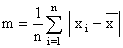
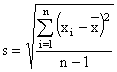
Mean Deviation  Standard Deviation
where x is the mean of the sample, n is an integer

Variance is the square of the Standard Deviation = s2


RF Cafe Software

RF Cascade Workbook
RF Cascade Workbook is a very extensive system cascaded component Excel workbook that includes the standard Gain, NF, IP2, IP3, Psat calculations, input & output VSWR, noise BW, min/max tolerance, DC power cauculations, graphing of all RF parameters, and has a graphical block diagram tool. An extensive User's Guide is also included. - Only $35.
RF system analysis including
frequency conversion & filters

Smith Chart™ for Excel
Smith Chart™ for Visio
RF & EE Symbols Word
RF Stencils for Visio

A Disruptive Web Presence

Custom Search
Over 9,000 pages indexed!
Read About RF Cafe
Webmaster: Kirt Blattenberger
KB3UON

Product & Service Directory
Personally Selected Manufacturers

RF Cafe T-Shirts & Mugs
Calculator Workbook
RF Workbench
Please Support My Advertisers