 In 2015 we would hardly think of electromagnetic
radiation in the 5 cm wavelength realm as being 'quasi-optical' as far as circuit-based
manipulation is concerned.
Optical wavelengths begin at around 6,300 Å for red light, which is 6.3x10⁻⁵ cm,
or 630 nm. The 5 cm wavelength used an example in a 1932 article in
Short Wave Craft magazine is equivalent to 6 GHz. 6 GHz was an
extraordinarily high frequency to be using for communications back then, and the
author did not intend to liken it to anywhere near visible light. Instead, his terming
its properties as 'quasi-optical' referred to how the waves interacted with physical
objects; e.g., reflection, refraction, absorption, and scattering. Barkhausen
oscillations were a popular subject of the era, as I pointed out recently in the
article "The Spook - Another Weird Effect to Haunt TV..."
In 2015 we would hardly think of electromagnetic
radiation in the 5 cm wavelength realm as being 'quasi-optical' as far as circuit-based
manipulation is concerned.
Optical wavelengths begin at around 6,300 Å for red light, which is 6.3x10⁻⁵ cm,
or 630 nm. The 5 cm wavelength used an example in a 1932 article in
Short Wave Craft magazine is equivalent to 6 GHz. 6 GHz was an
extraordinarily high frequency to be using for communications back then, and the
author did not intend to liken it to anywhere near visible light. Instead, his terming
its properties as 'quasi-optical' referred to how the waves interacted with physical
objects; e.g., reflection, refraction, absorption, and scattering. Barkhausen
oscillations were a popular subject of the era, as I pointed out recently in the
article "The Spook - Another Weird Effect to Haunt TV..."
 At least in the U.S., laws regarding the
recording of telephone conversations seem to be constantly changing and vary
from state to state. Violation penalties - including imprisonment - can be
severe in both cases. Some states require that all parties in the conversation
be apprised of the recording, while others only require that at least one party
(obviously the one doing the recording) be aware of it. As mentioned in this
1954 "Macs Radio Service Shop" story, some areas require that an audible "beep"
be sounded at regular intervals while recording is occurring. With the
ubiquitous use of smartphones featuring built-in recording capabilities,
opportunities for recording and being recorded are constant...
At least in the U.S., laws regarding the
recording of telephone conversations seem to be constantly changing and vary
from state to state. Violation penalties - including imprisonment - can be
severe in both cases. Some states require that all parties in the conversation
be apprised of the recording, while others only require that at least one party
(obviously the one doing the recording) be aware of it. As mentioned in this
1954 "Macs Radio Service Shop" story, some areas require that an audible "beep"
be sounded at regular intervals while recording is occurring. With the
ubiquitous use of smartphones featuring built-in recording capabilities,
opportunities for recording and being recorded are constant...
 Here is an advertisement for Electro-Voice
Manufacturing Company
microphones that I scanned from page 101 of my copy of the February 1943
QST magazine. As with many companies during the World War II era, this
one's theme is the service their products are providing to America's servicemen.
Per the ad: If you were receiving radio messages from men in the midst of earsplitting
battle noises, you'd hear crisp speech undistorted by background sound effects.
Electro-Voice Microphones, in military service, are helping to make it possible.
Similar microphones, designed to achieve such results, will be available for specific
commercial applications ... after our wartime job is done...
Here is an advertisement for Electro-Voice
Manufacturing Company
microphones that I scanned from page 101 of my copy of the February 1943
QST magazine. As with many companies during the World War II era, this
one's theme is the service their products are providing to America's servicemen.
Per the ad: If you were receiving radio messages from men in the midst of earsplitting
battle noises, you'd hear crisp speech undistorted by background sound effects.
Electro-Voice Microphones, in military service, are helping to make it possible.
Similar microphones, designed to achieve such results, will be available for specific
commercial applications ... after our wartime job is done...
 It would be more than a decade after the
publishing of this article before the first
direct-to-home satellite television broadcasts would be a reality, so it shows
how long plans were being made for such systems. Rural landscapes are still peppered
with the large vestigial C-band (~4 GHz) satellite dishes, many with faded
eyeballs and other clever (and ugly) artwork on them. Before coaxial cable was strung
beyond suburbs, country dwellers who either could not pull in over-the-air broadcasts
from downtown locations or just wanted more viewing options paid dearly for satellite
service. Equipment and installation costs on early systems could run into the $30k
realm. Today's satellite TV systems use...
It would be more than a decade after the
publishing of this article before the first
direct-to-home satellite television broadcasts would be a reality, so it shows
how long plans were being made for such systems. Rural landscapes are still peppered
with the large vestigial C-band (~4 GHz) satellite dishes, many with faded
eyeballs and other clever (and ugly) artwork on them. Before coaxial cable was strung
beyond suburbs, country dwellers who either could not pull in over-the-air broadcasts
from downtown locations or just wanted more viewing options paid dearly for satellite
service. Equipment and installation costs on early systems could run into the $30k
realm. Today's satellite TV systems use...
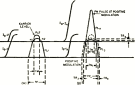 Robert Taylor claims - without contention
from what I can find - to have invented the concept of "super-modulation,"
whereby the normal "splatter" created by greater than 100% amplitude modulation
(AM) can be mitigated through use of specialized circuits. As with many
paradigm-changing discoveries, much was made of super-modulation in the late
1940s through early 1950s, and then it pretty much dropped off the charts. The
cause might have been that the sophistication of circuitry needed to keep
everything tuned and tracking properly to prevent harmonic and sideband was
deemed not worth the trouble once frequency modulation (FM) came on the scene.
FM quickly gained...
Robert Taylor claims - without contention
from what I can find - to have invented the concept of "super-modulation,"
whereby the normal "splatter" created by greater than 100% amplitude modulation
(AM) can be mitigated through use of specialized circuits. As with many
paradigm-changing discoveries, much was made of super-modulation in the late
1940s through early 1950s, and then it pretty much dropped off the charts. The
cause might have been that the sophistication of circuitry needed to keep
everything tuned and tracking properly to prevent harmonic and sideband was
deemed not worth the trouble once frequency modulation (FM) came on the scene.
FM quickly gained...
 By now, most people involved in science and
engineering have seen the iconic photos of cosmic rays and other
subatomic particles leaving a signature of their presence as streaks in a cloud
chamber. Invented by Scottish physicist Charles Wilson, the cloud chamber is a sealed
volume containing super-saturated water vapor that can be ionized by energetic particles
passing through it. The result is a tell-tale whitish line that can be straight
arced, or even a spiral, depending on the nature of the particle. First developed
in the early part of the 20th century, many particles predicted by researchers were
detected and identified. Many unexpected particles were also encountered that gave
physicists reasons to sharpen their pencils and develop new theories to explain.
Similar research and discoveries occur today using super-sensitive electronic detectors
instead of cloud chambers. CERN's Large Hadron Collider (LHC) is currently the world's
grandest particle collider for performing atomic and subatomic particle research...
By now, most people involved in science and
engineering have seen the iconic photos of cosmic rays and other
subatomic particles leaving a signature of their presence as streaks in a cloud
chamber. Invented by Scottish physicist Charles Wilson, the cloud chamber is a sealed
volume containing super-saturated water vapor that can be ionized by energetic particles
passing through it. The result is a tell-tale whitish line that can be straight
arced, or even a spiral, depending on the nature of the particle. First developed
in the early part of the 20th century, many particles predicted by researchers were
detected and identified. Many unexpected particles were also encountered that gave
physicists reasons to sharpen their pencils and develop new theories to explain.
Similar research and discoveries occur today using super-sensitive electronic detectors
instead of cloud chambers. CERN's Large Hadron Collider (LHC) is currently the world's
grandest particle collider for performing atomic and subatomic particle research...
 Beginning in the year 2000 and running through
today, May 17, 2020, I have been creating weekly custom
technology-themed crossword puzzles for the brain-exercising benefit and pleasure
of RF Cafe visitors who are fellow cruciverbalists. A database of thousands of words
has been built up over the years and contains only clues and terms associated with
engineering, science, physical, astronomy, mathematics, chemistry, familiar company
names etc. You will never find a word taxing your knowledge of a numbnut soap opera
star or the name of some obscure village in the Andes mountains. You might, however,
encounter the name of a movie star like Hedy Lamarr or a geographical location like
Tunguska, Russia, for reasons which, if you don't already know, might surprise you...
Beginning in the year 2000 and running through
today, May 17, 2020, I have been creating weekly custom
technology-themed crossword puzzles for the brain-exercising benefit and pleasure
of RF Cafe visitors who are fellow cruciverbalists. A database of thousands of words
has been built up over the years and contains only clues and terms associated with
engineering, science, physical, astronomy, mathematics, chemistry, familiar company
names etc. You will never find a word taxing your knowledge of a numbnut soap opera
star or the name of some obscure village in the Andes mountains. You might, however,
encounter the name of a movie star like Hedy Lamarr or a geographical location like
Tunguska, Russia, for reasons which, if you don't already know, might surprise you...
 Frequency modulation (FM) was, is, and always
shall be: x(t) = Xc·cos [Ωct + β·sin (Ωmt)], where
the carrier is xc(t) = Xc·cos (Ωct), and the modulating
signal is xm(t) = β·sin (Ωmt). Yea verily, thus sayeth Edwin
H. Armstrong. Amen, brothers and sisters of radio. The methods for generating and
degenerating[sic] FM might vary, but the fundamentals do not vary. Mr. Armstrong
developed and patented his system of frequency modulation in the late 1920s and
early 1930s, so when this article appeared in QST in 1939, FM was still fairly new
- or even unknown - to most people. Household radio dials still had only markings
for the commercial AM band (520 - 1720 kHz) and, in a few cases, a couple shortwave
bands (also AM)...
Frequency modulation (FM) was, is, and always
shall be: x(t) = Xc·cos [Ωct + β·sin (Ωmt)], where
the carrier is xc(t) = Xc·cos (Ωct), and the modulating
signal is xm(t) = β·sin (Ωmt). Yea verily, thus sayeth Edwin
H. Armstrong. Amen, brothers and sisters of radio. The methods for generating and
degenerating[sic] FM might vary, but the fundamentals do not vary. Mr. Armstrong
developed and patented his system of frequency modulation in the late 1920s and
early 1930s, so when this article appeared in QST in 1939, FM was still fairly new
- or even unknown - to most people. Household radio dials still had only markings
for the commercial AM band (520 - 1720 kHz) and, in a few cases, a couple shortwave
bands (also AM)...
 Robert Taylor, along with inventing the concept
of "super-modulation," also coined the new communications term "Intelligence
Transmission Efficiency." It refers in part to the ratio of power in the intended
sideband relative to power in the at least partially suppressed other sideband and
carrier. Admittedly, I have not read this material enough to fully comprehend the
concept of super-modulation, but at least based on the Fig. 1 waveform, there
seems to be an element that adds a DC bias to the detected signal due to a nonsymmetrical
(about 0 Vdc) transmitter modulation by pumping more power into the positive peaks.
I'm happy to be corrected by any knowledgeable reader. For that matter...
Robert Taylor, along with inventing the concept
of "super-modulation," also coined the new communications term "Intelligence
Transmission Efficiency." It refers in part to the ratio of power in the intended
sideband relative to power in the at least partially suppressed other sideband and
carrier. Admittedly, I have not read this material enough to fully comprehend the
concept of super-modulation, but at least based on the Fig. 1 waveform, there
seems to be an element that adds a DC bias to the detected signal due to a nonsymmetrical
(about 0 Vdc) transmitter modulation by pumping more power into the positive peaks.
I'm happy to be corrected by any knowledgeable reader. For that matter...
 This week's
crossword
puzzle is a new type that uses a "free form" layout where the software dynamically
creates the word grid, rather than beginning with a predefined grid that it then
fills with words. It appears the longer it is allowed to run, the greater the number
of words and cross-links it creates. After about 5 minutes, this 19x17 grid is showing
57 words and 61 cross-links... and now an hour later it shows 62 words and 70 cross-links
- not overly impressive in my view. The algorithm picks from the same database of
thousands of words which I have been creating for over twenty years and contains
only clues and terms associated with engineering, science, physical, astronomy,
mathematics, chemistry, familiar company names etc. You will never find a word taxing
your knowledge of a numbnut soap opera star or the name of some obscure village
in the Andes mountains. You might, however, encounter the name of a movie star like
Hedy Lamarr or a geographical location like Tunguska...
This week's
crossword
puzzle is a new type that uses a "free form" layout where the software dynamically
creates the word grid, rather than beginning with a predefined grid that it then
fills with words. It appears the longer it is allowed to run, the greater the number
of words and cross-links it creates. After about 5 minutes, this 19x17 grid is showing
57 words and 61 cross-links... and now an hour later it shows 62 words and 70 cross-links
- not overly impressive in my view. The algorithm picks from the same database of
thousands of words which I have been creating for over twenty years and contains
only clues and terms associated with engineering, science, physical, astronomy,
mathematics, chemistry, familiar company names etc. You will never find a word taxing
your knowledge of a numbnut soap opera star or the name of some obscure village
in the Andes mountains. You might, however, encounter the name of a movie star like
Hedy Lamarr or a geographical location like Tunguska...
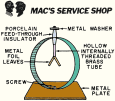 Electronics wizard, repairman, and experimenter
extraordinaire Mac McGregor, as sort of alter ego of author John T. Frye, provides
a brief lesson on electrostatics for his repair shop apprentice wing man Barney
(I don't think his last name was ever mentioned). In this 1973 Popular Electronics
magazine article, Mac had built two types of
electroscopes - one using a pair of pith balls suspended from silk strings and
another that was a cobbled-together version of a gold leaf electroscope. His motive
was two-fold. First and foremost was to accommodate his own interest in electrostatics,
and second to hopefully engender enough curiosity in Barney to cause him to do a
dive into science books to learn more. Given the potentially lethal levels of electrostatic
charge that builds on TV picture tubes they worked around, gaining a healthy respect
for an electrostatic charge...
Electronics wizard, repairman, and experimenter
extraordinaire Mac McGregor, as sort of alter ego of author John T. Frye, provides
a brief lesson on electrostatics for his repair shop apprentice wing man Barney
(I don't think his last name was ever mentioned). In this 1973 Popular Electronics
magazine article, Mac had built two types of
electroscopes - one using a pair of pith balls suspended from silk strings and
another that was a cobbled-together version of a gold leaf electroscope. His motive
was two-fold. First and foremost was to accommodate his own interest in electrostatics,
and second to hopefully engender enough curiosity in Barney to cause him to do a
dive into science books to learn more. Given the potentially lethal levels of electrostatic
charge that builds on TV picture tubes they worked around, gaining a healthy respect
for an electrostatic charge...
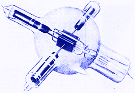 Here is Part 14 of a series entitled
"The
Saga of the Vacuum Tube," by Gerlad Tyne, that appeared in Radio News magazine
in 1944. Part 1 was printed in March 1943, and Part 22, the final chapter,
was published in April 1946. It could have been a stand-alone book. If I manage
to be able to buy issues with some of the other parts, those will be posted as well.
You might be aware of the origins of the amplifying vacuum tubes, beginning with
the accomplishments of Dr. de Forest and his Audion. As with most new technologies,
progress moved very rapidly once other researchers glommed on to the concept. Here,
Mr. Tyne discusses the development of the "Kenotron," "Pliotron," "Dynatron,"
and "Magnetron," by Drs. Langmuir, Dushman and Hull of the General Electric Laboratories,
during the years 1913 to 1921.
Here is Part 14 of a series entitled
"The
Saga of the Vacuum Tube," by Gerlad Tyne, that appeared in Radio News magazine
in 1944. Part 1 was printed in March 1943, and Part 22, the final chapter,
was published in April 1946. It could have been a stand-alone book. If I manage
to be able to buy issues with some of the other parts, those will be posted as well.
You might be aware of the origins of the amplifying vacuum tubes, beginning with
the accomplishments of Dr. de Forest and his Audion. As with most new technologies,
progress moved very rapidly once other researchers glommed on to the concept. Here,
Mr. Tyne discusses the development of the "Kenotron," "Pliotron," "Dynatron,"
and "Magnetron," by Drs. Langmuir, Dushman and Hull of the General Electric Laboratories,
during the years 1913 to 1921.
 Here are three more
technology-themed comics from vintage of Radio & Television New magazines.
Some issued had multiple comics, but these three had just one apiece, so I combined
them onto a single page. There is a huge list of previously posted comics at the
bottom of the page. With many of these comics, you might need to be familiar with
the mindset of the electronics world back in the day. Today it considered hilarious
today to see a video of someone walking into a street lamp pole while staring obliviously
into a smartphone. In the middle of the last century, fun was made of wives not
understanding their hubbies' hobbies, dealings with servicemen, and and goofy things
do-it-yourselfers of the era were doing.
Here are three more
technology-themed comics from vintage of Radio & Television New magazines.
Some issued had multiple comics, but these three had just one apiece, so I combined
them onto a single page. There is a huge list of previously posted comics at the
bottom of the page. With many of these comics, you might need to be familiar with
the mindset of the electronics world back in the day. Today it considered hilarious
today to see a video of someone walking into a street lamp pole while staring obliviously
into a smartphone. In the middle of the last century, fun was made of wives not
understanding their hubbies' hobbies, dealings with servicemen, and and goofy things
do-it-yourselfers of the era were doing.
 "There is no new thing under the sun." -
Ecclesiastes 1:9. "Everything old is
new again." - Peter Allen in All That Jazz. Many such idioms exist regarding
how often things tend to run in cycles; it's just that often times people who think
they are witnessing a new phenomenon are not aware of the previous occurrences.
I have written of examples where 'old timers' lament the attitudes of a fledgling
work force when writings show the previous generation of 'old timers' who worked
with the current 'old timers' in their youth expressed the same type concern. Experienced
Ham operators think newbies cannot carry on the tradition of wireless because they
are not required to learn Morse code anymore to earn a license.
"There is no new thing under the sun." -
Ecclesiastes 1:9. "Everything old is
new again." - Peter Allen in All That Jazz. Many such idioms exist regarding
how often things tend to run in cycles; it's just that often times people who think
they are witnessing a new phenomenon are not aware of the previous occurrences.
I have written of examples where 'old timers' lament the attitudes of a fledgling
work force when writings show the previous generation of 'old timers' who worked
with the current 'old timers' in their youth expressed the same type concern. Experienced
Ham operators think newbies cannot carry on the tradition of wireless because they
are not required to learn Morse code anymore to earn a license.
 Since 2000 - that's 20 years - I have been
creating custom
technology-themed crossword puzzles for the brain-exercising benefit and pleasure
of RF Cafe visitors who are fellow cruciverbalists. The jury is out on whether or
not this type of mental challenge helps keep your gray matter from atrophying in
old age, but it certainly helps maintain your vocabulary and cognitive skills at
all ages. A database of thousands of words has been built up over the years and
contains only clues and terms associated with engineering, science, physical, astronomy,
mathematics, chemistry, etc. You will never find a word taxing your knowledge of
a numbnut soap opera star or the name of some obscure village in the Andes mountains.
You might, however, encounter the name of a movie star like Hedy Lamarr or a geographical
location like Tunguska...
Since 2000 - that's 20 years - I have been
creating custom
technology-themed crossword puzzles for the brain-exercising benefit and pleasure
of RF Cafe visitors who are fellow cruciverbalists. The jury is out on whether or
not this type of mental challenge helps keep your gray matter from atrophying in
old age, but it certainly helps maintain your vocabulary and cognitive skills at
all ages. A database of thousands of words has been built up over the years and
contains only clues and terms associated with engineering, science, physical, astronomy,
mathematics, chemistry, etc. You will never find a word taxing your knowledge of
a numbnut soap opera star or the name of some obscure village in the Andes mountains.
You might, however, encounter the name of a movie star like Hedy Lamarr or a geographical
location like Tunguska...