|
|||||||||||||
 |
|||||||||||||
Videos for Engineers - Sea Water Antenna |
|||||||||||||
|
Background Increasing use of wireless communications require more and more antennas to support their data transmission. Many situations have limited available real estate for antenna placement. For example, Navy ships normally use metallic antenna elements to transmit and receive VHF (Very High Frequency) signals. However, these protruding structures lead to sighting problems and take up valuable space onboard. Additionally, the height of the antennae cause the ships to be detected on radar scans. The typical Navy vessel currently houses 80 different antennae. With increasing antenna demand in many situations, smaller antennas are becoming more valuable to save precious surface real estate. The Technology SSC Pacific has developed a technology that uses the magnetic induction properties of sodium chloride (salt) in sea water to create a VHF antenna. Sea water is pumped from the ocean into a stream and the width and length of the stream determine the frequency capabilities. An 80-foot-high stream could transmit and receive from 2 to 400 MHz with a relatively small footprint. The Sea Water Antenna is capable of transmitting and receiving VHF signals and has been tested at a receiving range of over 30 miles. The antennae needs of a typical Navy vessel with 80 metallic antennas could theoretically be replaced with only 10 Sea Water Antennas of varying heights and streams to cover the same frequencies. The technology could potentially be used on land with salt-supplemented water, replacing large unsightly antenna towers with fountains. Another use could be as a solar- or battery-powered emergency antenna system for watercraft. Key Benefits
Development Status Patent Pending: Navy Case Number 84943: Electrolytic Fluid Antenna |
|||||||||||||
 |
|||||||||||||
|
|||||||||||||
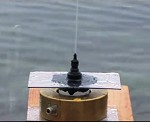 U.S. Navy engineers at the SPAWAR System Center Pacific has developed a technology that uses the magnetic
induction properties of sodium chloride (salt) in sea water to create a VHF antenna. Sea water is pumped from the ocean into a stream and the
width and length of the stream determine the frequency capabilities. An eighty-foot-high stream could transmit and receive from 2 to 400 MHz
with a relatively small footprint. The Sea Water Antenna is capable of transmitting and receiving VHF signals and has been tested at a receiving
range of over thirty miles. The antennae needs of a typical Navy vessel with eighty metallic antennas could theoretically be replaced with only
ten Sea Water Antennas of varying heights and streams to cover the same frequencies.
U.S. Navy engineers at the SPAWAR System Center Pacific has developed a technology that uses the magnetic
induction properties of sodium chloride (salt) in sea water to create a VHF antenna. Sea water is pumped from the ocean into a stream and the
width and length of the stream determine the frequency capabilities. An eighty-foot-high stream could transmit and receive from 2 to 400 MHz
with a relatively small footprint. The Sea Water Antenna is capable of transmitting and receiving VHF signals and has been tested at a receiving
range of over thirty miles. The antennae needs of a typical Navy vessel with eighty metallic antennas could theoretically be replaced with only
ten Sea Water Antennas of varying heights and streams to cover the same frequencies.  This archive links to the many video and audio
files that have been featured on RF Cafe.
This archive links to the many video and audio
files that have been featured on RF Cafe.
|
||||||||||||||||||||||||||||||||||||