|
|||||||||||||
 |
|||||||||||||
How to DX Satellites
|
|||||||||||||
During the early 1960s, Short-Wave Listening (SWL) was a remarkably popular era-defining hobby, as enthusiasts worldwide competed to pull in distant broadcasts from London, Moscow, or Hong Kong. "How to DX Satellites" challenged these listeners to advance beyond Earth-bound stations to the ultimate frontier: intercepting signals from orbiting spacecraft. While skeptics dismissed satellite DXing as impossible due to extreme distances, low power, and elusive verification, the author maintained it was achievable for those with the right patience and gear. Successful monitoring required sensitive communications receivers, crystal calibrators, and custom-adapted converters for VHF bands. Catching these fleeting signals, marked by the distinct Doppler frequency shift, offered a rare thrill for the dedicated hobbyist. Despite the immense difficulty of securing QSL cards from space agencies, the article championed the pursuit as the pinnacle of DXing, ensuring these rare, intercepted transmissions would become prized, historical collector's items in the burgeoning community of global radio enthusiasts. How to DX Satellites
Biggest of all challenges for the SWLer is bringing in space signals, but it can be done! By C. M. Stanbury, II Are you, as a short-wave listener, beginning to look around for something more challenging than bringing in London or Moscow or Hong Kong? If you're seeking more worlds to conquer, let me tell you about a real hair-curling DX challenge that is literally out of this world. I'm talking about signals from artificial earth satellites, sun satellites, moon probes, Venus shots and other assorted spaceships.
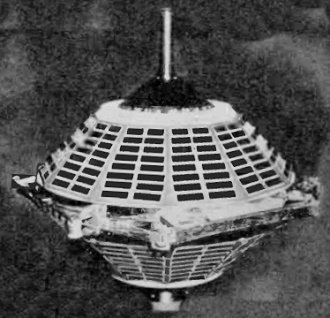
Experimenter's satellite is S-45 Ionosphere Beacon (related to Explorers), built by the U. S. to transmit on six frequencies for the benefit of anyone anywhere interested in or studying phenomenon of ionospheric signals.
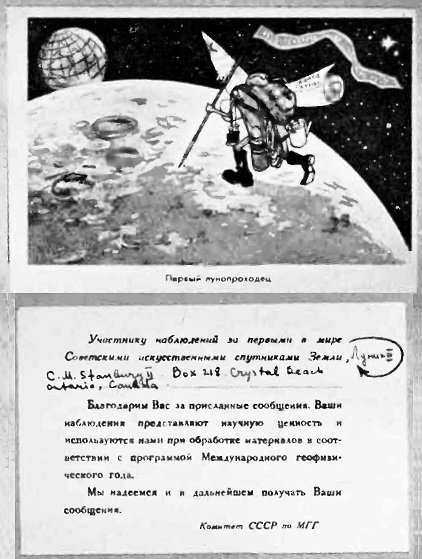
Two of author's coveted Russian QSL cards verify reception of signals from space vehicles. Card at right is standard Red QSL form. "Lunik Ill" note penned on other card (see circle) is a bit of irony. Russians kept Lunik III frequencies "secret" but faithfully QSLed, anyway.
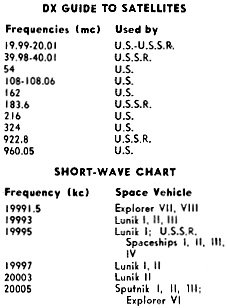
DX Guide to Satellites The mention of satellite DXing is enough to stop many people cold. Impossible, they say. But it can be done. I have done it and I can tell you that the resulting QSL cards are worth the time and effort required. DX catches usually are judged by four criteria: distance, power, accessibility of channel and ease of verification. Most bands qualify on at least one point. International broadcasters, for instance, have plenty of kilowatts and QSL faithfully. Even aeradios are often blessed with clear channels. Earth satellites and the others, unfortunately, don't qualify consistently on any of the criteria. Your target is likely to be a great distance away (100,000 miles, for instance) , power may amount to only a watt, the channels are offbeat and getting a QSL is like taking a five - spot away from Jack Benny. But satellites and spaceships truly represent the ultimate DX. Let's take a look at the equipment required. Fortunately, many satellite radios operate on short -wave, between 19990 and 20005 kc. Sputnik I (20005) was heard by SWLers around the world with only one watt of power, and America's Explorer VIII put out a good signal on 19991.5 kc. Equipment is no problem so far as these satellites are concerned. Amongst the VHF frequencies used for outer space work, 108 mc is the most popular. That is right atop the FM broadcast band but in order to use an FM tuner you'll have to adapt it for AM reception, possibly using it as a converter in front of your short-wave receiver. In general the signal is tapped off just in front of the tuner's detector stage and fed to the short-wave set's antenna post. The SW receiver is then set to 10.7 mc, the standard FM Intermediate Frequency (IF). Other types of converters are possible, of course. A less active VHF band, but one easier to pull in, is 54 mc, on the upper edge of the 6 -meter amateur band. Many receivers tune this band, and converters are available. The Transit (navigational) satellites use 54 mc. The top band now used for space work is 900 mc, in the UHF range. Industrial communications equipment might be adapted for reception here but, frankly, these loggings would be beyond the capabilities of most such gear. On whatever frequencies (below 300 mc) you work, it is advisable to use a crystal calibrator fitted with a 1-mc crystal. This accessory ranges in price between $20 and $30 but is well worth the price since exact tuning is a prime requisite for successful space monitoring. The best short-wave receiver for space DXing is, of course, the communications type which is not only sensitive but selective. If your set lacks selectivity, a Q-multiplier would be a worthwhile investment. Your best bet for an antenna is a single wire, as long as possible so it will receive well in all directions. A directional array would provide more gain but it would be difficult to know which way to point it. Long wires have been used for DX reception beyond 150,000 miles (Lunik I). How do you spot a signal from outer space? One clue is duration. Whether heard directly (line-of-sight) or via short-wave skip, reception from a fast-moving satellite should not last more than a few minutes. If it lasts even that long, turn on your BFO (beat frequency oscillator) and you'll hear a distinct frequency shift (Doppler effect) as the vehicle approaches, then recedes. In many instances reception lasts only a few seconds. Satellites transmit no call letters and the simple beep pattern of Sputnik I has been replaced by more complicated and less distinctive signals. The Soviets have put up many satellites transmitting in the short-wave ranges, so let's examine some Red signals. Three simple sound classifications are possible: (1) An irregular beep pattern with Al modulation, requiring a BFO for reception (otherwise the signals produce a clicking sound). Be careful not to confuse this signal with radioteletype, which is sent more regularly during marker periods and at higher speed during the handling of messages. (2) A high-speed pulse modulation producing a hiss. (3) An A2 modulation composed of two musical notes which sound simultaneously. This is Russia's most advanced signal and was used by the animal-bearing spaceship dubbed Arknik II. To pick up a Red spaceship signal proceed this way: after a launching is announced, listen to Radio Moscow until frequencies are given. Then tune to one of them and wait (there is a lot of waiting in space DX). If your equipment is well warmed up and reasonably stable, monitoring on short -wave will require only patience and good ears. If it's unstable you'll have to tune periodically. Send your signal reports, containing complete details, to: Secretary, Institute of Radiotechnics and Electronics, Academy of Sciences of Soviet Socialist Republics, Moscow - or to Mrs. Eugenia Stepanova, North American Service, Radio Moscow. In approximately two months you should receive a QSL card and/or a letter. While the card is highly decorative, it is of little value without the accompanying letter. The letter refers to your report as informative (rough translation) and thus at least implies confirmation. The easiest American satellites to DX are the Explorers because they are at the low end of the outer-space short -wave band. They operate on 19991.5, down near the frequencies used so often by the Russians, and not far from a WWV frequency. The Explorer signals sound much like the Soviet signals just described, so care must be taken not to confuse them. In the UHF ranges, 108 mc is used by so many spacecraft that identification becomes difficult and so does confirmation. Advanced communications systems can detect several different American space sounds, but most amateur rigs bring in only the satellite's carrier by using a beat frequency oscillator. This signal also is like the Russian signal (1) we described earlier. At lower frequencies, these space signals tend to sound similar to radioteletype, as we have noted, and on UHF, the resemblance becomes even stronger. Certainly, there is a difference between satellite signals and RTT but you will have to hear both to know what it is. There is one shortcut to identification of U.S. satellites. Watch your local paper for times at which a given satellite is visible in your area sand listen at those specific hours. Once you hear a U.S. space vehicle and tentatively identify it you're ready to go QSL hunting. Confirmations are harder to get out of Washington than from Moscow, but they will be worded better. Reports should state which satellite you believe you heard, frequency, date, exact time and a description of the sound. Make the latter as detailed as possible. Then you can request verification in the form of a letter, or you may enclose a self-prepared QSL to be signed and mailed back to you. Reports on Navy satellites go to the U.S. Naval Research Laboratories, Washington, D. C. Air Force space vehicles may be reported to U.S. Air Force Headquarters, Washington 25, D. C., but to receive a reply you'll definitely have to enclose a prepared card. Other reports may be sent to Director of Communications, Project . . . (name of satellite series, e.g., Project Tiros), c/o Office of Public Information, NASA, Room A -106, 1512 H Street N.W., Washington 25, D.C. No one can promise you satellite QSL's. Each attempt is a hit-or-miss proposition. But outer -space QSL's are worth the time and effort required, and tomorrow they will be collector's items. |
|||||||||||||
 |
|||||||||||||
|
|||||||||||||


|
||||||||||||||||||||||||||||||||||||