|
|||||||||||||
 |
|||||||||||||
Electronics Newsletter
|
|||||||||||||
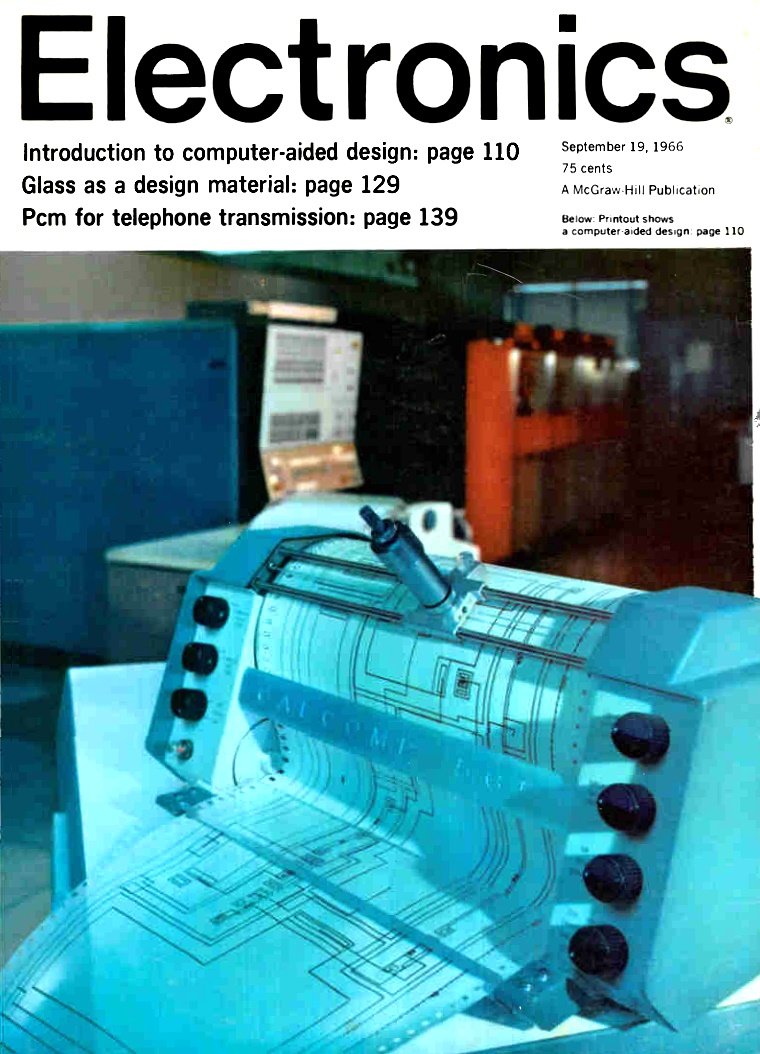
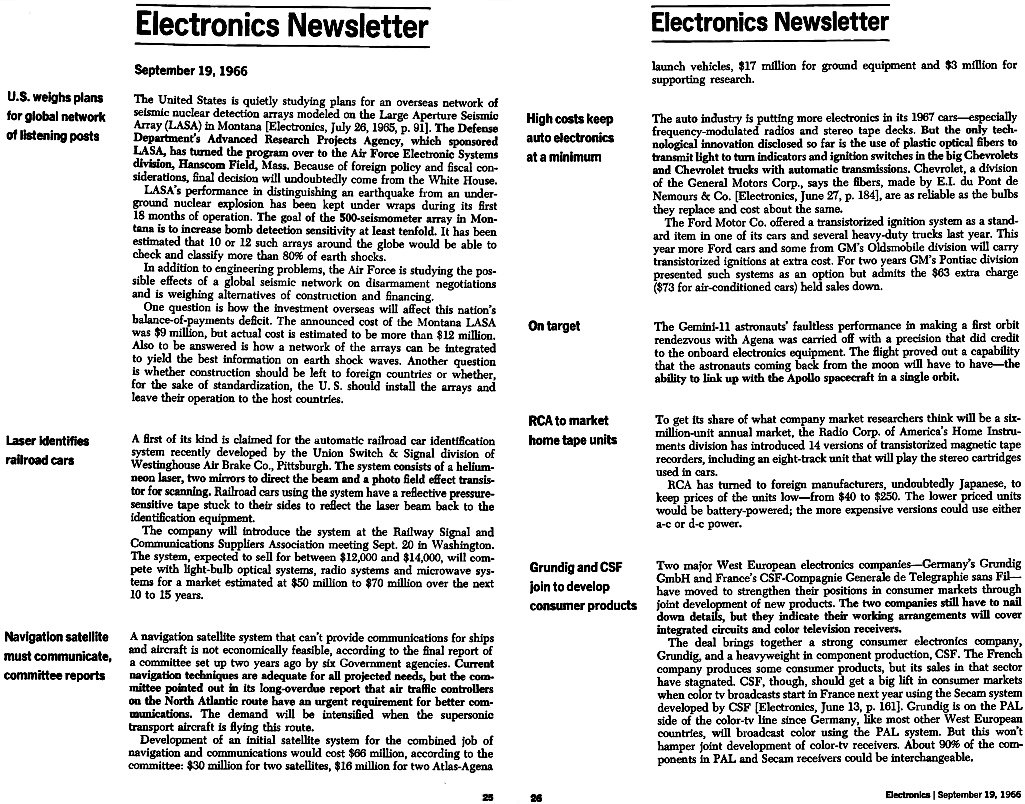
It is always interesting to read industry news stories from decades ago to see when products and techniques that we take for granted these days were just being introduced. Per this 1966 issue of Electronics magazine, the U.S. Air Force studied a global network of seismic arrays, modeled on Montana's Large Aperture Seismic Array (LASA), to detect nuclear tests. The project aimed for a 10x sensitivity increase, potentially classifying over 80% of global earth shocks. "High Costs Keep Auto Electronics at a Minimum," claimed one headline, its author likely never imagining the overwhelming amount of electronics in modern vehicles - which still adds significant cost. The Gemini-XI mission demonstrated a critical first-orbit rendezvous capability essential for future Apollo moon missions. Westinghouse's laser-based system for automatic railroad car identification, using reflective tape scanned by a helium neon laser, was a large, expensive, power-hungry system at the time. RCA launched 14 transistorized tape recorder models, priced from $40 to $250, relying on Japanese manufacturing. Electronics Newsletter - September 19, 1966
The United States is quietly studying plans for an overseas network of seismic nuclear detection arrays modeled on the Large Aperture Seismic Array (LASA) in Montana [Electronics, July 26, 1965, p. 91]. The Defense Department's Advanced Research Projects Agency, which sponsored LASA, has turned the program over to the Air Force Electronic Systems division, Hanscom Field, Mass. Because of foreign policy and fiscal considerations, final decision will undoubtedly come from the White House. LASA's performance in distinguishing an earthquake from an underground nuclear explosion has been kept under wraps during its first 18 months of operation. The goal of the 500-seismometer array in Montana is to increase bomb detection sensitivity at least tenfold. It has been estimated that 10 or 12 such arrays around the globe would be able to check and classify more than 80% of earth shocks. In addition to engineering problems, the Air Force is studying the possible effects of global seismic network on disarmament negotiations and is weighing alternatives of construction and financing. One question is how the investment overseas will affect this nation's balance-of-payments deficit. The announced cost of the Montana LASA was $9 million, but actual cost is estimated to be more than $12 million. Also to be answered is how a network of the arrays can be integrated to yield the best information on earth shock waves. Another question is whether construction should be left to foreign countries or whether, for the sake of standardization, the U. S. should install the arrays and leave their operation to the host countries. Laser Identifies Railroad Cars A first of its kind is claimed for the automatic railroad car identification system recently developed by the Union Switch Signal division of Westinghouse Air Brake Co., Pittsburgh. The system consists of helium neon laser, two mirrors to direct the beam and a photo field effect transistor for scanning. Railroad cars using the system have a reflective pressure sensitive tape stuck to their sides to reflect the laser beam back to the identification equipment. The company will introduce the system at the Railway Signal and Communications Suppliers Association meeting Sept. 20 in Washington. The system, expected to sell for between $12,000 and $14,000, will compete with light-bulb optical systems, radio systems and microwave systems for a market estimated at $50 million to $70 million over the next 10 to 15 years. Navigation Satellite Must Communicate, Committee Reports A navigation satellite system that can't provide communications for ships and aircraft is not economically feasible, according to the final report of a committee set up two years ago by six Government agencies. Current navigation techniques are adequate for all projected needs, but the committee pointed out in its long-overdue report that air traffic controllers on the North Atlantic route have an urgent requirement for better communications. The demand will be intensified when the supersonic transport aircraft is flying this route. Development of an initial satellite system for the combined job of navigation and communications would cost $66 million, according to the committee: $30 million for two satellites, $16 million for two Atlas-Agena launch vehicles, $17 million for ground equipment and $3 million for supporting research. High Costs Keep Auto Electronics at a Minimum The auto industry is putting more electronics in its 1967 cars - especially frequency-modulated radios and stereo tape decks. But the only technological innovation disclosed so far is the use of plastic optical fibers to transmit light to turn indicators and ignition switches in the big Chevrolets and Chevrolet trucks with automatic transmissions. Chevrolet, a division of the General Motors Corp., says the fibers, made by E.I. du Pont de Nemours & Co. [Electronics, June 27, p. 184], are as reliable as the bulbs they replace and cost about the same. The Ford Motor Co. offered a transistorized ignition system as a standard item in one of its cars and several heavy-duty trucks last year. This year more Ford cars and some from GM's Oldsmobile division will carry transistorized ignitions at extra cost. For two years GM's Pontiac division presented such systems as an option but admits the $63 extra charge ($73 for air-conditioned cars) held sales down. On Target The Gemini-11 astronauts' faultless performance in making a first orbit rendezvous with Agena was carried off with a precision that did credit to the onboard electronics equipment. The flight proved out a capability that the astronauts coming back from the moon will have to have - the ability to link up with the Apollo spacecraft in a single orbit. RCA to Market Home Tape Units To get its share of what company market researchers think will be a six-million-unit annual market, the Radio Corp. of America's Home Instruments division has introduced 14 versions of transistorized magnetic tape recorders, including an eight-track unit that will play the stereo cartridges used in cars. RCA has turned to foreign manufacturers, undoubtedly Japanese, to keep prices of the units low - from $40 to $250. The lower priced units would be battery-powered; the more expensive versions could use either a-c or d-c power. Grundig and CSF Join to Develop Consumer Products Two major West European electronics companies - Germany's Grundig GmbH and France's CSF-Compagnie Generale de Telegraphie sans Fil - have moved to strengthen their positions in consumer markets through joint development of new products. The two companies still have to nail down details, but they indicate their working arrangements will cover integrated circuits and color television receivers. The deal brings together a strong consumer electronics company, Grundig, and a heavyweight in component production, CSF. The French company produces some consumer products, but its sales in that sector have stagnated. CSF, though, should get a big lift in consumer markets when color tv broadcasts start in France next year using the Secam system developed by CSF [Electronics, June 13, p. 161]. Grundig is on the PAL side of the color-tv line since Germany, like most other West European countries, will broadcast color using the PAL system. But this won't hamper joint development of color-tv receivers. About 90% of the components in PAL and Secam receivers could be interchangeable. |
|||||||||||||
 |
|||||||||||||
|
|||||||||||||

|
||||||||||||||||||||||||||||||||||||