|
|||||||||||||
 |
|||||||||||||
Looking Through Glasses for New Active Components
|
|||||||||||||
John Mackenzie's 1966 Electronics magazine article predicted a future where glass would transcend its role as a passive material to become a primary semiconductor for devices like memories, transducers, and switches. This forecast has proven remarkably prescient. While crystalline silicon has dominated mainstream computing, the unique properties of amorphous materials, now classified under amorphous semiconductors or phase-change materials, have become foundational to modern technology. The most significant realization of this prediction is in non-volatile memory, where chalcogenide glasses are the active material in commercial Phase-Change Memory (PCM) and the memory cells of optical discs (CD-RW, DVD-RW). Furthermore, thin-film transistors (TFTs) made from amorphous silicon are ubiquitous in every LCD display, and specialized glass-based sensors are used in various applications. The author's vision of a "renaissance in glass technology" has been fully validated, with these materials now performing the precise "primary roles" he envisioned. Check this 2025 news headline: "Glass Use in Semis to Triple by 2030." Looking Through Glasses for New Active Components
John D. Mackenzie, known internationally for his work on glass, was born in Hong Kong and educated in England. After a postdoctoral fellowship at Princeton University, he did research at the General Electric Co. and became professor of materials sciences at Rensselaer in 1963. By John D. Mackenzie, Rensselaer Polytechnic Institute, Troy, N.Y Renaissance in glass technology is providing hundreds of new materials - including amorphous alloys - with potential applications as low-cost semiconductor components, transducers, memories and other devices. Glass isn't an ordinary electronic material, even though most component designers only use it in ordinary ways. Many kinds of components, from switching and memory diodes to computer memories, might be cheaply produced with glass if recent discoveries by glass scientists were exploited by electronics engineers. Glasses can now be made as semiconductors, photoconductors, magnets, transducers, optical switches, memory materials and superior insulators and dielectrics. Present applications are mainly based on just a few of the obvious physical characteristics of glass. Most engineers think of it as an easy to form, transparent, nearly impervious solid with high electrical resistivity. So they use glass for optical parts, tube envelopes, protective coatings, insulators and substrates. All are secondary roles, compared with the primary roles assigned to such materials as ferrites and crystalline semiconductors.
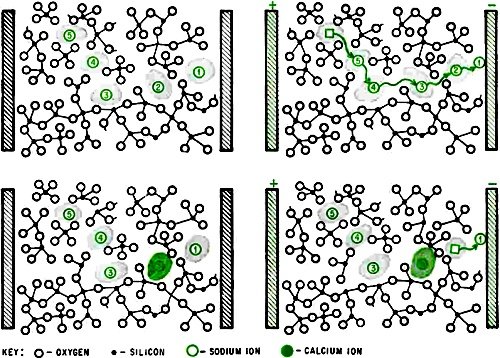
Divalent ions such as calcium improve resistivity of glass by preventing ionic condition. Weak electrostatic bonds hold monovalent sodium ions in place (upper left). A direct-current field, indicated by colored electrodes, causes the ions to move between the glassy chains (upper right). The stronger bond of a calcium ion (lower left) allows it to block the ions behind it when there is a d-c field (lower right).
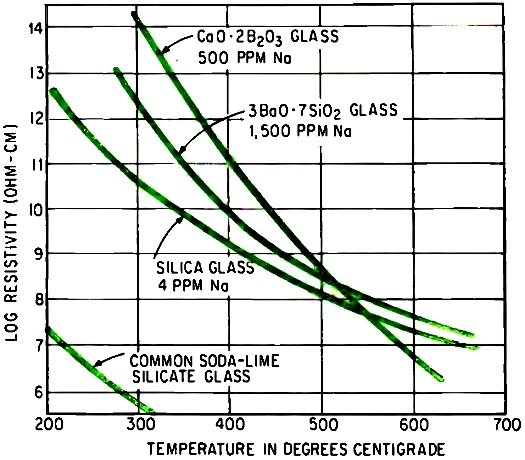
Ionic blocking of calcium or barium ions gives glasses containing sodium much higher resistivity than silica glass, which is nearly free of sodium but expensive.
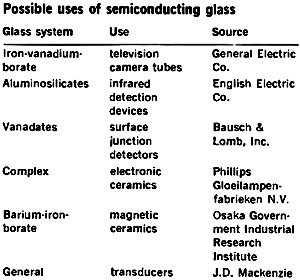
Possible uses of semiconducting glass.
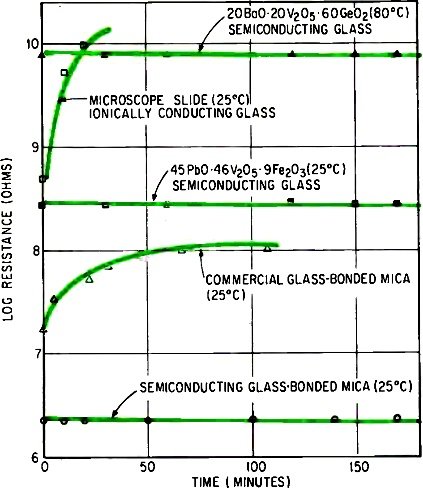
Superiority of semiconducting glass and glass-bonded mica over ionically conducting materials is indicated by effect of 200 volts of direct current. Increase in resistance with time indicates deterioration.
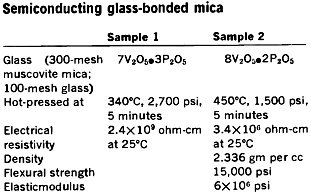
Semiconducting glass-bonded mica.
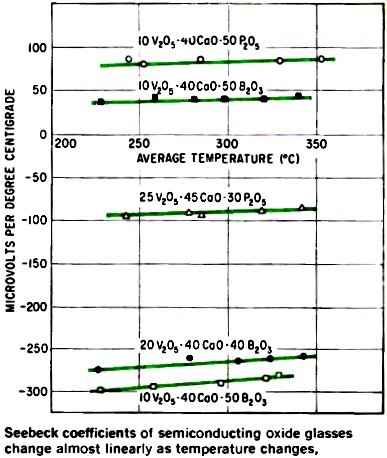
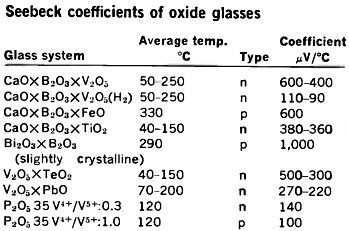
Seebeck coefficients of semiconducting oxide glasses change almost linearly as temperature changes, indicating they would make good temperature sensors and thermoelectric devices.
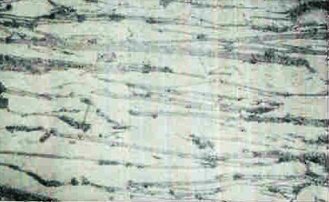
Layered structure of semiconducting glass-bonded mica, magnified 300X. Such high-strength composites can also be made with boron-nitride dielectric and graphite.
Seebeck coefficients of oxide glasses
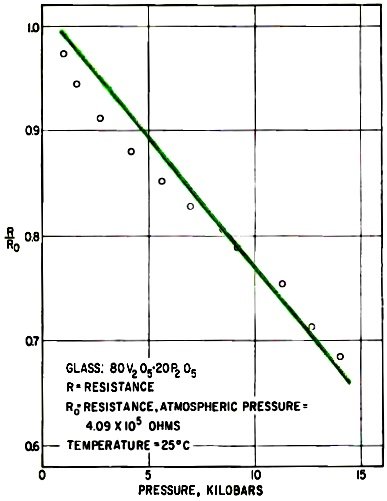
Increasing pressure linearly reduces resistivity of semiconductor glass, probably because distances between vanadium ions decrease, allowing conduction to increase. This glass could be used as a pressure transducer.
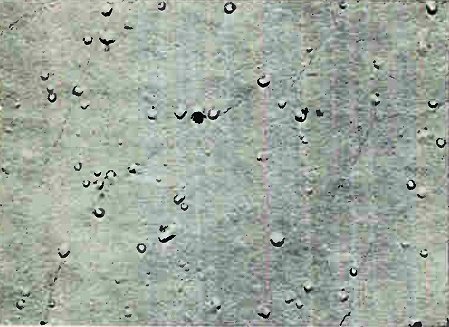
Semiconducting glass magnified 40,000 times by electron microscope. "Droplets" are tiny crystals about 100 angstroms in diameter. The size and distribution of crystals such as ferrites can be closely controlled in glass.
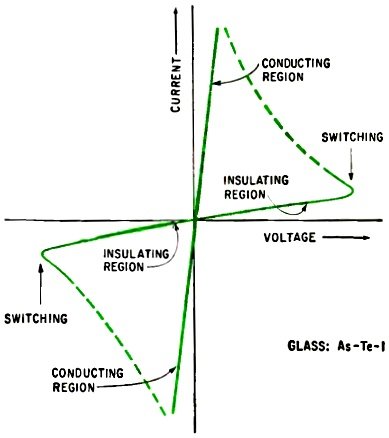
Current-voltage characteristics of diodes made of elemental arsenic-tellurium-iodine glass. Besides pronounced switching behavior, diodes made of this semiconducting glass will remember their states for long periods at zero bias voltage. This general concept of glass as an auxiliary material is actually very narrow in contrast with the capabilities of hundreds of new glasses. Few people realize, for example, that glasses are not solids, but rigid liquids that can have an almost infinite variety of compositions. Their room temperature resistivity can range from only 100 ohm-centimeters to 10 °, ohm-cm. They can conduct both ionically and electronically. Their structures can be controlled so that the glassy matrix is host to millions of ferrite crystals, opening up the possibilities of producing microminiature but numerically vast arrays of memory elements. Device designers can't really be faulted for not having exploited these and other potentially significant features of glass. Materials scientists have still not thoroughly probed all the inherent electronic properties of glass and some of the glasses that enhance such properties are new and untried. But it is apparent that glass is enjoying a technological renaissance certain to make it an increasingly important electronic device material in the coming decade. Some of the recent discoveries have already been converted into practical hardware. Uniqueness of Glass If device designers are to make maximum use of glass's inherent electronic properties they should recognize that it is unlike any other material. It can be put to work both as a liquid and a solid because it is a "frozen-in" liquid. Like most liquids it can - in the absence of physical disturbances and impurities - be cooled well below its freezing point without crystallizing. The viscosity of a watery liquid is 0.01 poise and that of glycerine is 10 poise. When the liquid becomes so cold that its viscosity has risen to 10 poise it becomes rigid. Such a liquid is defined as glass. Many materials can be rendered into the glassy or vitreous state in addition to the common glasses. Since glass is a rigid liquid it never melts but only softens when heated. This makes the fabrication of glass objects easy and permits materials to be dissolved in glass at high temperature. The added material can then be precipitated out in a controlled manner when the glass is cooler and rigid. This explains why a second phase - such as ferrite crystals of controllable size - can be uniformly distributed through the glass and why the compositions can be so varied. The inexhaustible flexibility of composition means, of course, wide flexibility in properties. In contrast, most solids consist of crystals. Since crystals are stoichiometry compounds - having fixed proportions - the control over their properties is restricted. Yet the atomic defects that make crystals so useful in electronic applications can be duplicated in glass. Glass behaves much like crystal in its short-range order (over spacings of a few atomic distances). How advantageous this is, is demonstrated, for example, in the manufacture of high-power lasers. A neodymium-doped glass laser rod 4 feet long and 3 inches in diameter is readily made by conventional glass-making techniques. But there is no practical way of making a sufficiently uniform single-crystal ruby laser of like size. Glass's fabrication ease should help make practical other new electronic systems, too. For instance, it is difficult to produce fine, superconducting magnet wire with adequate insulation. Many years ago glass workers learned to draw hollow, hair-like fibers of glass by pulling on a softened glass tube. Insulating superconducting wire can now be made inexpensively by putting a slug of the superconducting metal into a tube and softening and pulling both at once. High-Resistivity Glasses Formulating the glass to suppress ionic conduction improves insulating substrates, such as those for thin-film circuits. Common oxide glasses may not be chemically inert to the components they carry because they contain mobile and reactive alkali metal ions, particularly sodium ions. In silicate glasses, for instance, ionic electrical transport is entirely due to sodium ions. Their motion deteriorates circuits placed on the glass. Using pure silica glass, with a minimum of sodium ions, prevents deterioration. But such glass is difficult to fabricate, is expensive and its coefficient of thermal expansion is negligible - too low for good adherence of metal films. However, the motions of the sodium ions can be suppressed in inexpensive silicate and borate glasses by adding calcium and barium ions. Ionic conduction becomes negligible despite appreciable quantities of alkalis. Some newer glasses containing calcium ions are even much better insulators than silica, as the graph at the right indicates. One such glass, simply fused wollanstonite, is a silicate of the composition CaO•SiO2. Because ionic conduction occurs on an atomic scale, it has not been seen visually, but the mechanism is probably that diagramed at the left. Apparently the sodium ions must travel in preferential paths, which highly immobile ions such as calcium can block to pin down the sodium ions. Normally, the sodium ions are held in place between the silica tetrahedra (silicon atoms bonded to four oxygen atoms) by electrostatic binding, as in the upper left drawing. The sodium ions are cations (positively charged) while the oxygen has a negative charge. However, when there is a d-c potential across the glass, as in the upper right drawing, the greater attraction of the negative electrode causes the sodium ion numbered 1 to vacate its original site. Ion 2 can then move through the opening in the polymer-like chains of tetrahedra and replace ion 1. Ion 3 can then replace ion 2 and so on until ion 5 has moved along the path. Sodium ions move easily because their valence is low, only 1, and electrostatic binding is proportional to the valence, or charge, squared. Calcium and barium are divalent so their electrostatic binding is four times as strong. The lower set of diagrams show how a calcium ion - the solid colored circle - stays put in a d-c field. Sodium ion 1 can still move to the negative electrode but sodium ions 3, 4 and 5 are blocked. This blocking can occur millions of times in a piece of glass, effectively suppressing ionic conduction and making the glass more inert and more resistive. Semiconducting Oxide Glasses Most polyvalent cations are not only immobile in glass - even at temperatures of 200° to 300° C - but because they have different valence states they make possible electronic conduction in glass. Hence, glasses can be semiconductors, often surprisingly good ones. Some of the possible applications for such glasses are tabulated at the right. In a crystalline transition metal oxide like iron oxide, electronic conduction occurs by means of a highly complex charge-transfer mechanism. The mechanism involves carriers of low mobility, say less than 1 cm per volt-second. Electron motion in an n-type conductor may be represented by: Fe2+—O—Fe3+—>Fe3+—O—Fe2+ Electronic conduction can also occur in glass when enough variable valence ions are present, since the glass's short-range order is considered similar to a crystal's. Silicate glass containing 10% iron oxide has high resistivity but is also electronically conducting, so it is a semiconductor. In glasses the charge transfer is generally called "hopping" and is thought to be similar to impurity band conduction in doped germanium. This hopping, together with polarization induced by the charge, is called a polaron, which is now thought to be the most likely conduction mechanism. In glasses containing vanadium oxides, which the author has studied extensively, the hopping process is represented by: V4+—O—V5+—>V5+—O—V4+ Many hundreds of such semiconducting glasses have been made recently. Conduction is a bulk effect so the semiconductors are not polarized. Resistivity can vary with the concentration of variable valence ions and other factors. Semiconductor glasses are superior to conventional silicate glasses for all direct-current applications. An immediate and important application is improving the long-term performance of image-orthicon tubes. The targets of these tubes are glass disks 2 to 5 microns thick and about 2 inches in diameter. Their thickness must be uniform and the glass resistivity should remain at about 1012 ohm-cm at room temperature. Targets made of common glass deteriorate in time - ionic charge transfer under the d-c potential of tube operation causes electrolysis. Targets made of the new semiconducting glass give the tubes long life because the charge transfer is largely by electrons, not ions, and electrolysis does not occur. Crack-Proof Dielectrics Semiconducting glasses can also improve glass-bonded mica, widely used in electronics because of highly desirable dielectric and mechanical properties provided by the mica it contains. Unlike ordinary glass, cracks apparently do not propagate through this composite material, so it can be made into complex shapes by machining or molding. However, charge buildup during prolonged exposure to electrons leads to dielectric breakdown. This is due to the ionic nature of the glassy phase. If semiconducting glass is substituted for common silicate glass, electron conduction overcomes this difficulty, as shown at the left. Furthermore, the composite's resistivity range, controlled mainly by the glass phase, is greatly extended. The layered structure of the mica, as in the photomicrograph at the right, is probably what prevents crack propagation. Many other inorganic materials also have a layered structure. Among them are boron nitride, a good dielectric, and graphite, a good conductor. The author formed composite glasses with both these materials. They are machinable and possess interesting electrical properties. Varying the amount of graphite changes the resistivity and its temperature coefficient. The glass containing boron nitride has very low-loss factors, indicating it would be a superior capacitor material. Glass Transducers Exploitation of glass semiconductors as active semiconductors is still in its infancy. But it appears that oxide-glass semiconductors could make good temperature and pressure transducers and that other glasses can be made into switching and active but nonvolatile memory components. Many oxide-glass semiconductors have large Seebeck coefficients (a measure of thermoelectric conversion efficiency), as indicated by the typical values given in the graph and table at the right. The graph indicates also that the Seebeck coefficient is relatively stable over wide ranges of temperature and that the glasses can be made as p-type semiconductors (upper curves) or as n-type (lower curves). Thus, these glasses might make good, low-cost temperature sensors. Another distinction between semiconducting glasses and ionically conducting glasses is that the electronic conductivity of semiconductors increases with physical pressure. The resistivity change can be remarkably linear, as plotted by the author in the graph on page 134. The pressure was applied hydrostatically at room temperature; at 100°C, the resistance drops about an order of magnitude but is still very linear. Analysis indicated that the conductivity increase was due to compression of the glassy matrix, which increased the concentration of vanadium atoms per unit volume and increased conduction by the hopping process. An obvious potential use of this glass is as a pressure transducer. Such a transducer could have advantages over conventional pressure sensors, since the pressure sensed by a calibrated device could be read directly as a resistance value or used to initiate a control signal without converting from a nonelectronic value. Glass Ceramics Uncontrolled crystallization in glass is undesirable because it makes the physical properties uncontrollable. However, in recent years the controlled crystallization of glass has become a highly successful technology with electronic implications far wider than the present use of the technique to produce supporting materials. Glass can crystallize because it is a metastable solid - one whose structure may be radically changed by an impurity or physical disturbance. It tends to crystallize at temperatures that make the ions sufficiently mobile because the crystalline phase is invariably more stable thermodynamically. The glass ceramics widely used in electronics for missile radomes, high-temperature circuit boards and other components are an example of controlled crystallization. The insulating types are detailed in a recent book. The crystals, whose formation is triggered by electromagnetic radiation and heat, are less than a micron in diameter and closely knit together, so mechanical properties are excellent. They can also have high electrical resistivity and low loss factors. Glass ceramics with active electronic properties - such as the semiconductor glasses - can also be produced today. So it should be possible to further tailor and enhance their electronic properties. The composition and hence the electronic properties of such glass can be remarkably uniform, as evidenced by the electron micrograph on page 135. The picture shows semiconducting glass in an early stage of crystal formation, enlarged 40,000 times. The droplets that will later become crystals are only about 100 angstroms in diameter and the distances between them vary by only a small fraction of a micron. No such precision can be achieved in formation of single-crystal semiconductors. If three constituents - call them A, B and C - are combined to form a crystalline material, A and B will probably concentrate on the surface and C will have a concentration gradient. The electrical properties will also be nonuniform through the body of the material, and such factors as variations in temperature coefficient of expansion may cause strains and other defects. Glassy semiconductors on the other hand - including the amorphous metals discussed on page 136 - are almost like perfect single crystals in that there are no grain boundaries, with attendant faults and concentrations of impurities. This uniformity might someday be exploited to solve semiconductor production problems. For example, integrated-circuit manufacturers are beginning to make monolithic circuit arrays containing thousands of devices on a single-crystal substrate. When crystal semiconductors are used, the number of devices ruined by random flaws in the crystals pose serious problems. One such problem is the need to develop custom wiring patterns that avoid the faulty devices. New Magnetic Materials Well on the way to laboratory success is the production of glass ceramics containing ferrite crystals of controlled composition and distribution. This creates exciting possibilities in development of microelectronic magnetic devices. For example, if oxides are melted to form glass with a molecular composition of 20% B2O3, 30% BaO and 50% Fe2O3, controlled heat treatment will crystallize barium ferrite out of the glass. Barium ferrite is a hard, ferromagnetic material, suitable for magnets. Virtually any ferrite can be produced in glass hosts in this way. Thin films of barium-titanate ferroelectric have already been made, an achievement that makes possible the manufacture of thin-film capacitors with high dielectric constant. From a manufacturing viewpoint, the significance of glass ferrites is the ease of shaping and "assembling" ferrite elements, compared to the complex sequence of processes and assembly steps needed, for instance, to produce a ferrite-core memory. The glass can be pressed, molded, blown or drawn to produce rods, plates, films, fibers or complex forms. The crystals can be oriented in the glass by controlling the direction in which they grow. Phosphate glass, for one, contains long, glassy chains; ferrite crystals will grow along these chains and their easy direction of magnetization will be along the chains. Selective crystallization techniques, such as selective heating or irradiation, can control the location of the crystals. As a simple proof, the author wrapped a resistance-heated wire around a glass cylinder. When the glass was cooled, the ferrite appeared as a helix around the cylinder. Perhaps sense and drive wires could be counter-wound on such a helix by an ordinary coil-winding machine to produce a small memory. Or perhaps thin-film memories could be made with orthogonal wiring; if in a forming stage wiring cross-points were heated by an overcurrent so the ferrite crystallized in the underlying glass film, many of the deposition processes now required to make planar or laminar memories could be avoided. These possibilities remain to he proved by electronic device designers. Optoelectronic Switches and Memories Controlled crystallization has also led to the invention of phototropic or photochromic glasses - materials that change color when irradiated by light of one wavelength and then revert to their original color under light of another wavelength. Optoelectronic system designers have worked for some time with organic phototropic materials, but these suffer from "fatigue" - usually, after a few hundred color changes they lose their phototropy. Scientists at the Corning Class Works discovered that silicate glasses containing about ½% of silver halide crystals retain their phototropy for more than 300,000 cycles." Corning is studying the feasibility of using such glasses in optical displays, temporary data storage and data-processing systems, as well as ophthalmic, automotive and architectural applications." It might also be used as a Q switch, a device that boosts the peak power of laser pulses. The phototropy is a result of glass being a rigid liquid. Silver halide is dissolved in it at high temperature. After the glass is shaped it is heat-treated at a lower temperature until the halide crystals are about 50 to 100 angstroms in size. The glass is transparent to visible light, darkens under ultraviolet light and bleaches under light of a higher wavelength or when heated. Apparently, darkening results when the first wavelength releases halogens, but they cannot disperse in the glass and so they recombine under the bleaching stimulus. The reactions take from less than two minutes to hours depending on composition and stimuli, and darkened glass eventually bleaches. Corning scientists concede slow reactions may bar high-speed electronic applications, but point out that optical resolution is 10 to 20 times that of photographic film. So they envision other data and display uses." Another phototropic glass, discovered several years ago at the Pittsburgh Plate Glass Co., is based on glass having a short-range order like a crystal12 It has long been known that crystals can be made phototropic by generating color centers in them. Centers can be formed in glass by melting it under highly reducing conditions. Doping with cerium or europium ions improves the phototropy. A company spokesman reported in August that it has not been pursuing electronic applications of the glass because of the low volume that would be used. Nonoxide Glasses A group of glasses known as the chalcogenides now used for infrared transmissions started with arsenic trisulfide in the early 1950's. The constant hunt for better infrared transmitters that are more stable at high temperatures led to the discovery of many such nonoxide or elemental glassy systems. Again, many possess intriguing electronic properties. These glasses are made by melting together various proportions of the following elements: sulphur, selenium, tellurium, arsenic, antimony, thallium, chlorine, bromine, iodine, phosphorus, silicon and germanium. The melt is quenched to produce the glass. Some typical glass systems and applications are: As-S-Se, an insulator that melts at low temperature; As-Te-I, electronic switches and memory devices; As-Se-Te, photoconductor; and As-Ge-Si-Te, an infrared transmitter that withstands high temperature. Some elemental glasses transmit infrared light with wavelengths as long as 20 microns. Recently, the American Optical Co. began making arsenic trisulfide in long fibers by pulling the melt. This allows infrared light to be piped, as in visible-light fiber optics, and might pave the way for better methods of transmitting and steering laser signals. Some chalcogenides soften at temperatures below 0°C, others are viscous at 100°C, making it feasible to dip-coat temperature-sensitive devices in glass rather than organic materials. The softening temperatures can be controlled over a wide range. Several years ago, Bell Telephone Laboratories reported experimental success in dip-coating diodes with arsenic and sulfur glasses. They were good insulators and their chemical stability was superior to organic polymeric materials.18 But according to A.D. Pearson of the research team, that work was set aside primarily because the planar passivation process for silicon devices proved better. Nonetheless, glass should be an attractive coating for other types of devices. Elemental Glass Switches Current-voltage characteristics of some elemental glasses indicate they can be used as switching and memory devices. Pearson and his co-workers at Bell Telephone Laboratories reported on such devices verbally in May, 1962, at an Electrochemical Society meeting. When point contacts are made to a glass such as As-Te-I, a variation in applied voltage switches the device from an insulating to a highly conducting state." The switching can occur in less than a microsecond and is reversible. The diode would remain in a given state, even under zero bias, and could remember which state it was in for many days. A generalized current-voltage plot is shown below. Pearson says this work, too, is inactive at present. One reason is that crystal semiconductors have better long-term stability and thus are considered more suitable for telephone system applications. However, several companies in the U.S. and Europe are actively attempting to develop practical uses for elemental glasses. Little of this work is reported in the open literature since it is considered proprietary. [The Energy Conversion Devices Co. disclosed this month that the semiconductor devices it has begun offering commercially are principally elemental glasses and amorphous alloys. The active materials are homogenous, without p-n junctions. Devices being made or under development include a-c and d-c switches, temperature and pressure transducers, adaptive devices and nonvolatile memory elements. - Editor] Photoconducting Glasses The Russians have extensively studied the electronic properties of nonoxide glasses. One of the better known properties is photoconductivity - the photoconductivity of glassy selenium, for example, makes it a basic material for xerography. Glasses based on selenium, tellurium and arsenic are also photoconductors.16 In contrast to crystalline materials, the conductivity of the glasses is insensitive to impurity contents. This means electronic properties are easier to control during manufacture. Silicon and germanium are rendered into the amorphous - or glassy - state by vacuum evaporation and show higher conductivity and other interesting variations in semiconducting property.' It is not known for certain whether such vapor-deposited noncrystalline films are glasses. Glasses are usually considered materials made by cooling molten materials. Still another new form of glass of interest to electronics is electronically conducting glass based upon mixtures of oxides and nonoxides." Quenched and Pseudo Glasses Quenching and other exotic techniques of producing glasses from metals and other unusual materials are also being tried. In one quenching technique, called splat-cooling, droplets of molten metal are sprayed at high speed onto a revolving substrate cooled by liquid nitrogen. Alloys such as silicon and gold or silver can be made as glass by this method,18 and some metals that normally will not mix can be rendered into glassy or amorphous alloys. The technique is based on the fact that undercooled liquids can be prevented from crystallizing if the cooling - called quenching - is rapid enough. Since quenching rate depends upon heat conduction, the smaller the amount of material, the easier it is to make it into glass. Tiny glass bodies may not interest window and bottle manufacturers, but small amounts of materials can be highly important in processes such as those used to produce semiconductor integrated circuits. Although little information is available on metal glasses, related materials give strong indications that interesting electronic properties can be expected. These indications come from noncrystalline films formed by vapor deposition. The films are not necessarily similar to quenched glass films of the material, but often they are alike." Silicon dioxide films formed by diverse techniques - such as melting, vapor-phase hydrolysis, sputtering, thermal decomposition and shock-wave transformation and neutron bombardment of crystals - have similar refractive indexes and infrared absorption bands. One can conclude that each SiO2 sample is glass. If one also assumes that all vapor-formed, noncrystalline films are glass, many new electronic glasses or pseudo glasses have been discovered in recent years. Among these are: bismuth, a superconductor; MgO and MgF2, infrared transmitters; and cobalt-gold alloys, ferromagnetics. The latter should settle the question whether a noncrystalline material can be ferromagnetic.21 The cobalt-gold alloys were made by researchers at the International Business Machine Co. They vacuum-deposited the two metals onto a liquid nitrogen cooled substrate. The material remains amorphous until heated. As it becomes crystalline, its coercive force jumps, typically from 20 to 40 oersteds. The alloy appears to have a magnetic structure like fine-grained Permalloy. It seems, therefore, that microelectronic systems designers searching for new magnetic materials now have a possible alternative to conventional materials and oxide glasses containing ferrite. References 1. J.D. Mackenzie, "Vitreous State," Encyclopedia of Physics, Reinhold Publishing Corp., N.Y., 1966, p. 769. 2. S.M. Cox, "Ion migration in glass substrates for electronic components. Physics and Chemistry of Glasses 5, 1964, p. 161. 3. J.D. Mackenzie, "Fine Structure in Glass from Ionic Transport and Volumetric Considerations," Proc. VII International Congress on Glass, 1965, p. 22. 4. J.D. Mackenzie, "Semiconducting Oxide Glasses," Modern Aspects of the Vitreous State, Vol. 3, Butterworth Inc., Washington, 1964. 5. J.D. Mackenzie and S.P. Mitoff, "Semiconducting Glass," U.S. Patent No. 3,258,434, June 28, 1966. 6. J.D. Mackenzie, "Semiconducting Glass-Bonded Mica - A New Electronic Ceramic Composite," Bulletin American Ceramic Society, 45, 1966, p. 539. 7. P.W. McMillan, "Glass-Ceramics," Academic Press, N.Y., 1964. 8. H. Tanigawa and H. Tanaka, "Studies on Magnetic Microcrystalline Materials Produced by Crystallization of Glasses in the System 6203-BaO-Fe2O3," Bulletin, Osaka Government Industrial Research Institute, Japan, 15, 1964, p. 285. 9. A. Herczog and S.D. Stookey, "Glass and Methods of devitrifying same and making a capacitor therefrom," U.S. Patent No. 3,195,030, July 13, 1965. 10. W.H. Armistead and S.D. Stookey, "Photochromic Silicate Glasses Sensitized by Silver Halides," Science, 144, 1964, p. 150. 11. G.K. Megla, "Optical Properties and Applications of Photochromic Glass," Applied Optics, 5, 1966, p. 945. 12. E.L. Swarts and J. Pressau, "Phototropy of Reduced Silicate Glasses Containing the 575 m Color Center," Bulletin American Ceramic Society, 42, 1963, p. 231. 13. A.D. Pearson, "Sulphide, Selenide and Telluride Glasses," Modern Aspects of the Vitreous State, Vol. 3, Butterworth Inc., Washington, 1964. 14. A.D. Pearson, W.R. Northover, J.F. Dewald, and W.F. Peck, Jr., "Chemical, Physical, and Electrical Properties of Some Unusual Inorganic Glasses," Advances in Glass Technology, Plenum Press, N.Y., 1962, p. 357. 15. T.N. Vengel and B.T. Kolomiets, "Vitreous Semiconductors," Soviet Physics - Technical Physics, 2, 1957, p. 2,314. 16. J. Stuke, "Electrical and Optical Properties of Elementary Amorphous Semiconductors," Conference on Electronic Processes in Low-Mobility Solids, Sheffield University, England, 1966. 17. B.T. Kolomiets, "Vitreous Semiconductors," Physics Status Solidi, 7, 1964, p. 713. 18. W. Klement, Jr., R.H. Willens, and P. Duwez, "Noncrystalline Structures in Solidified Gold-Silicon Alloys," Nature, 187, 1960, p. 869. 19. D.R. Secrist and J.D. Mackenzie, "Identification of Uncommon Noncrystalline Solids as Glasses," Journal American Ceramic Society, 48, 1965, p. 487. 20. D.R. Secrist and J.D. Mackenzie, "Preparation of Noncrystalline Solids by Uncommon Methods," Modern Aspects of the Vitreous State, Vol. 3, Butterworth Inc., Washington, 1964. 21. S. Mader and A.S. Nowick, "Metastable Co-Au Alloys: Example of an Amorphous Ferromagnet," Applied Physics Letters, 7. 1965, p. 57 |
|||||||||||||
 |
|||||||||||||
|
|||||||||||||


|
||||||||||||||||||||||||||||||||||||