|
|||||||||||||
 |
|||||||||||||
Coaxial Connectors
|
|||||||||||||
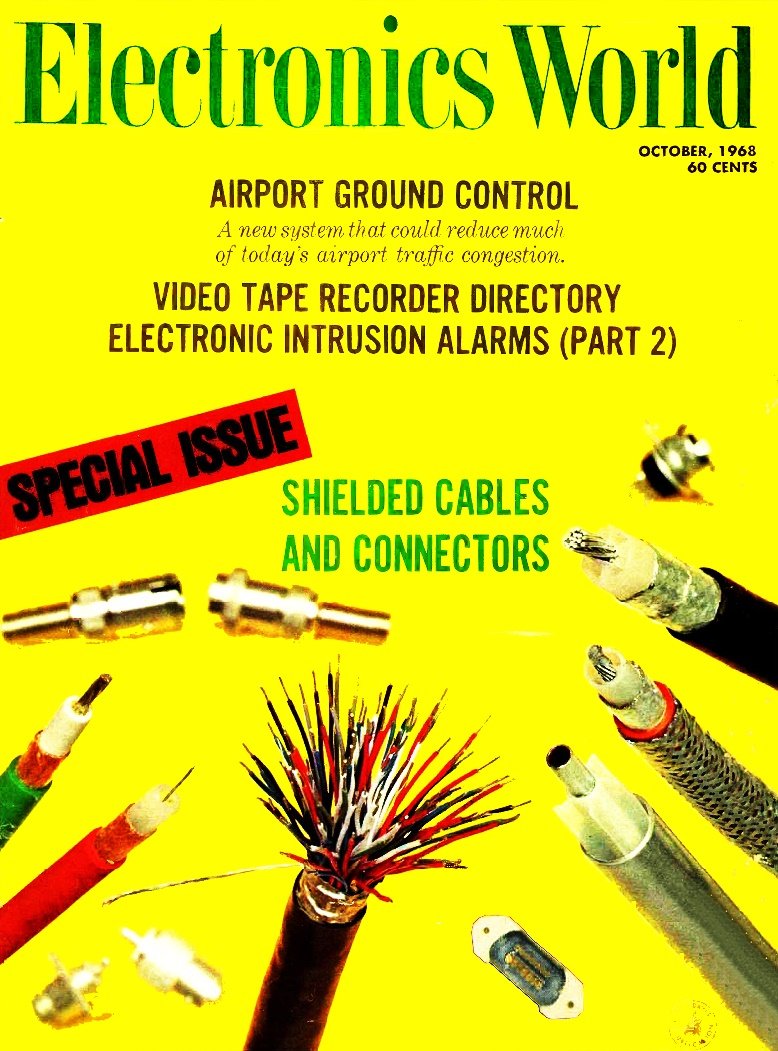
In his 1968 Electronics World magazine article, Amphenol RF Division VP Tore Anderson emphasizes that selecting coaxial connectors is as crucial as choosing the cable itself for optimal RF transmission system performance, maintaining constant impedance despite dielectric transitions and withstanding power without disrupting VSWR. Engineers often prioritize familiarity over suitability, leading to problematic adapters and system degradation, while even manufacturers misuse inexpensive types for high-power applications, risking damage. Connectors are classified by cable size, coupling methods (bayonet, threaded, push-on), and electrical needs like impedance matching, voltage handling, and specialized uses. Popular series span versatile originals like UHF, large high-power types like LC and LT, medium standards such as N and C, small favorites including BNC and TNC, plus high-voltage, subminiature, twinax, triax, and pulse variants. Misconceptions about impedance compatibility persist, especially for non-standard cables, but mismatches matter less at lower frequencies. Precise assembly avoids gaps that raise VSWR, using plated brass/copper contacts, varied insulators, and beryllium copper shields to minimize loss and leakage. Great detail is provided for all aspects of connector selection and performance. Printed-Circuit Laminates
The author joined Amphenol in late 1965. He formerly served as vice-president, engineering of Airtron Inc. He is a graduate of Cooper Union, he has served as a consultant to the DOD Advisory Group on Electronic Ports, as a delegate to the international Electrotechnical Commission for Waveguide and Flange Standardization, and is chairman of the USA Standards Institute C83.2 working group on r.f. connector standardization. Tore N. Anderson Vice-President, Engineering, Amphenol RF Division, Bunker-Ramo Corp. Proper selection of coaxial connectors is as important as the cable on which they are to be used. Sometimes engineers overlook application for convenience. The result is system degradation caused by using adapters with high v.s.w.r. Proper coaxial connector selection is second only to accurate cable specification in insuring optimum performance of a radio-frequency transmission system. The right connector maintains a constant impedance throughout the unit, regardless of the fact that a drastic transition from solid-dielectric coaxial line to air-dielectric line (in the connector) has taken place. And it can withstand the r.f. power levels employed without significantly affecting this delicate balance, measured in terms of standing wave ratio (s.w.r.). The first step in selecting the right r.f. connector for a given application is to narrow down the choice to a specific coaxial "series." Interestingly, however, this is frequently overlooked by the user intent on staying with a familiar-type connector for the sake of convenience. The result is often severe system degradation caused by the use of adapters and high v.s.w.r. Incidentally, several manufacturers have been known to make this same mistake. Some have used inexpensive phono-type connectors for r.f. applications exceeding 200 watts. Accidental damage to the fitting and dielectric occurs easily and tends to culminate in a blown final transmitter tube or power transistor due to shorted output. When classifying connectors into their respective series, there are three main defining characteristics. The first is by the size of cable for which they are designed, that is, they can be classified as small, medium, or large. Cables whose dimensions, for example, exceed ¼-in diameter are generally well suited to connectors of the UHF and type N style; below ¼ in, BNC and TNC are popular. For tiny miniature cables, the subminiature connector types such as the Amphenol 27 series (MIL-C-22557) or new SIR microwave subminiatures should be used. See Table 1. The second criterion of classification is the method of coupling or mating. See Fig. 1. This, in turn, can be broken down into three sub-categories. The first method of coupling is the bayonet-coupling method. The jacks and receptacles have two or three circular protrusions on the exterior of the body which are referred to as bayonet ears. The plugs have internal slanted slots on the internal portion of the coupling nut. The next method of coupling is by the use of threads. The jacks and receptacles have the external body threaded and the plugs have the internal thread on the coupling nut. The last comes with numerous "aliases," such as push-on, plug-in, and quick disconnect. But the principle is always the same; simply push to mate, pull to unmate. The connectors are held together during mating by a press fit, retaining springs, or, in some cases, by spring-loaded ball bearings. Each of the three basic methods has advantages and disadvantages. Some are apparent, like the ease of connecting a push-on coupling type over a threaded coupling type; some are not so apparent, like the noise generated in the circuit by the two-ear bayonet-locking type when subjected to vibration.
Fig. 1 - Mating characteristics of three connector types.
Table 1 - Useful electrical and mechanical specifications for a number of popular coax connector types.
Fig. 2 - The assembly method covering the 83-15P plug and adapter. See text for details.
Fig. 3 - Jacks tie cables to each other or to panels. Dimension A is the cable o.d. Dimension B is jack length.
Fig. 4 - Typical receptacle configuration. Dimension B is receptacle length. Dimension D projects through panel.
Fig. 5 - Adapters are used to tie connectors together and feed signals through panels. They can be male or female. The third criterion when classifying connectors is electrical or application, such as high voltage, close impedance matching, and d.c. pulse circuits, to name a few. Classification by Series "UHF" Series. Now that we have covered the basic parts and the rules of classification, the series themselves fall right into line. Of course, the first one we come to is the exception that proves the rule. The UHF series was the first real coax connector. It is designed for use with small diameter cables (0.185 in) to large diameter cables (0.680 in), and also cables having single and twin center conductors. The insulation materials of the UHF are the mica-filled Bakelite, Rexolite, polystyrene, and Teflon. The connector is not designed for impedance matching but it can be used at frequencies up to 200 MHz and peak voltages of 500 V. The twin-contact UHF connectors are manufactured in accordance with the applicable portions of the MIL-C-3655A specification. "LC" Series. The largest cable connector in common usage is the LC series. It is designed for cables of the 0.870-in diameter range. It has screw-thread coupling and is designed especially for the transmission of large amounts of r.f. energy. The LC's are made to match 50-ohm impedance cables and can withstand a peak voltage of 5000 V. The receptacle has a dielectric material of either Teflon or polystyrene. The plug, however, has the unique feature of using the cable dielectric and core as its insulator and contact. This series is covered by MIL-C-3650. "LT" Series. One of the other large series of connectors is the LT series. This series differs from the LC series in cable size, being 0.730-in diameter cable. The LT cable series is generally aluminum in order to reduce its weight. The LT Mil-Spec is MIL-C-26637. "LN" Series. The LN series is the next large connector group. The LN is used with only three cables: the RG14/U, RG-74/U, and RG -94/U. It has a threaded coupling connector. Peak voltage for the LN is 1000 V. There is no Mil -Spec for this series. "N" Series. The N series is by far the most popular of the medium-size connectors. The average cable diameter for the N connector is 0.400 in, but due to its popularity, the diameter ranges from around 0.200 in to 0.900 in for special applications. Some threaded N connectors are designed to match 50 -ohm cables and others to match 70-ohm cables. Type N is covered by MIL-C-39012 "C" Series. The C connectors are used with the same cables as the N. The C connector is a bayonet -locking connector which has been electrically improved to afford better matches for 50-ohm cables. It works well at frequencies up to 10,000 MHz. Teflon is used exclusively as the insulation material; so is the improved cable -clamping mechanism. The C can be used with peak voltages of 1000 V. Original connectors were made in accordance with MIL-C-3989, new units are made to MIL-C-39012. "HN" Series. For high-voltage use with medium-size cables, there are the HN connectors which can withstand maximum voltage of 5000 V peak. The HN is a screw - threaded coupling type with insulators of either polystyrene or Teflon. This is a 50-ohm constant-impedance connector, giving low v.s.w.r. values up to the 10,000 MHz limit. The specification of HN connectors is MIL-C-3643. "BNC" Series. The BNC connector is the most popular connector for small-size cables, having an average outer diameter of 0.250-in. The BNC is a bayonet-coupling type. The newer units incorporate improved clamping and use Teflon as the predominant insulation material. They are also constant 50-ohm impedance connectors with low v.s.w.r. values throughout the frequency range. Due to the smaller size, they are good only up to 500 V peak. The old BNC specification is MIL-C-3608, the new designs are covered by MIL-C-39012 specification. "TNC" Series. Since the two-ear bayonet-locking device tends to rock during vibration, setting up r.f. noise in the circuit, manufacturers developed the TNC connector which is a threaded-coupling BNC connector. "MHV" Series. The high-voltage (5000 V peak) version of the small-size connector is the MHV series. The MHV uses bayonet-type coupling and the cable-clamping method for the same cables as the BNC connectors. "BN" and "MC" Series. The BN and MC series are also for use with small-size cables. These screw-threaded couplings are low-cost items designed for low-power r.f. applications. "Subminax 27" and "5116" Series. "SM" and "MB" Series. There is another group of connectors for the subminiature size cables with 0.100 -in diameters. These are the constant-impedance, 50-ohm and 75-ohm 27 series: 50-ohm, 75-ohm, and 93-ohm matched 5116 series; and the non-constant impedance SM and MB series. They are push-on, screw-on, and bayonet-coupling, respectively. "Twinax" Series. This is a special application series for twin-conductor coax. They match the 95 -ohm impedance of RG -42/U. "Triai" Series. Triax connectors electrically connect the Triax cable's two braids separately when the threaded coupling connection is made. "Pulse" Series. Pulse connectors are rubber or ceramic insulated connectors rated to handle a 15,000-V pulse at sea level or a 5000-V one at 50,000 feet with no corona effect. Application Requirements Considerable misunderstanding exists in the field concerning the impedance match of connectors and cables. Most UG-type connectors, for example, are designed for an impedance match with 50-ohm cables. In the case of type N connectors there is a group with smaller center contacts to provide a 70-ohm impedance. These are old designs, covered by military drawings, which do not include newer design features such as reactive cancellation characteristics. In the new miniature connectors there are 75- and 93-ohm versions, but in many cases they have not been completely checked with regard to v.s.w.r. Most applications for higher impedance cables are at relatively low frequencies such as encountered in video and pulse circuitry. For such low-frequency applications, the electrical length of the connector is a small fraction of a wavelength and appears as a small shunt capacitance in the circuit. Generally speaking, where the electrical length of the connector does not exceed 1/50 wavelength, a mismatch between cable and connector has negligible effect. With a mated BNC plug and jack this would correspond to a frequency of 140 MHz. In many cases, connectors that are mechanically designed for 75- and 93-ohm cables require some form of shouldered contact because the cable conductor is too small to position the contact properly. This tends to make the impedance lower than the 50-ohm nominal. The BNC connectors for use with RG-9 /U and RG-62/U are examples of this construction. To increase the impedance of a connector from 50-ohm nominal requires a smaller center contact or a larger outer conductor. In most cases, it is not feasible to reduce the diameter of the center contact without introducing fabrication and assembly problems. To increase the outer conductor means an in- crease in the shell size and basically a completely new connector design. Whenever the application requires the use of higher impedance cables, and there is no standard matched-impedance connector available, the possible use of a 50-ohm connector should be carefully considered. Demanding a 75- or 93-ohm connector may result in an expensive item which offers little improvement in performance. Additional problems are created when it is necessary to mate these special impedance connectors with standard test equipment. The latter generally has 50-ohm connectors and very few inter-impedance adapters are available. Understand Assembly Techniques Assuming a connector is properly designed and manufactured to the required tolerances, the most important contributions to high v.s.w.r. are those variables associated with the assembly of the connector to the cable. See Fig. 2. The importance of this operation cannot be overemphasized. Any air gap between the cable core and the connector insulator introduces an impedance discontinuity that can greatly increase the s.w.r. of the assem- bly. Similar effects are present when the connector contact is not butted against a square cut of the cable dielectric. For best results, special fixtures and tools should be used to accurately cut the cable dielectric and position the contact. This procedure is recommended whenever a precision assembly is required. Check Frequency, Power Needs Next to impedance matching, the electrical characteristic of most importance is voltage rating. In general, r.f. connectors are a compromise type of design wherein one desirable characteristic is sacrificed to some extent in order to obtain other characteristics. This is especially true with regard to impedance matching and high-voltage characteristics. The two are not compatible. To obtain a high-voltage rating, especially at the junction of the cable core and connector insulator, requires a long overlap of the cable core. This presents an inductive discontinuity. It can be compensated to some extent by an adjacent section of low-impedance line which generally takes the form of an oversize center contact. These two sections comprise a line which is an appreciable portion of a wavelength at the higher frequencies and always limits the connector to usage at something less than the 10-GHz range of the standard connector. The HN series and high-voltage C connectors are examples of this construction. For a 1.5 maximum s.w.r. these connectors can be used up to 4 GHz. Attenuation in an r.f. transmission line is a paramount design consideration. In practice, the loss in connecting cables is large in comparison with that of the connectors. Therefore, in most cases, the latter can be disregarded. A type N connector, for example, has a dissipative loss of approximately 0.03 dB at 10 GHz, but the reflective loss in a system with various combinations of cable and connectors can be much higher. Consequently, a careful selection of well-designed, properly assembled connectors is the only available solution to this problem. There is some small r.f. leakage from coaxial connectors. The slotted outer contacts are a contributing factor although leakage through the slots is reduced by the shielding of the coupling mechanism. Threaded-coupling types of connectors are better in this respect than the bayonet-lock type. When properly tightened, they form a low- resistance contact which effectively suppresses any leakage from the slots. Even with the bayonet-lock connectors, the leakage is small provided the cable support is such that the spring loading of the bayonet coupling mechanism permits a full bottoming of the outer contact. All of the recently designed connectors use positive metal-to-metal clamping of the braid wires to insure a consistent low- resistance connection at this point. Coax-Connector Construction As in the construction of a cable, let's start in the center and work out. There are two types of center contacts (male and female) which are terminated in the center conductor of the cable. The male contact, sometimes referred to as the male pin, almost always has a solder pocket in one end and is tapered at the other. The female or socket contact may have a variety of terminations such as a solder, flattened and pierced, or turret, but the front end is always hollow, slotted, and set. The male contact is made from ½-in hard brass for ease in machining and is plated with gold or silver. The trend seems to be toward gold plating because it doesn't tarnish and because of the increase in solderability. The female contacts are either brass or beryllium copper; the majority being beryllium copper because of its good spring action even after many insertions and withdrawals. Again, the platings are gold or silver, with gold becoming more popular. Both male and female may be what we call captivated or a captive contact. This is done by adding a shoulder of some type on the contact and then physically holding it in the connector. It is usually held stationary by placing it between two insulators which are, in turn, held stationary by a clamp nut or staking operation. As in the cable, we come next to the dielectric or, as it is referred to in the connector, the insulator. The insulator varies in configuration depending upon the connector style and type. The materials also vary with the applications. The major insulation materials are polystyrene, Rexolite, polyfluoron (tradenamed Kel-F) , poly tetrafluoroethylene (Teflon), glass, and mica-filled Bakelite. Next, is the outer contact. It is this portion of the connector that is electrically connected to the outer shield of the cable and serves the same purpose, that is, to carry a signal, to act as a shield, or as a grounding member of the circuit. In the case of jacks and receptacles. the body of the connector is the outer contact. The plug may have an outer contact and a coupling nut or just a coupling nut which acts as the outer contact. The term, "outer contact" is used only when referring to the tined portion of the body and is generally made out of silver-plated beryllium copper, again because of its good spring action and good electrical characteristics. Still working outward, the coupling nut is encountered. This nut is that portion of the connector that mechanically joins two connectors. In the case of bayonet coupling, it is sometimes referred to as the bayonet sleeve. The coupling nut material is ½ hard brass with either a gold or silver plating. Most of the UG items are silver plated. Connector bodies, last on our inside-looking-out list, are also silver-plated or gold -plated brass. Their configuration depends on the type of connector. Cable-Retention Methods Now let's take a quick look at the back of the connectors and the methods of attaching the cable to the connectors themselves. There are three basic methods of doing this: (1) soldering, (2) clamping, and (3) crimping. In UHF series, the cable braid is soldered to the connector. The second method of attachment is by clamping and is by far the most popular. In order to accomplish this, it is necessary to use additional piece parts. The first of these is the braid clamp and has two basic forms: one a tapered clamp or old style, the other an improved braid clamp. Both are silver-plated brass material. The second piece part is the sealing gasket. Originally the gasket was a flat rubber gasket. The improved type is a V-grooved gasket or chevron seal. Next comes flat washer, either of brass or phosphorous bronze with silver plate. The last part is the clamp nut. The inside diameter of the clamp nut is equal to the outside diameter of the cable and the o.d. is threaded to screw into the body of the connector. It is this part that holds the cable into the connector. The old-style clamping parts accomplished the sealing and clamping by compressing the flat gasket between the clamping nut and the braid clamp. This gave a fairly adequate seal but the cable retention, being dependent upon the rubber member, was rather weak. The last form of cable retention is by the use of a crimp. In this type, the braid clamp, gasket, washer, and clamp nut are replaced by a ferrule clamp nut assembly which is an extension of the body. The cable dielectric and center conductor are put inside the ferrule and the cable braid, and compressed by means of a crimping tool. The inner ferrule assembly is of silver- or gold-plated brass but the outer ferrule must be a softer alloy because it must be deformed. We can use the crimp in this application because it is outside of the electrically critical area of the connector. The biggest advantage to the crimping assembly method is that it is easier. The cable stripping dimensions are not as critical and there is no braid combing and no torque tightening problem to interfere with satisfactory cable retention. Its main disadvantage is the need for special tools. Basic Coax Connector Terms Plugs The term "plug" defines the mating characteristics and can be broadly stated as that unit, when mated, which encompasses or fits over its mate. The two main types are the straight plug and the right-angle plug. The right-angle can be of two types. The first is where the body of the unit is made from a block of brass with the circular mating units and cable-clamping portions brazed or threaded into it. This form is termed "cubic construction." The second is made by brazing the two circular portions directly together. This is usually referred to as mitered construction. Jacks. There are two principles that define a jack. First, a jack is the mating unit to the plug and all mating features fit inside the plug during mating. Also, it must have a means for securing it to the end of a cable. There are three types of jacks. See Fig. 3. The first is only secured to the end of a cable and is referred to as a cable jack; the second is secured to the cable but is mounted to a panel by means of a square flange, this is called a panel jack; the last unit is mounted to the panel by a shoulder and hex nut and is called a bulkhead jack. Receptacles. The receptacle has the same mating characteristics as the jack but has no cable-clamping parts. See Fig. 4. The receptacle is open-wired with the center conductor soldered on to the unit and the cable braid sometimes soldered to a grounding lug nut. Adapters. An adapter takes two or more incompatible items and joins them together. The names applied to the adapters depend on their functions. See Fig. 5. The straight adapter joins two like units of the same series. These are also called feedthrough adapters when mounted to a panel. The angle adapter usually has a plug, or male end, and a receptacle, or female end, and is used where an angle connection is needed and an angle plug cannot be used. The "T" adapter joins three units together and can be any combination of ends, such as three -receptacle ends, two-receptacle ends, and one plug or possibly one cable-clamp end, and so on. There are also between-series adapters which give us a transition from one series to another. A note of caution should be interjected here. When referring to adapters of all types, it is necessary to be explicit as to the ends of the adapter. Some people describe an adapter by designating the unit with which it is to mate, such as an adapter for two plugs. This is not an adapter with two male or plug ends, but just the opposite; an adapter with two female or receptacle ends. The other method of describing an adapter is to discuss its own construction. The use of both methods is recommended when describing adapters. Also, when calling out a between -series adapter, it is necessary to indicate the specific series involved, such as an adapter with a BNC female end and a series N male end. Cable Terminations. Cable terminations are used when a complete cable connector is not required. Basically, it is a means of clamping the cable braid and jack while allowing the core to pass through. Cable terminations can be supplied with various methods of mounting from square-flange mounting to strap mountings. Resistor terminations. This is an electrical termination rather than mechanical. Generally, it takes the form of plugs with built -in resistors that close and load the circuit when mated. Caps: Shorting and Non-Shorting. This same principle is used in shorting caps. The shorting cap is nothing more than a unit having the mating features of a plug or a receptacle, except that it shorts out the center contact to the cap body. Hoods. Since receptacles are open-wired. covering the open end by means of a hood reduces noise pickup. The hood is either attached to the flange or screwed onto the threaded portion of the bulkhead connector. Pressurized Connectors. Another general term that requires clarification is pressurized connectors. There are two methods of pressurizing connectors. The most effective means being the use of a glass bead which is soldered into the connector body itself. The other method of pressurizing is by means of a rubber seal gasket compressed between two insulators. This is not a hermetically sealed connector and should not be referred to as such. Its sealing effectiveness varies greatly and, in general, should be used only where low pressure differentials exists. A Look at Mil-Spec Connectors Since the majority of r.f. connectors find their way into military applications, let's briefly review the military terminology associated with r.f. connectors. The UG portion of the number has been assigned the meaning "Connector,R.F.". The "/U" indicates that it is for general usage and officially defined as "used in two or more general installation classes such as airborne, shipboard, or ground." The number assigned to the connector is the identifying number and is assigned on a first-come, first-served basis. There is no correlation between this number and the type or series of the connector. Provisions are made in the military nomenclature to reflect changes. This is the function of the letter inserted after the number and before the /U. The higher the letter, the later the revision. On some connectors, use revisions are as high as, "E": indicating a fifth revision of the original design. A revision number is assigned when the detail parts and subassemblies therein are no longer interchangeable, but the component itself is interchangeable physically, electrically, and mechanically. If the change is of such a nature that the connector is not interchangeable with its forerunners, it will be assigned a new nomenclature. There are two other identification symbols used in connection with r.f. lines. These are CW and MX. The MX denotes a miscellaneous category and covers such things as caps, hoods, and armor clamps. The CW designates a cover and is used with caps exclusively. It can be seen, then, that proper selection of coaxial connectors depends upon several factors. For a quick recap, the following should be evaluated on a step-by-step basis: 1. Determine coaxial cable -- cable should be chosen on the basis of impedance, temperature, attenuation or power capacity. 2. Determine possible connector series. 3. Constant or non-constant impedance. 4. Coupling. 5. Cost and availability. 6. Shell style. 7. Solder or crimp terminations. |
|||||||||||||
 |
|||||||||||||
|
|||||||||||||



|
||||||||||||||||||||||||||||||||||||