|
February 1967 Electronics World
 Table
of Contents Table
of Contents
Wax nostalgic about and learn from the history of early electronics. See articles
from
Electronics World, published May 1959
- December 1971. All copyrights hereby acknowledged.
|
Recent in 1967, that is. These
half dozen developments made the headlines in Electronics World magazine
in February of the year. Solid-state electronics was rapidly gaining on the
traditional vacuum tube, and the new technologies were glomming onto the trend.
Lasers, integrated circuits, computer-aided design, superconductors, and similar
technologies were moving from the realm of science fiction to reality.
Operational power levels were still relatively low, and physical sizes were
still rather large and heavy, but as history has shown, incremental improvements
happen quickly. More than half a century later, compare these news items to
their modern equivalents or descendants. ICs have sub-micron gate widths, lasers
can read/write data on an optical disk with microwatts of power to melt missiles
in the air from a mile away, sonars and radars can detect and identify objects
without human intervention, superconducting magnets steer and contain atomic
nuclei containing megajoules of energy. We've come a long way, baby.
Recent Developments in Electronics
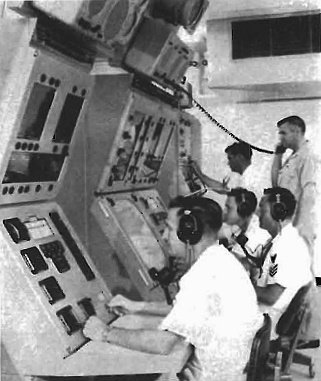
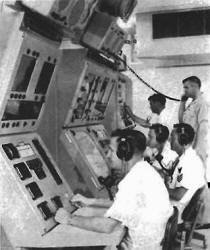 Anti-Submarine Trainer. Navy ship
crewmen at the Fleet Anti-Submarine Warfare School, San Diego, California, are practicing
a simulated, but realistic, attack on a submarine. The mock attack is being carried
out in the Underwater Battery Plot Room of a new $3.5 million attack training system
built by Honeywell. Sailors at the two attack consoles (in the foreground), using
information from sonar equipment (in the background), are able to simulate the firing
of an antisubmarine rocket missile at their target with deadly accuracy. The system
also permits computer-controlled battles to be fought with moving symbols on a make-believe
sea that is displayed on a large projection screen. Six operating areas encompass
3000 sq. ft. of floor space-conning station, combat information center, underwater
battery plot, problem critique display room, launcher captain's station, and computer
room. Anti-Submarine Trainer. Navy ship
crewmen at the Fleet Anti-Submarine Warfare School, San Diego, California, are practicing
a simulated, but realistic, attack on a submarine. The mock attack is being carried
out in the Underwater Battery Plot Room of a new $3.5 million attack training system
built by Honeywell. Sailors at the two attack consoles (in the foreground), using
information from sonar equipment (in the background), are able to simulate the firing
of an antisubmarine rocket missile at their target with deadly accuracy. The system
also permits computer-controlled battles to be fought with moving symbols on a make-believe
sea that is displayed on a large projection screen. Six operating areas encompass
3000 sq. ft. of floor space-conning station, combat information center, underwater
battery plot, problem critique display room, launcher captain's station, and computer
room.
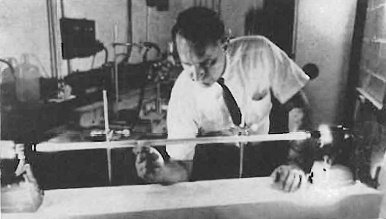
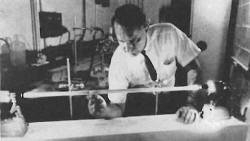 Long Laser Rod. Laser rods, the
key working elements of most high-power pulsed lasers, are getting longer. Smaller
than a cigarette a few years ago, such rods now may be three feet or more in length
as shown by this lengthy specimen. Made of glass containing a trace of an impurity
called neodymium, the rod is used in experiments aimed at increasing the size, power
output, and efficiency of laser systems suitable for welding, drilling, and micromachining.
The laser rod, made by Pittsburgh Plate Glass Co. for Westinghouse research laboratory
experiments, is shown illuminated at both ends with ordinary light to bring out
its uniformity of structure. The entire laser is in the background. Long Laser Rod. Laser rods, the
key working elements of most high-power pulsed lasers, are getting longer. Smaller
than a cigarette a few years ago, such rods now may be three feet or more in length
as shown by this lengthy specimen. Made of glass containing a trace of an impurity
called neodymium, the rod is used in experiments aimed at increasing the size, power
output, and efficiency of laser systems suitable for welding, drilling, and micromachining.
The laser rod, made by Pittsburgh Plate Glass Co. for Westinghouse research laboratory
experiments, is shown illuminated at both ends with ordinary light to bring out
its uniformity of structure. The entire laser is in the background.
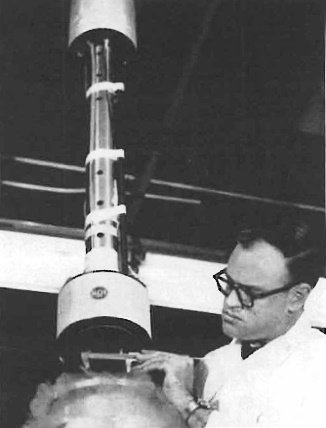
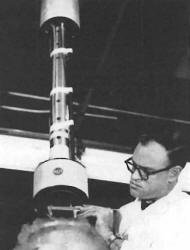 Superconductive Magnet. This superconductive
magnet is used to test the high-field properties of specially coated wire ribbon
during the manufacturing process. The magnet generates a field intensity of 110
kilogauss in almost a 3-inch clear bore. The special ribbon is wound into a solenoid
which is then submerged in a bath of liquid nitrogen. At the extremely low temperature,
resistance disappears, and very high currents can be made to flow and be sustained
in the solenoid. This results in the production of a very intense magnetic field.
The superconductive ribbon, which is now being offered commercially by RCA, is made
from crystalline niobium-tin that has been vapor-deposited on a flexible stainless-steel
alloy substrate and then electroplated with silver. Superconductive magnets are
widely employed in laboratories in the fields of high-energy physics, medicine,
and biology. Superconductive Magnet. This superconductive
magnet is used to test the high-field properties of specially coated wire ribbon
during the manufacturing process. The magnet generates a field intensity of 110
kilogauss in almost a 3-inch clear bore. The special ribbon is wound into a solenoid
which is then submerged in a bath of liquid nitrogen. At the extremely low temperature,
resistance disappears, and very high currents can be made to flow and be sustained
in the solenoid. This results in the production of a very intense magnetic field.
The superconductive ribbon, which is now being offered commercially by RCA, is made
from crystalline niobium-tin that has been vapor-deposited on a flexible stainless-steel
alloy substrate and then electroplated with silver. Superconductive magnets are
widely employed in laboratories in the fields of high-energy physics, medicine,
and biology.
Computer Helps Design Computers. Using a computer-controlled
display screen and a special "pen" that writes with light, an IBM engineer lays
out the design for electronic-computer circuit. After he has experimented with various
patterns and is satisfied with the final design, the computer produces a precise
scale drawing of the circuit. The drawing shown beneath the screen in the photo
is a computer-generated hard copy of the circuit that was sketched by the engineer.
Intermediate drawings, which must be redrafted when the engineer modifies his design,
can be eliminated.
Dielectric Tape Camera System. The scanning mirror of a new
dielectric tape camera system developed for weather and cartographic satellites
is shown here. The new system combines the functions of camera and tape recorder
in a single unit that is smaller, lighter, and requires less power than film and
tube camera systems now in use. Heart of the system is a unique electronic "film"
which can be erased and reused indefinitely, can store information for long periods
of time, has a high immunity to radiation, and uses a completely electronic processing
of photos requiring no chemicals or heat. The scanning mirror reflects light from
the scene being photographed through optical lenses onto the special plastic tape,
where the images are recorded electrostatically. The system is being developed for
NASA by RCA.
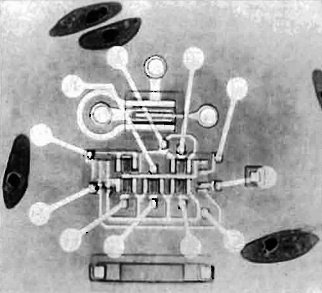
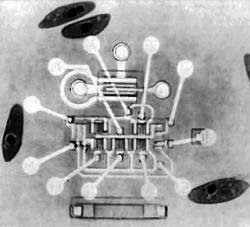 Paramecia, microscopic single-celled animals,
seem huge compared to this experimental, high-speed circuit. The monolithic circuit,
in which all the components are built into a single chip of silicon, is believed
to be the smallest and fastest ever reported. It operates in less than 400 picoseconds
(trillionths of a second) and occupies are area of about 10 thousandths of an inch
square. Each transistor (striped structures in center) is about 0.001-in square
-- smaller than a paramecium's nucleus. The larger transistor above the circuit
(keyhole-shaped structure) is included in this experimental integrated circuit in
order to facilitate testing by the developer, IBM. Paramecia, microscopic single-celled animals,
seem huge compared to this experimental, high-speed circuit. The monolithic circuit,
in which all the components are built into a single chip of silicon, is believed
to be the smallest and fastest ever reported. It operates in less than 400 picoseconds
(trillionths of a second) and occupies are area of about 10 thousandths of an inch
square. Each transistor (striped structures in center) is about 0.001-in square
-- smaller than a paramecium's nucleus. The larger transistor above the circuit
(keyhole-shaped structure) is included in this experimental integrated circuit in
order to facilitate testing by the developer, IBM.
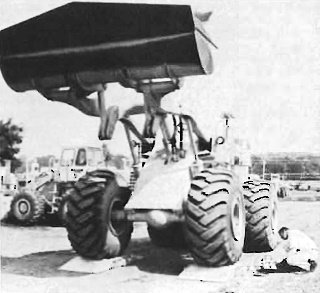
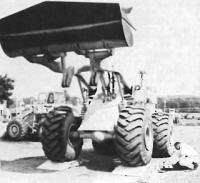 Electronic Platform Scale. A new
portable electronic platform scale determines the load imposed by the wheels of
the 70,000-lb front-loader to an accuracy of 99.95 percent. Battery-powered and
designed for use in remote areas, the unit's platforms and ramps weigh only 800
lbs. The combined load on the platforms, each with a capacity of 100,000 lbs, is
transmitted through electronic load cells to the readout instrument, where the signal
is amplified to translate into the actual value of the load being applied. Weighing
system is made by Revere Corp. of America. Electronic Platform Scale. A new
portable electronic platform scale determines the load imposed by the wheels of
the 70,000-lb front-loader to an accuracy of 99.95 percent. Battery-powered and
designed for use in remote areas, the unit's platforms and ramps weigh only 800
lbs. The combined load on the platforms, each with a capacity of 100,000 lbs, is
transmitted through electronic load cells to the readout instrument, where the signal
is amplified to translate into the actual value of the load being applied. Weighing
system is made by Revere Corp. of America.
|