|
|||||||||||||
 |
|||||||||||||
Carl and Jerry Adventure: ROTC Riot
|
|||||||||||||
Certainly my high school, Southern Senior High (class of '76), in Harwood, Maryland, had a JROTC (Junior Reserve Officer Training Corps) program in the 1970s, but I have no recollection of it. Maybe because of the Vietnam War, not as many ROTC groups were being formed. In fact, I don't think there was anything about ROTC in my yearbook. This 1962 Carl and Jerry adventure titled "ROTC Riot" took place at the semi-fictional Parvoo University, where the electronics and technology pair was attending for electrical engineering. ROTC upperclassmen were famously difficult to tolerate due to their attitude of superiority -- and desire to do unto others as was done unto them. In this instance, knowledge of RF principles allowed the pseudo-inductees (a requirement by a particular government dictate) to trip up their platoon's lieutenant -- in the presence of a general, no less! It is kind of out of character for the boys, but desperation can release forces otherwise contained. Carl and Jerry Adventure: ROTC Riot
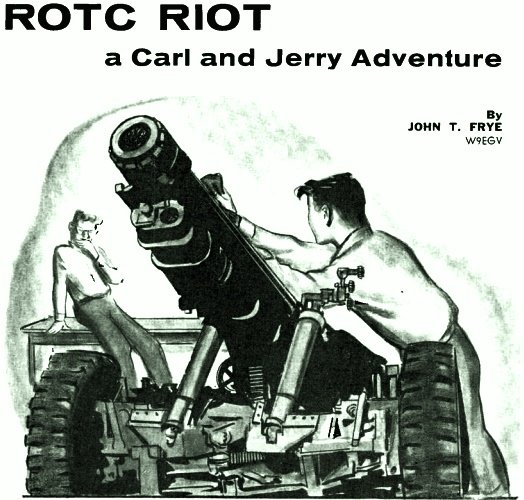
Carl and Jerry were alone in the big armory building on the campus of Parvoo University. Under the Morrill Act, all physically-fit male undergraduate students attending the land-grant institution were required to enroll in some form of military training during their freshman and sophomore years. Both boys belonged to the Army's Reserve Officer Training Corps, familiarly known on the campus as "rot-see," and that is why they were in the armory. Strictly speaking, that is why Jerry was in the armory. At the suggestion of his lieutenant, he was working off three demerits by polishing the howitzer. Carl was keeping his buddy company and providing some dubious moral support. "You missed a spot there by the breech," he pointed out critically from where he lolled lazily on a bench. "How did you goof up this time and give old Zimmie a chance to gig you?" "My shoulder brass was a little tarnished -- or so dear Lieutenant Zimmerman complained," Jerry answered. "I don't see how it could be with all the rubbing I've done, but I'll have to admit my brass doesn't shine the way yours does. Yet I never see you making with the Brasso and Blitzcloth. How come?" "Oh, didn't I tell you ?" Carl asked, affectedly smothering a yawn. "I take my hat and shoulder brass to the lab with me and dunk them in a weak solution of sulfuric acid. Works fine. Polishing is for peasants." "Now you tell me! With friends like you, who needs enemies? But Lt. Zimmerman is a real clown, and I'll bet his grandpappy was in the Prussian Army. He really loves to ride me. 'Mr. Bishop,' he says in that nasty-nice voice of his, 'since you can't seem to clean little things, suppose we see what you can do with something bigger. I expect that howitzer to sparkle!' Have you heard his latest?" "Nope." "As you know, he's drilling us for Corps Day. He's taped a whole drill he intends to feed into the armory p.a. system so he 'may better observe the reaction time of the troops to spoken orders.' Get a load of this," Jerry said, as he walked to a table at the end of the armory and switched on a tape recorder. In a few seconds the voice of Lt. Zimmerman could be heard barking out occasional commands against the steady beat of a metronome. Music was playing very faintly in the background. "I notice the local broadcast station is getting into that playback amplifier a bit," Jerry observed. "Zimmie was over here this afternoon checking to make sure the commands were given at the right time so that the squad wouldn't run into the armory walls when they started at the right spot and were pointed in the right direction. You'd think he was bucking for general instead of being just a Parvoo senior in rot-see. If I dared, I'd like to put a few commands of my own on that tape just to foul him up--" Jerry's voice trailed off and his eyes took on the glassy look they always wore when he was in the throes of electronic inspiration. "Say, Carl," he said eagerly, "do you still have that little battery-operated two-meter transmitter in your locker?" "Sure. I was checking it out last night, and it works fine; but why?" "Be a good Joe and go get it while I keep burnishing the loudenboomer. I want to try something." Carl went with alacrity, for he knew that when Jerry got that look interesting things usually happened. It was only three blocks from the armory to the residence hall ; so he was soon back carrying a compact little u.h.f. transmitter no larger than a cigar box.
"Fine, fine!" he exulted. "Now let the tape play all the way through and write down the exact time that elapses from the start to the end of each order and the nature of the order. I'll finish polishing; and then back to our room! We have work to do tonight." After they had supper, Carl and Jerry locked the door of their room in H-3 and started on their project. "What I have in mind," Jerry explained, "is to put some commands of my own on the tape of this miniature, battery-operated tape recorder and feed the output into the two-meter transmitter. As you saw this afternoon, any time that transmitter is turned on in the vicinity of the tape recorder in the armory, the very strong r.f. field overloads the first amplifier tube in the recorder and forces it to make like a detector. Under those conditions, any modulation on the transmitter carrier feeds right through the amplifier in the recorder." "Why does r.f. do that?" "A strong r.f. signal that reaches the grid of this amplifier tube swings that grid positive on positive half-cycles of the r.f. During these swings, the grid attracts electrons from the cathode which must flow to ground through the grid resistor, often several megohms in value. Trapped electrons piling up on the grid will bias the tube negatively to the knee of its characteristic curve, and it becomes a grid-leak detector instead of an audio amplifier. "That's why ham rigs are often heard on tape recorders, hi-fi amplifiers, p.a. systems, electric organs, broadcast radios, and TV sets, even though the ham transmitters are functioning perfectly and legally. Police and taxicab radios do the same thing. For this to happen, the r.f. field must be intense, which means that it only occurs near the transmitter. The condition is often aggravated when the transmitter frequency is high and wavelength is short, because then it is more likely that standing waves will appear on the amplifier wiring and put a maximum signal on the grid of a high-gain amplifier tube." "Aw, sure! I remember now. The ARRL Handbook explains how the condition can usually be corrected by installing a simple resistance/capacitance filter in the grid circuit and lowering the value of the grid resistor. We did that to this little recorder. But are you going to let the transmitter run all the time the tapes are playing? The r.f. will blank out the other tape." "I know, and I don't want to do that. I want to use some of Zimmie's orders and some of my own. We'll rectify part of the audio output from my tape recorder with a silicon diode and use the developed d.c. to operate a little relay that turns on the plate supply to the transmitter. We'll put enough capacitance across the relay coil so that the stored current will hold the relay closed between words. That way the transmitter will turn on every time one of my orders starts and will cut off a second or so after the order is given." Actually marrying the tape recorder to the transmitter was an easy job for Carl and Jerry, and it was still early in the evening when they slipped into the still-empty armory carrying a small box that housed both the transmitter and miniature recorder. This box was concealed in the space behind a desk drawer, and a tiny micro-switch was mounted so that when this drawer was shoved in the last sixteenth of an inch the tape recorder and transmitter heaters were turned on. They turned on both recorders and were delighted to discover the timing on the tape Jerry had made was perfect The few orders he gave substituted perfectly for those of the lieutenant that were covered up. When the volume control of the battery-operated recorder was carefully adjusted, it was very difficult to tell who was giving the command. Jerry was an excellent mimic. Satisfied, they carefully rewound both tapes, pulled out the desk drawer a fraction of an inch, and went back to H-3 and to bed. It would be nice to report that their consciences kept them awake, but they slept like cherubim. Drill for the boys did not come until late in the afternoon of the next day. Anticipating the discomfit of their thoroughly disliked upper classman, they looked forward eagerly to the event, and finally it arrived. Carl managed to stand close to the desk until the lieutenant switched on the tape recorder. At the precise moment the officer pushed the "Play" button, Carl nudged the drawer shut with his knee and went to join Jerry in the drill squad. He had been so intent on performing this critically-timed operation that he did not notice a man, smartly dressed in a regular Army uniform, who had entered the hall and was now standing quietly by the door. "You didn't start the thing -- I hope!" Jerry whispered fervently out of the corner of his mouth. "See that silver star on the uniform of the stranger? He's a Brigadier General. Must be doing a little inspection between planes. You didn't start it, did you?" "It's off and running," Carl whispered back. "Stand by for court-martial!" At this moment Lt. Zimmerman noticed the distinguished visitor; and, after a shocked double-take, he threw him a snappy salute. The general returned the salute and waved for him to carry on. The tape had already started delivering a little sermon from Lt. Zimmerman on military obedience: "A good soldier obeys every order of his commanding officer instantly, resolutely, and unquestioningly, no matter how foolish the command may seem at the moment. That is the basis of our drill today. Until the tape recorder says otherwise, it is your commanding officer. No matter how much any other person -- including the sergeant or myself -- may try to dissuade you, you shall carry out your orders unflinchingly. Fall in!" As the squad started to go through the maneuvers dictated by the tape, Lt. Zimmerman sauntered over and shook hands with the general, who was still standing near the door, close to a wall. Carl and Jerry were sweating copiously, and not from the April warmth, as they marched the length of the armory, made a left turn, marched across the end, made another left turn, and started back. Both boys were trying desperately to recall the orders Jerry had put on their tape and to picture the probable result when these orders started coming through the speakers. They were not left in doubt for long.
The face of the lieutenant, as he watched his men march toward him, wore a look of mingled puzzlement and anger; but as they came relentlessly closer, the look changed to something similar to horror. "Stop! Company halt! Aw, cut it out, fellows!" his voice trailed off in a most unmilitary wail; but not a man even hesitated. They marched straight against the two officers, forcing them backward, and pinned them against the wall while the soldierly legs still pumped up and down in a rhythmic one-two one-two one-two. Mercifully, the tape recorder finally gave an order to about-face, and the freed lieutenant ran over and stopped the tape recorder. Serious as the situation was, Carl and Jerry could hardly keep from grinning as they saw him lift it off the desk and run his hand all around it in a vain search for hidden wires. "Lieutenant," the red-faced general said sternly, as he tried to restore a crease to his trouser legs that had been rumpled and soiled by the scraping shoes of the squad, "may I suggest that you dismiss the company? I think we should go into the office and have a little talk about the danger of allowing your command to leave your control, even for a few minutes." As soon as the door closed behind the angry general and the sheepish-looking lieutenant, the rest of the boys filed out of the armory, still chattering excitedly about the strange happenings. Carl and Jerry stayed only long enough to retrieve the little box from its hiding place behind the drawer. "Whew, that was close!" Jerry said as they started at a quick trot back to their own quarters. "I only wanted to march the squad into a wall and let Zimmie see how it feels to be made to look foolish in front of everybody. I actually felt sorry for him when the general was chewing him out, but maybe he'll be a little more tolerant from now on." "Okay, but let's hurry," Carl said, looking back over his shoulder. "I'm not going to rest easy until we've dismantled this handy-dandy little electronic sergeant and erased the tape. That general had firing-squad eyes if I ever saw them!" |
|||||||||||||
 |
|||||||||||||
|
|||||||||||||

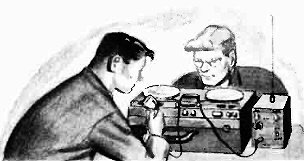 Jerry started the recorder again and placed the transmitter on the wooden table
beside it. He flipped on the transmitter, and anything he said into the transmitter
microphone blotted out and rode over the top of anything playing from the tape.
Jerry started the recorder again and placed the transmitter on the wooden table
beside it. He flipped on the transmitter, and anything he said into the transmitter
microphone blotted out and rode over the top of anything playing from the tape.
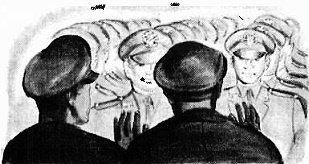 The squad marched smartly past the two officers. Then the first of the spurious
orders barked from the speakers. The squad turned to the left. In a few seconds
a command in Lt. Zimmerman's voice turned the men left again. Then, when they were
squarely opposite the two officers, another of the false commands turned them left
once more and they started marching straight at the general and the lieutenant.
The squad marched smartly past the two officers. Then the first of the spurious
orders barked from the speakers. The squad turned to the left. In a few seconds
a command in Lt. Zimmerman's voice turned the men left again. Then, when they were
squarely opposite the two officers, another of the false commands turned them left
once more and they started marching straight at the general and the lieutenant.

|
||||||||||||||||||||||||||||||||||||