|
|||||||||||||
 |
|||||||||||||
Chronistor Elapsed Time Indicator
|
|||||||||||||
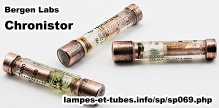
Bergen Labs Chronistors, on the Lampes-et-Tubes.com website. The Chronistor, which appeared in a 1958 issue of Popular Electronics magazine, was a compact elapsed time indicator in the form of a common glass fuse. Powered by electroplating, it requires roughly 1 mA of DC current to migrate metal ions from anode to cathode via an electrolyte, resulting in visible cathode deposition along a glass-printed hour scale. Standard options included 500, 1000, or 2500-hour ranges, with specials (like a 1-year, 8760-hour version) from Bergen Laboratories. The article outlines a basic series circuit for AC line operation, comprising a half-wave rectifier, pilot lamp, and limiting resistor for the Chronostat - a prebuilt unit in a plastic case supplying unfiltered DC. Resistor selection for voltage variations, and milliammeter tuning for optimal current determined its precision. The Chronistor was pitched as an inexpensive timer for household items to track usage and lifespan. A modern counterpart could be a digital LCD hour meter or ESP32-based elapsed time logger, delivering non-destructive, resettable accuracy sans chemical wear. I could not locate any modern equivalent that monitors elapsed time only while under power. How Long Did You Use It?
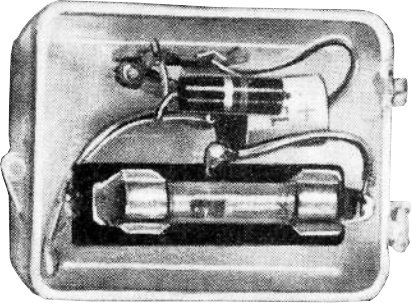
Complete timing unit, with built-in rectifier and pilot light, fits inside plastic box. Miniature electroplating unit shows the length of time your electronic equipment is operated. A chronistor is a tiny elapsed time indicator with the size and appearance of a glass clip-mounting radio fuse. It is suitable for direct wiring into a home or industrial device, and it mounts in a standard fuse clip for convenience of observation and replacement. By means of a time scale calibrated in hours which is printed directly on its glass side, the Chronistor indicates by an electroplating process the amount of time current has been applied. With a d.c. flow of about 1 milliampere through the unit, metal ions from the anode are carried through the electrolyte and deposited on the cathode. The "growth" of the cathode provides the visible indication of elapsed time. Standard ranges are 500, 1000 and 2500 hours; other ranges are available on special order.
Fig. 1 - Simple series circuit designed for direct a.c. line operation of Chronistor.
Table 1 - Values of the series resistor used for various time indications and d.c. supply voltages.
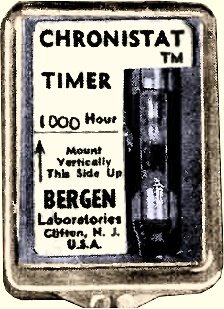
1000-hour Chronistat. Current Requirements Current needed to activate the Chronistor can be obtained from any d.c. source. The better regulated the current source, the higher the accuracy of the indicator. In most applications, however, an unregulated supply will be adequate. A resistor in series with the indicator in conjunction with the applied d.c. voltage will determine current flow through the plating unit and hence its elapsed time indication. See Table 1. Resistors shown are all 5% 1-watt units and calculated to the nearest EIA (RETMA) value. The Chronistor cartridge is available separately from Bergen Laboratories, 247 Crooks Ave., Clifton, N. J., or as part of a complete assembly known as a "Chronostat." Packed into the 2 1/4" x 1 1/4" x 1 5/8" plastic case of the Chronostat is a 10-ma. rectifier, a pilot lamp, the indicator and its series-limiting resistor. Shown in Fig. 1 is the circuit of the Chronostat. It operates directly from the a.c. line. The limiting resistor is chosen to compensate for the use of unfiltered d.c. from the half-wave rectifier used as the current source. Its value is 75,000 ohms. Construction If you would like to build your own Chronostat, you can use the circuit in Fig. 1. Make sure that the rectifier and indicator polarities are correct. This simple series circuit should present no difficulties, but , it is necessary to use the rectifier specified to insure accurate timing. A higher or lower efficiency rectifier will require a different value of limiting series resistor. When using a d.c. supply, the best way to determine the needed resistance value is to insert a d.c. milliammeter in series with the indicator and adjust a variable series resistor for the correct current flow as shown in Table 1. The 1000-hour Chronistat shown will find its most useful application as a diamond stylus life timer for your hi-fi record player. Most diamonds have a playing life of about 1000 hours, and the connection of a 1000-hour indicator across your turntable motor leads will indicate when it's time to check or replace your stylus. |
|||||||||||||
 |
|||||||||||||
|
|||||||||||||




|
||||||||||||||||||||||||||||||||||||