February 1970 Popular Electronics
 Table of Contents Table of Contents
Wax nostalgic about and learn from the history of early electronics. See articles
from
Popular Electronics,
published October 1954 - April 1985. All copyrights are hereby acknowledged.
|
"DXing" is amateur
radio shorthand for long distance communications. While there is no formal exact
distance beyond which an operator has officially made a 'long distance' contact,
a generally accepted range is maybe 50 miles or so. To some extent, DX is relative
to the equipment and power being used. For instance if you have a maximum legal
transmitter output power of 1500 watts and an optimally sited, mounted and tuned,
high gain antenna, with low loss transmission cable, and super sensitive receiver,
etc., and make a successful contact 100 miles away, no one would give you kudos
for your effort. However, if you managed the same result using a handheld transceiver
with a 'rubber duck' stub antenna while walking through a deep valley, you would
be considered a DX superman. This article describes a much more rare and difficult
means of making DX contacts and collecting QSL cards - bodily travelling across
the globe to visit other amateur radio operators at their home bases (although I'm
not sure doing so qualifies for a QSL card unless radio contact is made).
First Person DX'ing
 Mr. SWL - Arthur Cushen - Circles the Globe
Visiting Broadcasters Mr. SWL - Arthur Cushen - Circles the Globe
Visiting Broadcasters
 First of the ten international broadcasting
stations visited by my wife, Ralda, and me was the VOA 250,000·watt installation
at Dixon, Calif. We were interviewed for a VOA broadcast to Asia. The antenna site
occupies 800 acres. <left> First of the ten international broadcasting
stations visited by my wife, Ralda, and me was the VOA 250,000·watt installation
at Dixon, Calif. We were interviewed for a VOA broadcast to Asia. The antenna site
occupies 800 acres. <left>
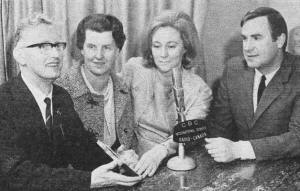
Radio Canada maintains an active club and our second interview was conducted
by Elaine McMaster (club secretary) and Duncan Nicholson (club vice president).
These interviews gave me an opportunity to tell listeners what it was like to DX
on the shortwaves from New Zealand. <right>
 Arriving in England we were cordially greeted
by the staff of the BBC. While in London I gave a first-hand report of New Zealand
DX'ing to Henry Hatch, who moderates many of the World Radio Club programs. Since
I am blind I did a program for "Radio 4" for blind listeners. <right> Arriving in England we were cordially greeted
by the staff of the BBC. While in London I gave a first-hand report of New Zealand
DX'ing to Henry Hatch, who moderates many of the World Radio Club programs. Since
I am blind I did a program for "Radio 4" for blind listeners. <right>
 On to Denmark, only to be greeted by the
sad news that Radio Denmark was considering cessation of its English-language programs.
Christion Flagstad is addressing Ralda and me with Luise Berald and Dick Platt of
Radio Denmark, right, joining the conversation. <left> On to Denmark, only to be greeted by the
sad news that Radio Denmark was considering cessation of its English-language programs.
Christion Flagstad is addressing Ralda and me with Luise Berald and Dick Platt of
Radio Denmark, right, joining the conversation. <left>
 At Halmstad, Sweden, the European DX Council
held an International Parliament to discuss matters of common interest. At left
is J. Vastenhoud of Radio Nederland; at right, renowned Radio Sweden Editor, Arne
Skoog. <right> At Halmstad, Sweden, the European DX Council
held an International Parliament to discuss matters of common interest. At left
is J. Vastenhoud of Radio Nederland; at right, renowned Radio Sweden Editor, Arne
Skoog. <right>
 On our way home, we stopped at Radio RSA,
Johannesburg, South Africa. We were interviewed again(!) by Dorianne Berry and Arthur
Hanna, two more well known announcers. Unfortunately, these few photos cannot possibly
show all the wonderful people we met nor express our deep thanks to all who were
so cordial to us. <left> On our way home, we stopped at Radio RSA,
Johannesburg, South Africa. We were interviewed again(!) by Dorianne Berry and Arthur
Hanna, two more well known announcers. Unfortunately, these few photos cannot possibly
show all the wonderful people we met nor express our deep thanks to all who were
so cordial to us. <left>
- Ralda and Arthur Cushen
Posted january 25, 2024
(updated from original
post on 6/15/2017)
|