|
How the short-wave bands will sound for the next few months.
Most of the international broadcasting stations scattered throughout the world
will make schedule changes on Sunday, March 1. These changes will be in effect during
the months of March and April and will be revised on May 3. Frequency and broadcasting
time schedules set up in May will continue throughout the summer season of May,
June, July, and August. Changes will also be made on September 6 and November 1.
Utilizing the latest computer techniques to predict radio transmitting conditions,
we have analyzed the international broadcasting bands and prepared the following
summary for the spring of 1964
11 Meters (25.60-26.10 mc).
This international broadcasting band has been useless for the past few years.
Since we are at the minimum of our sunspot cycle, very poor conditions will persist
for another two or three years. No DX stations should be heard in this band.
13 Meters (21.45-21.75 mc).
If you tuned to this band during the winter of 1963-64, you may have heard a
few weak DX stations. These should have been audible only during the daylight hours.
There may be some DX openings in the spring, but these will be confined to the reception
of a few South American stations. For the most part, however, this band will be
dead.
16 Meters (17.70-17.90 mc).
There is considerably more international broadcasting activity in this band than
in either the 11- or the 13-meter bands. In general, some DX can be expected during
the daylight hours. Best results should be observed from stations transmitting in
austral Asia, South America, Latin America, and Africa.
19 Meters (15.10-15.45 mc).
This will be the best DX band during the daylight hours in March and April. Considerable
DX should be heard from stations in the southern hemisphere and from transatlantic
or transpacific DX stations from early morning to late afternoon.
25 Meters (11.70-11.97 mc).
Expect to see less and less DX audible on this band during the spring. Signal
strengths will be low and, during the daylight hours, the atmospheric noise will
be high. Some DX may be heard from Latin America around sunset and in the early
evening hours. Close - in stations (800-2000 miles) will be heard in the United
States and Canada throughout the daylight hours.
31 Meters (9.50-9.77 mc).
During local daylight hours, this band will be useful for short distances (500-2000
miles). At sunset and in the early evening hours reception will vary from very good
to barely marginal. Expect to hear stations from the southern hemisphere and occasionally
high -power broadcasters in Europe.
41 and 49 Meters (7.1-7.3 mc and 5.95- 6.20 mc).
In the hours of local darkness, these two bands will be very active. At sunset
the best DX will be from the east since the path of the radio signal is entirely
in darkness. Around dawn, with darkness to the west, most DX heard on these bands
will come from that direction. In the daylight hours, reception will be restricted
to a range of 500-750 miles. All listeners can expect extremely severe interference
levels due to the channel crowding on both bands. This is the same condition that
persisted throughout the past winter.
Standard Broadcasts.
Scores of listeners had an opportunity in December, January, and February to
hear their first transatlantic regular AM broadcast-band DX. Some stations from
Europe may still be heard during the first few weeks of March. Atmospheric noise
levels will be increasing, and by April practically all European DX stations will
no longer be audible. Listen occasionally for AM broadcasting stations from Latin
America and the countries bordering the Caribbean along the South American coast.
Wrap Up.
Summaries of radio receiving conditions will now appear in the March, May, September,
and November issues of Popular Electronics. In addition to these summaries,
a short discussion of general band conditions to be expected for that particular
season will be included in each column. Our topics will range from sunspots, the
ionosphere and ionospheric disturbances, to any other material thought to be of
interest to the DX listener. Your comments, questions and suggestions are always
welcomed.
|
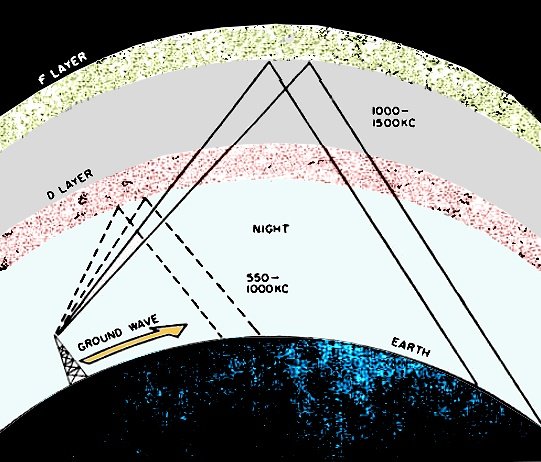
Nighttime atmosphere ionization.
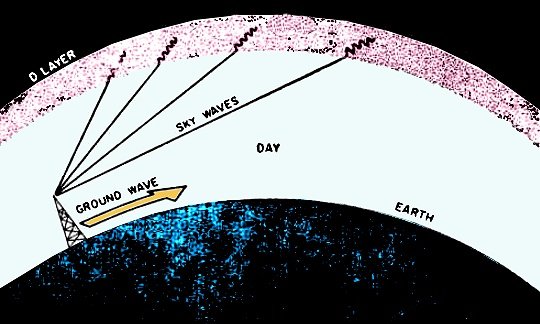
Daytime atmosphere ionization.
The How and Why of Broadcast-Band DX
During the past winter, DX'ing for stations in the standard AM broadcast band
was especially good. Listeners east of the Mississippi reported that numerous European
stations could be heard shortly after sunset. On the West Coast, broadcast-band
stations in Japan, the Philippines, and Australasia could be intercepted.
Broadcast-band DX is possible only during the periods when most - or all - of
the path between the transmitter and receiver is in total darkness. During the daylight
hours, the ionosphere absorbs all of the sky-wave signal radiated by AM broadcasting
stations. Around sunset, the D layer changes character; instead of absorbing radio
waves, it reflects signals below about 1000 kc. Signals on the high-frequency end
of the AM broadcast band pass unhindered through the D layer (during the nighttime
hours) and are reflected by that part of the ionosphere called the F layer.
The maximum distance of D layer reflected signals is about 1200 miles. Signals
reflected by the F layer will occasionally cover 2500 miles in a single hop. DX
from more distant stations involves multiple reflections between the ionosphere
and the earth.
Editor's Note: Five years ago, most of the countries engaged
in international broadcasting agreed to make major schedule changes four times a
year. Schedule changes (frequencies and times) are necessitated by seasonal trends
in radio wave propagation conditions.
For the past year, Stanley Leinwoll has been preparing month-to-month predictions
of radio receiving conditions. To enhance the use of his material, the editors of
Popular Electronics have decided to delete the monthly tabular listing
and in its place publish a quarterly report. This report will conform with the practices
established by the Geneva Radio Regulations and will appear in our March, May, September,
and November issues.
|