|
|||||||||||||
 |
|||||||||||||
QSL from Sputnik
|
|||||||||||||
QSL cards from the former Soviet block countries, collected by long-time DXer, Lynn L. (WB0U), in the late 1980s. That was the the period when Gorbachev was dissolving the U.S.S.R.
QSL from Sputnik
By C. M. Stanbury, II
Have you heard Sputnik? Yes. Have you received your QSL? Unless you live on the other side of the iron curtain, chances are pretty good you haven't. Despite the fact that Radio Moscow has repeatedly asked for reports on the Soviet satellites, until now the highly prized space-QSL's have not been crossing the "red divide." What's needed to verify Sputnik? An address? Yes, that will help a little. How about transmission data to prove your reception ? Yes, knowing how to get this is essential. But even more important is your approach. Without the proper approach, a DX'er is a very dead duck so far as Sputnik verifies are concerned. The Proper Approach. The key word of this approach is frankness. Most of you know that the opposite seems to be the standard for at least 90% of the broadcasts coming from Radio Moscow. The same evasiveness carries over into their handling, of DX reports. The following excerpt is typical.
To meet this kind of thing with more evasion would result in an endless series of correspondence which would net the DX'er nothing but propaganda. On the other hand, following a straight-line approach, cutting through the Soviet curves, will - nine chances out of ten - bring you what you are after. The following are the final paragraphs of the letter that brought home my SPUTNIK QSL.
Thank you very much for the cards and letters you have sent me in the past. I do hope you or somebody else will correct this most unfortunate QSL situation. Radio Moscow, like any other International Short-Wave Service is dependent upon the world's SWL's. A letter such as that above would seem to leave them very little choice but to fulfill their obligations. You'll note, however, that the letter is courteous. Any station has the right to ignore a rude or insulting DX report. Transmission Data. You will need transmission data to prove your reception. Easiest to obtain are the number of beeps per minute. Merely count the beeps in a 30-second period and multiply by two. If you have a slightly musical ear, you can make your report considerably better. Estimate the modulation frequency by comparing the Sputnik signal with the alternate 440- and 600-cps tones transmitted by Station WWV. If your receiver is poorly calibrated on the upper short-wave frequencies, the WWV signal on 20,000 kc. can be used to zero in the satellite's frequency of 20,005 kc. First locate WWV. If the signal is strong, tune to its upper edge. If WWV is being received weakly, tune just above the edge. In either case, retune every 10 or 15 minutes (unless WWV has disappeared) to decrease the danger of missing the Sputnik if you are slightly off frequency or if your receiver is drifting. Where to Report. If you have already sent a report either in care of Radio Moscow or to The USSR Committee on the International Geophysical Year, wait one month for a reply. If you have not yet sent a report, send your first one to the committee and wait three months. Make this a standard report with a casual request for a QSL. If you do not get results, send a second report to: Eugenia Stepanove, North American Service, Radio Moscow. Ask her to forward it to the proper agency and say why you think you deserve a QSL.
Posted September 1, 2022 |
|||||||||||||
 |
|||||||||||||
|
|||||||||||||


 How one SWL managed to get his prized space verification
 The call letters of the Chinese language
transmission you heard are the same as the ones used for the North American broadcasts
- the first bars of Dunaevsky's "Song of the Motherland."
The call letters of the Chinese language
transmission you heard are the same as the ones used for the North American broadcasts
- the first bars of Dunaevsky's "Song of the Motherland." 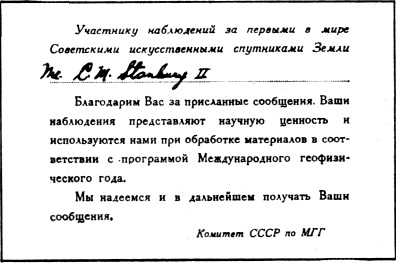 I am going to speak frankly. Even if you had
not promised to verify reception of your Sputniks, it would be an act of bad faith
not to do so. Many listeners all over the world took the time and trouble to receive
and report reception of your satellites. They certainly deserve QSL cards or letters
for their efforts.
I am going to speak frankly. Even if you had
not promised to verify reception of your Sputniks, it would be an act of bad faith
not to do so. Many listeners all over the world took the time and trouble to receive
and report reception of your satellites. They certainly deserve QSL cards or letters
for their efforts. 
|
||||||||||||||||||||||||||||||||||||