|
|||||||||||||
 |
|||||||||||||
Learning Electronics at Residence Schools
|
|||||||||||||
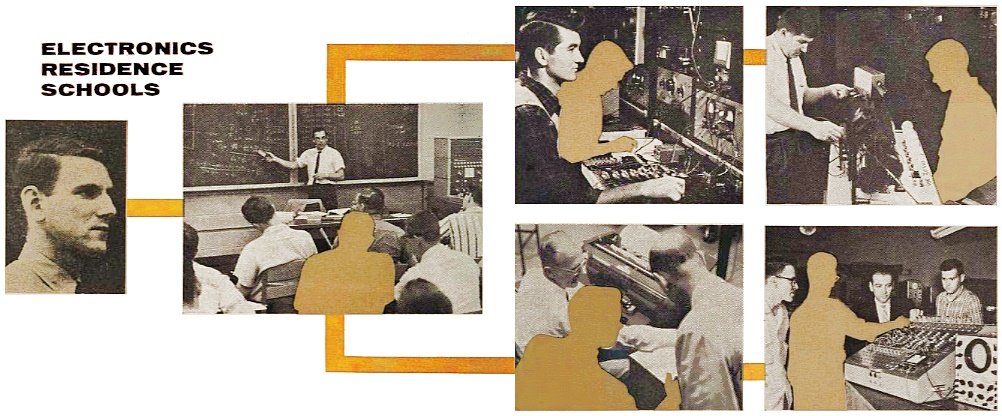
This 1962 Popular Electronics magazine article highlights a golden age for electronics servicing, an industry employing legions of technicians skilled in the (now) arcane arts of vacuum tube circuitry and RF alignment. It was an era before disposable electronics; complex television and radio sets were valuable investments that demanded professional maintenance and repair. The proliferation of these devices in American homes created a massive, sustainable job market. Residence schools emerged to fill this critical need, offering intensive, hands-on training. A full-time TV servicing course typically ran for nine months, requiring a total of 40 hours per week between classroom instruction and mandatory homework, at a cost of $750 to $1,000 ($8k-$11k in 2025). For those seeking more advanced, comprehensive training, such as a technical institute program covering communications and specialized electronics, the commitment expanded significantly to two years or more and cost up to $2,500 ($27k in 2025). Direct, instructor-led classroom and laboratory training was essential for mastering the manual dexterity and schematic comprehension required to join this thriving technical trade, a cornerstone of main street commerce where a skilled technician could build a stable and lucrative career. Military service training provided an excellent basis, but not sufficient knowledge and hands-on experience to "hit the ground running" in the domestic equipment realm. Learning Electronics at Residence Schools
Last month we took a look at the inner workings of electronics home-study schools. We found out what subjects are covered, how these subjects are taught, the approximate cost of the courses, and so on. This month, we will cover the same ground for electronics "residence" schools - schools that you attend in person. As you might expect, the number of hours a week in class, how this time is spent, the amount of homework, the subjects covered, and (most important) the total length of the training will vary with the particular school. Here's what you are likely to encounter. At most residence schools, you will spend between 20 and 30 hours a week in class as part of a full-time electronics training course. In general, the schools which provide less in-class training make up the difference with additional homework, but some amount of homework will be required with any training course. Usually, the schools expect you to devote a total of about 40 hours a week to your study. Thus, a 6-hour-a-day, 5-day-a-week course will also involve an extra 10 hours a week of home study. You must put in about 9 hours a week of classroom work for the average part-time or evening course, and you will spend at least 9 hours a week at homework. (Such courses usually operate on a 3-hour-a-night, 3-night-a-week basis). If you take a TV Servicing, Communications, or Advanced Trade School type of course, you will spend about 50% of your time in classroom lectures, the other 50% in the shop or laboratory. The Technical Institutes follow the lead of most Universities, and devote about 2 hours to lectures for each hour of laboratory work. The same proportion holds true for evening classes.
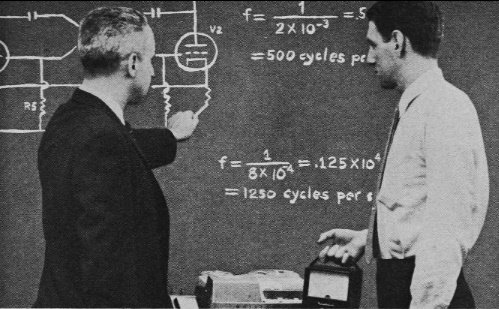
The average TV servicing course will run approximately 9 months of full-time day study, while a corresponding communications course will take 9 months to a year for completion. An advanced trade school course, which includes TV servicing and communications as well as specialized study in other fields of electronics, will usually require at least 1-1/2 years of fulltime training. The full technical institute courses run from 2 years to 27 months; usually, they are comprised of 8 or 9 quarters, with each quarter being 12 or 13 weeks in length. In general, those schools which provide equivalent courses for evening classes allow more time for you to complete the training. Thus, an evening course in TV servicing will take at least 1-1/2 years to complete. Our survey shows that the evening training is identical with that provided for full-time day classes, except in the case of technical institutes and universities. Most evening classes at technical institutes cover about 75% to 90% of the day class material. Then, if you want to go on toward a full B.S.E.E. degree, you must put in 3 to 6 months of residence work. Advantages of Residence Schools You have personal contact with your instructors. There are those who say a picture is worth 1000 words, but a demonstration is often worth 10,000 words. If you are one of these people, residence training is your best bet. In other words, if you have difficulty in learning a manual skill (such as soldering, operating test equipment, etc.) until you have seen someone else do it, or if it gives you more confidence to have an expert at your shoulder to check your work, you should definitely choose residence training. You'll find companionship with others in the same status. At best, a thorough study of electronics is a long, hard road. Some people prefer to make this "trip" with others. You may be able to gain a better understanding of a subject if you can discuss the problems with other students in the same situation. Most residence schools encourage this type of group discussion, as well as group activities outside of class. You'll see major electronic; installations first-hand. Practically all resident-type electronics schools conduct class field trips to local manufacturing concerns, TV shops, broadcast studios, and research laboratories. This gives the students an opportunity to see professional technicians at work and to see today's electronics equipment in use. A wider range of equipment is available. It's quite obvious that a home-study school is not going to ship you a complete working model of a shipboard or aircraft radar. Nor are they going to install a full-scale electronic computer in your home. But both of these units (or units of the same complexity) are available at the laboratories of various technical institutes. It would even be difficult for a home -study course to supply all of the equipment found in the average TV service type of residence school. So if you want exposure to specialized equipment, it would be best for you to consider resident training. Disadvantages of Residence Schools School is a "full-time job." This is the most obvious drawback to in -residence training. Unless you plan to take an evening course, you must spend about 25 hours a week in class, and devote a few more hours to homework. This routine is extremely difficult when added to another 40 hours on a full-time job. Even if you are working only part time and can get along on the reduced income, you'll find that the strain will show up after a few months. Schedules must be maintained. Unlike home study, you must keep up with the "class average" in residence-type work. If you're slow in learning or you find the subject difficult, you will always be under pressure. If you're fast, you may become impatient and will probably become bored. Even if you're "average," you will have to scramble to catch up if you happen to miss a few classes. Study is difficult to interrupt. Because you must keep up with the class, residence schools can't tolerate frequent or long interruptions in training, no matter what the cause. This means that illness or personal problems can easily throw you off. Most residence schools will drop you back a class after a prolonged absence. Or, they could ask you to prove (by special examination) that the interruption did not affect your standing. If these interruptions are frequent, the school may ask you to discontinue the training until you have placed your affairs in order. Study material is not repeated. Except in very rare cases, lectures, class demonstrations, and examinations cannot be repeated for individual students. If you miss something of importance, you'll just have to get along without it. Even more significant, if you don't understand a particular point, you will have a very limited opportunity to question the instructor on an individual basis. Obviously, an instructor with 20 or 30 students cannot handle more than about one question per student. On the other hand, you can read each home-study lesson as many times as necessary. Likewise, your home-study instructor will answer all questions, and in writing. A comparison of evening and daytime residence courses can be summed up like this. If you want a TV servicing, communications, or advanced trade school course, you can have the training either during the day or in the evening, but evening study will naturally be spread over a much longer period of time. The chief advantage of evening work is that it permits you to complete the course and perhaps obtain a degree without a long interruption in your regular employment. If you want a technical institute course with a degree, you had best attend "full-time," or at least plan to squeeze in a few months of full-time resident training at the end of the line. And if you are after a B.S.E.E. degree, those few months of study are going to expand into at least a year. Examinations Unlike home-study schools, residence schools rarely require an examination at the end of each lesson. Instead, you take an examination after completing study of each subject. In general, the TV servicing, communications, and advanced trade schools form a new class every month or 6 weeks. Such a class stays together for the duration of the entire course, and each month or 6 weeks the class moves on to study a new subject. For example, your first month of study might cover applied science; the next month, electricity and magnetism; the third month, radio principles; and so on, through 9 to 18 months. Each week, you are given a "brush up" or "preview" examination covering the past week's study. If you show any signs of weakness, the instructors bring them to your attention. Then there is a final class examination covering the entire subject. If you pass this final exam satisfactorily, you move on with your class to the next subject. The technical institutes follow essentially the same plan, except that final examinations are usually given at the end of each quarter, as are university examinations. A few technical institutes also require that you pass a "master" examination before granting a degree. Each school has its own particular method of presenting examinations. Today, a number of residence schools follow the practice of "open-book" examinations, as in home -study courses. Naturally, the questions are worded so that you can't simply "match up" answers. In most cases, the questions are problems to be solved, with the answers to be written out in essay form. And you're actually encouraged to read through the reference material as well as your own lecture notes while you're solving the problems. The theory here is that this method tends to duplicate circumstances you will encounter in your future work. Other schools still hold to the idea that you must understand and remember what you have learned. Their examinations are written and presented accordingly. Checking Your Progress Since resident training involves considerable shop and laboratory work, your progress in these areas is also carefully monitored. Although the schools usually do not present formal examinations on shop or laboratory work, you must show the instructors that you have learned the practical side of electronics and that you are acquiring the necessary manual skills. For example, in any course you will learn basic shop practices (wiring, soldering, etc.). And you will probably be expected to construct simple (or even complex) electronic devices. After you build a device, the instructor will check it out for proper operation and look over your workmanship. If your work is not up to standard (even though the unit operates), the instructor will point out the defects. If you have done an exceptionally sloppy job, you may have to build the entire project over again. Again, the instructor may want to check your ability to use an oscilloscope. After instruction, you will be assigned to measure various waveforms under the watchful eye of the instructor. If you fail to use the 'scope properly, the instructor will have you repeat the measurements until he is certain that you understand what you are doing. A Second Try Now we come to the favorite question, "What happens if I flunk ?" If you fail to pass a monthly subject examination in a TV servicing, communications, or advanced trade school, you will usually be asked to repeat the entire month's study. Sometimes, too, the schools will permit you to take a special examination on the month's work if they feel that you might pass with a second try. They realize that you may have been suffering from "examination jitters," or that there may have been extenuating circumstances, such as absence from class due to illness, personal problems, etc. But if they feel that you simply don't understand the material, they will probably want you to repeat it in another class. A second failure generally brings a request that you discontinue the course (although some schools have allowed students to repeat a particular subject three or four times, in rare instances). The technical institutes and universities usually employ the standard grading system for examinations: A, excellent; B, good ; C, average; D, poor, but passing; F, failure. You can pass any given subject with a D, but you must maintain a C average to graduate and receive a degree. As you may know, the policy for granting a degree is usually outside the school's jurisdiction. Shop and Laboratory Training Personalized shop and laboratory training is the strong point of in-residence electronics study, whether you go during the day or in the evening. And residence schools pride themselves on the quantity and quality of their laboratory equipment. A school specializing in TV servicing will have at least one completely equipped TV service shop, while a communications school will duplicate a typical TV and radio broadcasting studio. In all cases, the schools use this laboratory and shop equipment to reproduce actual industrial and commercial situations, giving you the opportunity to "learn by doing." Although the shop and laboratory programs vary with each school, all schools follow a general pattern of demonstration and lecture on a group or class basis, followed by individual instruction. When your class progresses to a particular shop or laboratory, each item of equipment is fully explained in class lectures and demonstrations. The instructors describe what the equipment is for, how it operates, and how it is used. Sometimes, these lectures are supplemented with various technical films. After the theoretical discussion and practical demonstration at the class level, each student, or group of two or three students, will perform experiments using the particular item of equipment. This gives each student an opportunity to "get the feel" of test equipment. Once you've completed these courses, you should be able to recognize all standard types of test instruments, and use them without fumbling over the knobs or connecting an ohmmeter across a high -voltage source! Tools and Equipment Normally, you will not be required to provide any tools or test equipment for residence training. Most schools lend you a complete kit of tools (and sometimes simple test equipment, such as an ohmmeter) for the duration of the course. There is no additional charge, unless the tools or equipment are damaged or missing when it's time for you to return them. Some schools recommend that you purchase your own set of tools and will provide tool kits at reduced cost. Other schools make standard test equipment available to students at discount prices. In general, reference texts, slide rules, and similar items are also supplied at reduced cost. Occasionally, a school will recommend that you buy special reference texts. What About Cost? As is the case with home-study courses, all in-residence electronics training courses do not cost the same amount. The best "yardstick" to cost is that you will pay between 75 cents and $1.00 for each classroom hour of residence training. Thus, a 9-month TV servicing course (1080 hours, based on 36 weeks at 30 hours a week) will cost between $750.00 and $1000.00. A full technical institute course could run between $2200.00 and $2500.00. Except for the length of training, the difference in cost often reflects the quality and scope of the program. Some schools give you more per hour of training in various ways. Their laboratories are more extensive and better equipped, their instructors are more gifted, and their placement services are more elaborate. This does not mean that the less expensive training is "cut rate," but the old rule that "You get what you pay for" still applies. If you can pay for a course in cash at the beginning of it, you will receive a substantial discount on the overall price. However, the technical institutes and other schools offering long courses do not expect you to plunk down $2000.00 or more. In practically all cases, such schools call for monthly or quarterly payments. A great number of schools arrange for weekly (about $25.00), monthly (about $100.00), or quarterly (about $250.00) pay-as-you-go installments after you have made an initial down -payment. Usually, this type of plan allows you to discontinue the course at any time, without further obligation. For example, a technical institute may require a $250.00 down-payment for the first quarter, and $250.00 in advance for each quarter thereafter. And you are free to drop the course at the end of any quarter. A number of schools offer a contract plan in which you make an initial down - payment, and fixed monthly payments until the total price is paid, no matter how long the course takes. They usually offer this as an alternative to the pay-as-you-go plan, and at a substantially reduced cost. But you are under obligation to pay for the course, whether you finish it or not. You can definitely save money this way, but you should understand the contract and make sure of your future plans before you sign it. |
|||||||||||||
 |
|||||||||||||
|
|||||||||||||


|
||||||||||||||||||||||||||||||||||||