Search RFC: |                                     
Please support my efforts by ADVERTISING!
About | Sitemap | Homepage Archive
Serving a Pleasant Blend of Yesterday, Today, and Tomorrow™
Vintage Magazines
Electronics World
Popular Electronics
Radio & TV News
QST | Pop Science
Popular Mechanics
Radio-Craft
Radio-Electronics
Short Wave Craft
Electronics | OFA
Saturday Eve Post
Alliance Test | Isotec
Please Support My Advertisers!
RF Cafe Sponsors
Aegis Power | Centric RF | RFCT
Empwr RF | Reactel | SF Circuits

Formulas & Data

Electronics | RF
Mathematics
Mechanics | Physics


Calvin & Phineas

kmblatt83@aol.com

Resources

Articles, Forums, Radar
Magazines, Museum
Radio Service Data
Software, Videos


Artificial Intelligence

Entertainment

Crosswords, Humor Cogitations, Podcast
Quotes, Quizzes

Parts & Services

1000s of Listings

        Software:

Please Donate
RF Cascade Workbook | RF Symbols for Office
RF Symbols for Visio | RF Stencils for Visio
Espresso Engineering Workbook
everythingRF RF Engineering Resources Database - RF Cafe

Radio-Radar Telescope Will Listen to Stars and Map Moon
September 1961 Popular Mechanics

September 1961 Popular Mechanics
September 1961 Popular Mechanics - RF Cafe[Table of Contents]

Wax nostalgic about and learn from the history of early mechanics and electronics. See articles from Popular Mechanics, published continuously since 1902. All copyrights hereby acknowledged.

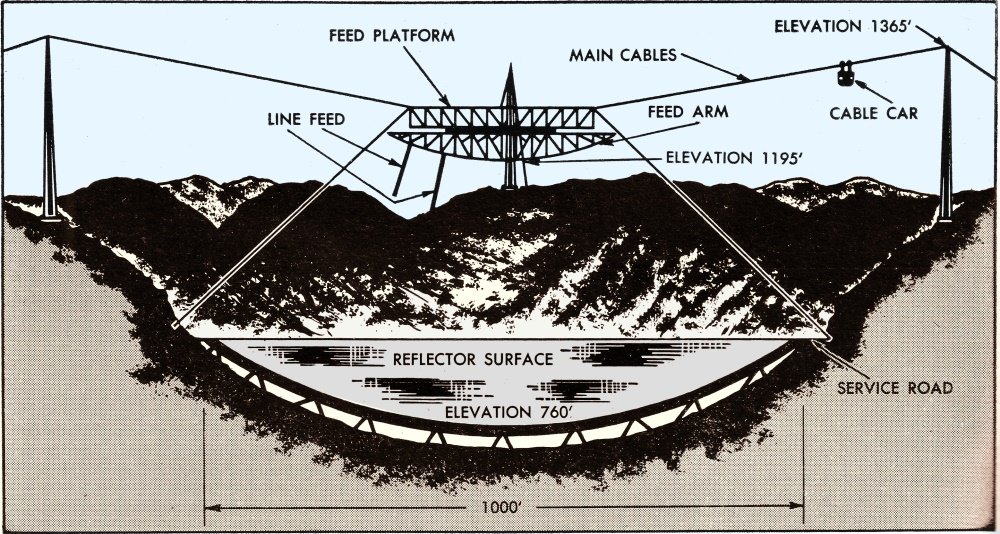
The 1,000-meter radiotelescope at Arecibo, Puerto Rico, the one used by Carl Sagan's team for broadcasting a "here we are" message toward the globular star cluster M13, in the constellation of Hercules, back in 1974, experienced a catastrophic mechanical failure in December of 2020. It saw "first light," a term used by astronomers for the first time a telescope is used for observation, in November 1963. This article on the proposed 1,000-meter Arecibo radiotelescope appeared in a 1961 issue of Popular Mechanics magazine. After many modifications over its lifetime, it operated over a 300 MHz to 10 GHz range, and although the dish is fixed in position, the moveable feedhorn facilitates a coverage of -1° to 39° relative to the zenith position. The transmitters were used for radar measurement of moons and planets. This document issues by the National Science Foundation in December 2010 announced the Arecibo Observatory retirement.

Radio-Radar Telescope Will Listen to Stars and Map Moon

Radio-Radar Telescope Will Listen to Stars and Map MoonThis fall a team of space scientists will turn on a giant radio-radar telescope nestled in a mountain valley near Arecibo, Puerto Rico, to investigate, among other things, the properties of the ionosphere.

It also will bombard the moon with radar signals; the echoes will produce a topographical map.

The $6,000,000 'scope, a tool of the Defense Department, has a fixed reflector.


Posted December 20, 2023

everythingRF RF Engineering Resources Database - RF Cafe