|
|
|||||||||
| Software: RF Cascade Workbook | RF Symbols for Office | RF Symbols & Stencils for Visio | Espresso Workbook | ||||||||||
|
|||||||||||||||||||||||||||||||
   |
   |
||||||||||||||||||||||||||||||
|
Please Support RF Cafe by purchasing my ridiculously low-priced products, all of which I created. RF & Electronics Symbols for Visio RF & Electronics Symbols for Office RF & Electronics Stencils for Visio T-Shirts, Mugs, Cups, Ball Caps, Mouse Pads These Are Available for Free |
|||||||||||||||||||||||||||||||



The Laser - Theory and Experiments
February
1971 Radio-Electronics

|
February 1971 Radio-Electronics  [Table of Contents] [Table of Contents]
Wax nostalgic about and learn from the history of early electronics. See articles from Radio-Electronics, published 1930-1988. All copyrights hereby acknowledged. |

AI-enhanced and colorized version of image below.
This 1971 Radio-Electronics magazine article provides a comprehensive technical overview of laser theory and practical application. It explains that laser action requires a population inversion within a medium, typically contained in an optical cavity with reflective surfaces to amplify coherent light through stimulated emission. The author distinguishes between three-level systems, such as the ruby laser, and four-level systems, exemplified by the helium-neon gas laser. Advanced techniques like Q-switching are described as methods to achieve high-power pulses by interrupting the cavity. Beyond core physics, the text explores the diverse utility of lasers in engineering and biology. Applications range from high-bandwidth communications, precise alignment for surveying, and delicate micro-welding to medical breakthroughs like retinal photocoagulation and experimental skin cancer treatments. By detailing these functions, the article frames the laser not just as a scientific curiosity, but as a transformative tool that continues to solve complex problems across modern industry and healthcare.
The Laser - Theory and Experiments

This time we see how the laser works and some of the ways it is being used in industry today. Bell Labs Photo
By U.S. Bureau of Radiological Health
This is the second part of a continuing series on lasers. It will cover every aspect of lasers from basic theory of operation to actual experiments that can be performed with low-power lasers.
Optical Cavities
Once the lasing medium has been pumped and a population inversion obtained, lasing action may begin. If, however, no control were placed over the direction of beam propagation, photon beams would be produced in all directions. This is called superradiant lasing.
The direction of beam propagation can be controlled by placing the lasing medium in an optical cavity formed by two reflectors facing each other along a central axis (Fig. 6).
Photon beams which are produced along the cavity axis are reflected 180° at each reflection and travel once more through the lasing medium causing more stimulated emission. Thus, the beam grows in magnitude with each traverse of the lasing medium.

Fig. 6 - Optical cavities as they are used and how they work. They can be plane mirrors, curved, or prisms.

Fig. 7 - Q-switch and pulse output diagram. Note the sharper pulse delivered by the Q-switch approach.

Fig. 8 - Energy levels of chromium. Note that this is a 3-level energy system. The chromium is an impurity in the ruby.

Fig. 9 - Energy levels of neon. The gas laser has a 4-level energy system. It uses 90% helium and 10% neon.
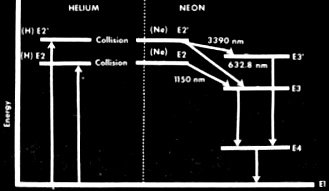
Fig. 10 - Detailed energy level diagram of a gas laser. Here a mixture of helium and neon is used.
Since the reflectors are not 100% reflective some photons are lost by transmission through the mirrors with each passage. If the pumping is continuous. a state of equilibrium is soon reached between the number of photons produced by atoms raised to the excited state and the number of photons emitted and lost. This results in a continuous laser output and is usually used only with low-power-input levels. Higher power inputs usually are achieved in the form of a pulse, and the output is also in pulse form. One of the mirrors in the system is usually made more transparent than the other and the output, pulsed or continuous. is obtained through this reflector.
Q-switching (or Q-spoiling) is used to produce an exceptionally high -power output pulse. The term "Q" as applied to lasers is derived from the more familiar Q of electrical circuits. Lasers are resonant cavities and in a similar way, many electrical devices are resonant. The Q is a numerical index of the ability of the resonant cavity to store energy at the output frequency. The higher the Q, the more effective the power concentration at the resonant frequency. Q-switching in lasers refers to the method of laser operation in which the power of the laser is concentrated into a short burst of coherent radiation. A Q-switch is a device which interrupts the optical cavity for a short period of time during pumping. A schematic of a Q-switched solid state laser is shown in Fig. 7.
Lasing action normally begins as soon as a population inversion is achieved and continues as long as pumping action maintains the inversion. The Q-switch interrupts the optical cavity and reduces the losses due to lasing until pumping can achieve a greater population inversion, say 70 to 80%, the Q switch then suddenly restores the cavity and the resulting pulse is much shorter and more powerful than would normally be achieved.
One example of a Q switch is the Pockel's cell. made of a crystal of ammonium or potassium dihydrogen phosphate (ADP or KDP) sandwiched between two crossed polarizers. In its de-energized state the crystal does not affect polarized light. When an electric field is applied across the crystal, however, the plane of polarization of the incident light is rotated by 90°, allowing it to pass the second crossed polarizer. This completes the optical cavity and results in a "giant pulse."
Reflectors may consist of plane mirrors, curved mirrors, or prisms, as shown in Figs. 6 and 7. The mirror coating may be silver, if laser output power is low, but higher powers may require dichroic material. A dichroic material is a crystalline substance in which two preferred states of polarization of light may be propagated with different velocities and, more important, with different absorption. By appropriate choice of material and thickness, the light impinging upon the dichroic coating may be either totally absorbed or totally reflected. The first ruby lasers were constructed with the crystal ends polished optically flat and silvered. Semiconductor lasers use a similar technique. Gas lasers may use mirrors as seals for the ends of the gas tube or may utilize exterior mirrors. In the latter case, the tubes use end windows of glass or quartz set at Brewster's angle and the output is polarized light.
The Ruby Laser
The first laser successfully operated was a ruby laser. It was constructed and operated by Dr. T. H. Maiman in 1960. Ruby is a crystal form of aluminum oxide with about 0.05 %, by weight, chromium as an impurity. The chromium gives the ruby its red color and is responsible for the lasing. Chromium has the 3-level energy system, shown in Fig. 8.
In a ruby laser, the electrons of chromium atoms are pumped to an excited energy level by a xenon flashlamp placed beside or around the ruby rod. The chromium electrons absorb photons in a band centered around 545.1 nm and are raised from their ground level to excited level E2. From here they drop almost immediately to level E3 by means of a phonon (radiationless) transition. The small amount of energy lost here is through heat and vibration. The electrons will reside in level E3 for a considerable length of time - much less than a second - but for an electron that is a relatively long time. Thus, since the flash lamp operates in a period of microseconds, a population inversion can be obtained.
The excited atoms begin to de-excite spontaneously, dropping from level E3 to E1, and since a population inversion is in effect, stimulated emission may begin. In any lasing medium, stimulated emission may occur in all directions and no particular direction of propagation is favored. As stated earlier, to control the emission direction and increase the amount of energy within the pulse, the lasing medium is placed in an optical cavity. Photons not emitted along the axis of the cavity pass out of the system and are lost. lf, however, a photon cascade is aligned with the cavity axis, it encounters one of the mirrors and is reflected back upon itself, passing once more through the lasing medium and triggering more excited atoms to undergo stimulated emissions. The pulse thus grows in size and on each encounter with the less reflective mirror, part of it emerges from the laser as high intensity coherent light.
The pulse from a typical ruby laser lasts only a few microseconds, since the pumping is not continuous. The flashlamp is run by a charge stored in capacitor banks, and once the lamp has flashed, the capacitors must be recharged. Pumping occurs over a few hundred microseconds and continues as long as the flashlamp is discharging.
The He-Ne Laser
The most common laser used today in both industry and education is the He -Ne laser. It was first operated in 1961 by Ali Javan and has proved to be the forerunner of a whole family of gas lasers. Since gas lasers are all quite similar in construction and behavior, we shall discuss the He-Ne as representative of the group.
The lasing medium in the He-Ne laser is a mixture of about 90% helium and 10% neon, with neon providing the lasing action. An energy level diagram for neon is shown in Fig. 9.
The 4-level system of a gas laser differs from the 3-level system of chromium in that the emission of a photon does not return the atom to a ground level. Transitions from level E3 to E4 and E4 to El are accomplished through a phonon transition in which energy is transferred mainly through heat.
Pumping neon to an excited state is not done directly by the energy source. Instead, indirect pumping is provided by exciting atoms of helium which then transfer energy to the new atoms by way of electron collision. These two gases are used because they have electron excitation levels which are almost identical, thus facilitating the necessary energy transfer. Additionally, in the mixture of gases used, one does not need to affect a population inversion in helium to obtain a population inversion in neon. A more complete energy level scheme for He -Ne is in Fig. 10.
The He-Ne gas mixture is in a sealed tube. Exciting the helium is accomplished by a discharge of electricity through the tube, similar to a neon sign. The mirrors can be enclosed in the tube or may form the end caps of the tube containing the He-Ne mixture. This is a solid geometrical configuration and results in a stable light output.
Since the alignment of the mirrors is a delicate procedure, one common method is to mount the mirrors separate from the laser tube. When this is done, the ends of the laser tube are made of Pyrex or quartz set at Brewster's angle to the axis of the laser, and the output is polarized light.
Other Lasers
Other lasers operate in similar but more complicated ways. Changes in molecular energy levels may be used rather than changes in electron energy levels, but output is still obtained through the stimulated emission of radiation.
Laser Applications
Soon after the invention of the laser, the device was described as "a solution looking for a problem ". Since that time the laser is providing eagerly- sought solutions to a long list of problems in engineering and biology. These solutions and their applications hold great promise for future work.
Engineering Applications
Communications: The higher the frequency of a carrier signal, the greater the amount of information that can be impressed upon it. One optical carrier of He-Ne laser frequency (@ 5 x 10¹⁴ Hz) could theoretically carry 10,000,000 simultaneous phone calls or 8000 simultaneous television programs. This capability makes the laser very attractive to the communications industry.
Many problems must be solved, however, before practical communications applications are possible. Carrier modulation has been done. but it is a difficult process. Since the carrier is light, point to point transmission can be stopped by such simple things as fog, rain. dust. or an object passing through the beam. One solution being examined is transmission through pipes with mirrors directing the light around bends.
Tracking and ranging systems: A number of laser tracking and ranging systems are being used today. They are often referred to as LADAR (LAser Detection And Ranging), just as RAdio Detection And Ranging is referred to as RADAR. Ranging systems record the time it takes a signal to travel to the target and return and translates this time to distance. The minimal divergence of the beam is important because it allows the operator to pinpoint the object for which readings are taken. The Army has developed a range -finder that uses this concept.
Surveying: The collimated beam of the laser is ideal for a number of surveying applications. One laser, operating continuously, can replace two men and a transit. Giant earth-boring machines are now aligned using the laser. Bulldozers clearing land, graders leveling land. barges or dredges working on dredging harbors or setting piers, pipe layers and ditch diggers are all using the laser as a simple method for alignment.
Mechanical measurements: The Michaelson interferometer has been the center of renewed interest since the advent of the laser. Formerly. the interferometer could he used only to measure very small changes in length. Now the device is useful for distances up to several hundred feet. Applications include seismology, where a stable source of coherent light can detect very small earth movements; metalworking, where the interferometer controls the operations of a milling machine; flow rate control; and large scale movements such as building sway or bridge movements.
Welding and cutting: The high intensity output capability of the laser was first demonstrated by burning holes in razor blades. Presently this capability is being used on FEBRUARY 1971 production lines for cutting and welding. Diamonds are used as dies to make wire. Before the laser, drilling holes in the diamonds took days. Today, the lasers has reduced the cutting time to minutes. Cutting and working of other hard materials is also done easily with the laser. Welding wires in transistors and microchip circuits is also done with lasers, and laser beams can be projected through the envelope of a glass tube to weld broken wires inside.
Holography: The laser's coherent light has given new impetus to the photographic process of holography. Three - dimensional images are being used for display devices and as a method of spotting defects in automobile tires, as well as in scientific research applications such as particle size measurement. Recently, a crystal cube has been used to record numerous holograms. The small size of the cube and the large number of three-dimensional images stored may herald a new era in information and data storage and retrieval.
Biological Applications
Retinal coagulation: I he retina of the eye is loosely attached to the choroid coat. The retina is of neurodermal origin while the choroid is ectodermal. In the embryo, these two join and throughout the life of the individual are held by a thin layer of connective tissue. In an adult, a number of circumstances can cause the retina to separate from the body of the eye. This results in a loss of vision as the light cannot be properly focused upon the detached retina.
For a number of years, retinas were reattached by using a long needle-like probe to weld the retina to the choroid with a scar. This worked well, producing one or more blind spots but allowing the proper focus to be attained once more. About 1950, the xenon photocoagulator was introduced. producing the same effect with a pulse of intense white light which, when focused by the lens on the retina. effected the reattachment by coagulated blood in a fashion similar to a spot weld.
More recently, retinal repair has been done with a laser as the light source. Ruby lasers were used first, then neodymium. and finally argon lasers. The real value of the argon laser over the xenon photocoagulator is the size of the spot weld. An argon laser can produce welds much smaller than the size of a xenon weld, allowing finer "stitching," this being of particular value around the fovea. In addition, neither anesthesia nor hospitalization is required with laser photocoagulation.
Skin-cosmetic repair: The laser's destructive effects have been used to treat skin disorders. Since laser light is preferentially absorbed by pigmented tissue, one of the first experiments undertaken was the removal of tattoos. Favorable results were obtained, leading to further work, especially in the cosmetic treatment of angiomas.
An angioma is an excess of blood and lymph vessels in the upper skin layers. The multitude of fine blood vessels produces a discoloration of the skin and appears as a port wine color. The laser is used to occlude the blood vessels and blanch the skin. leading to an eventual healing of the impact area and restoration of normal skin color.
Skin cancer: Skin cancers have been treated experimentally. Since there is a difference between normal and cancerous skin cells, a search is under way for a dye or pigment that is completely selective for cancer cells. Partial results have been obtained and cancer cells can now he stained considerably darker than normal cells. The darker cancer cells are then more susceptible to the impact of a laser beam because they absorb more light energy and are more severely damaged than are normal unstained cells. Next month we will present more laser applications and start looking into laser safety.
(continued next month)

Copyright: 1996 - 2026 |
About RF Cafe RF Cafe began life in 1996 as "RF Tools" in an AOL screen name web space totaling 2 MB. Its primary purpose was to provide me with ready access to commonly needed formulas and reference material while performing my work as an RF system and circuit design engineer. The World Wide Web (Internet) was largely an unknown entity at the time and bandwidth was a scarce commodity. Dial-up modems blazed along at 14.4 kbps while tying up your telephone line, and a lady's voice announced "You've Got Mail" when a new message arrived... |
Copyright 1996 - 2026 All trademarks, copyrights, patents, and other rights of ownership to images
and text used on the RF Cafe website are hereby acknowledge My Hobby Website: My Daughter's Website: |
