|
|||||||||||||
 |
|||||||||||||
How to Bend Your Own Chassis
|
|||||||||||||
Despite all the prefabricated, relatively inexpensive products available these days, there are still many people who like to build their own projects. Whether electrical or mechanical - or both - some sort of enclosure is usually involved. Often, you can cannibalize an existing, retired project to use its chassis or find a product at Walmart or a home improvement store that does not cost too much that you can buy just to get its enclosure. Buying a pre-formed chassis for your project can get expensive, so there are times when the best option is to obtain a piece of sheet metal (which can also be expensive) and bend it yourself. If you have never attempted such an endeavor, believe me it can be pretty challenging, especially with heavier gauge metal. It is usually best to lay out and drill / cut / punch / file as many holes as possible prior to doing any bending. This chassis bending article presents a good method for forming your sheet metal, but does omit recommending making holes prior to bending - maybe hole cutting was in the next month's edition. If you need a custom box but do not feel confident making it yourself, try taking your plans to a heating and air conditioning shop that does its own ductwork fabrication in-house. Those guys are really good at this stuff, and you will probably get a better price than going to a machine shop. How to Bend Your Own Chassis
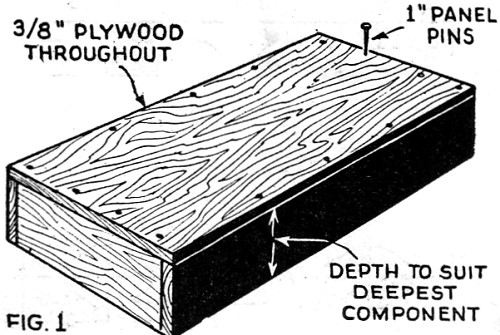
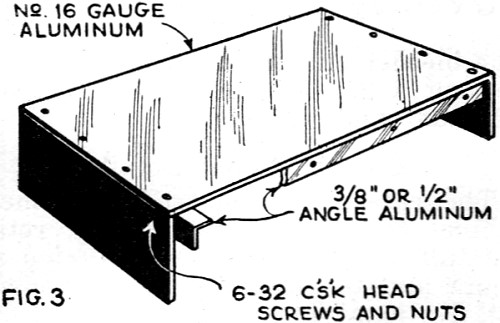
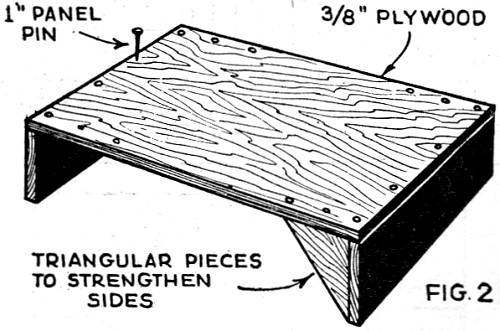
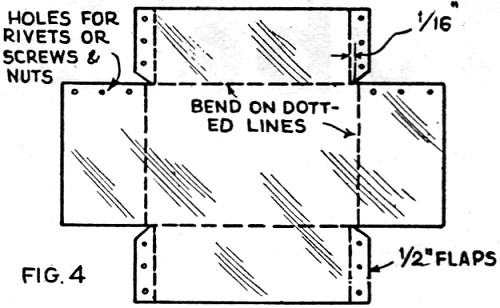
To earn the coveted title of Advanced Constructor, you certainly must do something about set-chassis making. It all depends on how you go about the work. You can with advantage start off with a really simple wooden chassis, gaining confidence for more ambitious metal affairs as you construct various shapes and sizes. Shall we take a look at Fig. 1, for a start? Here is the most straightforward complete chassis we can imagine. It is made up entirely of wood - preferably treated wood of the metallized variety. This is available in England, but not here, to our knowledge. Metal foil or screening could be put over the wood. Tin, zinc or brass could be used in an emergency. So that the design in Fig. 1, built up of metallized wood, or metal-covered wood, is a really sound chassis. Its size depends, of course, on your own needs. The governing considerations will be the depth - determined by your deepest sub-chassis mounted component. You can use 3/8 in. wood for this Fig. 1 chassis, tacking together the top, sides and ends with 1 inch panel pins (brads). Be generous with these pins, and then you will have a stout chassis that will stand any amount of knocking about. If you know that the sub-chassis wiring is going to be rather complicated, or if there are going to be a lot of components - some being therefore inaccessible - you might try the Fig. 2 chassis, which is a more skeletonized version. Tack the top portion to two ends, strengthening up the structure with four triangular pieces of wood. Use the same wood as before, and the same pins. With a shallow chassis this method is very satisfactory. So much for simple wood chassis, which are becoming more popular as amateurs realize the easy way they can be made up - and as it dawns on amateurs that a good metallized or metal covered, as explained, wood chassis can do all that a more ornate all metal job can do. There are times, though, when a really nice metal chassis is wanted - and then, assuming you are inexperienced - the Fig. 3 construction is admirable. All you need are three perfectly flat pieces of No. 16 gauge aluminum, one for the top and two for the ends. These are then held together by angle brackets, which you can readily buy quite cheaply - especially in brass. But they are also available in aluminum if you look long enough. Now we come to the more complicated sort of chassis - a real all-metal affair. You can see how it is dimensioned from Fig. 4. About the bending. This is really quite an art - but an easily acquired one if you go the right way about it. The first need is a hardwood block to work upon. It should have true corners - to make sharp bends in the metal when it is hit. Hit with a wooden or rawhide mallet, too. If an ordinary hammer is used it will badly mark the metal. You can see how this job is done from Fig. 5. At Fig. 6 is just a little idea for chassis experiments. Make up a stand, with two slots in the ends, so that the chassis can be swiveled around - then you can examine components and get at tricky bits of wiring. -Courtesy English "Amateur Wireless." |
|||||||||||||
 |
|||||||||||||
|
|||||||||||||




|
||||||||||||||||||||||||||||||||||||