|
 Have you heard about this? I hadn't. If
you think the only goal in Afghanistan is to stamp out the Taliban, think again.
An article in the October 2011 issue of Scientific American details the
extensive mineral surveys that have been carried out there in the last year or so.
Afghanistan is home to what may be the largest cache of rare earth elements in the
world, with a potential to replace China as the largest extractor (~90%) of those
atoms that lie in the lanthanide and actinide regions of the
periodic table
- the two rows that are typically pulled out of the chart. China, you may have heard,
is severely restricting the export of rare earths - wanting to keep it for themselves
- thereby triggering a near panic. Prices are rising so alarmingly that reopening
mines1 in the U.S. has once again become
profitable in spite of the crippling regulations that years ago closed down operations
here (huge loss of jobs and tax revenue) and forced us to become reliant on offshore
supplies - just like what is happening today with oil and gas, BTW. Have you heard about this? I hadn't. If
you think the only goal in Afghanistan is to stamp out the Taliban, think again.
An article in the October 2011 issue of Scientific American details the
extensive mineral surveys that have been carried out there in the last year or so.
Afghanistan is home to what may be the largest cache of rare earth elements in the
world, with a potential to replace China as the largest extractor (~90%) of those
atoms that lie in the lanthanide and actinide regions of the
periodic table
- the two rows that are typically pulled out of the chart. China, you may have heard,
is severely restricting the export of rare earths - wanting to keep it for themselves
- thereby triggering a near panic. Prices are rising so alarmingly that reopening
mines1 in the U.S. has once again become
profitable in spite of the crippling regulations that years ago closed down operations
here (huge loss of jobs and tax revenue) and forced us to become reliant on offshore
supplies - just like what is happening today with oil and gas, BTW.
| Platinum Group Metals |
| Platinum |
Catalytic converters, electronics, chemical processing |
| Palladium |
Catalytic converters, capacitors, CO sensors |
| Rhodium |
Catalytic converters, chemical processing |
| Ruthenium |
Electronic contacts, resistors, superalloys |
| Iridium |
Spark plugs, alloys, chemical processing |
| Osmium |
Electronic contacts, electron microscopy,
surgical implants |
| Rare Earth Elements |
| Scandium |
Aerospace components, aluminum alloys |
| Yttrium |
Lasers, TV & computer displays, microwave filters |
| Lanthanum |
Oil refining, hybrid-car batteries, camera lenses |
| Cerium |
Catalytic converters, oil refining, glass lenses |
| Praesodymium |
Aircraft engines, carbon arc lights |
| Neodymium |
Computer hard drives, cell phones, high-power magnets |
| Promethium |
Portable x-ray machines, nuclear batteries |
| Samarium |
High-power magnets, ethanol, PCB cleansers |
| Europium |
TV & computer displays, lasers, optical electronics |
| Gadolinium |
Cancer therapy, MRI contrast agent |
| Terbium |
Solid-state electronics, sonar systems |
| Dysprosium |
Lasers, nuclear-reactor control rods |
| Holmium |
High-power magnets, lasers |
| Erbium |
Fiber optics, nuclear-reactor control rods |
| Thulium |
X-ray machines, superconductors |
| Ytterbium |
Portable x-ray machines, lasers |
| Lutetium |
Chemical processing, LED bulbs |
| Other Critical Minerals |
| Indium |
LCDs, semiconductors, solar thin films |
| Manganese |
Iron & steel production, aluminum alloys |
| Niobium |
Steel production, aerospace alloys |
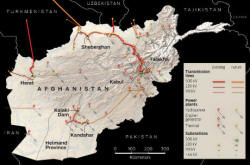
There are a lot more than rare earth elements available, though. According to a
map2 published with the article, there
are equally large reserves of copper, lithium, tin, lead, zinc, gold, silver, tungsten,
mercury, iron, emeralds, talc, gypsum and much more. An estimated worth of hundreds
of billions of dollars - maybe a trillion or more - of extractable wealth is available
just in the stashes identified so far. Teams of scientists from the United States
Geological Survey (USGS) have been surveying the Afghanistan countryside under the
protection of U.S. military troops6 and
CIA operatives. The Taliban has a huge interest in protecting the poppy fields in
Afghanistan, where a significant portion of their funding originates - to supplement
the money provided3 by some of our "allies"
like Saudi Arabia, Egypt, and Persian Gulf nations. The official line is that we
hope to eventually supplant the farmers' current profits from the opium trade with
royalties paid by mining operations. Of course, what we are most likely to get,
if anything at all, is both.If you are one of those people who said the whole reason for attacking Iraq was
for oil profits, you will probably say the same about our presence in Afghanistan,
only this time for real gold rather than black gold. If you are,
then the fact that we have not received one drop of free oil from Iraq will probably
not affect your belief about our likelihood of profiting off of Afghanistan. The
fact is that just as the American taxpayer has funded untold billions of dollars
worth of state-of-the-art power generation and transmission systems, schools, hospitals,
daycare centers, roads, colleges, computers, medicine, cars and trucks, cellphones
and towers, radios and televisions, toys and games, clothing, guns and ammunition,
military gear, training for police, firefighters, teachers, medical personnel, and
the list goes on, we have been doing the same thing in Afghanistan. Oh incidentally,
we have paid for the same things in Kuwait, African countries, and elsewhere. Come
to think of it, America did a lot of that for Europe after World War II4. But I digress.
Are you surprised to learn that some of our soldiers have died to protect surveying
efforts in Afghanistan? Well, here comes the real rub. Many multinational investors
have begun staking claims all over the country for mining rights once the region
is deemed safe enough to commence operations. One of the largest players is China
Metallurgical Group with pending leases on a copper deposit with an estimate in
value of at least $43B. Hmmm... funny that I could not find any references to China
helping to fund the military operations in Afghanistan. In fact, when I do a search
about China's involvement there, all I could find was information about how they
have been abetting the resistance forces. Didn't China assist the forces in both
North Vietnam and in North Korea? Yeah, I thought so. But hey, enjoy your cheap
electronics and tools, and clothes, and toys, and furniture, and well, just about
everything else. Didn't America assist China in its defense against the southern
Japan invasion during World War II5? Yeah,
I thought so. Dang, I digressed again.
IEEE's October 2011 edition of Spectrum magazine also happened to run
an article titled, "Re-Engineering Afghanistan: At What Cost?," reporting on our electrical
power infrastructure work in Afghanistan. Trillion-dollar "Stimulus" packages are
authorized here at home ostensibly to fund our own infrastructure projects - roads,
bridges, dams, etc. - but the money has disappeared into a black hole and nobody
seems to know where it went (of course it went to fund certain states' bloated employee
pensions and immorally mismanaged budgets); meanwhile we also spend billions of
our tax dollars in yet another country whose vast majority of the population wants
to cut our throats - literally. Yes, our troops have died defending the power grid,
too.
Is anybody else tired of this? Our money and technical know-how builds the world
while here at home we suffer record high unemployment and industry is dying at an
ever-increasingly fast pace. Politicians are responsible for creating the laws and
whacko regulations that have doomed America, yet the same ones are voted back into
office cycle after cycle. A conspiracist might conclude it has all been intentional,
because the only other explanation is gross incompetence on the part of government.
If our Afghanistan experience turns out like Iraq has turned out, then don't count
on getting any kind of return on your hard-earned tax money from the "investment"
we have put into the place.
Access to the full Scientific American article is restricted to digital subscribers
(I subscribe to the tree-killing version), so the accompanying charts and tables
that break down various countries' share of the rear earth metals, quantities imported
versus quantities produced domestically, etc., are not readily available to most
people. Below is a small sampling of the data presented.
Ironically, this headline was just posted today:
China Rare Earths Supplier Suspends Production
1:
Rare Earth Mining in the United States Gets a Second Chance
2: The SciAm website does not have the large
map shown in the thumbnail, but it is on
Nature's website. 3:
Financers
of the Taliban 4:
Marshall Plan
5:
China Defensive 6:
Slideshow of U.S. troops protecting USGS scientists
See also Toxic Air from
China, The Real
Price of Gold, Afghanistan's Buried Riches - Rare Earths & More,
E-Waste... Just Don't
Think About It
Posted May 4, 2020
(updated from original post on 10/20/2011)
|








 "
"