|
| VFS(pk) |
Full-scale peak input voltage |
| VFS(pk-pk) |
Full-scale peak-to-peak input voltage |
| VFS(rms) |
Full-scale input rms voltage |
| PFS(mW) |
Full-scale input power in mW units at full-scale input voltage |
| PFS(dBm) |
Full-scale input power in dBm units at full-scale input voltage |
| fsample-rate |
Sampled analog input signal frequency in Hertz (Hz) |
| VLSB(mVpk-pk) |
Peak-to-peak input voltage at one "q" (LSB) level; i.e., n=1 |
| VLSB(mVprms) |
Rms input voltage at one "q" (LSB) level; i.e., n=1 |
| Vn_bits(mVpk-pk) |
Peak-to-peak input voltage at n "q" levels; i.e., 0≤n≤2N |
| Vn_bits(mVrms) |
Rms input voltage at n "q" levels; i.e., 0≤n≤2N |
| ΔPn1_to-n2-_bits(dB) |
Difference in Pn1(dBm) and Pn2(dBm) expressed in units
of dB |
| snrquant |
Signal-to-noise ratio due to quantization (sampling) |
| SNRquant |
snrquant expressed in decibels |
| SNRaperture_jitter |
Signal-to-noise ratio due to aperture jitter |
| NSDADC |
Noise spectral density expressed in decibels |
| NFADC |
Noise figure expressed in decibels |
These equations predict the RF electrical performance of an Analog-to-Digital
Converter (ADC, A2D, A/D converter, etc.). Since A/D converters are often the last
stage in a receiver chain, it is extremely useful to be able to predict the contribution
for noise figure, signal-to-noise ratio, power levels, etc., since those values
are needed for a complete cascade analysis. Lots of variations on the equations
can be found across the Internet, so I have endeavored to reduce them to a few most
common quantities. Calculations for dynamic range vary considerably amongst sources,
so they are not presented here. It is best to consult device datasheets when possible
for specific values.
Note: The following equations
are valid for pure sinewave inputs with no DC
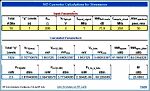 offset voltage. "R" is the input
resistance in ohms. Be sure to note units and subscripts for both the input parameters
and for the equations, or you will end up with really bad results. offset voltage. "R" is the input
resistance in ohms. Be sure to note units and subscripts for both the input parameters
and for the equations, or you will end up with really bad results.
Full Scale Voltage & Power
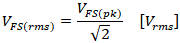
Power of a sinewave is calculated based on the root-mean-square (rms) value of
the full-scale voltage. VFS(rms) calculated from the peak (pk) input
voltage is:
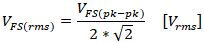
Using the peak-to-peak voltage (pk-pk):
Full-scale input power in units of milliwatts (mW) based on full-scale peak-to-peak
input voltage is:

Full-scale input power in units of dBm is:

Quantization Levels of an Analog-to-Digital Converter (ADC)
The value of a 1-bit (LSB, aka "q" level) voltage step anywhere between 0 and
N bits for an N-bit ADC is:


The value of an n-bit voltage step anywhere between 0 and N bits for an
N-bit ADC is:


Because decibel units represent a logarithmic and not linear relationship between
of number of ADC bits ("n") and power level, a simple multiplication of "n"
or "n2 - n1" times some fixed power reference value does not
work. Instead, you must calculate the value in watts (or mW, nW, etc.) for each
number of bits using the voltage at each level, then conversion to dBm units can
be made for an absolute value at each bit count:


The difference in Pn1(dBm) and Pn2(dBm) is expressed in units of dB as follows:

Signal-to-Noise Ratio (SNR) of an Analog-to-Digital Converter (ADC)
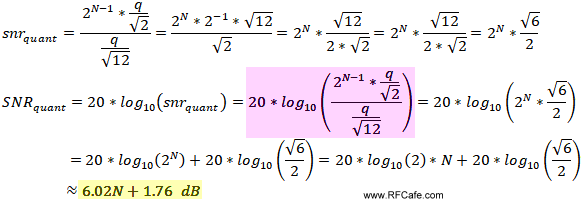
Most sources give the ideal quantization-based signal-to-noise ratio (SNR) equation
as 6.02*N + 1.76 dB (yellow highlight
below). A little more research turns up the
source of that equation (purple highlight below). Here, I show the
steps between purple and yellow, using common rules of logarithms and rules of exponents.
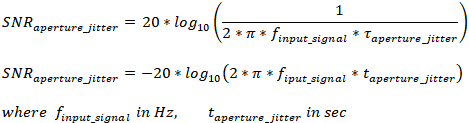
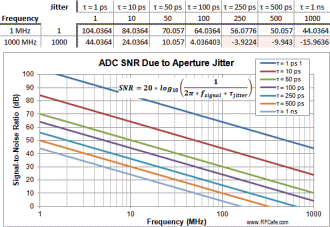 Another equation exists for
calculating SNR based on
aperture jitter that looks like the following.
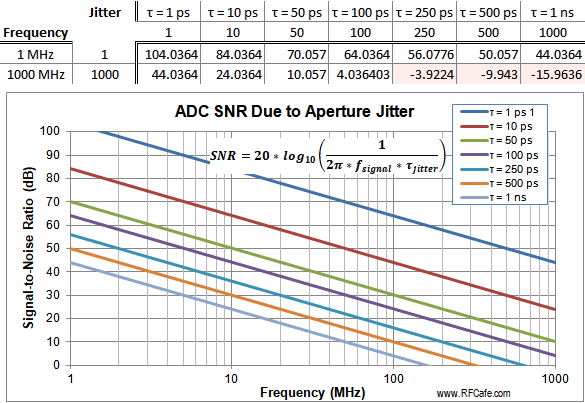
Note in the graph to the right that the SNR goes negative - which is invalid - when
finput_signal*taperture_jitter >
1/2π. Another equation exists for
calculating SNR based on
aperture jitter that looks like the following.
Note in the graph to the right that the SNR goes negative - which is invalid - when
finput_signal*taperture_jitter >
1/2π.

It might be best to use the worst case of either SNRclock_jitter or
SNRquant for system budget planning. Datasheets often provide SNR information,
which should be used instead of any generalized equations.
Noise Figure of an Analog-to-Digital Converter (ADC)
Probably the most difficult equation to find for an ADC is for noise figure (NF),
which is typically the last component in a cascade calculation of a receiver chain.
My source for the equation is a
Texas Instruments (TI) document authored by Mr. Tommy Neu
(it also appeared in
MWJ). You need the SNR value either from the
ADC datasheet or from the above equation is required. Noise spectral density (NSD)
is also needed, so its equation is provided as follows. NSD units are formally W/Hz
or, equivalently, V/√Hz; however, the equations are provided without units
because of the manner in which bandwidth is absorbed into them in these simple forms.
 , ,
where: 
Finally, the noise figure (NF) is calculated, where kTB is -174 dBm/Hz:

Example
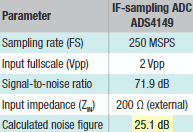 An example for the
ADS4149
from the aforementioned TI paper (page 4) helps to clarify the application. An example for the
ADS4149
from the aforementioned TI paper (page 4) helps to clarify the application.
fsample_rate = 250 Msps
N = 16 bits
Vpk-pk = 2 V
SNRfull_scale = 71.9 dB
kTBT=290K,B=1_Hz = -174 dBm
R = 200 Ω



Updated August 16, 2019
|