|
Transmission lines take on many forms in order to accommodate particular applications.
All rely on the same basic components - two or more conductors separated by a dielectric
(insulator). The physical configuration and properties of all the components determines
the characteristic impedance, distortion, transmission speed, and loss.
See a discussion on transmission lines and coaxial connectors.
The
following formulas are presented in a compact text format that can be copied and
pasted into a spreadsheet or other application.
For the following equations,
ε is the dielectric constant (ε = 1 for air)
| Two Conductors in Parallel (Unbalanced)
Above Ground Plane For D << d, h Z0= (69/ε½)
log10{(4h/d)[1+(2h/D)2]-½}
 |
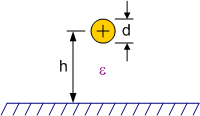
Single Conductor Above Ground Plane
For d << h Z0= (138/ε½) log10(4h/d)
|
| Two Conductors in Parallel (Balanced)
Above Ground Plane For D << d, h1, h2
Z0= (276/ε½) log10{(2D/d)[1+(D/2h)2]-½}

|
Two Conductors in Parallel (Balanced)
Different Heights Above Ground Plane For D << d, h1,
h2 Z0= (276/ε½)log10{(2D/d)[1+(D2/4h1h2)]-½}
 |
| Single Conductor Between Parallel Ground
Planes For d/h << 0.75 Z0= (138/ε½)
log10(4h/πd)

|
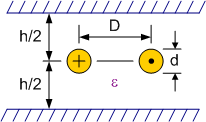
Two Conductors in Parallel (Balanced)
Between Parallel Ground Planes For d << D, h Z0=
(276/ε½) log10{[4h tanh(πD/2h)]/πd}
|
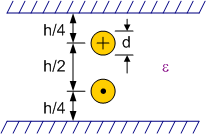
| Balanced Conductors Between Parallel
Ground Planes For d << h Z0= (276/ε½)
log10(2h/πd)
|
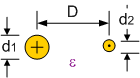
Two Conductors in Parallel (Balanced)
of Unequal Diameters Z0= (60/ε½)
cosh-1 (N) N = ½[(4D2/d1d2) -
(d1/d2) - (d2/d1)]
 |
| Balanced 4-Wire Array For
d << D1, D2 Z0= (138/ε½)
log10{(2D2/d)[1+(D2/D1)2]-½}

|
Two Conductors in Open
Air Z0= 276 log10(2D/d)

|
| 5-Wire Array For d <<
D Z0= (173/ε½) log10(D/0.933d)
 |
Single Conductor in Square Conductive
Enclosure For d << D Z0≈ [138 log10(ρ)
+6.48-2.34A-0.48B-0.12C]/ε½ A = (1+0.405ρ-4)/(1-0.405ρ-4)
B = (1+0.163ρ-8)/(1-0.163ρ-8) C = (1+0.067ρ-12)/(1-0.067ρ-12)
ρ= D/d

|
| Air Coaxial Cable with Dielectric Supporting
Wedge For d << D Z0≈ [138 log10(D/d)]/[1+(ε-1)(θ/360)]½)
ε = wedge dielectric constant θ= wedge angle in degrees

|
Two Conductors Inside Shield (sheath
return) For d << D, h Z0= (69/ε½)
log10[(ν/2σ2)(1-σ4)]
ν = h/d
σ = h/D 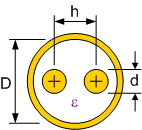
|
| Balanced Shielded Line For
D>>d, h>>d Z0= (276/ε½) log10{2ν[(1-σ2)/(1+σ2)]}
ν = h/d
σ = h/D 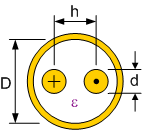
|
|
| Two Conductors in Parallel (Unbalanced) Inside Rectangular
Enclosure For d << D, h, w
∞ Z0= (276/ε½) {log10[(4h tanh(πD/2h)/πd)- ∑ log10[(1+μm2)/(1-νm2)]}
m=1 μm=sinh(πD/2h)/cosh(mπw/2h)
νm=sinh(πD/2h)/sinh(mπw/2h)
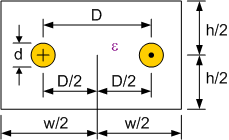 |
Equations appear in "Reference Data for Engineers," Sams Publishing 1993
|