 RF Cafe visitor Mike M. sent this very
interesting note after reading this "Frequency Modulation Fundamentals" article: Again, you hit it
out of the ballpark, Kirt! Great article out of QST. Absolutely accurate to credit
"The Old Man" Edwin Armstrong for the invention/development of FM and much more,
plus the work of Dan Noble, who worked with the Connecticut State Police and Motorola
as Director of Research. Also many, many others. Some that have never been properly
credited. Guys like Bob Morris, W2LV and Frank Gunther, W2ALS. They were both interviewed
by Ken Burns for "Empire of the Air". I was fortunate enough to talk to both of
these guys after I got my Tech license in 1970. My immediate supervisor/mentor from
1972 until he retired in ~1990...
RF Cafe visitor Mike M. sent this very
interesting note after reading this "Frequency Modulation Fundamentals" article: Again, you hit it
out of the ballpark, Kirt! Great article out of QST. Absolutely accurate to credit
"The Old Man" Edwin Armstrong for the invention/development of FM and much more,
plus the work of Dan Noble, who worked with the Connecticut State Police and Motorola
as Director of Research. Also many, many others. Some that have never been properly
credited. Guys like Bob Morris, W2LV and Frank Gunther, W2ALS. They were both interviewed
by Ken Burns for "Empire of the Air". I was fortunate enough to talk to both of
these guys after I got my Tech license in 1970. My immediate supervisor/mentor from
1972 until he retired in ~1990...
 Robert Balin created many quizzes for
Popular Electronics magazine during the 1960s and 1970s. Topics included
series circuits, electrochemistry, electronic analogy, electronic coupling, electronics
analogy, audio, electronic units, capacitor circuits, AC circuit theory, magnetic
phenomena, electronics geography, electronic noise, plugs and jacks, electronic
switching, diodes, and many more. This "Electronics Physics Quiz" is the 59th that I have posted. It challenges
you to name the effects that were first noticed as the result of unexpected actions
during laboratory experiments. Many of the names, as you might expect, eponymously
honor their progenitors. My score was 80%...
Robert Balin created many quizzes for
Popular Electronics magazine during the 1960s and 1970s. Topics included
series circuits, electrochemistry, electronic analogy, electronic coupling, electronics
analogy, audio, electronic units, capacitor circuits, AC circuit theory, magnetic
phenomena, electronics geography, electronic noise, plugs and jacks, electronic
switching, diodes, and many more. This "Electronics Physics Quiz" is the 59th that I have posted. It challenges
you to name the effects that were first noticed as the result of unexpected actions
during laboratory experiments. Many of the names, as you might expect, eponymously
honor their progenitors. My score was 80%...
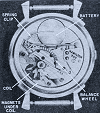 The world's first electric wristwatch
went on sale on January 3, 1957 - the Ventura model, by Hamilton Electric, and it
retailed for $200. I use the event as the theme of the RF Cafe logo for that day
in history. Unlike today's electric watches which use a crystal for timing,
the early watches used a pulsed motor to energize the balance wheel coil, in place
of a mainspring and an escapement mechanism. Some "atomic" wristwatches today like
the Casio Waveceptor (<$40) use the WWV signals from Boulder, Colorado, to synchronize
the time with world standards. The watch shown in this article from the February
1958 edition of Radio-Electronics magazine is a model 500, which you can find more
detail about on the Unique Watch Guide website...
The world's first electric wristwatch
went on sale on January 3, 1957 - the Ventura model, by Hamilton Electric, and it
retailed for $200. I use the event as the theme of the RF Cafe logo for that day
in history. Unlike today's electric watches which use a crystal for timing,
the early watches used a pulsed motor to energize the balance wheel coil, in place
of a mainspring and an escapement mechanism. Some "atomic" wristwatches today like
the Casio Waveceptor (<$40) use the WWV signals from Boulder, Colorado, to synchronize
the time with world standards. The watch shown in this article from the February
1958 edition of Radio-Electronics magazine is a model 500, which you can find more
detail about on the Unique Watch Guide website...
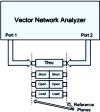 Joe Cahak, owner of Sunshine Design Engineering
Services, has submitted another fine article for posting here. Joe has many years
of automated RF testing experience to leverage when writing this paper on making
measurements with scattering parameters (S-parameters) involved. He begins, "In many RF and Microwave measurements
the S-Parameters are typically expressed in dB (decibels) Magnitude units and Degrees
in the polar coordinate system. Network and Vector Network Analyzers and Spectrum
Analyzers all measure with voltage ratio measurements, so to convert to dB in terms
of volts we must use the following equation. The Spectrum Analyzer is a frequency
discriminating detector that detects the voltage for the signal. It will give the
amplitude of signal as a function of frequency. It is scalar in measurement dimension
magnitude..."
Joe Cahak, owner of Sunshine Design Engineering
Services, has submitted another fine article for posting here. Joe has many years
of automated RF testing experience to leverage when writing this paper on making
measurements with scattering parameters (S-parameters) involved. He begins, "In many RF and Microwave measurements
the S-Parameters are typically expressed in dB (decibels) Magnitude units and Degrees
in the polar coordinate system. Network and Vector Network Analyzers and Spectrum
Analyzers all measure with voltage ratio measurements, so to convert to dB in terms
of volts we must use the following equation. The Spectrum Analyzer is a frequency
discriminating detector that detects the voltage for the signal. It will give the
amplitude of signal as a function of frequency. It is scalar in measurement dimension
magnitude..."
 According to the Wikipedia entry, Cannon
Electric Company introduced the now-familiar D-Sub (D-subminiature) connector format in 1952. This advertisement in
a 1954 issue of Radio & Television News magazine is the first one I recall seeing.
D-Sub connectors were a really big deal back in the 1980s when personal computers
(PCs) first appeared. CRT monitors used them, printers used them, scanners used
them, network interfaces used them, mice and keyboards used them (those that didn't
use PS/2 connectors, which were an invention of IBM for their Personal System 2
computers). Nowadays the USB (Universal Serial Bus) and HDMI (High-Definition Multimedia
Interface ) connectors have replaced most D-Subs in the computer cable realm...
According to the Wikipedia entry, Cannon
Electric Company introduced the now-familiar D-Sub (D-subminiature) connector format in 1952. This advertisement in
a 1954 issue of Radio & Television News magazine is the first one I recall seeing.
D-Sub connectors were a really big deal back in the 1980s when personal computers
(PCs) first appeared. CRT monitors used them, printers used them, scanners used
them, network interfaces used them, mice and keyboards used them (those that didn't
use PS/2 connectors, which were an invention of IBM for their Personal System 2
computers). Nowadays the USB (Universal Serial Bus) and HDMI (High-Definition Multimedia
Interface ) connectors have replaced most D-Subs in the computer cable realm...
 Yeah, I thought the same thing... a "Wamoscope?" Was it produced by the Wham-O toy company that makes
the Hula Hoop, the Frisbee, the Super Ball, and Silly String? Wham-O was founded
in 1948, and this article appeared in a 1956 edition of Radio & Television News
magazine, so why not? Actually, Wamoscope is derived from "WAve-MOdulated oscilloSCOPE."
Developed by Sylvania Electric Products, it combined a traveling-wave tube with
a cathode ray tube in single enclosure. That enabled microwave signals to be fed
directly to the CRT for amplifications and processing. Evidently the idea did not
catch on since the market was never filled with Wamoscope sets. A brochure for Sylvania's
6762 Wamoscope is shown at the bottom of the page...
Yeah, I thought the same thing... a "Wamoscope?" Was it produced by the Wham-O toy company that makes
the Hula Hoop, the Frisbee, the Super Ball, and Silly String? Wham-O was founded
in 1948, and this article appeared in a 1956 edition of Radio & Television News
magazine, so why not? Actually, Wamoscope is derived from "WAve-MOdulated oscilloSCOPE."
Developed by Sylvania Electric Products, it combined a traveling-wave tube with
a cathode ray tube in single enclosure. That enabled microwave signals to be fed
directly to the CRT for amplifications and processing. Evidently the idea did not
catch on since the market was never filled with Wamoscope sets. A brochure for Sylvania's
6762 Wamoscope is shown at the bottom of the page...
 This is another example of one of those
advertisements you likely would not see in a modern electronics magazine.
There is nothing fundamentally problematic about its content or message, but politically
correct standards would condemn any depiction of a woman expressing such excessive
appreciation for a man's efforts. It might, after all, convey the idea that
all television antenna servicemen should expect such treatment from all women. It
also implies that only men can be TV antenna servicemen / servicepersons. If that
sounds nutty, well, what can I say. It's the world we live in as evidenced by
news items of late. Keep firmly in mind that what is accepted as a social norm today
might be considered to be a crime in a few decades, so exercise caution in all you
do in the presence of witnesses be it written, videoed, spoken, or acted out...
This is another example of one of those
advertisements you likely would not see in a modern electronics magazine.
There is nothing fundamentally problematic about its content or message, but politically
correct standards would condemn any depiction of a woman expressing such excessive
appreciation for a man's efforts. It might, after all, convey the idea that
all television antenna servicemen should expect such treatment from all women. It
also implies that only men can be TV antenna servicemen / servicepersons. If that
sounds nutty, well, what can I say. It's the world we live in as evidenced by
news items of late. Keep firmly in mind that what is accepted as a social norm today
might be considered to be a crime in a few decades, so exercise caution in all you
do in the presence of witnesses be it written, videoed, spoken, or acted out...
 RF Cafe visitor Dave H. wrote to offer the
following additional information about the
history of mobile radio communications. It is fairly extensive,
so it is posted at the bottom of the page. "I liked the article about Don Wallace
and his car to home radio. I knew that in Detroit, the police had attempted to have
car to car transmissions. They were not overly successful however. They did implement
a station to car, 1 way transmission. I discovered the facts about the Detroit police
radios while researching a paper that I wrote entitled: 'SAW Filters : The Unsung
Heroes of the Cell Phone Revolution.' Did you know that that the phone developed
by Martin Cooper while at Motorola, circa 1973, had a filter board that measured
10 inches by about 1 inch? That would be a tad hard to find..."
RF Cafe visitor Dave H. wrote to offer the
following additional information about the
history of mobile radio communications. It is fairly extensive,
so it is posted at the bottom of the page. "I liked the article about Don Wallace
and his car to home radio. I knew that in Detroit, the police had attempted to have
car to car transmissions. They were not overly successful however. They did implement
a station to car, 1 way transmission. I discovered the facts about the Detroit police
radios while researching a paper that I wrote entitled: 'SAW Filters : The Unsung
Heroes of the Cell Phone Revolution.' Did you know that that the phone developed
by Martin Cooper while at Motorola, circa 1973, had a filter board that measured
10 inches by about 1 inch? That would be a tad hard to find..."
 This is the first of a two-part series on
the move of the
WWV transmitter stations operated by the National Bureau of Standards
(now called National Institute of Standards and Technology) from Greenbelt, Maryland,
to Boulder, Colorado. WWV Part II appeared in the February 1967 edition of the ARRL's
QST magazine. WWV began transmitting time / frequency standards in 1920
in order to provide a means for remote stations and laboratories to calibrate local
standards that would prevent transmitting stations from interfering with each other.
Although most people don't realize it, the 60 kHz signal that their 'atomic'
clocks and watches use to self-adjust time emanates from the WWVB antenna in Boulder.
This first installment of the article discusses the history and rationale for relocating
the WWV facility...
This is the first of a two-part series on
the move of the
WWV transmitter stations operated by the National Bureau of Standards
(now called National Institute of Standards and Technology) from Greenbelt, Maryland,
to Boulder, Colorado. WWV Part II appeared in the February 1967 edition of the ARRL's
QST magazine. WWV began transmitting time / frequency standards in 1920
in order to provide a means for remote stations and laboratories to calibrate local
standards that would prevent transmitting stations from interfering with each other.
Although most people don't realize it, the 60 kHz signal that their 'atomic'
clocks and watches use to self-adjust time emanates from the WWVB antenna in Boulder.
This first installment of the article discusses the history and rationale for relocating
the WWV facility...
 Each week, for the sake of all avid cruciverbalists
amongst us, I create a new
technology-themed crossword puzzle using only words from my custom-created
lexicon related to engineering, science, mathematics, chemistry, physics, astronomy,
etc. In this crossword for June 14th you will never find among the words names of
politicians, mountain ranges, exotic foods or plants, movie stars, or anything of
the sort. You might, however, see someone or something in the exclusion list who
or that is directly related to this puzzle's theme, such as Hedy Lamarr or the
Bikini Atoll, respectively. Enjoy!
Each week, for the sake of all avid cruciverbalists
amongst us, I create a new
technology-themed crossword puzzle using only words from my custom-created
lexicon related to engineering, science, mathematics, chemistry, physics, astronomy,
etc. In this crossword for June 14th you will never find among the words names of
politicians, mountain ranges, exotic foods or plants, movie stars, or anything of
the sort. You might, however, see someone or something in the exclusion list who
or that is directly related to this puzzle's theme, such as Hedy Lamarr or the
Bikini Atoll, respectively. Enjoy!
 When I saw this Hughes Research and Development
Laboratories employment ad in a 1955 issue of Radio & Television News, I wasn't
sure how to take it. The text of the ad makes no reference to the bar graph and
the weird drawing. Note the
"bottle" is actually a slide rule. The graph can be interpreted
to indicate that the more education a person has, the less likely he is to have
children. If the typical age of the respondent is in the twenties, then that might
reflect how people still in school to earn a higher degree would not be having children.
It might also show that people with higher degrees focus more on their careers than
on having a family. If you extrapolate the graph backward, does it imply people
with an Associate's degree might average 1.5 children, those with just a high
school diploma have about 1.7 children, and high school dropouts average maybe 2.0
kids? You have to also assume that most of the people with higher degrees earned
them prior to beginning work or else you would have to ask what the Ph.D. with 0.9
kids did...
When I saw this Hughes Research and Development
Laboratories employment ad in a 1955 issue of Radio & Television News, I wasn't
sure how to take it. The text of the ad makes no reference to the bar graph and
the weird drawing. Note the
"bottle" is actually a slide rule. The graph can be interpreted
to indicate that the more education a person has, the less likely he is to have
children. If the typical age of the respondent is in the twenties, then that might
reflect how people still in school to earn a higher degree would not be having children.
It might also show that people with higher degrees focus more on their careers than
on having a family. If you extrapolate the graph backward, does it imply people
with an Associate's degree might average 1.5 children, those with just a high
school diploma have about 1.7 children, and high school dropouts average maybe 2.0
kids? You have to also assume that most of the people with higher degrees earned
them prior to beginning work or else you would have to ask what the Ph.D. with 0.9
kids did...
 Have I mentioned that my YL, Melanie, decided
she would earn her Amateur radio Technician license? After living in a household
with a bilingual husband (English and Electronics) for nearly 38 years and having
become fairly proficient at ETL (electronics as a third language*), Melanie decided
to earn her Technician license. She has never delved into the technical aspects
of electricity / electronics, but because of hearing me speak of it (too) often
and having proof-read my writings and scanned and OCR'ed more than a thousand
articles from vintage electronics magazines, her gray cells are permeated with the
vocabulary, lingo, jargon, vernacular, slang, and argot of the realm. Being an expert
test taker, she will undoubtedly pass the written test with flying colors. With
much self-restraint, I have avoided offering my sage advice and knowledge during
her studies of the ARRL's Ham Radio License Manual. The current edition
is the 4th, being valid from 2018 through 2022. Melanie has asked for a little clarification
on SWR, decibels and couple other minor topics, but otherwise has progressed...
Have I mentioned that my YL, Melanie, decided
she would earn her Amateur radio Technician license? After living in a household
with a bilingual husband (English and Electronics) for nearly 38 years and having
become fairly proficient at ETL (electronics as a third language*), Melanie decided
to earn her Technician license. She has never delved into the technical aspects
of electricity / electronics, but because of hearing me speak of it (too) often
and having proof-read my writings and scanned and OCR'ed more than a thousand
articles from vintage electronics magazines, her gray cells are permeated with the
vocabulary, lingo, jargon, vernacular, slang, and argot of the realm. Being an expert
test taker, she will undoubtedly pass the written test with flying colors. With
much self-restraint, I have avoided offering my sage advice and knowledge during
her studies of the ARRL's Ham Radio License Manual. The current edition
is the 4th, being valid from 2018 through 2022. Melanie has asked for a little clarification
on SWR, decibels and couple other minor topics, but otherwise has progressed...
 Listen to the
Podcast! Just in time for Halloween, John T. Frye's teenage sleuths
Carl & Jerry unexpectedly recorded a late-night conversation
between two men where they plot how to dispose of the "body" when death occurred
as a result of prolonged choking. Employing their trademark technical prowess and
scheming ability, the pair sets a trap for the perpetrators and dutifully summon
the authorities as they complete their nefarious act of the night before. Halloween
comes into play because the recordings were made for use in creating sound effects
during the reading of Edgar Allen Poe's "The Pit and the Pendulum" and "The
Cask of Amontillado." This story, which appeared in a 1955 issue of Popular
Electronics magazine, is a little dark compared to a typical story...
Listen to the
Podcast! Just in time for Halloween, John T. Frye's teenage sleuths
Carl & Jerry unexpectedly recorded a late-night conversation
between two men where they plot how to dispose of the "body" when death occurred
as a result of prolonged choking. Employing their trademark technical prowess and
scheming ability, the pair sets a trap for the perpetrators and dutifully summon
the authorities as they complete their nefarious act of the night before. Halloween
comes into play because the recordings were made for use in creating sound effects
during the reading of Edgar Allen Poe's "The Pit and the Pendulum" and "The
Cask of Amontillado." This story, which appeared in a 1955 issue of Popular
Electronics magazine, is a little dark compared to a typical story...
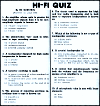 Here is a quick
Hi-Fi Quiz for all you audiophiles out there. Although it appeared
in a 1955 issue of Radio & Television News magazine, save for question
#10 all of Q's and A's still apply to today's equipment. Even that one
can be easily guessed. Q4 might seem a bit foreign, but think of the "groove" type
as applying to 78, 45, or 33-1/3 rpm platters and you'll do OK. Question #7
could be a baffler (pun intended - you'll see how) were it not for one obviously
invalid option that it takes an RF guy (or gal) to recognize its inanity. Good luck.
BTW, I missed Q1, but should have known better.
Here is a quick
Hi-Fi Quiz for all you audiophiles out there. Although it appeared
in a 1955 issue of Radio & Television News magazine, save for question
#10 all of Q's and A's still apply to today's equipment. Even that one
can be easily guessed. Q4 might seem a bit foreign, but think of the "groove" type
as applying to 78, 45, or 33-1/3 rpm platters and you'll do OK. Question #7
could be a baffler (pun intended - you'll see how) were it not for one obviously
invalid option that it takes an RF guy (or gal) to recognize its inanity. Good luck.
BTW, I missed Q1, but should have known better.
 Many topics of the
electronics-themed comics which appeared in Radio-Craft were suggested
by the magazine's readers. Staff artists like Frank Beaven turned those suggestions
into cartoons. For a while there was a special feature called "Radio Term Illustrated"
where, as the name suggests, terms like "Signal Generator" and "High Potential"
are rendered in farcical form. These four comics, two of each type, appeared in
a May 1947 issue of Radio-Craft. I have to admit that even with my familiarity with
vintage electronics memes I do not get the Television "Organ" comic (yes, I understand
the organ grinder, but not how it applies to TV).
Many topics of the
electronics-themed comics which appeared in Radio-Craft were suggested
by the magazine's readers. Staff artists like Frank Beaven turned those suggestions
into cartoons. For a while there was a special feature called "Radio Term Illustrated"
where, as the name suggests, terms like "Signal Generator" and "High Potential"
are rendered in farcical form. These four comics, two of each type, appeared in
a May 1947 issue of Radio-Craft. I have to admit that even with my familiarity with
vintage electronics memes I do not get the Television "Organ" comic (yes, I understand
the organ grinder, but not how it applies to TV).