|
|||||||||||||
 |
|||||||||||||
Underground Service Cable and Circuit Breaker Panel Replacement
|
|||||||||||||
|
1 | 2 | 3 | 4 | 5 | 6 | 7 | 8 | 9 | 10 | 11 | 12 | 13 | 14 | 15 | 16 | 17 | 18 | 19 | 20 | 21 | 22 | 23 | 24 | 25 | 26 | 27 | 28 | 29 | 30 | 31 | 32 | 33 | 34 | 35 | 36 | 37
Electrician's apprentice, grandson Calvin (aptly named after the Calvin and Hobbes character). He's holding one of my cable bender tools - one smart guy! If you have been an RF Cafe website visitor for a long time, you might recall back in 2010 when I posted Kirt's Cogitations #258: How an Electrical Engineer Spends "Vacation." It showcased the extensive electrical wiring I did on my daughter's horse riding business (Equine Kingdom) barn/stables. Since then, she added an extension to that building, and then had a huge indoor riding arena built, and I wired them as well. My long-ago resume includes electrical vocational curriculum in high school, then a few years of electrician work prior to enlisting in the USAF as an Air Traffic Control Radar Repairman. In the intervening years, I have completed many electrical wiring, troubleshooting, and repair projects for myself, family, and friends (all at no charge). A few years ago, she and her husband, a major in the U.S. Army National Guard, moved to an old former diary farm property. The buildings are old and dilapidated, but we are slowly patching and improving them. All of the processing equipment was been stripped out, and the facility has been converted to horse facility use with a feed room, tack room, indoor riding arena, and tractor/hay storage. Earlier this month (March 2026), the new submersible pump we just installed late last summer stopped working. I replaced all of the original plumbing, along with the pump, including storage tank, controls, pipe, and valves. The original well house (2' tall x 6' x 8') was knocked down and replaced with a much more modern and convenient structure (it looks like an outhouse). Click on the image to the right for project details. Anyway, the problem was that one leg of the 240 V underground service from the main power pole to the breaker panel had opened, leaving just 120 V for the pump. I turned off the breaker to the pump to keep it from getting damaged. When I measured the panel bus voltage, one leg read 120 V, and the other leg was at about 70 V. Turns out the current that would normally be supplied by the other 120 V leg was being supplied in series with the submersible pump motor - a very undesirable situation. There were only a few lights on that leg, so only a few amps of current, but enough to burn out the motor over time. Fortunately, I discovered it quickly. The readings were not unlike what an open neutral might cause. As a temporary measure, I moved all the circuits from the dead leg over to the live one, so the warehouse building with the panel only had 120 V. A minor crisis had ensued, requiring a recovery plan. Fortunately, there is another well on the property that is connected with this one via an underground valve (accessible from inside a section of 16" diameter concrete culvert pipe buried vertically).
Electric service to the farm property includes transformer, current transformer (CT), meter, manual transfer switch box, 200 A disconnect breaker, backup generator, and auto-switchover panel.
The snarl of service cables at the top of the utility pole - three overhead sets and one to the buried set. This task was within my purview. Having performed many electric service heavy-ups (increasing the amperage) and troubleshooting calls in my days, I am somewhat - but not entirely - comfortable working with 240 V service from the utility pole (no ultimate-stupid yet). At nearly 68 years old, I do need to be more careful and think things out more completely before diving in. One of the dairy farmer's daughters live across the street, but she does not remember specifics about her father's activities, and she did not remember when the well was originally put in, or when the electric service was added. The best guess was sometime in the 1980s.
This is the original outside circuit breaker panel (improper indoor type) on the warehouse.
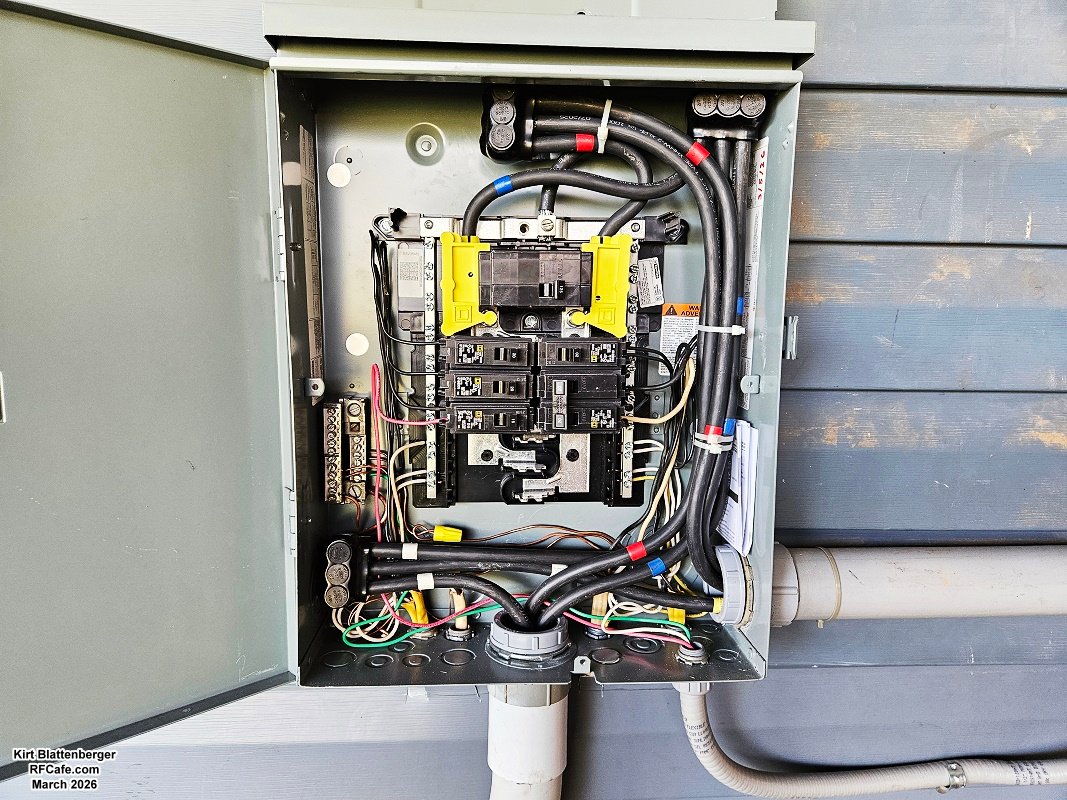
New circuit breaker panel (outdoor rated). Aluminum 2-0 XHHN cables in from utility pole, to panel bus, and out to barn breaker panel. Prior to this failure, my daughter and son-in-law had been asking about replacing the overhead wires with buried lines from the central utility pole. I contacted an engineer, Zach, at Duke Energy, about whether they would do the job either for free or for a cost. He came out to assess the situation and determined that the power pole and distribution was a kludge job of power company and owner components. He had his manager - a 40-year employee - take a look. He just shook his head and smiled when he saw it. Both of them are good guys. Back before stricter rules and lawyer involvement in every aspect of business, evidently linemen and farm owners made deals about what could and could not be done. A cardinal rule of utility poles is that customer-owned equipment could not be mounted to them. This one has a big transfer switch hanging on it that at one time was used to switch manually between a backup generator and the overhead service. The switch is not used anymore since an automatic switchover unit was later installed for the generator. I have not had the nerve to try the switch for fear that it might break and not close properly again. The way the circuit goes is as follows. 240 V comes off the transformer and runs down the pole, straight through the transfer switch box (no splices or connections), into a double-pole, 200 A main disconnect circuit breaker, then to the automatic generator switchover panel. From there, it goes back to the transfer switch, through the switch, and back up the pole. At the top of the pole, the feed is split to three sets of overhead lines and one set of underground lines (which runs back down the pole through 2" PVC pipe. A current transformer (CT) coil at the output of the line transformer feeds a sample of the current to a single meter, so that the entire property's energy use is measured there. Duke Energy decided that they would only take responsibility for the pole, transformer, and two of the sets of overhead lines (to the house and to the barn), as well as the two other utility poles. Everything else is our problem. Maybe a crafty lawyer could convince them to assume ownership of the entire mess, but we will deal with it ourselves.
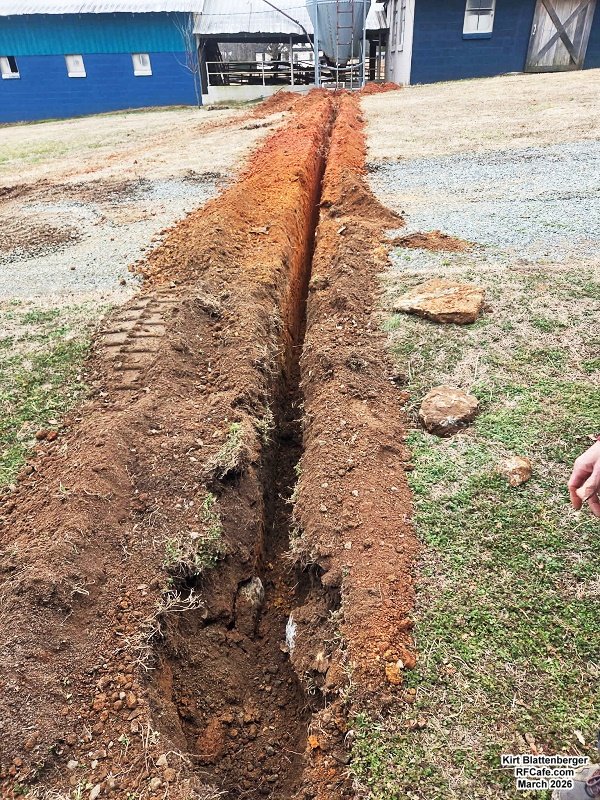
2" PVC conduit between utility pole and warehouse. NEC stipulates minimum 18" to top of pipe. We did 24". The water pipes were 12"-16" down.
Trench between warehouse and barn.
Aluminum 2-0 XHHN wire spool.
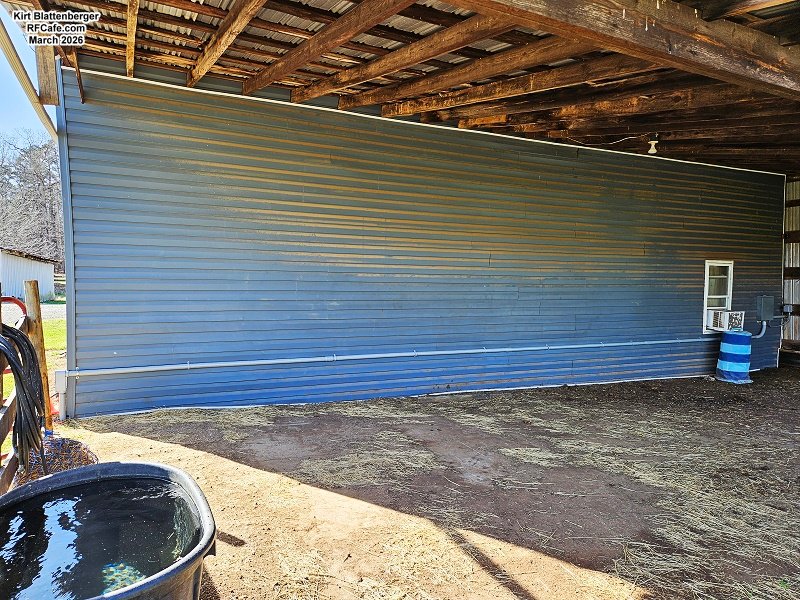
Make-shift pulley tripod for pulling cables. Since it was desired to eventually replace the service to the barn, I devised a plan to do the entire project at one time. We would trench from the utility pole to the warehouse building with the power panel, and then from that building to the barn. Rather than lay underground cable (type UDF), we installed 2" PVC conduit and ran 2-0 XHHN aluminum cable which is rated for 150 A. The National Electric Code (NEC) would have allowed 1½" PVC, but for the extra cost, it was worth making the cable easier to pull. Plus, there is plenty of room if anything else is ever required. Code mandates that no more than 360° worth of turns are permitted within a run between pull boxes. The pole-to-warehouse run has three 90° turns, but two of them are 90° sweeps, plus a few degrees of snaking through trench, and the other is a 90° LB, so no problem there. The warehouse-to-barn run has two 90°, two 45° sweeps, sweeps plus some snaking, and two 90° LBs, so no problem there, either. There will be no inspection since just about anything goes on a farm property, but I like to do things by the book, both for personal pride, and in case an insurance company issue ever arises.
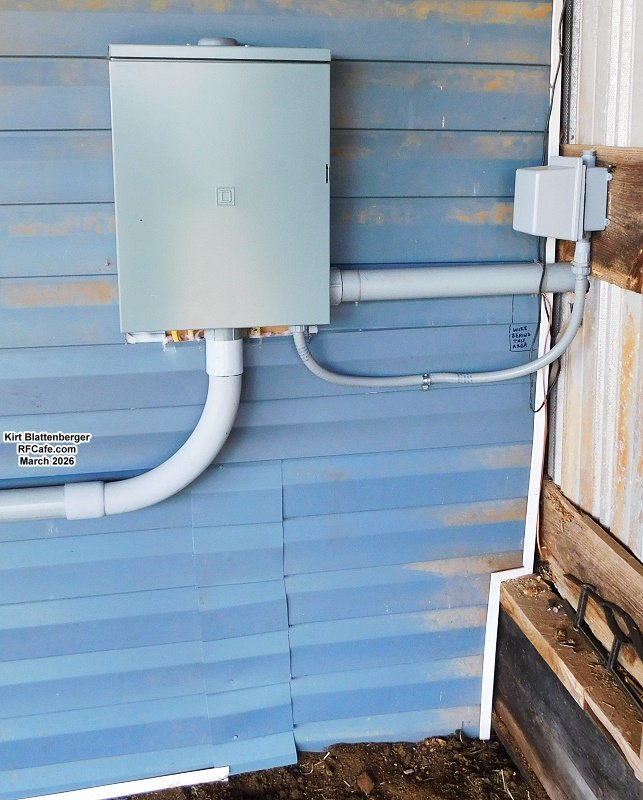
2" PVC conduit from warehouse circuit breaker panel to LB box to buried PVC. The circuit breaker panel on the warehouse was mounted outside, under an open, covered area, but it was an indoor panel. I replaced it with a spanking new Square D, 150 A main breaker outdoor panel. Since the panel in the barn is in a section that is slated for razing later in the year, I also installed a new 150 main breaker indoor panel in the feed room. I did not use any of the old panels or circuit breakers because they were all pretty rough. The NEC allows for making splices within a breaker panel (aka load center) so long as the total number and size of wires does not exceed its rate capacity. That eliminated the need to install a separate junction box to split off from the warehouse to the barn. I made splices inside the warehouse panel, and they fit just fine. It required the use of my cable bender tools for a couple of the short, small radius bands. It turned out really nice and neat - and it looks cool as a bonus!
Completed new circuit breaker panel installation, and new outdoor receptacle.
New circuit breaker panel in barn feed room. Romex cable extensions from old panel. All of the Romex cable reached easily into the new warehouse breaker panel, but I needed to mount junction boxes to extend all the Romex cable inside the barn feed room. After measuring the 2-0 XHHN cable run lengths three times, then adding a 10% fudge factor, I placed an order at a local electrical supply company - I like to support local business, even though I could have save a few pennies ordering it online. The counter guy extended the contractor price since I ordered 750 feet, at $1.30/foot. It came on a small wooden spool, which was very convenient. It weighed about 100 pounds so it was easy to manage. I mounted it on a pipe, between two saw horses, so it is easily fed out. I actually lost sleep worrying about not buying enough cable, but it turns out there was just about 10% left over, so my measurements, including allowances for inside the breaker panel were spot-on. We'll be burying another buried run later so the wire won't be wasted. I also worried about how difficult the group of 2-0 wires would be to pull through the conduit (80' and 105' runs). We threaded 1/2" diameter rope through the sections of PVC as they were glued together. Using the technique learned many moons ago for attaching the cables for the pull, I bent over the end of the first cable and tied the rope to it, and used pump pliers to crush the loop flat, then wrapped it amply with plastic electrical tape. The the second wire was positioned about foot back from the end and taped securely. The third wire was also taped to the first wire, about two feet back and taped; that way no strain is placed on the second wire that might cause it to pull loose. The entire group was not taped in order to prevent creating a stiff, unbendable region that would be hard to pull around a bend. Neither was the bundle taped anywhere along its length.
LB pull boxes at warehouse (left) and barn (right). 5/8" diameter by 8' copper ground rods driven full length, 4 AWG solid ground to panel busses. Warehouse panel originally have no ground connection.
New wiring at utility pole installation. Box on left end is new; it will eventually have the circuit breaker bus reinstalled. Middle box is 200 A disconnect circuit breaker. Right panel is generator auto-switchover. My cables are at the bottoms of panels. Since pulling the rope on both runs would be straight up out of the ground, requiring muscular strength at an uncomfortable angle, I constructed a tripod from 2x4 lumber, and attached a pulley at the apex. That allowed the puller to use his (her in this case - my daughter) weight rather than muscles. It was just a simple, single pulley for changing the direction of force, not to multiply it. My daughter pulled as I kept the cables untwisted and pushed them from the input end. Both pulls went incredibly easily, without any problems. We didn't even need to use "monkey poop" - the yellow cable-pulling grease - on them. Greatly relieved, we then fed the cables through the LB boxes and into the panels. Again, no problems.
Yours truly repairing one of the severed water lines.
Original circuit breaker panel is to the far right. New panel on left. Romex extensions at top. I have not mentioned the connections at the utility pole end yet. Rather than running the new cables over to and up the pole, I decided to mount a new panel next to the 200 A disconnect panel, and make connections from there. Since I used a small outdoor circuit breaker panel, I will be able to mount a GFCI receptacle and service light out there at a later date. For the sake of saving time, I removed the bus assembly and made the splices from the generator auto-switchover panel in the breaker panel. In retrospect, I should have just run the PVC directly into the auto-switchover. I did it the way I did due to a bad assumption about how the circuit was routed between the old transfer switch panel and the 200 A disconnect breaker. It could have been simpler, and saved about $60 worth of 2-0 and 1-0 copper wire copper. I'll spare you the details; suffice it to say all went well as originally planned. Since there is no main electric meter to pull to disconnect the property from the overhead transformer, the 200 A disconnect circuit breaker serves the purpose. Before doing the final service wire hookup, I turned off the backup generator (so it would not turn on when detecting loss of line power), then shut off the 200 A breaker. That killed power to the entire property. Without fear or trepidation, I proceeded to make up all the splices and bus connections in the circuit breaker panels. All circuit breakers were confirmed off in the warehouse and barn panels, then I winced whilst throwing the 200 A back on. Happily, there were no sparks. I verified the presence of 120 V and 240 V everywhere it should be, and finally, after three weeks of planning and execution, breathed a huge sigh of relief! All that remained was to turn on all the breakers and pray for no short circuits. None. Done. The second well was back in operation with no apparent damage to the motor. Yea! Duke Energy will be called out to drop the overhead line running to the barn, and to cut loose the connection that used to go to the underground feeder (for now, I cut it off about 8' above the ground and taped the ends of the wires). As a footnote, I will mention that while digging the two trenches, buried polyethylene water pipes were cut through. I was able to dig and locate one of them ahead of time, but had no idea of the whereabouts of the others. A few coupler nipples and hose clamps later, water was flowing again. While in the vicinity of the feed room, we went ahead and stuffed a pipe through the concrete floor, into it for later supply to a sink and toilet. I also had to dig to locate where the water pipe tapped off to the buildings that will be torn down, and cap that off. All done. Whew! Did I mention that during the project, I had an electrical contractor come out and work up a price to have the job done professionally. It came to a bit more than $8k just for the pole-to-warehouse run, and that was with us digging the trench and taking care of any wire or pipes encountered. The warehouse-to-barn run would have been at least another $8k ... $16k total. Our total parts cost came out under $3k, so that represents quite a savings, and I know the job was done correctly and neatly, with no possibility of hidden shortcuts. It pays (or saves) to know someone that can do the job.
- Kirt Blattenberger |
|||||||||||||
 |
|||||||||||||
|
|||||||||||||
 "
"








|
||||||||||||||||||||||||||||||||||||