|
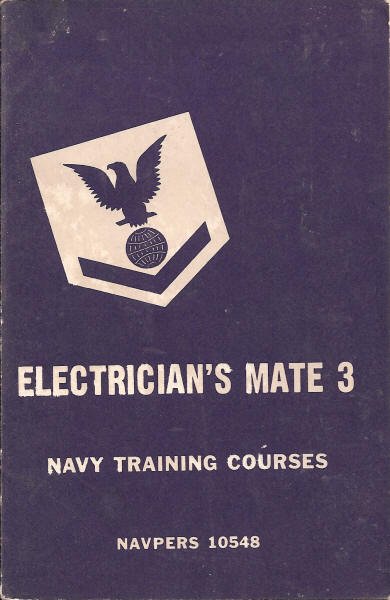
Here is the "Electrician's Mate 3 - Navy Training Courses"
(NAVPERS 10548) in its entirety (or will be eventually). It should provide one of
the Internet's best resources for people seeking a basic electricity course - complete
with examples worked out. See
copyright.
See Table of Contents.
¶ U.S. GOVERNMENT PRINTING OFFICE;
1949
Electrician's Mate
3 - Navy Training Courses NAVPERS
10548
Introduction by Kirt Blattenberger
In January of 1945, my father-in-law, Marlet Goodwin, enlisted in
the Merchant Marines and spent two years working in the "belly of the
beast" in the engine rooms of the ships on which he sailed. He recently
passed on to me some of the training manuals that he received while
in the Merchant Marines and later while in the Naval Reserves. Some
of the information contained in those manuals are amazingly detailed
- both for mechanical and electrical systems. Since the basics have
not changed much over the past 70 years, I thought it might be useful
to make some of the content available here.
Copyright
  Government
publications are considered to be in the public domain, and may be freely
redistributed so long as credit is given*.
Accordingly, I have undertaken the task of scanning and publishing the
content of the Electrician's Mate 3 course here. Other manuals will
be added as time permits. The time consumed in doing so is extensive.
Each page was scanned once to do an optical character recognition (OCR)
processing on it, and then again to obtain the images (OCR tries to
interpret images as text and makes a real mess there). Although anyone
may freely copy a government publication, no one may copy my version
of the publication of it. If you want to publish content from the manuals,
you must scan your own images and create your own duplicate text. However,
I welcome anyone to print out these complete pages for use in self-study,
or even as part of a classroom course - just be sure to give proper
credit. Government
publications are considered to be in the public domain, and may be freely
redistributed so long as credit is given*.
Accordingly, I have undertaken the task of scanning and publishing the
content of the Electrician's Mate 3 course here. Other manuals will
be added as time permits. The time consumed in doing so is extensive.
Each page was scanned once to do an optical character recognition (OCR)
processing on it, and then again to obtain the images (OCR tries to
interpret images as text and makes a real mess there). Although anyone
may freely copy a government publication, no one may copy my version
of the publication of it. If you want to publish content from the manuals,
you must scan your own images and create your own duplicate text. However,
I welcome anyone to print out these complete pages for use in self-study,
or even as part of a classroom course - just be sure to give proper
credit.
Here is the "Electrician's Mate 3 - Navy Training Courses" (NAVPERS
10548) in its entirety (or will be eventually). It should provide one
of the Internet's best resources for people seeking a basic electricity
course - complete with examples worked out (links to quizzes at end
of chapters).
Electrician's Mate
3 - Navy Training Courses
NAVPERS 10548
PREFACE
This book is written to aid the
striker for Electrician's Mate 3 to qualify for advancement to that
rate. The combination of this training course and practical experience
will enable the striker to meet the official requirements for advancement
to EM3. These requirements, as given in The Manual of Qualifications
for Advancement in Rating (NavPers 18068), are reproduced in appendix
II. This course is based on an elementary knowledge of electricity and
mathematics. Therefore, before starting this course the striker should
complete the two basic Navy Training Courses, Electricity, NavPers 10622,
and Mathematics, NavPers 10620. The duties of an Electrician's Mate
also require an elementary knowledge of machines, tools, and blueprints.
Hence, while studying this course, the striker should review these additional
basic Navy Training Courses-Basic Machines, NavPers 10624; Use of Tools,
NavPers 10623; and Use of Blueprints, NavPers 10621. . This training
course presents the basic phenomena of direct current necessary for
an EM3 to perform his duties on direct current machinery. He should
also have a similar back-ground on alternating current machinery. Such
background he will find in the appropriate chapters of the Navy training
course for Electrician's l.1ate 2c, NavPers 10103. As one of the NAVY
TRAINING COURSES, this book represents the joint efforts of the Training
Publications Section of the Bureau of Naval Personnel and of those Naval
establishments specially cognizant of the technical aspects of Electrician's
Mates' duties.
TABLE
OF CONTENTS
Page
CHAPTER 1 Electrical currents
and circuits - Ohm's Law
CHAPTER 2 Magnetism
CHAPTER 3 Electromagnetism and
magnetic circuits
CHAPTER 4 lnduction
CHAPTER 5 Alternating and direct
current generators
CHAPTER 6
Direct current generators
CHAPTER 7
Types of direct current generators
CHAPTER 8
Operation of direct current generators
CHAPTER 9
Direct current motors
CHAPTER 10 Maintenance
of direct current motors and generators
CHAPTER 11
Page Direct current controllers
CHAPTER 12
Cables
CHAPTER 13 Batteries
CHAPTER
14 Electrical systems in small craft
CHAPTER 15 Searchlights
CHAPTER 16 Blueprint reading and sketching
CHAPTER 17 Safety precautions
APPENDIX
I Answers to quizzes
APPENDIX
II Qualifications for advancement
Index
STUDY GUIDE
If you are in the Regular Navy, you will be striking for the general
service rating (EM). To meet the qualifications for 3rd class in this
rating (see column EM, appendix II) you will have to study all the chapters
in this book. If you are a member of the Naval Reserve you will be striking
for either the emergency rating as power electrician (EMP) or shop electrician
(EMS). To meet the qualifications for EMS you have to study all the
chapters of this book except chapter 11 (D. C. Controllers). For EMP3
rate you have to study all the chapters except chapter 10 (Maintenance
of Direct Current Motors and Generators). However, to gain a well-rounded
view of the duties of the general service rating, it is recommended
that you also read the additional chapters 10 or 11, which do not pertain
directly to your rating.
*
Relevant excerpt from the www.cendi.gov website.
Frequently Asked Questions About Copyright Issues Affecting
the
U.S. Government CENDI/2004-8 Updated March 2007
2.2.4 What is public domain? Public domain refers to works that
are not protected by copyright and are publicly available. They may
be used by anyone, anywhere, anytime without permission, license or
royalty payment.
A work may enter the public domain because
the term of copyright protection has expired (see FAQ Section 2.1.6),
because copyright has been abandoned, or in the U.S. because it is a
U.S. Government work and there is no other statutory basis for the Government
to restrict its access (see FAQ Section 3.1.5).
A work is not
in the public domain simply because it does not have a copyright notice.
Additionally, the fact that a privately created work is, with permission,
included in a U.S. Government work does not place the private work into
the public domain. The user is responsible for determining whether a
work is in the public domain.
It is important to read the permissions
and copyright notices on U.S. Government publications and Web sites.
Many Government agencies follow the practice of providing notice for
material that is copyrighted and not for those that are in the public
domain. Examples of government agency copyright policies and statements
are: National Library of Medicine,38 NASA Center for AeroSpace Information
(CASI),39 and Library of Congress.
|