|
|||||||||||||
 |
|||||||||||||
America's Own Marconi - Nathan B. Stubblefield
|
|||||||||||||
America's Own Marconi - Nathan B. Stubblefield
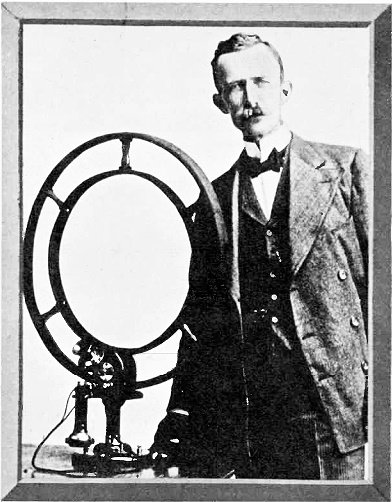
Inventor Nathan B. Stubblefield and his invention, now believed by many to be first radio. Photo was taken around the turn of the century. The large loop above modified telephone is thought to be the rig's antenna. By Martha K. Gunter, W9HIX Many now believe it was an obscure Kentuckian who achieved the first wireless transmission of voice. Who invented radio? The answer for most people is Guglielmo Marconi, the Italian engineer who died in 1937. But there is a growing group of dissenters, and in one town in Kentucky virtually everybody from the dog catcher to the bank president will tell you the true father of radio was Nathan B. Stubblefield. The town is Murray (pop. about 10,000), which calls itself the Birthplace of Radio because Stubblefield lived there until his death in 1928. To feed and clothe his family, Nathan Stubblefield raised and sold vegetables but most of his time was given over to experiments involving the telephone, and more particularly a telephone which operated without the benefit of wires. Stubblefield lived on the edge of town in a little shack surrounded by an untrimmed hedge. Like a lot of inventors, he drew an elaborate curtain of secrecy over his experiments and automatically suspected that everyone wanted to steal his inventions. He kept a gun handy to discourage prowlers. Under such conditions it is not surprising that other Murray residents came to think of him as slightly mad. Children pointed at him when he appeared on the street and dogs barked at his heels. According to all evidence at hand, Stubblefield did make some discoveries and inventions which would have been of value in their time. But because of his passion for secrecy and his failure to put his inventions to the use of others, his contribution to the world of science is virtually nil. Stubblefield seems to have been experimenting with wireless transmissions before Marconi and some of his earlier probings in the field may have been contemporary with Bell's telephone experiments (Bell received his patent in 1876) and even the mathematical formulations pertaining to radio waves which were published in 1865 and 1873 by James Clerk Maxwell. Stubblefield and his son Bernard with two pieces of his equipment. Note the rods driven into the ground in front of Bernard. The inventor never divulged the exact components of any of his equipment. Photograph probably dates from 1905.
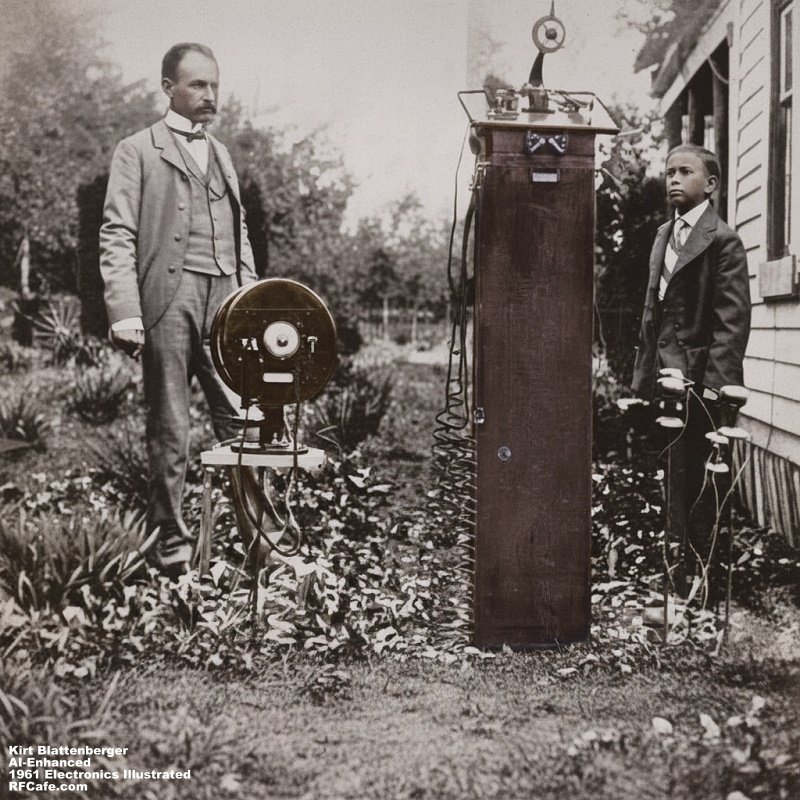
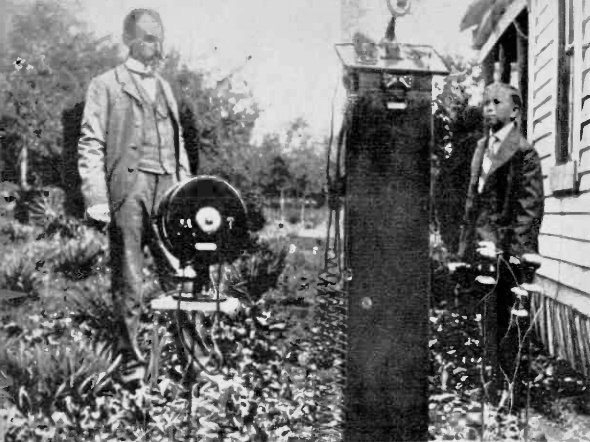
Stubblefield and his son Bernard with two pieces of his equipment. Note the rods driven into the ground in front of Bernard. The inventor never divulged the exact components of any of his equipment. Photograph probably dates from 1905. It is known that Stubblefield did achieve wireless transmission of the human voice in 1885. Marconi received his patent for a radio-telegraph device on June 2, 1896. It was not until 1888 that Heinrich Hertz demonstrated the existence of electromagnetic waves. The only person Stubblefield allowed to be near him when he was experimenting was a son, Bernard, who was born around 1890. Sometimes, however, he did allow chosen individuals to view demonstrations of his apparatus and later even gave public exhibitions. After his 1885 experiment he one day ran into Duncan Holt, a Murray contractor who was as near a friend as he had, and exclaimed, "Duncan, I've done it. I've been able to talk without wires ... all of 200 yards ... and it'll work anywhere!"He still did not let Holt see the equipment, however. That honor was withheld until 1892, when Stubblefield allowed Dr. Rainey T. Wells, an attorney and prominent educator, to view his tangle of wires and telephones. Dr. Wells later wrote: "One day Stubblefield invited me to his farm for a demonstration of some kind of wireless outfit. Mind you, this was in the days when even telephones were rare. He had a shack about four feet square near his house, from which he took an ordinary telephone receiver such as we have today, but entirely without wires. Handing me this, he asked me to walk some distance away and listen. I had hardly reached my post which happened to be in an apple orchard, when I heard, 'Hello, Rainey,' come booming out of the receiver. I jumped a foot and said to myself: 'This fellow is fooling me. He has wires someplace.' I moved to the side about 20 feet but all the while he kept talking to me. I talked back and he answered me as a human voice sounds over a telephone today. But there were no wires." Also in 1892 Stubblefield gave his first public demonstration on the town square in Murray. Hundreds of people watched as he set up one piece of equipment beside the courthouse and then another about 250 feet away. Those present noticed there were no connecting wires. Stubblefield spoke in low tones into one piece of equipment and his words came out of the other piece, distinct and clear. The crowd was astounded. Few, if anyone, realized what they had just seen and heard, however. In fact, the demonstration, plus such things as eerie wireless lights sometimes glimpsed in the trees outside Stubblefield's shack and weird voices that seemed to come from the air, only strengthened the suspicion of neighbors that they had a genuine nut in their midst.
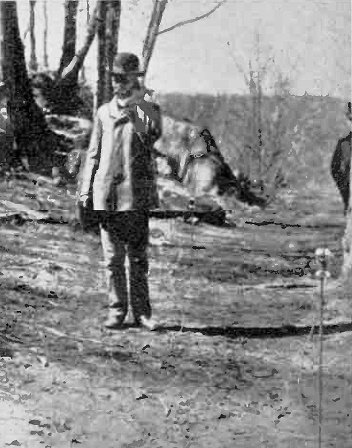
Stubblefield on bank of the Potomac in 1902 receiving wireless telephone message from the central office some three-fourths mile away. Today, several sources credit Stubble112 field as the inventor of radio telephone. The World Almanac says he made the first radio broadcast in 1902. World History at a Glance by Joseph Reither of New York University declares him the inventor of the wireless telephone. Joseph Nathan Kane in his book, Famous First Facts, attributes two firsts to Stubblefield: the first radio broadcast and the first marine demonstration of wireless telephony. The marine demonstration took place March 20, 1902, on the steam launch Bartholdi on the Potomac River near Washington. Stubblefield was able to transmit his voice from the launch to scientists on the bank as the craft chugged up the river. Stubblefield said in an interview published March 21, 1902, in the Washington Post: "My invention ... is capable of sending simultaneous messages from a. central distribution station over a very wide territory. For instance, anyone having a receiving instrument, which would consist merely of a telephone receiver and a few feet of wire, and a signaling gong could, upon being signaled by a transmitting station ... be informed of weather news. My apparatus is capable of sending out a gong signal as well as voice messages. Eventually it will be used for the general transmission of news of every description. "I have as yet devised no method whereby it can be used with privacy. Wherever there is a receiving station the signal and the message may be heard simultaneously. Eventually I, or someone, will discover a method of tuning the transmitting and receiving instruments so that each will answer only its mate. "The system can be developed until messages by voice can be sent and heard all over the country, to Europe, all over the world." What equipment did Stubblefield use? Probably no one will ever know exactly because the inventor never divulged his secrets. The New York Sun in 1930 described the gear of the then dead inventor in this manner: "His transmitting apparatus was placed in a box four feet high and six inches in width. A coil of heavy wire was at one end and led to the ground. He [Stubblefield] made the startling statement that the earth's electrical waves furnished the power by which an ordinary telephone transmitter was operated. About a quarter of a mile away another box was fastened to a stump. There were wires leading to the ground and a pair of telephone receivers on top. "Examination showed that the wires terminated in each case at steel rods topped with a ball of iron which was nickel-plated. "Stubblefield claimed that the earth and all about it is charged with electrical power, part of which he was harnessing and that in time spoken messages could be sent without wires thousands of miles. "He admitted that he had developed radio-frequency current through a battery of his own arrangement, an earth battery, following which he devised a system of modulation and an adjustment for tuning. The detector was a receiving coil, tapped for adjusting inductance." A modern assessment of Stubblefield's equipment doesn't divulge much more. He probably used a standard telephone receiver fitted for wireless reception. His transmitter, of his own design, probably contained, among other things, a ground battery cell system, an amplifier of some sort and some tuning coils. His use of rods driven into the ground suggests he may have stumbled onto underground radio (see Underground Radio Is News Again!, March '61 EI), although the iron balls atop his ground rods could have served as antennas. Stubblefield made the 1902 trip to Washington in an attempt to obtain patents and he did receive one radiotelephone patent, No. 887357, on May 12, 1908. Why didn't Stubblefield become known as the inventor of radio? No one can give an answer. Stubblefield was on the edge of fame after his demonstrations in 1902, but then he faded. His refusal to allow anyone to buy into his invention, giving him working capital, probably was a reason. Some believe his invention was stolen while visiting Washington in 1912, since Stubblefield took it with him in a trunk when he left and no one saw him return with it. Whatever happened, Stubblefield returned home a disappointed and embittered man. Soon after, his house mysteriously burned and his family left him. He then moved into a crude, drafty hut lined with corn husks. Forgotten by the world, Stubblefield worked on in the hut until March 28, 1928, when he died of starvation and neglect. Nathan B. Stubblefield's home town continues to back him as the inventor of radio and the local station honors him by having his initials in its call letters, WNBS. There is a monument to him on the Murray State College campus. But his ironic fate probably was spelled out at the time of his death. His passing was not even mentioned in news report on the radio. |
|||||||||||||
 |
|||||||||||||
|
|||||||||||||


|
||||||||||||||||||||||||||||||||||||