|
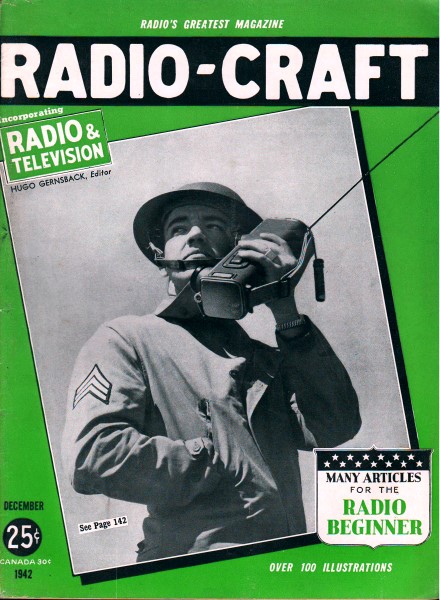
December 1942 Radio-Craft
 [Table
of Contents] [Table
of Contents]
Wax nostalgic about and learn from the history of early electronics.
See articles from Radio-Craft,
published 1929 - 1953. All copyrights are hereby acknowledged.
|
 When my kids were young and
we lived in a wooded area, I bought a set of Motorola Family Radio Service (FRS) radios
for them to carry so that Melanie and I could keep track of them while they were
outside playing. There was a little fishing pond a few hundred feet into the woods
that they liked to visit (and occasionally catch a trout).
The radios were palm-sized and had a range of about a mile (newer models reach much
farther) and operated on a few AAA batteries. That represents When my kids were young and
we lived in a wooded area, I bought a set of Motorola Family Radio Service (FRS) radios
for them to carry so that Melanie and I could keep track of them while they were
outside playing. There was a little fishing pond a few hundred feet into the woods
that they liked to visit (and occasionally catch a trout).
The radios were palm-sized and had a range of about a mile (newer models reach much
farther) and operated on a few AAA batteries. That represents
 a
huge advance in technology compared to the first "portable" hand-held radios that
appeared on the battlefields during World War II - the Handy-Talkie. The development
was such a big deal that the cover of the September issue of
Radio-Craft
had a photo of Winston Churchill communicating on a Handy-Talkie. Handy-Talkies
used vacuum tubes and dry cell batteries and were about the size, ironically, of
the first commercial cellular phone introduced by Motorola
(the DynaTAC) in 1973. "Walkie-Talkies" were a backpack-mounted
radio unit that had a dry cell or lead acid battery for power. Nowadays, of course,
cellphone coverage reaches just about everywhere that an FRS type radio would be
useful, and since most kids carry phones, the need for child location is filled
by default. a
huge advance in technology compared to the first "portable" hand-held radios that
appeared on the battlefields during World War II - the Handy-Talkie. The development
was such a big deal that the cover of the September issue of
Radio-Craft
had a photo of Winston Churchill communicating on a Handy-Talkie. Handy-Talkies
used vacuum tubes and dry cell batteries and were about the size, ironically, of
the first commercial cellular phone introduced by Motorola
(the DynaTAC) in 1973. "Walkie-Talkies" were a backpack-mounted
radio unit that had a dry cell or lead acid battery for power. Nowadays, of course,
cellphone coverage reaches just about everywhere that an FRS type radio would be
useful, and since most kids carry phones, the need for child location is filled
by default.
See also
The Walkie-Talkie - March 1955 Popular Electronics,
A
Self-Contained Handie-Talkie - June 1944 QST, and
The New Handy-Talkie - December 1942 Radio-Craft,
Walkie-Talkies: Something for Everyone - April 1974 Popular
Electronics,
A Self-Contained
Handie-Talkie - June 1944 QST,
Inside the Handie-Talkie
- July 1946 Radio-Craft.
The New Handy-Talkie
 1 - Staff Sergeant Thomas W. Gloystein is
shown in the field with the new portable, hand voice set. He was formerly a fireman
in Cincinnati, Ohio, and is now an instructor of Radio Communication at Fort Benning,
Georgia. 1 - Staff Sergeant Thomas W. Gloystein is
shown in the field with the new portable, hand voice set. He was formerly a fireman
in Cincinnati, Ohio, and is now an instructor of Radio Communication at Fort Benning,
Georgia.
2 - An American soldier with the latest field transceiver used by forward observation
patrols.
3 - Another view of an American soldier in the field with the new type transceiver
used by forward observation patrols.
4 - The newest product of the Army Signal Corps - a hand-set radio receiver and
transmitter combined into a small, compact portable unit, is shown in action. The
antenna telescopes into the back of the set when it is "off the air." The soldier
switches from receiving to the sending position by pushing a "push-to-talk" button
under his fingertips. This set has been informally named the "handy-talkie."
5 - Visiting generals witness paratroops mass jump exercises at Lawson Field
during their stay at Fort Benning*, Georgia.
* Note that due to fraudulent media propaganda which accused a White police
officer of murdering repeat criminal and drug addict
George Floyd,
Ft. Benning,
named after a Confederate General, has been renamed to Ft. Moore. New data from
the medical examiner's report suggests Floyd died from an
overdose
of fentanyl.
Posted January 5, 2024
(updated from original
post on 1/5/2015)
|