|
|
|||||||||
| Software: RF Cascade Workbook | RF Symbols for Office | RF Symbols & Stencils for Visio | Espresso Workbook | ||||||||||
|
|||||||||||||||||||||||||||||||
   |
   |
||||||||||||||||||||||||||||||
|
Please Support RF Cafe by purchasing my ridiculously low-priced products, all of which I created. RF & Electronics Symbols for Visio RF & Electronics Symbols for Office RF & Electronics Stencils for Visio T-Shirts, Mugs, Cups, Ball Caps, Mouse Pads These Are Available for Free |
|||||||||||||||||||||||||||||||



Module 8 - Introduction to Amplifiers
Navy Electricity and Electronics Training
Series (NEETS)
Chapter 1: Pages 1-31 through 1-40

Module 8 - Introduction to Amplifiers
Pages i, 1-1, 1-11, 1-21, 1-31, 2-1, 2-11, 2-21, 2-31, 3-1, 3-11, 3-21, 3-31, 3-41, 3-51, 3-61, AI-1, Index
| NEETS Modules | |
| - | Matter, Energy, and Direct Current |
| - | Alternating Current and Transformers |
| - | Circuit Protection, Control, and Measurement |
| - | Electrical Conductors, Wiring Techniques, and Schematic Reading |
| - | Generators and Motors |
| - | Electronic Emission, Tubes, and Power Supplies |
| - | Solid-State Devices and Power Supplies |
| - | Amplifiers |
| - | Wave-Generation and Wave-Shaping Circuits |
| - | Wave Propagation, Transmission Lines, and Antennas |
| - | Microwave Principles |
| - | Modulation Principles |
| - | Introduction to Number Systems and Logic Circuits |
| - | - Introduction to Microelectronics |
| - | Principles of Synchros, Servos, and Gyros |
| - | Introduction to Test Equipment |
| - | Radio-Frequency Communications Principles |
| - | Radar Principles |
| - | The Technician's Handbook, Master Glossary |
| - | Test Methods and Practices |
| - | Introduction to Digital Computers |
| - | Magnetic Recording |
| - | Introduction to Fiber Optics |
| Note: Navy Electricity and Electronics Training Series (NEETS) content is U.S. Navy property in the public domain. | |
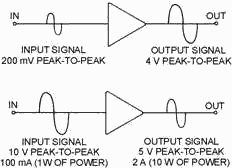
The Class of Operation of a transistor amplifier is determined by the percent of time that current flows through the transistor in relation to the input signal.
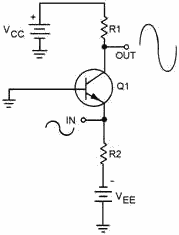
In Class a Operation, transistor current flows for 100% (360º) of the input signal. Class a operation is the least efficient class of operation, but provides the best fidelity.
In Class AB Operation, transistor current flows for more than 50% but less than 100% of the input signal.
1-31
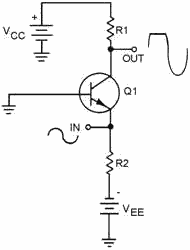
In Class B Operation, transistor current flows for 50% of the input signal.
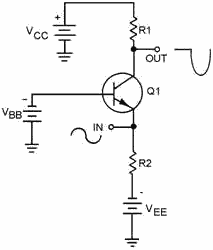
In Class C Operation, transistor current flows for less than 50% of the input signal. Class C operation is the most efficient class of operation.
1-32
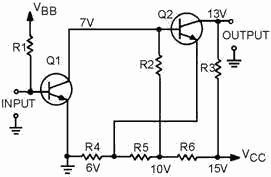
Coupling is used to transfer a signal from one stage to another.
Direct Coupling is the connection of the output of one stage directly to the input of the next stage. This method is not used very often due to the complex power supply requirements and impedance- matching problems.
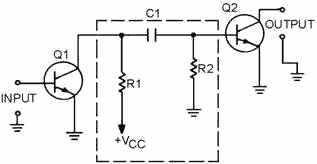
RC Coupling is the most common method of coupling and uses a coupling capacitor and signal-developing resistors.
1-33
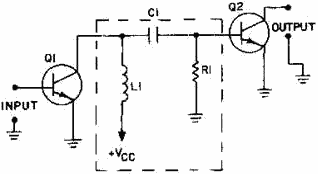
Impedance Coupling uses a coil as a load for the first stage but otherwise functions just as RC coupling. Impedance coupling is used at high frequencies.
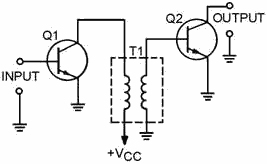
Transformer Coupling uses a transformer to couple the signal from one stage to the next. Transformer coupling is very efficient and the transformer can aid in impedance matching.
1-34
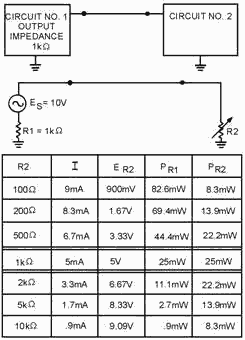
Maximum Power Transfer occurs between two circuits when the output impedance of the first circuit matches the input impedance of the second circuit.
A Maximum Voltage Input Signal is present when the input impedance of the second circuit is larger than the output impedance of the first circuit (mismatched).
1-35
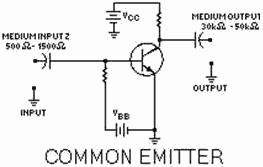
The Common-Emitter configuration of a transistor amplifier has MEDIUM Input and MEDIUM Output Impedance.
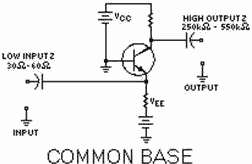
The Common-Base configuration of a transistor amplifier has Low Input and High Output Impedance.
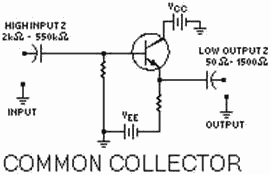
The Common-Collector (Emitter Follower) configuration of a transistor amplifier as High Input and Low Output Impedance.
1-36
Feedback is the process of coupling a portion of the output signal back to the input of an amplifier.
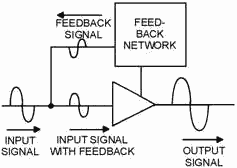
Positive (Regenerative) Feedback is provided when the feedback signal is in phase with the input signal. Positive feedback increases the gain of an amplifier.
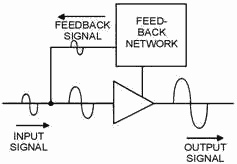
Negative (Degenerative) Feedback is provided when the feedback signal is 180º out of phase with the input signal. Negative feedback decreases the gain of an amplifier but improves fidelity and may increase the frequency response of the amplifier.
1-37
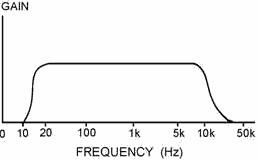
The IDEAL Frequency Response of an audio amplifier is equal gain from 15 Hz to 20 kHz with very low gain outside of those limits.
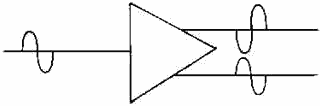
A Phase Splitter provides two output signals that are equal in amplitude but different in phase from a single input signal. Phase splitters are often used to provide input signals to a push-pull amplifier.
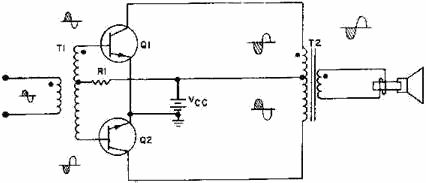
A Push-Pull Amplifier uses two transistors whose output signals are added together to provide a larger gain (usually a power gain) than a single transistor could provide. Push-pull amplifiers can be operated class A, class AB or class B.
1-38
Answers to Questions Q1. Through Q33.
A-1. Amplification is the control of an output signal by an input signal so that the output signal has some (or all) of the characteristics of the input signal. The output signal is generally larger than the input signal in terms of voltage, current, or power.
A-2. No, the input signal is unchanged, the output signal is controlled by the input signal but does not effect the actual input signal.
A-3. To amplify the input signal to a usable level.
A-4. By function and frequency response.
A-5. An audio power amplifier.
A-6. An RF voltage amplifier.
A-7. The amount of time (in relation to the input signal) in which current flows in the output circuit.
A-8. A, AB, B, C.
A-9. Class B operation.
A-10. The amplifier operates (and therefore uses power) for less time in class C than in class
A. A-11. Class a operation.
A-12. To transfer energy (a signal) from one stage to another.
A-13. Direct, RC, impedance, and transformer coupling.
A-14. RC coupling.
A-15. Transformer coupling.
A-16. RC coupling.
1-39
A-17. Impedance coupling.
A-18. Equal impedance.
A-19. Lower than.
A-20. Common emitter-medium input, medium output; common base-low input, high output; common collector-high input, low output.
A-21. Common collector.
A-22. Transformer coupling.
A-23. The process of coupling a portion of the output of a circuit back to the circuit input.
A-24. Positive and negative or regenerative and degenerative.
A-25. Positive (regenerative) feedback.
A-26. Negative (degenerative) feedback.
A-27. Negative (degenerative) feedback.
A-28. Negative (degenerative) feedback.
A-29. a device that provides two output signals that differ in phase from a single input signal.
A-30. a phase splitter is used to provide the input signals to a push-pull amplifier.
A-31. a push-pull amplifier is used when high power output and good fidelity are needed.
A-32. a push-pull amplifier provides more gain than a single transistor amplifier.
A-33. Class A, Class AB or Class B operation.
1-40

Copyright: 1996 - 2026 |
About RF Cafe RF Cafe began life in 1996 as "RF Tools" in an AOL screen name web space totaling 2 MB. Its primary purpose was to provide me with ready access to commonly needed formulas and reference material while performing my work as an RF system and circuit design engineer. The World Wide Web (Internet) was largely an unknown entity at the time and bandwidth was a scarce commodity. Dial-up modems blazed along at 14.4 kbps while tying up your telephone line, and a lady's voice announced "You've Got Mail" when a new message arrived... |
Copyright 1996 - 2026 All trademarks, copyrights, patents, and other rights of ownership to images
and text used on the RF Cafe website are hereby acknowledge My Hobby Website: My Daughter's Website: |