|
|||||||||||||
 |
|||||||||||||
Anatech Electronics July 2025 Newsletter |
|||||||||||||

Press Release Archives: Content is copyright of company represented. Page format, custom text and images are RF Cafe copyright - do not distribute. Note: Posting of press releases costs $100 each for non-advertisers.
Sam Benzacar, of Anatech Electronics, an RF and microwave filter company, has published his July 2025 Newsletter that, along with timely news items, features his short op-ed titled "3GPP Release 20 Gets Us Closer to 6G." In it, he states, "One of the most significant areas of emphasis in Release 20 is integrating artificial intelligence (AI) and machine learning into the radio access network (RAN) and the core network." I have seen numerous news items in the last few months reporting on the melding of AI and network communications. This type of AI "intelligently" controls the global and local systems by optimizing traffic flow via real-time tower and control center analysis. A major feature is device-to-device (D2D) communications that can bypass the network - although you can bet the networks will be listening even if uninvited (and maybe have the unadvertised ability to override the D2D activity - my conspiracy input). Do an AI search on the title of this newsletter and you will find lots of information on 3GPP, along with a wide range of opinions regarding its features and goals. A Word from Sam Benzacar - 3GPP Release 20 Gets Us Closer to 6G
The upcoming Release 20 from the 3rd Generation Partnership Project (3GPP) won't get us to 6G, but it promises some pretty impressive new capabilities. Release 20 is essentially a bridge between 5G-Advanced and the future development of 6G. While it does not formally define 6G, it focuses on research and technology that will eventually make it into the 6G standard. One of the most significant areas of emphasis in Release 20 is integrating artificial intelligence and machine learning into the radio access network (RAN) and the core network. This includes developing support for in-network model training, real-time inference, and AI-based optimization of network resources. By embedding intelligence directly into network operations, operators can improve performance, automate management tasks, and reduce operational complexity. Another key development area is the continued enhancement of sidelink and device-to-device communications. Building on the progress made in previous releases, Release 20 will improve support for direct communications between devices in applications such as public safety, drone operations, and advanced automotive use cases, particularly for vehicle-to-everything (V2X) systems.
Release 20 is expected to refine support for time-sensitive networking and ultra-reliable low-latency communications for industrial and enterprise users. These capabilities are critical for smart manufacturing, automation, and mission-critical systems that demand precise timing, high availability, and deterministic behavior. In addition, as networks are becoming more complex and software-defined, new features are anticipated to bolster authentication, protect data integrity, and support secure edge computing. AI-driven security solutions may also emerge to detect and respond to evolving threats in real time. Although Release 20 is not a full standards release, it is a study-oriented release intended to shape the agenda for Release 21 and the formal introduction of 6G. The work is expected to continue through 2025, focusing on exploratory research and long-term capability development. MIT Integrates GaN Transistors into Silicon CMOS
Wolfspeed File for Chapter 11 Bankruptcy
Study Shows Significant Growth in RF Power Market
UK Shows Impressive New Directed Energy Weapon
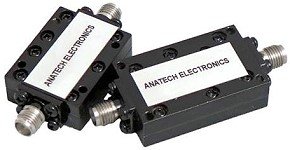
Anatech Electronics Introduces a New Line of Suspended Stripline and Waveguide Type RF Filters
Check out Our Filter Products
Cavity Band Pass Filters LC Band Pass Filters Cavity Bandstop/Notch Filter About Anatech Electronics Anatech Electronics, Inc. (AEI) specializes in the design and manufacture of standard and custom RF and microwave filters and other passive components and subsystems employed in commercial, industrial, and aerospace and applications. Products are available from an operating frequency range of 10 kHz to 30 GHz and include cavity, ceramic, crystal, LC, and surface acoustic wave (SAW), as well as power combiners/dividers, duplexers and diplexers, directional couplers, terminations, attenuators, circulators, EMI filters, and lightning arrestors. The company's custom products and capabilities are available at www.anatechelectronics.com. Contact: Anatech Electronics, Inc. |
|||||||||||||
 |
|||||||||||||
|
|||||||||||||

 By Sam Benzacar
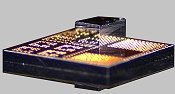 A team of researchers at
MIT, working with collaborators, has created a technique for integrating performance
gallium nitride transistors onto conventional silicon CMOS chips. Their method centers
on producing miniature GaN transistors, known as dielets, which are precisely cut
and attached to silicon wafers using a low-temperature copper-to-copper bonding
process. This technique eliminates the need for costly materials like gold and avoids
reliance on specialized fabrication tools or environments. Combining GaN's speed
and power-handling capabilities with the versatility of silicon's digital processing,
the resulting hybrid chips deliver greater energy efficiency and reduced heat output.
To prove the concept, the team built a power amplifier that outperformed traditional
silicon-based signal strength and efficiency designs.
A team of researchers at
MIT, working with collaborators, has created a technique for integrating performance
gallium nitride transistors onto conventional silicon CMOS chips. Their method centers
on producing miniature GaN transistors, known as dielets, which are precisely cut
and attached to silicon wafers using a low-temperature copper-to-copper bonding
process. This technique eliminates the need for costly materials like gold and avoids
reliance on specialized fabrication tools or environments. Combining GaN's speed
and power-handling capabilities with the versatility of silicon's digital processing,
the resulting hybrid chips deliver greater energy efficiency and reduced heat output.
To prove the concept, the team built a power amplifier that outperformed traditional
silicon-based signal strength and efficiency designs.  Wolfspeed, a major supplier
of wide bandgap semiconductor chips for RF and microwave applications, will reportedly
file for Chapter 11 bankruptcy as part of a restructuring deal with creditors. The
plan will cut its $6.5 billion debt by about 70%, or $4.6 billion, and reduce annual
interest costs by 60%. Wolfspeed will receive $275 million in new funding to support
operations during the process and use $1.3 billion in existing cash to pay vendors
and serve customers. The company will remain operational and expects to exit bankruptcy
by the end of Q3 2025. Wolfspeed was effectively founded in the late 1980s as part
of Cree Research. It acquired Infineon's RF power business in 2018 and then sold
off its lighting divisions to focus on the booming market for RF components. It
was officially named Wolfspeed in 2015.
Wolfspeed, a major supplier
of wide bandgap semiconductor chips for RF and microwave applications, will reportedly
file for Chapter 11 bankruptcy as part of a restructuring deal with creditors. The
plan will cut its $6.5 billion debt by about 70%, or $4.6 billion, and reduce annual
interest costs by 60%. Wolfspeed will receive $275 million in new funding to support
operations during the process and use $1.3 billion in existing cash to pay vendors
and serve customers. The company will remain operational and expects to exit bankruptcy
by the end of Q3 2025. Wolfspeed was effectively founded in the late 1980s as part
of Cree Research. It acquired Infineon's RF power business in 2018 and then sold
off its lighting divisions to focus on the booming market for RF components. It
was officially named Wolfspeed in 2015.  According to a recent analysis
by ResearchAndMarkets.com, the global RF power market is expected to expand from
$3.9 billion today to an estimated $6.6 billion by 2032. The growth projection is
based on a booming market for both commercial and military applications. Additional
momentum comes from expanding semiconductor manufacturing capabilities and the growing
use of RF energy in highly targeted medical procedures.
According to a recent analysis
by ResearchAndMarkets.com, the global RF power market is expected to expand from
$3.9 billion today to an estimated $6.6 billion by 2032. The growth projection is
based on a booming market for both commercial and military applications. Additional
momentum comes from expanding semiconductor manufacturing capabilities and the growing
use of RF energy in highly targeted medical procedures.  The British Army has successfully
tested an RF-based directed energy weapon (DEW) to counter drone swarms. Conducted
at a military test range in West Wales, the demonstration attacked two drone swarms
and brought down 100 of them. The initiative was spearheaded by Team Hersa - a collaboration
between Defense Equipment & Support and the Defense Science and Technology Laboratory
- while Thales UK developed the system under a $50 million government investment.
The British Army has successfully
tested an RF-based directed energy weapon (DEW) to counter drone swarms. Conducted
at a military test range in West Wales, the demonstration attacked two drone swarms
and brought down 100 of them. The initiative was spearheaded by Team Hersa - a collaboration
between Defense Equipment & Support and the Defense Science and Technology Laboratory
- while Thales UK developed the system under a $50 million government investment. 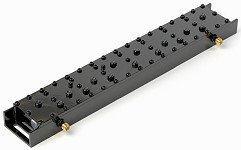



|
||||||||||||||||||||||||||||||||||||