|
|||||||||||||
 |
|||||||||||||
Radio Frequencies and Their Allocation
|
|||||||||||||
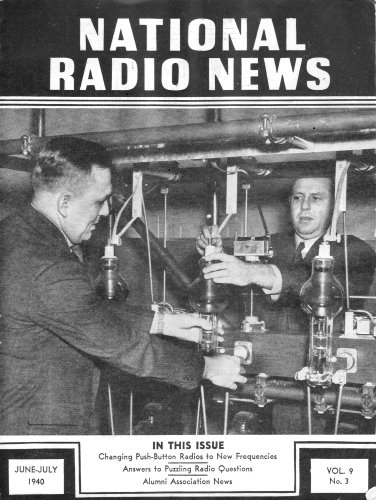
BTW, the picture below has nothing to do with the article. It appeared on the table of contents page and I thought it would make a good addition since the article itself had no image. See also National Radio Institute advertisement, December 1954 Radio News; Mathematics in Radio in July 1932 Radio News; Measuring Inductance and Capacity, June 1931 Radio-Craft; Mathematics in Radio, March 1933 Radio News; Radio Frequencies and Their Allocation, June | July 1940 National Radio News; Your Radio Training and the Defense Program, December 1940 | January 1941 National Radio News. Radio Frequencies and Their Allocation
The radio spectrum, or radio waves form one portion of the total electromagnetic spectrum. The electromagnetic spectrum covers eight different classes of radiation-electric waves, radio waves, infra-red, visible light, ultra-violet, X-rays, gamma rays, and secondary cosmic rays. The emission of this energy may be likened to the expanding ripples of water suddenly disturbed by a thrown stone. However, electromagnetic energy travels in all directions. Since electromagnetic radiations have a common speed (that of light), their only difference is in frequency and wave length. "Frequency" may be characterized as the number of these waves per second, and "wave length" as the distance between successive waves. The divisions between the various classes of electromagnetic radiations are not definite. The lines of separation are based largely upon the effects and the particular method of producing the various emissions. Under certain conditions, some of these electromagnetic impulses may be seen, felt, or heard. Of the eight classes of electromagnetic radiations, that portion classed as "radio waves" covers a relatively small part of the total electromagnetic spectrum. Radio facilities are extremely limited. In order to provide the maximum possible service for the benefit of the public, it is necessary to control and restrict the use of the available channels. As transmission by radio waves spans great distances, it has been found necessary to have international agreement on the proportion of available channels to be allocated for particular services. To prevent interference within our own country, it is necessary to further apportion the frequencies in the best interests of users. Besides the standard broadcast channels. our radio spectrum is shared by other primary services, such as: fixed, marine, aviation, emergency, amateur, miscellaneous, experimental, Government, and broadcast services other than standard broadcast. These general service allocations cover various classes of station, including: relay, international broadcast, high frequency broadcast, noncommercial education, facsimile, television, point-to-point telephone and telegraph, agriculture, press, coastal, telegraph and telephone, ship, aircraft, aeronautical, blind landing systems, airport, municipal and State police, marine fire, forestry, geological, mobile press, motion picture, amateur phone, telegraph and television, as well as experimental classes of stations. The present useful radio spectrum, in which channels are now allocated, ranges from 10 to 300,000 kilocycles, or in terms of wave lengths from 30,000 meters to 1 meter. That portion below 100 kilocycles is popularly referred to as "long waves"; from 100 kilocycles to 550 kilocycles as "medium long waves'"; from 550 to 1600 kilocycles as "broadcast" ; 1600 to 6000 kilocycles as "medium short waves"; 6,000 to 30,000 kilocycles as "short waves"; and above 30,000 kilocycles as "very short" or "ultra-short waves." The band below 100 kilocycles is occupied by Government and commercial long wave fixed service stations. From 100 kilocycles to the beginning of the broadcast band at 550 kilocycles we have the medium long wave stations, as follows: 100 to 200 kilocycles - Government and private ship, coastal, and fixed service stations. 200 to 400 kilocycles - primarily Government aids to navigation, such as radio navigation for aircraft, and radio beacon service to ships, interspersed with airport on 278 kilocycles, direction finding on 375 kilocycles, and miscellaneous fixed stations. 400 to 550 kilocycles - Government and commercial ship and coast stations in the maritime service centered near the international calling and distress frequency of 500 kilocycles (600 meters). The rest of the spectrum from the end of the "broadcast" band at 1600 kilocycles, involving the so-called "medium short," "short," and "ultra-short" wave bands, could be pictured as a many layered sandwich, with police, amateur, aviation. Government, ship, coastal, broadcast, mobile press, special services, experimental television fixed, forestry, and all other classes of stations providing varying depths of filling. Of course, this does not mean that all these bands are completely filled. Radio communications is still undergoing change, and the Federal Communications Commission, in licensing individuals and firms to use the public's radioways, is charged with preparing for the future, as well as for the present. Hence, some channels are held open for future developments, while others already allocated, are subject to shift with changing events.
Posted April 10, 2023 |
|||||||||||||
 |
|||||||||||||
|
|||||||||||||

 This article was released to National Radio
News by the Federal Communications Commission, Washington, D. C.
This article was released to National Radio
News by the Federal Communications Commission, Washington, D. C. 
|
||||||||||||||||||||||||||||||||||||