See Page 1 |
2 |
3 |
4 |
5 of the December 2020 homepage
archives.
 Right on time for the anniversary of
Pierre and Marie Curie's 1989 discovery of the radioactive element
radium is this article which appeared in a 1944 issue of Radio-Craft magazine. Editor
Hugo Gernsback comments on the recently released (1943) film titled "Madame Curie*,"
starring Greer Garson as Marie Curie and Walter Pidgeon as Pierre, criticizing it
for not delving more deeply into the technical aspects of radium. Chief among the
objections was the omission of information about how radiation treatment had been
shown to cure some forms of cancer. Indeed, he cited his own experience with a "growth"
on his hand that was successfully treated at a "radium hospital" where the doctor
applied a bulb of radium to the tissue for a mere five minutes. It disappeared in
less than two weeks. Beyond that would be radium's usefulness in generating electricity,
creating wonderful visual effects created by its elemental decay using a spinthariscope... Right on time for the anniversary of
Pierre and Marie Curie's 1989 discovery of the radioactive element
radium is this article which appeared in a 1944 issue of Radio-Craft magazine. Editor
Hugo Gernsback comments on the recently released (1943) film titled "Madame Curie*,"
starring Greer Garson as Marie Curie and Walter Pidgeon as Pierre, criticizing it
for not delving more deeply into the technical aspects of radium. Chief among the
objections was the omission of information about how radiation treatment had been
shown to cure some forms of cancer. Indeed, he cited his own experience with a "growth"
on his hand that was successfully treated at a "radium hospital" where the doctor
applied a bulb of radium to the tissue for a mere five minutes. It disappeared in
less than two weeks. Beyond that would be radium's usefulness in generating electricity,
creating wonderful visual effects created by its elemental decay using a spinthariscope...
 "From the early days of analog radio receivers
to the
superheterodyne channelized receivers of today, many things have
changed. Today, different technologies are in use and their capabilities have grown
immensely. This article will give you a brief overview of the development of radio
receivers. Furthermore, it will show how channelization has made it possible to
use one radio receiver to listen to many different radio stations simultaneously.
In modern telecommunications, a point-to-point communication medium can be shared
among multiple transmitters in various ways; for example, many different telephone
calls can be transferred simultaneously via the same wire. In this case, each telephone
conversation can be considered as a separate channel on this medium. Another example
is traditional TV or radio stations that are transmitted..." "From the early days of analog radio receivers
to the
superheterodyne channelized receivers of today, many things have
changed. Today, different technologies are in use and their capabilities have grown
immensely. This article will give you a brief overview of the development of radio
receivers. Furthermore, it will show how channelization has made it possible to
use one radio receiver to listen to many different radio stations simultaneously.
In modern telecommunications, a point-to-point communication medium can be shared
among multiple transmitters in various ways; for example, many different telephone
calls can be transferred simultaneously via the same wire. In this case, each telephone
conversation can be considered as a separate channel on this medium. Another example
is traditional TV or radio stations that are transmitted..."
Lotus Communication Systems began in 2009, setting up CNC machine shop and RF/microwave
assembling and testing lab in Middlesex Country, Massachusetts. Lotus is committed
to highest quality and innovative products. Each
RF/microwave module meets
exceedingly high standards of quality, performance and excellent value, and are
100% MADE IN USA. Lotus' RF/microwave products cover frequency band up to 67 GHz.
Lotus also offers an COTS shield enclosures for RF/microwave prototyping and production.
All products are custom designed. We will find a solution and save your time and
cost. Lotus has multiple 4 axis CNC machines and LPKF circuit plotters.
 Since 2008, IEEE's International Symposium
on the Physical and Failure Analysis of Integrated Circuits (IFPA) has on occasion
held an "Art of Failure Analysis" photo contest. Familiar shapes and patterns
occur regularly in nature at the macro level that can be seen and recognized by
almost anyone; e.g., the Nautilus spiral, the Fibonacci series in plant life, and
fractal structures. It takes a high power optical microscope or even a scanning
electron microscope (SEM) to see those sights in the realm of the very small. Sometimes,
though, the images are downright bazaar and look eerily familiar... Since 2008, IEEE's International Symposium
on the Physical and Failure Analysis of Integrated Circuits (IFPA) has on occasion
held an "Art of Failure Analysis" photo contest. Familiar shapes and patterns
occur regularly in nature at the macro level that can be seen and recognized by
almost anyone; e.g., the Nautilus spiral, the Fibonacci series in plant life, and
fractal structures. It takes a high power optical microscope or even a scanning
electron microscope (SEM) to see those sights in the realm of the very small. Sometimes,
though, the images are downright bazaar and look eerily familiar...
 We don't hear much - if any - talk these
days about a certain weapon type being a "peace maker," "game changer," or a "stale
mate proposition." That is because most nations, or for that matter terrorist groups,
have access to some ferocious weapons. The world has operated for a long time on
the Mutually Assured Destruction (MAD) principle, where skirmishes have been fairly
local. Many conspiratorialists as well as arguably rational people believe the real
game at hand is Mutually Assured Financial Destruction (no clever acronym for that
one), where world financial powers cooperatively trade off monetary wins and losses
via what was termed by President Eisenhower the
Military-Industrial Complex. You don't need to be one who wears
a tinfoil hat or keeps your savings buried in a jar in the back yard to suspect
at least some form of malfeasance is going on at the expense of we the little people... We don't hear much - if any - talk these
days about a certain weapon type being a "peace maker," "game changer," or a "stale
mate proposition." That is because most nations, or for that matter terrorist groups,
have access to some ferocious weapons. The world has operated for a long time on
the Mutually Assured Destruction (MAD) principle, where skirmishes have been fairly
local. Many conspiratorialists as well as arguably rational people believe the real
game at hand is Mutually Assured Financial Destruction (no clever acronym for that
one), where world financial powers cooperatively trade off monetary wins and losses
via what was termed by President Eisenhower the
Military-Industrial Complex. You don't need to be one who wears
a tinfoil hat or keeps your savings buried in a jar in the back yard to suspect
at least some form of malfeasance is going on at the expense of we the little people...
Berkeley
Nucleonics Corporation (BNC) is a leading manufacturer of precision electronic
instrumentation for test, measurement, and nuclear research. Founded in 1963, BNC
initially developed custom pulse generators. We became known for meeting the most
stringent requirements for high precision and stability, and for producing instruments
of unsurpassed reliability and performance. We continue to maintain a leadership
position as a developer of custom pulse, signal, light, and function generators.
Our designs incorporate the latest innovations in software and hardware engineering,
surface mount production, and automated testing procedures.
 Just in time for Christmas - a
yuletide crossword puzzle for you to work in the last moments
of work while waiting for the boss to give the order to leave early for the lone
holiday weekend. For the sake of avid cruciverbalists amongst us, each week I create
a new crossword puzzle that has a theme related to engineering, mathematics, chemistry,
physics, and other technical words. The clues with asterisks (*) are particular
to this December 20th Christmas-themed crossword puzzle. As always, it contains
no names of politicians, mountain ranges, exotic foods or plants, movie stars, or
anything of the sort unless it/he/she is related to this puzzle's technology theme... Just in time for Christmas - a
yuletide crossword puzzle for you to work in the last moments
of work while waiting for the boss to give the order to leave early for the lone
holiday weekend. For the sake of avid cruciverbalists amongst us, each week I create
a new crossword puzzle that has a theme related to engineering, mathematics, chemistry,
physics, and other technical words. The clues with asterisks (*) are particular
to this December 20th Christmas-themed crossword puzzle. As always, it contains
no names of politicians, mountain ranges, exotic foods or plants, movie stars, or
anything of the sort unless it/he/she is related to this puzzle's technology theme...
 Anyone out there old enough to remember when
you were a kid and managed to be able to stay up late enough, maybe on a Saturday
night, to be able to watch the television station sign off the air at night? Here
in the U.S., the custom was to announce the end of the programming day, play the
National Anthem, and then put up the station logo while broadcasting a single tone.
The
tone and test patterns were actually used by TV technicians for
calibrating instruments for use in servicing sets. In 1951 when this TV Station List
appeared in Radio-Electronics magazine, black and white (B&W) was still
the standard, so these images are what you would have seen then. I'm not quite that
old (born in 1958), but I do recognize the stations we could receive at my parent's
home in Mayo, Maryland. Being located between Washington, D.C., and Baltimore, a
pretty good selection of both VHF and UHF... Anyone out there old enough to remember when
you were a kid and managed to be able to stay up late enough, maybe on a Saturday
night, to be able to watch the television station sign off the air at night? Here
in the U.S., the custom was to announce the end of the programming day, play the
National Anthem, and then put up the station logo while broadcasting a single tone.
The
tone and test patterns were actually used by TV technicians for
calibrating instruments for use in servicing sets. In 1951 when this TV Station List
appeared in Radio-Electronics magazine, black and white (B&W) was still
the standard, so these images are what you would have seen then. I'm not quite that
old (born in 1958), but I do recognize the stations we could receive at my parent's
home in Mayo, Maryland. Being located between Washington, D.C., and Baltimore, a
pretty good selection of both VHF and UHF...
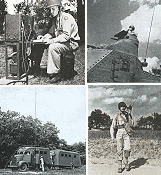 December 1942 was just a year into America's
"official" involvement in World War II. Already, both wired and wireless communications
had made major advances and were indisputably vital in both the logistical and strategic
aspects of troop movement, supply chains, fighting battles, and evacuation of wounded
personnel. It also played a large part in propaganda campaigns. This was all true
for both Axis and Allied forces.
Ham radio operators provided a huge boost to the Signal Corps
because they came at least partially trained for the jobs. These dozen and a half
photos from the field exhibit the state of the art at the time. Maybe you'll recognize
a father, grandfather, or uncle in one of them. For that matter, you might even
recognize a mother, grandmother, or aunt... December 1942 was just a year into America's
"official" involvement in World War II. Already, both wired and wireless communications
had made major advances and were indisputably vital in both the logistical and strategic
aspects of troop movement, supply chains, fighting battles, and evacuation of wounded
personnel. It also played a large part in propaganda campaigns. This was all true
for both Axis and Allied forces.
Ham radio operators provided a huge boost to the Signal Corps
because they came at least partially trained for the jobs. These dozen and a half
photos from the field exhibit the state of the art at the time. Maybe you'll recognize
a father, grandfather, or uncle in one of them. For that matter, you might even
recognize a mother, grandmother, or aunt...
 "Future wireless networks of the 6th generation
(6G) will consist of a multitude of small radio cells that need to be connected
by broadband communication links. In this context, wireless transmission at THz
frequencies represents a particularly attractive and flexible solution. Researchers
at Karlsruhe Institute of Technology (KIT) have now developed a novel concept for
low-cost terahertz receivers that consist of a single diode in
combination with a dedicated signal processing technique. In a proof-of-concept
experiment, the team demonstrated transmission at a data rate of 115 Gbit/s and
a carrier frequency of 0.3 THz over a distance of 110 meters. The results are reported
in Nature Photonics. 5G will be followed by 6G: The sixth generation of mobile communications
promises even higher data rates..." "Future wireless networks of the 6th generation
(6G) will consist of a multitude of small radio cells that need to be connected
by broadband communication links. In this context, wireless transmission at THz
frequencies represents a particularly attractive and flexible solution. Researchers
at Karlsruhe Institute of Technology (KIT) have now developed a novel concept for
low-cost terahertz receivers that consist of a single diode in
combination with a dedicated signal processing technique. In a proof-of-concept
experiment, the team demonstrated transmission at a data rate of 115 Gbit/s and
a carrier frequency of 0.3 THz over a distance of 110 meters. The results are reported
in Nature Photonics. 5G will be followed by 6G: The sixth generation of mobile communications
promises even higher data rates..."
Berkeley
Nucleonics Corporation (BNC) is a leading manufacturer of precision electronic
instrumentation for test, measurement, and nuclear research. Founded in 1963, BNC
initially developed custom pulse generators. We became known for meeting the most
stringent requirements for high precision and stability, and for producing instruments
of unsurpassed reliability and performance. We continue to maintain a leadership
position as a developer of custom pulse, signal, light, and function generators.
Our designs incorporate the latest innovations in software and hardware engineering,
surface mount production, and automated testing procedures.
"Conduct-RF-Phase-Temperature-Stable-Cables-12-8-2019.htm" target="_top">
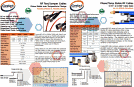 ConductRF, a manufacturer of precision RF coaxial
cable assemblies and connectors, announces the availability of "Conduct-RF-Phase-Temperature-Stable-Cables-12-8-2019.htm"
target="_top"> Phase Stable / Temperature Stable solutions for both commercial and
laboratory precision RF applications. 50 ppm phase accuracy with temperature
phase matching capabilities, low loss and high power options, broad connector choices.
Manufacturing capabilities include solutions built at our ITAR registered facility
in Methuen, Massachusetts, as well as partner facilities in the U.S. and around
the world. ConductRF offers cost effective equivalent and improved RF solutions
to all major interconnect manufacturers, specializing in phase stability over temperature... ConductRF, a manufacturer of precision RF coaxial
cable assemblies and connectors, announces the availability of "Conduct-RF-Phase-Temperature-Stable-Cables-12-8-2019.htm"
target="_top"> Phase Stable / Temperature Stable solutions for both commercial and
laboratory precision RF applications. 50 ppm phase accuracy with temperature
phase matching capabilities, low loss and high power options, broad connector choices.
Manufacturing capabilities include solutions built at our ITAR registered facility
in Methuen, Massachusetts, as well as partner facilities in the U.S. and around
the world. ConductRF offers cost effective equivalent and improved RF solutions
to all major interconnect manufacturers, specializing in phase stability over temperature...
 Signing up for the U.S. Air Force's delayed
enlistment program in May of 1978 gave me six months to come up to speed on basic
electronics principles. Two years had passed since graduating from high school,
and I had been working as an electrician in the interim. I had done three years
of the electrical vocational program in high school so the fundamentals of electricity
- Ohms law, Kirchhoff's law, AC & DC motors, industrial control circuits, commercial
and residential wiring, etc. - were familiar, but electronics theory - transistors,
tubes, diodes - had not been covered much. Knowing I would be attending many months
of USAF electronics technical school, boning up on the topic seemed prudent. Having
previously built a couple Heathkits, I decided to buy their electronics courses,
along with the
Heathkit ET-3100 Design Experimenter. The model shown in this
1982 Heathkit catalog... Signing up for the U.S. Air Force's delayed
enlistment program in May of 1978 gave me six months to come up to speed on basic
electronics principles. Two years had passed since graduating from high school,
and I had been working as an electrician in the interim. I had done three years
of the electrical vocational program in high school so the fundamentals of electricity
- Ohms law, Kirchhoff's law, AC & DC motors, industrial control circuits, commercial
and residential wiring, etc. - were familiar, but electronics theory - transistors,
tubes, diodes - had not been covered much. Knowing I would be attending many months
of USAF electronics technical school, boning up on the topic seemed prudent. Having
previously built a couple Heathkits, I decided to buy their electronics courses,
along with the
Heathkit ET-3100 Design Experimenter. The model shown in this
1982 Heathkit catalog...
 Since 1996, ISOTEC has designed, developed
and manufactured an extensive line of RF/microwave connectors, between-series adapters, RF components
and filters for wireless service providers including non-magnetic connectors for
quantum computing and MRI equipments etc. ISOTEC's product line includes low-PIM
RF connectors components such as power dividers and directional couplers. Off-the-shelf
and customized products up to 40 GHz and our low-PIM products can meet -160 dBc
with 2 tones and 20 W test. Quick prototyping, advanced in-house testing and
high-performance. Designs that are cost effective practical and repeatable. Since 1996, ISOTEC has designed, developed
and manufactured an extensive line of RF/microwave connectors, between-series adapters, RF components
and filters for wireless service providers including non-magnetic connectors for
quantum computing and MRI equipments etc. ISOTEC's product line includes low-PIM
RF connectors components such as power dividers and directional couplers. Off-the-shelf
and customized products up to 40 GHz and our low-PIM products can meet -160 dBc
with 2 tones and 20 W test. Quick prototyping, advanced in-house testing and
high-performance. Designs that are cost effective practical and repeatable.
 Imagine if engineers used
physical mock-ups of semiconductor substrates with BB-sized metal
balls representing electrons and holes to design the next whiz-bang transistor.
You'd think they were insane. Seventy-three years ago, before powerful computers
and software were available to simulate the physics, engineers were doing just that
sort of thing to figure out how to design vacuum tubes. This "Monthly Review" feature
in the December 1947 issue of Radio Craft magazine has a photo of one of
the models. Hills and valleys in the base represented voltage potentials that influenced
the trajectory of the balls. Pretty clever, really. Also reported was the death
of world-famous physicist and originator of the quantum theory, Mr. Max Planck.
He was 89 years old - not bad for the era... Imagine if engineers used
physical mock-ups of semiconductor substrates with BB-sized metal
balls representing electrons and holes to design the next whiz-bang transistor.
You'd think they were insane. Seventy-three years ago, before powerful computers
and software were available to simulate the physics, engineers were doing just that
sort of thing to figure out how to design vacuum tubes. This "Monthly Review" feature
in the December 1947 issue of Radio Craft magazine has a photo of one of
the models. Hills and valleys in the base represented voltage potentials that influenced
the trajectory of the balls. Pretty clever, really. Also reported was the death
of world-famous physicist and originator of the quantum theory, Mr. Max Planck.
He was 89 years old - not bad for the era...
 I when I originally posted NIST Technical
Note 1297, it had the name "Essentials of Expressing Measurement Uncertainty." Since that
time, the NIST website changed its link to the updated version which now goes by
the title of "Guidelines for Evaluating and Expressing the Uncertainty of NIST Measurement
Results." It includes a lot of new data; in fact, it has been nearly totally re-written.
This is a valuable reference for anyone who needs to understand the proper method
for calculating measurement uncertainties. Preface to the 1994 Edition The previous
edition, which was the first, of this National Institute of Standards and Technology
(NIST) Technical Note (TN 1297) was initially published in January 1993... I when I originally posted NIST Technical
Note 1297, it had the name "Essentials of Expressing Measurement Uncertainty." Since that
time, the NIST website changed its link to the updated version which now goes by
the title of "Guidelines for Evaluating and Expressing the Uncertainty of NIST Measurement
Results." It includes a lot of new data; in fact, it has been nearly totally re-written.
This is a valuable reference for anyone who needs to understand the proper method
for calculating measurement uncertainties. Preface to the 1994 Edition The previous
edition, which was the first, of this National Institute of Standards and Technology
(NIST) Technical Note (TN 1297) was initially published in January 1993...
 "University at Buffalo researchers are reporting
a new,
two-dimensional transistor made of graphene and the compound molybdenum
disulfide that could help usher in a new era of computing. As described in a paper
accepted at the 2020 IEEE International Electron Devices Meeting, which is taking
place virtually next week, the transistor requires half the voltage of current semiconductors.
It also has a current density greater than similar transistors under development.
This ability to operate with less voltage and handle more current is key to meet
the demand for new power-hungry nanoelectronic devices, including quantum computers.
'New technologies are needed to extend the performance of electronic systems in
terms of power, speed, and density..." "University at Buffalo researchers are reporting
a new,
two-dimensional transistor made of graphene and the compound molybdenum
disulfide that could help usher in a new era of computing. As described in a paper
accepted at the 2020 IEEE International Electron Devices Meeting, which is taking
place virtually next week, the transistor requires half the voltage of current semiconductors.
It also has a current density greater than similar transistors under development.
This ability to operate with less voltage and handle more current is key to meet
the demand for new power-hungry nanoelectronic devices, including quantum computers.
'New technologies are needed to extend the performance of electronic systems in
terms of power, speed, and density..."
 If you like pictures of très cool-looking
devices involving vacuum-filled (an oxymoron?) glass enclosures, i.e., lamps and
tubes, then you will want to spend a few minutes perusing the personal collection
of Giorgio Basile, of Nivelles, Belgium. Per the homepage of his
Lamps &
Tubes website: "My collection consists of more than 4,000 lamps and vacuum tubes.
This is a wide area! In addition to well known incandescent lamps, radio tubes and
cathode ray tubes, it includes, among others: arc lamps, light sources for the laboratory,
transmitting tubes, camera tubes, flash lamps, microwave tubes, photocells, photomultipliers,
radiation detectors, rectifiers, relays, thyratrons, vacuum gauges, X-ray tubes... If you like pictures of très cool-looking
devices involving vacuum-filled (an oxymoron?) glass enclosures, i.e., lamps and
tubes, then you will want to spend a few minutes perusing the personal collection
of Giorgio Basile, of Nivelles, Belgium. Per the homepage of his
Lamps &
Tubes website: "My collection consists of more than 4,000 lamps and vacuum tubes.
This is a wide area! In addition to well known incandescent lamps, radio tubes and
cathode ray tubes, it includes, among others: arc lamps, light sources for the laboratory,
transmitting tubes, camera tubes, flash lamps, microwave tubes, photocells, photomultipliers,
radiation detectors, rectifiers, relays, thyratrons, vacuum gauges, X-ray tubes...
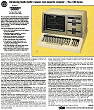 If you had $4,000 to spend on a
desktop computer today, your money would get you a top-end 8-core
microprocessor with at least 32 GBytes of super-fast RAM, a couple TBytes of solid
state hard drive space, and at least a 32" high definition screen monitor. It would
be a top-of-the-line machine any serious gamer would envy. In 1982, the same cash
would also get you a top-of-the-line computer, but it would have a 1-core processor,
a whopping 768 KBytes of sub-MHz RAM, a 10 MByte hard disk drive, and a 12"
monochrome display. That describes the IBM PC, Tandy's TRS-80, as well as the Zenith
Z-100 PC shown here from the Heathkit 1982 Christmas catalog. If you were around
back then... If you had $4,000 to spend on a
desktop computer today, your money would get you a top-end 8-core
microprocessor with at least 32 GBytes of super-fast RAM, a couple TBytes of solid
state hard drive space, and at least a 32" high definition screen monitor. It would
be a top-of-the-line machine any serious gamer would envy. In 1982, the same cash
would also get you a top-of-the-line computer, but it would have a 1-core processor,
a whopping 768 KBytes of sub-MHz RAM, a 10 MByte hard disk drive, and a 12"
monochrome display. That describes the IBM PC, Tandy's TRS-80, as well as the Zenith
Z-100 PC shown here from the Heathkit 1982 Christmas catalog. If you were around
back then...
 LadyBug Technologies was founded in 2004
by two microwave engineers with a passion for quality microwave test instrumentation.
Our employees offer many years experience in the design and manufacture of the worlds
best vector network analyzers, spectrum analyzers, power meters and associated components.
The management team has additional experience in optical power testing, military
radar and a variety of programming environments including LabVIEW, VEE and other
languages often used in programmatic systems. Extensive experience in a broad spectrum
of demanding measurement applications. You can be assured that our Power Sensors
are designed, built, tested and calibrated without compromise. LadyBug Technologies was founded in 2004
by two microwave engineers with a passion for quality microwave test instrumentation.
Our employees offer many years experience in the design and manufacture of the worlds
best vector network analyzers, spectrum analyzers, power meters and associated components.
The management team has additional experience in optical power testing, military
radar and a variety of programming environments including LabVIEW, VEE and other
languages often used in programmatic systems. Extensive experience in a broad spectrum
of demanding measurement applications. You can be assured that our Power Sensors
are designed, built, tested and calibrated without compromise.
 This "The National QSO Page" editorial from
the December 1938 issue of Radio News magazine really took me by surprise. Evidently
there was a rift with amateur radio operators over whether Radio News was
attempting to
overthrow the American Radio Relay League's (ARRL) dominance in
the Ham realm. At the time, the ARRL had only been in existence for 24 years. There
had been some previous criticism of the ARRL for not sufficiently (in Radio
News' opinion) defending access to dedicated Ham spectrum and legal transmit
power levels, and also for the ARRL counting among its membership anyone who subscribed
to the organization's QST magazine. The former point is arguable, but the
latter seems rather petty since likely the percentage of subscribers who were not
ARRL members, too, is probably very small. Interestingly, Radio News accused the
ARRL of being weak lobbyists in Washington... This "The National QSO Page" editorial from
the December 1938 issue of Radio News magazine really took me by surprise. Evidently
there was a rift with amateur radio operators over whether Radio News was
attempting to
overthrow the American Radio Relay League's (ARRL) dominance in
the Ham realm. At the time, the ARRL had only been in existence for 24 years. There
had been some previous criticism of the ARRL for not sufficiently (in Radio
News' opinion) defending access to dedicated Ham spectrum and legal transmit
power levels, and also for the ARRL counting among its membership anyone who subscribed
to the organization's QST magazine. The former point is arguable, but the
latter seems rather petty since likely the percentage of subscribers who were not
ARRL members, too, is probably very small. Interestingly, Radio News accused the
ARRL of being weak lobbyists in Washington...
"Skyworks-High-Power-FEM-Automotive-V2V-V2X-12-15-2020.htm" target="_top">
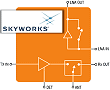 Skyworks is pleased to introduce the "Skyworks-High-Power-FEM-Automotive-V2V-V2X-12-15-2020.htm"
target="_top"> SKYA21043, a highly-integrated, 5 GHz front-end module (FEM) incorporating
a 5 GHz single-pole, double-throw (SPDT) transmit/receive (T/R) switch, a 5 GHz
high-gain low-noise amplifier (LNA) with bypass, and a 5 GHz power amplifier (PA)
intended for high-power 802.11p applications and systems. Qualified to AEC-Q104
(Grade 2), the SKYA21043 meets rugged reliability requirements for automotive applications
including vehicle-to-vehicle (V2V) and vehicle-to-everything (V2X) covering smart
antennas, compensators, and roadside units for automotive infrastructure, backhaul
and cellular... Skyworks is pleased to introduce the "Skyworks-High-Power-FEM-Automotive-V2V-V2X-12-15-2020.htm"
target="_top"> SKYA21043, a highly-integrated, 5 GHz front-end module (FEM) incorporating
a 5 GHz single-pole, double-throw (SPDT) transmit/receive (T/R) switch, a 5 GHz
high-gain low-noise amplifier (LNA) with bypass, and a 5 GHz power amplifier (PA)
intended for high-power 802.11p applications and systems. Qualified to AEC-Q104
(Grade 2), the SKYA21043 meets rugged reliability requirements for automotive applications
including vehicle-to-vehicle (V2V) and vehicle-to-everything (V2X) covering smart
antennas, compensators, and roadside units for automotive infrastructure, backhaul
and cellular...
PCBONLINE supplies complex rigid and flex-rigid
printed circuit
boards (PCBs),and one-stop production with maximum flexibility ranging from
prototype sample to mass production. Rigid-flex, HDI, multilayer, IC-loadboard,
LCP 5G optical module, ceramic, MCPCB. Materials include Rogers, Taconic, Arlon,
Isola, Bergquist, Kapton, Panasonic, and more. After more than 15 years of continuous
efforts, PCBONLINE constantly updates our equipment, improves our technology, and
serves you with the highest quality. Cost and delivery quotations online without
the need for multiple phone call and/or e-mails.
"Copper-Mountain-Technologies-2-Port-VNA-Calibration-Video-12-15-2020.htm" target="_top">
 Copper Mountain Technologies (CMT), a leading
developer of innovative RF test and measurement solutions for engineers all over
the world, has produced a video demonstrating how to properly "Copper-Mountain-Technologies-2-Port-VNA-Calibration-Video-12-15-2020.htm"
target="_top"> perform a 2-port calibration on a vector network analyzer (VNA).
Virtually interact with CMT's software to complete a simulated calibration of a
2-port VNA. Note that the series of dashes and spaces along the video progress bar
indicate where the action stops between steps to allow you time to replicate the
action. You will need to click on the start arrow each time to resume action... Copper Mountain Technologies (CMT), a leading
developer of innovative RF test and measurement solutions for engineers all over
the world, has produced a video demonstrating how to properly "Copper-Mountain-Technologies-2-Port-VNA-Calibration-Video-12-15-2020.htm"
target="_top"> perform a 2-port calibration on a vector network analyzer (VNA).
Virtually interact with CMT's software to complete a simulated calibration of a
2-port VNA. Note that the series of dashes and spaces along the video progress bar
indicate where the action stops between steps to allow you time to replicate the
action. You will need to click on the start arrow each time to resume action...
 Here are a couple good
Christmas-themed comics from the January 1942 issue of the American
Radio Relay League's (ARRL) monthly magazine, QST. Ironically, the "Old Year" Father
Time with the sickle would not have been able to legally key that transmitter by
the time readers had received this edition, because the U.S. government shut down
all amateur radio transmissions (except a few specially sanctioned civil defense
units) immediately after the Japanese attack on Pearl Harbor on December 7th of
the previous year (see "War Comes"). Although, he would probably have received special
dispensation from the FCC permitting him to send... Here are a couple good
Christmas-themed comics from the January 1942 issue of the American
Radio Relay League's (ARRL) monthly magazine, QST. Ironically, the "Old Year" Father
Time with the sickle would not have been able to legally key that transmitter by
the time readers had received this edition, because the U.S. government shut down
all amateur radio transmissions (except a few specially sanctioned civil defense
units) immediately after the Japanese attack on Pearl Harbor on December 7th of
the previous year (see "War Comes"). Although, he would probably have received special
dispensation from the FCC permitting him to send...
 Experts and news outlets
told Americans and people of the world not to use hydroxychloroquine (HCQ) as an
off-label treatment for the Wuhan Flu, in spite of its being safely prescribed for
decades. We were told by "experts" that no vaccine could possibly be developed in
less than a year. Now, the American Medical Association (AMA) has changed its mind
on HCQ and a vaccine is being distributed today. Politically motivated fake science
has likely caused suffering and death for an untold number of people. Per
Resolution 509 (p18), November 2020: "RESOLVED, That our American
Medical Association rescind its statement calling for physicians to stop prescribing
hydroxychloroquine and chloroquine until sufficient evidence becomes available to
conclusively illustrate that the harm associated with use outweighs benefit early
in the disease course..." Careful who you listen to - it could kill you. Experts and news outlets
told Americans and people of the world not to use hydroxychloroquine (HCQ) as an
off-label treatment for the Wuhan Flu, in spite of its being safely prescribed for
decades. We were told by "experts" that no vaccine could possibly be developed in
less than a year. Now, the American Medical Association (AMA) has changed its mind
on HCQ and a vaccine is being distributed today. Politically motivated fake science
has likely caused suffering and death for an untold number of people. Per
Resolution 509 (p18), November 2020: "RESOLVED, That our American
Medical Association rescind its statement calling for physicians to stop prescribing
hydroxychloroquine and chloroquine until sufficient evidence becomes available to
conclusively illustrate that the harm associated with use outweighs benefit early
in the disease course..." Careful who you listen to - it could kill you.
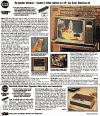 If you are shopping for a new television
set and are willing to spend $500, you can get a fully assembled and ready to play
Samsung 55" 4K UHD LED Smart TV with Alexa Built-in, or maybe a Vizio 50" 4K UHD
LED Smart TV (UHD = 3,840px x 2,160px = 8,294,400 px^2). The same $500 in 1982
got you a
19" CRT with 525 horizontal scan lines (only 480-490 actually
visible), but theoretically an infinite number of points across each line due to
the analog nature of the signal. Come to think of it, an argument could be made
that the old CRT displays had a higher resolution than the UHD modern digital TV
(infinite versus 8.3 million, respectively). Ditto for the total number of color
levels - infinite for analog versus 16.8 million for digital (8 bits per color =
[28]^3). Fully assembled and ready to play 19" TVs could be bought in 1982 for about
the same price, so the motivation for going to the trouble of building your own
set was mostly pride and personal satisfaction... If you are shopping for a new television
set and are willing to spend $500, you can get a fully assembled and ready to play
Samsung 55" 4K UHD LED Smart TV with Alexa Built-in, or maybe a Vizio 50" 4K UHD
LED Smart TV (UHD = 3,840px x 2,160px = 8,294,400 px^2). The same $500 in 1982
got you a
19" CRT with 525 horizontal scan lines (only 480-490 actually
visible), but theoretically an infinite number of points across each line due to
the analog nature of the signal. Come to think of it, an argument could be made
that the old CRT displays had a higher resolution than the UHD modern digital TV
(infinite versus 8.3 million, respectively). Ditto for the total number of color
levels - infinite for analog versus 16.8 million for digital (8 bits per color =
[28]^3). Fully assembled and ready to play 19" TVs could be bought in 1982 for about
the same price, so the motivation for going to the trouble of building your own
set was mostly pride and personal satisfaction...
MPDevice (MPD) has become a trustworthy and reliable company in the global RF
market as a manufacturer of passive RF devices. Included are attenuators and terminations,
coaxial connectors, adapters, and cable assemblies, DC blocks, surge arrestors,
power combiner / dividers, and directional couplers. The Korean Telecommunication
market is now entering into the era of hyperconnected society. With continuous enhancement
in R&D capabilities and quality control, MPD will continue in an effort to become
the No. 1 technologically innovative company with a focus on the emerging 5G
marketplace.
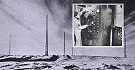 The old adage about pioneers taking the
arrows is true in many realms - not just the exploration and settling of the wild
west. This story titled "Sparks on Ice" recounting the trials and tribulations of the troops
who installed and debugged the first arctic directional beacons appeared in a 1945
issue of Flying Age magazine. "Sparks" (or "Sparky") was an endearing nickname given
to early radio operators who used spark gap transmitters to send out their Morse
code messages. It stuck around for many years after better transmitter systems were
developed - although it is not very often heard today. The most interesting part
of Mark Weaver's article is a discussion of the many atmospheric phenomena that
affect radio waves of various wavelengths. A lot of smart people - enlisted, commissioned,
and civilian - sacrificed mightily... The old adage about pioneers taking the
arrows is true in many realms - not just the exploration and settling of the wild
west. This story titled "Sparks on Ice" recounting the trials and tribulations of the troops
who installed and debugged the first arctic directional beacons appeared in a 1945
issue of Flying Age magazine. "Sparks" (or "Sparky") was an endearing nickname given
to early radio operators who used spark gap transmitters to send out their Morse
code messages. It stuck around for many years after better transmitter systems were
developed - although it is not very often heard today. The most interesting part
of Mark Weaver's article is a discussion of the many atmospheric phenomena that
affect radio waves of various wavelengths. A lot of smart people - enlisted, commissioned,
and civilian - sacrificed mightily...
 Remember the era when those big parabolic
satellite television antennas (TVRO - television receive-only)
began appearing on lawns all over the place? Some people painted them with camouflage
to help disappear them from view, while others painted them to match the themes
of their houses. Some got really obnoxious and painted targets or, even worse, big
ugly eyeballs on the antennas. Most systems at the time operated on C-band, which
explains, along with lower sensitivity receivers, the large size. The earliest antennas
and receivers which came to market in the late 1970s coincident with the first TV
broadcast satellites cost more than $10,000. By 1982 when this Heathkit Christmas
catalog was printed, prices were down to just a few thousand dollars. Nowadays,
a much smaller antenna operating at Ku-band is provided at no cost... Remember the era when those big parabolic
satellite television antennas (TVRO - television receive-only)
began appearing on lawns all over the place? Some people painted them with camouflage
to help disappear them from view, while others painted them to match the themes
of their houses. Some got really obnoxious and painted targets or, even worse, big
ugly eyeballs on the antennas. Most systems at the time operated on C-band, which
explains, along with lower sensitivity receivers, the large size. The earliest antennas
and receivers which came to market in the late 1970s coincident with the first TV
broadcast satellites cost more than $10,000. By 1982 when this Heathkit Christmas
catalog was printed, prices were down to just a few thousand dollars. Nowadays,
a much smaller antenna operating at Ku-band is provided at no cost...
 "A hacker can reproduce a circuit on a chip
by discovering what key transistors are doing in a circuit - but not if the transistor
'type' is undetectable. Purdue University engineers have demonstrated a way to disguise
which transistor is which by building them out of a sheet-like material called black
phosphorus. This built-in security measure would prevent hackers from getting enough
information about the circuit to reverse engineer it. The findings appear in a paper
published Monday (Dec. 7) in Nature Electronics. Reverse engineering chips
is a common practice - both for hackers and companies investigating intellectual
property infringement. Researchers also are developing X-ray imaging techniques
that wouldn't require actually touching a chip..." "A hacker can reproduce a circuit on a chip
by discovering what key transistors are doing in a circuit - but not if the transistor
'type' is undetectable. Purdue University engineers have demonstrated a way to disguise
which transistor is which by building them out of a sheet-like material called black
phosphorus. This built-in security measure would prevent hackers from getting enough
information about the circuit to reverse engineer it. The findings appear in a paper
published Monday (Dec. 7) in Nature Electronics. Reverse engineering chips
is a common practice - both for hackers and companies investigating intellectual
property infringement. Researchers also are developing X-ray imaging techniques
that wouldn't require actually touching a chip..."
 Although the original purpose of this note
was just to announce a couple post-WWI era
U.S. Air Force recruitment posters I found in The Saturday Evening
Post magazines back in the late 1940s, some info I found regarding the newest USAF
logo might also interest you. There is a plethora of old Air Force posters available
for viewing on the Internet, but I haven't seen these two, which are particularly
directed toward flight officers and the newfangled jet aircraft of the future. Operational
jet-powered fighter craft did not appear until the final year of World War II,
although Germany did have their Messerschmitt Me 262. Except maybe for the C-130,
you probably won't see any propeller-driven aircraft in today's USAF promotional
material. If you have any cause to display the USAF's new (relatively) wings symbol,
be sure to consult this entire section of regulations governing the proper... Although the original purpose of this note
was just to announce a couple post-WWI era
U.S. Air Force recruitment posters I found in The Saturday Evening
Post magazines back in the late 1940s, some info I found regarding the newest USAF
logo might also interest you. There is a plethora of old Air Force posters available
for viewing on the Internet, but I haven't seen these two, which are particularly
directed toward flight officers and the newfangled jet aircraft of the future. Operational
jet-powered fighter craft did not appear until the final year of World War II,
although Germany did have their Messerschmitt Me 262. Except maybe for the C-130,
you probably won't see any propeller-driven aircraft in today's USAF promotional
material. If you have any cause to display the USAF's new (relatively) wings symbol,
be sure to consult this entire section of regulations governing the proper...
 COMSOL's Jiyoun Munn has an article posted
on the Interference Technology website entitled, "The Vital Role of Simulation for Virtual EMI and EMC Test Environments."
I first saw it reproduced in NASA's Tech Briefs. He begins: "Before deploying
microwave and millimeter-wave devices and systems within 5G, the Internet of Things
(IoT), and high-speed wireless communication, it is essential to predict their performance.
This need has increased the demand for virtual test platforms through simulation
software. High carrier and system bus frequencies are necessary for high-data-rate
communication between multiple devices present in such systems. However, increased
operational frequencies may induce undesirable and troublesome electromagnetic compatibility
(EMC) and electromagnetic interference (EMI) issues, especially when communication
is congested. Moreover, the impact from other physics is no longer negligible..." COMSOL's Jiyoun Munn has an article posted
on the Interference Technology website entitled, "The Vital Role of Simulation for Virtual EMI and EMC Test Environments."
I first saw it reproduced in NASA's Tech Briefs. He begins: "Before deploying
microwave and millimeter-wave devices and systems within 5G, the Internet of Things
(IoT), and high-speed wireless communication, it is essential to predict their performance.
This need has increased the demand for virtual test platforms through simulation
software. High carrier and system bus frequencies are necessary for high-data-rate
communication between multiple devices present in such systems. However, increased
operational frequencies may induce undesirable and troublesome electromagnetic compatibility
(EMC) and electromagnetic interference (EMI) issues, especially when communication
is congested. Moreover, the impact from other physics is no longer negligible..."
 Exodus Advanced Communications is a multinational
RF communication equipment and engineering service company serving both commercial
and government entities and their affiliates worldwide. Power amplifiers ranging
from 10 kHz to 51 GHz with various output power levels and noise figure
ranges, we fully support custom designs and manufacturing requirements for both
small and large volume levels. decades of combined experience in the RF field for
numerous applications including military jamming, communications, radar, EMI/EMC
and various commercial projects with all designing and manufacturing of our HPA,
MPA, and LNA products in-house. Exodus Advanced Communications is a multinational
RF communication equipment and engineering service company serving both commercial
and government entities and their affiliates worldwide. Power amplifiers ranging
from 10 kHz to 51 GHz with various output power levels and noise figure
ranges, we fully support custom designs and manufacturing requirements for both
small and large volume levels. decades of combined experience in the RF field for
numerous applications including military jamming, communications, radar, EMI/EMC
and various commercial projects with all designing and manufacturing of our HPA,
MPA, and LNA products in-house.
These archive pages are provided in order to make it easier for you to find items
that you remember seeing on the RF Cafe homepage. Of course probably the easiest
way to find anything on the website is to use the "Search
RF Cafe" box at the top of every page. Some quoted items have been shortened
to save space. About RF Cafe.
Homepage Archive Pages
2026:
Jan |
Feb |
Mar |
Apr |
May |
Jun |
Jul | Aug
| Sep | Oct | Nov | Dec
2025:
Jan |
Feb |
Mar |
Apr |
May |
Jun |
Jul |
Aug |
Sep |
Oct |
Nov |
Dec
2024:
Jan |
Feb |
Mar |
Apr |
May |
Jun |
Jul |
Aug |
Sep |
Oct |
Nov |
Dec
2023:
Jan |
Feb |
Mar |
Apr |
May |
Jun |
Jul |
Aug |
Sep |
Oct |
Nov |
Dec
2022:
Jan |
Feb |
Mar |
Apr |
May |
Jun |
Jul |
Aug |
Sep |
Oct |
Nov |
Dec
2021:
Jan |
Feb |
Mar |
Apr |
May |
Jun |
Jul |
Aug |
Sep |
Oct |
Nov |
Dec
2020:
Jan |
Feb |
Mar |
Apr |
May |
Jun |
Jul |
Aug |
Sep |
Oct |
Nov |
Dec
2019:
Jan |
Feb |
Mar |
Apr |
May |
Jun |
Jul |
Aug |
Sep |
Oct |
Nov |
Dec
2018:
Jan |
Feb |
Mar |
Apr |
May |
Jun |
Jul |
Aug |
Sep |
Oct |
Nov |
Dec
2017:
Jan | Feb |
Mar |
Apr |
May |
Jun |
Jul |
Aug |
Sep |
Oct |
Nov |
Dec
2016:
Jan | Feb |
Mar |
Apr |
May |
Jun |
Jul |
Aug |
Sep |
Oct |
Nov |
Dec
2015:
Jan | Feb |
Mar |
Apr |
May |
Jun |
Jul |
Aug | Sep |
Oct |
Nov |
Dec
2014:
Jan | Feb |
Mar |
Apr |
May |
Jun |
Jul |
Aug |
Sep |
Oct |
Nov |
Dec
2013:
Jan | Feb |
Mar |
Apr |
May |
Jun |
Jul |
Aug |
Sep |
Oct |
Nov |
Dec
2012: 1 |
2 | 3
| 4 | 5
| 6 | 7
| 8 | 9
| 10 | 11
| 12 | 13
(no archives before 2012)
- Christmas-themed
items
|