Electronics Pioneers & History
- See Full List of AI Topics -
 Thomas Augustus Watson was born January 18, 1854, in Salem, Massachusetts.
His practical knowledge and skills in electrical engineering and mechanics were
largely self-taught, acquired through his work as a machinist and electrician. He
did not attend college but learned extensively through hands-on experience. Watson
began his career working at the electrical machine shop of Charles Williams in Boston.
This shop was known for its work in telegraphy and electrical devices. In 1874,
Alexander Graham Bell, who was experimenting with ways to transmit sound electronically,
hired Watson as his assistant. Watson's technical skills were essential in turning
Bell's ideas into working prototypes. He worked closely with Bell to develop and
refine the necessary components. On March 10, 1876, the first successful telephone
message was transmitted. Bell's famous words, "Mr. Watson, come here, I want to
see you," were heard by Watson, marking the first instance of a clear, understandable
voice transmission over a wire. Watson continued to work with Bell to improve and
commercialize the telephone. He was involved in setting up the first telephone exchange
and contributed to the early growth of the telephone industry. After his work with
Bell, Watson pursued various other interests. He established a successful shipbuilding
company, Fore River Ship and Engine Company, which later became a significant shipbuilding
enterprise in the United States. Thomas A. Watson died on December 13, 1934. See
Exploring Life: The Autobiography of Thomas A. Watson. Thomas Augustus Watson was born January 18, 1854, in Salem, Massachusetts.
His practical knowledge and skills in electrical engineering and mechanics were
largely self-taught, acquired through his work as a machinist and electrician. He
did not attend college but learned extensively through hands-on experience. Watson
began his career working at the electrical machine shop of Charles Williams in Boston.
This shop was known for its work in telegraphy and electrical devices. In 1874,
Alexander Graham Bell, who was experimenting with ways to transmit sound electronically,
hired Watson as his assistant. Watson's technical skills were essential in turning
Bell's ideas into working prototypes. He worked closely with Bell to develop and
refine the necessary components. On March 10, 1876, the first successful telephone
message was transmitted. Bell's famous words, "Mr. Watson, come here, I want to
see you," were heard by Watson, marking the first instance of a clear, understandable
voice transmission over a wire. Watson continued to work with Bell to improve and
commercialize the telephone. He was involved in setting up the first telephone exchange
and contributed to the early growth of the telephone industry. After his work with
Bell, Watson pursued various other interests. He established a successful shipbuilding
company, Fore River Ship and Engine Company, which later became a significant shipbuilding
enterprise in the United States. Thomas A. Watson died on December 13, 1934. See
Exploring Life: The Autobiography of Thomas A. Watson.
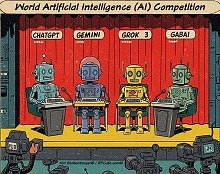 This content was generated primarily
with the assistance of ChatGPT (OpenAI), and/or
Gemini (Google), and/or
Arya (GabAI), and/or Grok
(x.AI), and/or DeepSeek artificial intelligence
(AI) engines. Review was performed to help detect and correct any inaccuracies; however,
you are encouraged to verify the information yourself if it will be used for critical
applications. In all cases, multiple solicitations to the AI engine(s) was(were)
used to assimilate final content. Images and external hyperlinks have also been
added occasionally - especially on extensive treatises. Courts have ruled that AI-generated
content is not subject to copyright restrictions, but since I modify them, everything
here is protected by RF Cafe copyright. Many of the images are likewise generated
and modified. Your use of this data implies an agreement to hold totally harmless
Kirt Blattenberger, RF Cafe, and any and all of its assigns. Thank you. Here is
Gab AI in an iFrame. This content was generated primarily
with the assistance of ChatGPT (OpenAI), and/or
Gemini (Google), and/or
Arya (GabAI), and/or Grok
(x.AI), and/or DeepSeek artificial intelligence
(AI) engines. Review was performed to help detect and correct any inaccuracies; however,
you are encouraged to verify the information yourself if it will be used for critical
applications. In all cases, multiple solicitations to the AI engine(s) was(were)
used to assimilate final content. Images and external hyperlinks have also been
added occasionally - especially on extensive treatises. Courts have ruled that AI-generated
content is not subject to copyright restrictions, but since I modify them, everything
here is protected by RF Cafe copyright. Many of the images are likewise generated
and modified. Your use of this data implies an agreement to hold totally harmless
Kirt Blattenberger, RF Cafe, and any and all of its assigns. Thank you. Here is
Gab AI in an iFrame.
AI Technical Trustability Update
While working on an update to my
RF Cafe Espresso Engineering Workbook project to add a couple calculators about
FM sidebands (available soon). The good news is that AI provided excellent VBA code
to generate a set of Bessel function
plots. The bad news is when I asked for a
table
showing at which modulation indices sidebands 0 (carrier) through 5 vanish,
none of the agents got it right. Some were really bad. The AI agents typically explain
their reason and method correctly, then go on to produces bad results. Even after
pointing out errors, subsequent results are still wrong. I do a lot of AI work
and see this often, even with subscribing to professional versions. I ultimately
generated the table myself. There is going to be a lot of inaccurate information
out there based on unverified AI queries, so beware.
Electronics & High Tech
Companies | Electronics &
Tech Publications | Electronics &
Tech Pioneers | Electronics &
Tech Principles |
Tech Standards Groups &
Industry Associations | Societal
Influences on Technology
|