|
|||||||||||||
 |
|||||||||||||
Mac's Service Shop: Solid-State Service Instruments
|
|||||||||||||
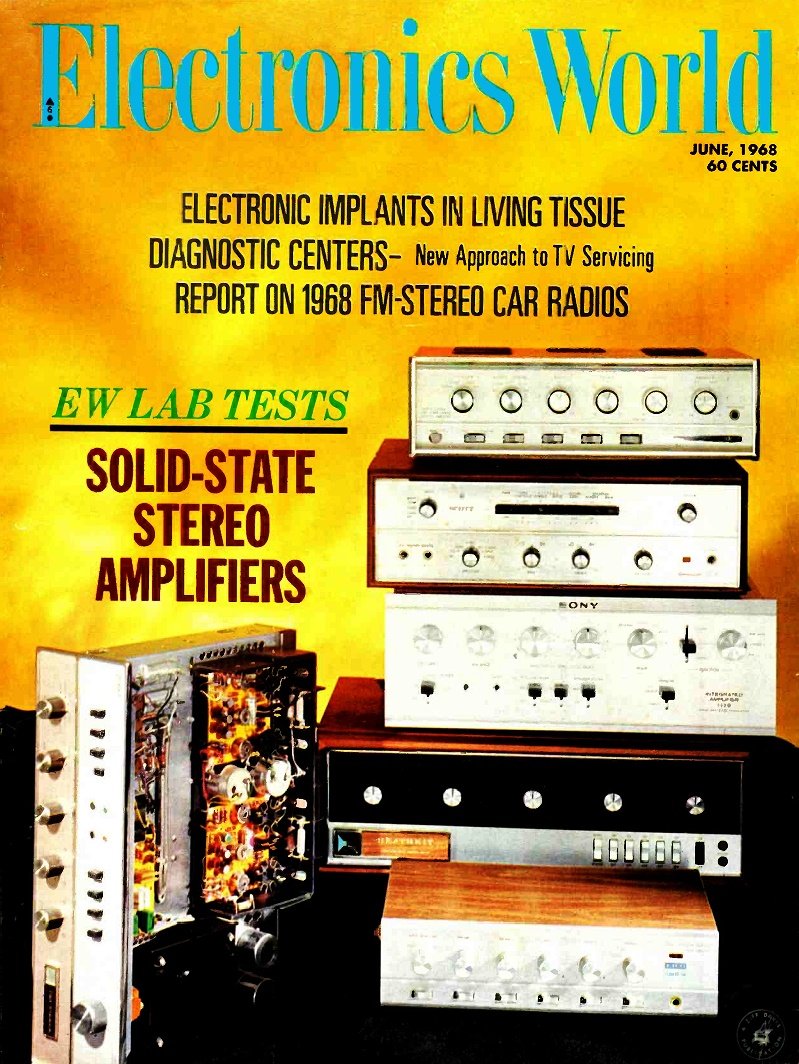
The debate about upgrading electronics service shop equipment from vacuum tube to solid-state instruments was raging in the late 1960s, when this Mac's Service Shop story appeared in Electronics World magazine. Barney is querying Mac regarding FET-based VOM performance specifications he is considering to replace a VTVM. He covets the Hewlett-Packard 217A square-wave generator, delivering clean 1 Hz-10 MHz waves with 5-ns rise time and scope triggering, justifying its $300-$400 cost for precise scope testing. An electronic counter for 5 Hz-10 MHz frequencies, with four- or six-digit readouts and line- or crystal-gated accuracy, tempts at $350-$700. Barney wants a $125 Model 1110 secondary standard for WWV-calibrated precision. Benefits of solid-state include compactness, portability, ruggedness, and reliability over tube gear, though repair challenges from ICs, obsolescence, and parts scarcity loomed. Ultimately, they resolved to embrace progress while fixing sets with old tools as prudence dictated. Mac's Service Shop: Solid-State Service Instruments
"Hey Boss," Barney said to Mac, his employer, you've been mooning over that catalogue for a good half hour. Sure and I know your name's McGregor, but is the prospect of having to turn loose of a few bucks all that painful to a Scotsman ?" "Keep a civil tongue in your head, you Black Irishman!" Mac retorted with a fierce scowl. "It's not giving up the money that hurts; it's just that we canny Scots like to do the best we can. I want to order some new service equipment, and I find there are a lot of ways to go. Solid-state devices have invaded the service instrument field, just as they have clone in almost every other electronics field; and this has sort of muddied the water. I used to know the specs of most popular service instruments by heart, but now I find it's a whole new horse race - if you don't mind my mixing a few metaphors!" "I don't mind; I'm used to it; but what kind of instruments are you thinking of buying?" "Well, for one thing, we need a new v.t.v.m., or equivalent, for use in making outside calls. I'm wondering if one of those new solid-state v.o.m.'s might not be a better buy. Thanks to the use of FET's, such a v.o.m. achieves an input resistance at least as high as the 11-megohm input of a conventional v.t.v.m. One of those I've been looking at has a built-in power supply for working off the line or it can be switched to self-contained batteries. That would make it handy for working on equipment where there's no convenient a.c. outlet for plugging in the instrument; yet we could conserve the batteries when this feature isn't needed." "How about accuracy?" "It is rated just as good as the tube-type instruments. In fact, I should imagine the long-time accuracy might be better because you wouldn't have the tube-aging factor to contend with. Also, since other components of the instrument will not be subjected to self-generated heat, as they are in a v.t.v.m., these components should last longer. All in all, I shouldn't be at all surprised if this new type of v.o.m. night not eventually put the v.t.v.m., that faithful old work horse of the service technician, out to pasture." "Kind of sad, ain't it ?" Barney mused. "But I guess that's progress. What other goodies are you contemplating buying?" "I'd like to have a really good square-wave generator that will have a fast enough rise time to let us take full advantage of the capabilities of our new wide-band, driven-sweep scope. I want something that will produce a good clean square wave up to at least 1 MHz. The Hewlett-Packard Model 217A I've been looking at is typical of a new breed of fully transistorized generators that will easily satisfy such demands. In fact, it will produce square waves from 1 Hz to 10 MHz with a rise time of 5 nanoseconds or better. The 'on' time of the square wave - or the relative length of the 'bottom' horizontal portion of the square wave compared with the 'top' horizontal portion - can be varied between 25% and 75 %. A triggering source for the scope's driven sweep is also provided. "The $300-$400 price tags on these instruments sound salty when compared with the cost of the usual service -type square-wave generator whose rise time is measured in microseconds or even milliseconds, but the price is still a lot lower than it was before fast-acting solid-state switching devices got into the picture. "If we're willing to settle for a rise time of ten nanoseconds and dispense with some of the other features, we can get the price down below $200; but I'm inclined to go whole-hog and get the better instrument. Admittedly, that rise time is better than we need with our present scope; but in square-wave testing, if you have to make allowance for the limitations of the scope amplifier and for the limitations of your generator, you end up feeling quite unsure about what you are really seeing on the tube face. How much of the distortion seen there is produced by the amplifier or device being tested, and how much is produced by your equipment? It seems to me the logical place to start upgrading is with the signal source. If you can be certain your generator is producing a clean, fast -rise square wave at a repetition rate in the MHz, you are in a position to evaluate the contribution the scope amplifier makes to the distortion seen. Knowing this, you can then proceed to check the amplifier or delay line with confidence." "Sounds logical," Barney agreed. "Does that wind up your buying spree, Diamond Jim ?" "Not quite. For a long, long time I've wanted an electronic counter to measure frequency, and it looks as though the use of transistors and integrated circuits may eventually enable me to satisfy my wish. In fact, I can buy one right now that will count from 5 Hz to 10 MHz for only $350 if I am willing to accept a four-figure readout and a gate based on the power-line frequency. This basic model has gate periods of 1 second and 0.1 second. For $125 more, you get a six-figure readout, which, of course, would be much better for high-frequency measurement." "How about the accuracy? Doesn't that gate's being keyed to the line frequency impair the accuracy a great deal ?" "Depends on what you mean by 'a great deal'. The accuracy of the count is the usual plus-or-minus one Hz plus- or-minus the accuracy of the line frequency. In the United States, this accuracy is typically better than 0.1% for commercial power. But if you need greater accuracy, you can get it for about double the money in a counter whose gate is operated by a stable 1-MHz crystal oscillator. This model has gate periods of .01, 0.1, 1, and 10 seconds with a five-figure readout. A six-figure readout is an option. And, of course the counter can be used to measure time intervals from 1 microsecond to 1 second. "The point I want to stress is that these and similar counters coming on the market from the development labs make extensive use of IC's. This leads to a reduction in size and cost and an improvement in reliability." "Hey, do I get to say anything in this dialogue, or do I have to content myself with being your straight man ?" Barney demanded. "If you really have anything to contribute - which I doubt - I might be persuaded to listen," Mac answered. "Thanks a great big heap!" Barney retorted. "I was just going to mention that International Crystal has just come out with a Model 1110 transistorized secondary frequency standard with outputs at 1 MHz, 100 kHz, and 10 kHz. Used in conjunction with a general coverage communications receiver, this standard can be calibrated against WWV to provide an accuracy of one part in 1011. The long-term stability of the 1-MHz oscillator is claimed to be plus or minus 10 Hz over a range of 40 °F to 100 °F. While this is not in the league with the counters you were discussing and would require the use of an external receiver and some operating skill to read frequencies accurately, it only costs $125 and would be plenty good enough for most amateur radio or service technician measurements." "That is interesting, and I'm going to look into it," Mac promised. "But in our discussion we've just scratched the surface of solid-state applications to service instruments. Digital voltmeters; transistorized scopes; signal, sweep, and marker generators; dot and color bar generators - well, you just name it, and solid-state versions are either on the market or are in R & D laboratories." "I'm all for it," Barney offered. "For one thing, the use of transistors and IC's produce instruments that are smaller, easier to carry, and that take up less bench room. What's more, they are rugged and not easily damaged by jars or vibration. These things are important in portable instruments you have to lug along on house calls. Finally, from our own experience, we know solid-state devices fail much more rarely than do tubes; so it would seem safe to assume these new instruments will last longer and require less service." "I agree with everything you say, but that last point brings up one disadvantage of the new instruments: they are not going to be so easy to repair when something floes go wrong with them. IC's are not readily tested %with the equipment and know-how found in the average service shop. Furthermore, changing a critical IC or even a transistor in a service instrument may make recalibration necessary. "Another thing: there's not as much standardization and stability in the stocking of transistors and IC's as there is in tube stocks. 13v the time one of these solid-state devices hits the market it may be already obsolete because a new and improved type is emerging from its own lab or the labs of competitors. We both know instrument manufacturers stuck pretty close to well-established and popular tubes, avoiding the new and the esoteric; so getting replacement tubes was never a problem. I can't help wondering how true this will be of IC's and transistors. Will we be able to get replacements in five or ten ears ?" "You've got a point," Barney said; "but I still like transistorized service equipment. Surely the instrument manufacturers will keep a goodly stock of replacement IC's and transistors on hand - or at least the reputable manufacturers will." "Okay, okay!" Mac said. "I'm not arguing with you. I just wanted to mention what might be a couple of small drawbacks to transistorized service equipment. Like you, I'm still for it because the advantages far outweigh the disadvantages. At any rate, I'm resigned to having everything transistorized. Any day now I expect someone to come out with a transistorized coat-hanger. But now suppose we get busy and see if we can fix some TV sets with our out-of-date tube-type service equipment!" Mac's Radio Service Shop Episodes on RF Cafe This series of instructive technodrama™ stories was the brainchild of none other than John T. Frye, creator of the Carl and Jerry series that ran in Popular Electronics for many years. "Mac's Radio Service Shop" began life in April 1948 in Radio News magazine (which later became Radio & Television News, then Electronics World), and changed its name to simply "Mac's Service Shop" until the final episode was published in a 1977 Popular Electronics magazine. "Mac" is electronics repair shop owner Mac McGregor, and Barney Jameson his his eager, if not somewhat naive, technician assistant. "Lessons" are taught in story format with dialogs between Mac and Barney. There are 131 stories as of January 2026.
|
|||||||||||||
 |
|||||||||||||
|
|||||||||||||

|
||||||||||||||||||||||||||||||||||||