|
|||||||||||||
 |
|||||||||||||
Mac's Service Shop: Taming Static Electricity
|
|||||||||||||
As is usually the case, John Frye uses his monthly "Mac's Service Shop" story to entertain whilst proffering a valuable lesson in the field of electronics. Mac is famous for his superb knowledge of electrical principles, and for his ability to troubleshoot and solve just about any problem put before him. His sidekick technician, Barney, is a young Ham operator who often needs the admonishment and/or wisdom provided by Mac. In this 1975 Popular Electronics magazine piece titled "Taming Static Electricity," Barney is saved by Mac from the wrath of office girl Matilda after she received an electrostatic discharge (ESD) shock intentionally administered by the young man. Prior to the advent of microelectronic circuits, everyday ESD was generally not a huge concern in the electronics realm because components were naturally robust enough to survive the high voltage, but as things miniaturized, ESD began causing damage and/or failure. Micron-dimension gate widths in ICs are easily destroyed by even a couple hundred volts applied for a split second. By 1975, special instruments and test procedures were being developed to study ESD in electronics. Mac's Service Shop: Taming Static Electricity
Through the open door of the service department, Mac watched Matilda typing in the outer office. She did not hear Barney, Mac's assistant, come in from the bright freezing weather outside. He quietly removed his snow boots and stealthily walked across the floor, sliding his feet on the carpet, until he was standing directly behind the absorbed girl. He slowly reached out a forefinger towards the nape of her neck, and she suddenly let out a shriek scattering the papers she was holding. Barney beat a hasty retreat to the service department with Matilda in hot pursuit. "Let me kill him," Matilda begged, trying to dodge around Mac and get at Barney. "He stuck me with a pin." "I did not," Barney denied, grinning down maddeningly. "I didn't even touch you." Static Electricity Is to Blame "He's right. I saw the whole thing," Mac said. "He gave you a shock with static electricity, and that gives me an excuse to continue a discussion of several months ago. Then we talked about the uses of static electricity for such things as smoke precipitation, ore separation, spray painting, and flocking. These are examples of static electricity on its good behavior - which it usually isn't! Most of the time it's causing shocks, unruly hair, clinging clothes, lightning strokes, and explosions; or it's fouling up printing and manufacturing processes or destroying IC's and transistors. Astronomy has been called the wise child of a foolish mother, astrology. In the same way, static electricity might be called the mischievous, annoying parent of a hardworking son, current electricity, which provides us with light, heat, telecommunication, and power. So now let's talk about how we can take the mischief out of static electricity."
Custom Materials' Model CMI -7777M Static Meter. "Amen!" Matilda said soulfully, rubbing the back of her neck. "You both know from your high school physics or our previous discussion that, when certain substances are placed in firm contact and then separated, electrons transfer from atoms of one substance to atoms of the other. Atoms which lose electrons become positively charged ions, or cations; those gaining an electron become negatively charged ions, or anions. Both a potential difference and an electrostatic attraction develop between the separated, oppositely charged surfaces. In fact, if only one electron in 100,000 atoms of a surface is exchanged, that surface is very strongly charged. The substances vary widely, but one or both is usually a poor conductor. Some combinations are: glass and silk, wool and hard rubber, paper and a printing press roll, a fabric belt and a steel pulley, a rubber tire and the pavement, a cold dry stream of particle- bearing air and an airplane wing." "Or the soles of a pair of size eleven clodhoppers sliding across a nylon carpet," Matilda injected tartly, glowering at Barney's feet. "Electrostatic attraction is what makes your hair follow the comb on a snappy winter day such as this," Mac hastened to continue. "The passage of the comb leaves one type of charge on the hair and the opposite on the comb. But since the individual hairs have similar charges, they repel each other after the comb is taken away leaving you with a Phyllis Diller coiffure. Dampening the hair provides a conductive path for the charges to leak off the ends and permits you to comb it down. "Here we have one rule for the control of static electricity problems: provide a comparatively low resistance path for the charge to leak off as fast as it accumulates on a nonconductor or on the surface of an insulated conductor. I say 'comparatively low resistance path' because a resistance as high as one megohm will ordinarily be adequate for preventing a potential buildup. When the relative humidity is raised above 70%, most insulators become conductive enough, either through absorption or hygroscopic action, to allow a static charge to leak away as fast as it is formed. Where static electricity causes the adhesion or repulsion of sheets of paper, layers of cloth, fibers, etc., humidifying the atmosphere has proved to be a solution in some industrial applications. Unfortunately, this sometimes brings on new problems with both materials and personnel. "There is another way we can put moisture to work as a conducting path. That is by loading a plastic with a 'detergent' hygroscopic material or by spraying this material on a fabric or rug. This material will attract and hold water molecules forming a conductive path that prevents static buildup. Tomorrow, Matilda, I'll spray that rug out there with Anti -Shock Spray, marketed by Bigelow-Sanford, Inc., Greenville, S.C. Then you should be safe from Barney's shocking behavior until the humidity takes over in the summer." "Then high relative humidity doesn't prevent the 'generation' of static electricity; it simply interferes with the accumulation of a charge high enough to be noticed," Barney observed. "Incidentally, how high a stored charge is 'high enough' to cause trouble ?" "Consider what happens in explosions of gases and vapors ignited by electrostatically produced sparks. The ability of such a spark to produce ignition depends on its energy, which is some fraction of the total stored energy. In a nonconductor, in which the charges are tightly bound, this fraction is low because only a small area can contribute to the spark; but with a conductor, through which charges move easily, the total charge contributes to the effect. That's why sparks between two nonconductors generating a charge seldom produce hydrocarbon gas explosions directly, but they induce charges in nearby conductors which are quite capable of producing such explosions.
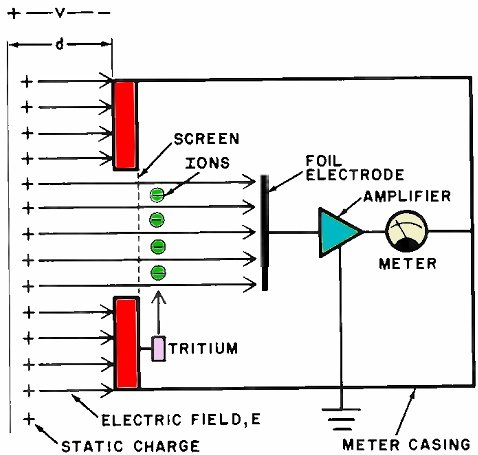
Diagram shows how meter to measure static buildup works. "Stored energy is a function of both voltage and capacity. It can be calculated from the formula: E = ½CV2 x 10-4; where E is the energy in millijoules, or thousandths of a watt - second; C is the capacity, related to the surface area, in picofarads; and V is the potential across the spark gap in volts. It has been found that about 0.25 millijoules of stored energy is required for ignition of optimum mixtures of air and saturated hydrocarbon gases and vapors. Sparks arising from potential differences of less than 1500 volts are unlikely to be hazardous in these mixtures because of the short gap and the heat loss at the terminals. Plugging these minima into the formula, you come up with 222 pF, which is slightly less than the capacitance of a large man. As the voltage goes up, the minimum capacity goes down. The spark from Barney's finger to your neck, Matilda, was at least ¼ inch long, which indicates his body had a charge of around 20,000 volts. At that voltage, a capacitance of only 1¼ pF., or about that of a 20-penny nail, could store enough energy to ignite gasoline fumes. Incidentally, remember when we used to see gasoline trucks dragging metal chains to ground static buildup? We don't see that any longer because it didn't work well. Now they bond the metal tank of the delivery truck to the ground tank before gasoline is pumped into or out of the truck tank. "Electrostatic voltages far below the 1500 -volt level can do expensive damage to the equipment we use here. Some MOSFET's will be permanently damaged if as little as 30 volts is applied across the thin oxide region from gate to source. If your body is charged, just touching a lead can destroy such a device. Safe handling of many IC's and transistors requires that everything coming in contact with them be devoid of static charges, which is another way of saying everything should be grounded." Special Products "Custom Materials, Inc., Chelmsford, Mass., manufactures a special electrically conductive plastic product called VELOSTATR just for this purpose. The conductivity is inherent and not dependent on moisture attraction, as is the case with many other 'antistatic' materials. When workbench, stool seat, and floor mat are covered with Velostat; when the worker is wearing Velostat boots, apron, or gloves; and when all these Velostat items are bonded to each other and to ground with Velostat ribbon; there's no opportunity for damaging electrostatic charges to accumulate. "Now, let's consider some other ways of eliminating static charges. "The shape of a conductor has much to do with the distribution of a charge on its surface. The mutually repelling action of like charges concentrates the charge on the portion with the least radius of curvature. On a needle point, where the radius is near zero, the charge can be so concentrated that it ionizes the air at the point and is absorbed in the process. The discharge in such a case starts at a much lower voltage than would be the case if the conductor did not have a sharp point. Static-discharging 'wicks' bolted to the trailing edges of airplane wings are often made of frayed copper braid to take advantage of this ability of small diameter points to dissipate a charge. "If a series of needle-pointed conductors is fastened to a metal bar so as to form a 'comb' and this is mounted close to a fabric belt being electrostatically charged by running over a metal pulley, the belt charge will induce an opposite charge in the comb. An ionized path between the belt and the needle points then dissipates the charge as rapidly as it forms. This works equally well with paper passing over rollers. "A battery of such combs can be made to ionize the air by placing a high voltage on them. Then a fan blowing this conducting ionized air across any area where troublesome static charges may form will bleed off the charge to some nearby grounded object it can accumulate." "What's this picture of a handheld device that looks like a ray gun ?" Barney asked. "That's a picture of Custom Material's instrument for measuring the potential of static electric charges from a safe distance. Here's a diagram of how it works. The meter, which is essentially at ground potential, is handheld at distance, d, from the charged object. A potential difference V, develops between the object and the gun tip setting up an electric field, E, directly proportional to V and inversely proportional to d. An opening in the gun barrel is covered with a wire screen; and directly behind the screen and to the side is a small sample of radioactive tritium emitting beta rays or electrons toward the screen. Electron- bombarded air molecules are ionized to form a thin layer on which the electric field of the static charge impinges. Since a field exerts a force on a charge, the ionized air molecules move forward or backward, depending on the polarity of the charge, the amount of movement being related to the intensity of the charge. "A metal electrode behind the layer of ionized air is connected to a sensitive FET amplifier and the current produced by the movement of the charged air molecules is displayed on a meter on the back of the gun. By holding the gun tip at distances of 2", 6", and 12" from the charged object and using a 3-position mechanical range selector, nine full-scale values covering a range of 500 to 200,000 volts are achieved. "Now, we've got to knock it off and start earning a buck, although we've barely scratched the surface of the fascinating subject. We've talked before about lightning, the really big show of static electricity. Sometime, maybe we will discuss precautionary measures used in operating rooms, around explosives, in dusty locations, on helicopters, etc. Mac's Radio Service Shop Episodes on RF Cafe This series of instructive technodrama™ stories was the brainchild of none other than John T. Frye, creator of the Carl and Jerry series that ran in Popular Electronics for many years. "Mac's Radio Service Shop" began life in April 1948 in Radio News magazine (which later became Radio & Television News, then Electronics World), and changed its name to simply "Mac's Service Shop" until the final episode was published in a 1977 Popular Electronics magazine. "Mac" is electronics repair shop owner Mac McGregor, and Barney Jameson his his eager, if not somewhat naive, technician assistant. "Lessons" are taught in story format with dialogs between Mac and Barney. There are 131 stories as of January 2026.
|
|||||||||||||
 |
|||||||||||||
|
|||||||||||||

 By John T. Frye, W9EGV, KHD4167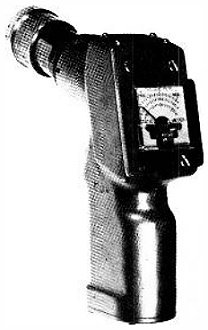

|
||||||||||||||||||||||||||||||||||||