|
|||||||||||||
 |
|||||||||||||
Mac's Radio Service Shop: Spring Fancies
|
|||||||||||||
Mac's young technician sidekick Barney decides to one-up the do-it-yourself television repair books that were flooding magazine pages those days by writing a series of do-it-yourself surgery books. He figures if the other guys can get rich by convincing Joe Sixpack that he can easily fix problems in his TV set - where potentially lethal voltages lurk in every corner - in as little as five minutes while saving hundreds of dollars from those rascally shop owners, then surely those same people might buy his books for removing your own appendix or tonsils. Deny the greedy doctors of their fees for such simple operations. Barney might have been the first to dream up the concept of the now-popular "for Dummies" series of books. Mac's Radio Service Shop: Spring FanciesBy John T. Frye
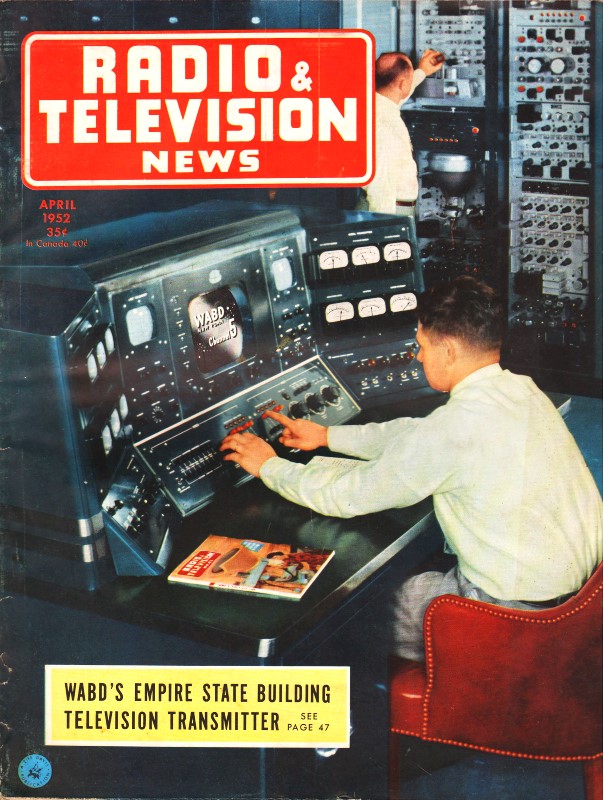
"Ah me," Mac sighed; "what wouldn't I give to be young again in the spring-time!" "Yes," Miss Perkins said with an echoing sigh. "All you need is a look at that rapt expression on his face to know how true are those words about in the spring a young man's fancy lightly turns to thoughts of love." Barney floated through the door and gradually allowed his eyes to focus on the faces of the other two. Then he spoke in a voice of quiet awe: "I have just been the recipient of a beautiful thought!" "Blonde, brunette, or redhead ?" Mac inquired solicitously. "Whatever are you babbling about?" Barney asked with a puzzled frown. "I mean I've just figured out how I'm going to make my first million dollars." "Thoughts of love," Mac quoted mockingly out of the corner of his mouth to Miss Perkins. "And pray tell us," he continued to Barney, "just how you are going to harvest all this lettuce." "It's a lead-pipe cinch," Barney answered confidently. "I'm going to write a book entitled 'How to Remove Your Own Appendix, or That of a Friend or Member of Your Family, Using Only a Discarded Razor Blade.'" "Hm-m-m-m," Mac said slowly; "I see you like a short snappy title anyway. Where did you get your inspiration for this future best-seller?" "At the lunch room magazine rack this noon. I was leafing through several of the magazines that try to give popular explanations of various scientific and mechanical achievements, and I ran across quite a few ads for books that promised to tell the television set owner just how he could repair his own television set. Right then I decided that if you could tell a guy who didn't know from nothing about radio or television how he could locate and repair any one of the thousand and one things that can get wrong with a TV set, telling him how to perform a single operation like an appendectomy ought to be duck soup." "But," Miss Perkins objected, "if the TV instructions are a flop, all the guy will have is a botched-up set; but if your surgical instructions go wrong, he will have a candidate for a harp. That's too dangerous." "How safe do you think it is to encourage an untrained person to go prowling around in a TV chassis carrying various lethal potentials up to 15,000 volts and better?" Barney demanded. "For years radio magazines have been warning technicians, who are already familiar with high voltage circuits, to be extremely careful to avoid shock in work on television sets; but these books blandly egg the set owner on into wading right into his receiver. Some of them try to protect themselves by saying there is no danger when instructions are followed, but any technician who has had any experience with the ability of untrained people to follow directions in dealing with electronic equipment takes a very dim view of the average person's ability to follow instructions. Look what happens when most people try to take the tubes out of their little a.c.-d.c. sets and put them back the way they were, even when they have a tube diagram to help them." "You've got a point there," Mac agreed; "but leaving the danger angle entirely out of it, how much help do you think these books would really be to the average owner of a TV set." "Why they would be a wonderful help," Barney said with a straight face. "They promise to show you how you can repair anything from a shorted picture tube to a set that won't stay in sync in from a few seconds on the comparatively simple jobs to up to five whole minutes on the really tough ones. Just think of that! Why it often takes poor old inefficient me, who never read one of those books, almost five whole minutes to get the back off some of the receivers that use a whole handful of woodscrews to hold it on." "Guess we'd better buy some of those books and read 'em," Mac suggested wryly. "We certainly should," Barney blandly agreed. "The fellow who has one of these books needs only a screwdriver to make all of his repairs. There you have gone and wasted better than a thousand dollars on your scopes, sweep generators, vacuum tube voltmeters, bar generators, tube testers, and service manuals. After we have studied these books, we can sell all of that expensive and unnecessary equipment and buy ourselves a nice new screwdriver apiece and really settle down to turning out the TV sets. Since, at the outside, we shall have to spend only five minutes on a set, we'll really make money fast. As it is, we often waste three or four hours running down a tough intermittent or doing a complete job of realignment. Come to think of it, we can let Matilda here read the books, too, and then she can fix sets just as well as you can, for experience is entirely unnecessary, and all of those years that you have spent studying and working on electronic equipment have just been wasted." "Tsk, tsk! What a pity!" Mac exclaimed with a broad grin. "Better had we get one of these books at once." "I'm not sure a technician can buy them," Barney said darkly. "The writers of these books do not trust radio and television technicians. In fact, they encourage the set owner to buy the book so that he can avoid being 'soaked' by independent repairmen. I think I'll use that line in advertising my own book 'Don't let the doctor gouge you for performing a simple operation.' I'll argue; 'buy this book and take out your own appendix. No experience necessary.' " Miss Perkins looked desperately from Mac's faintly-smiling face to the dead-serious one of Barney. "Mac, how can you stand there and encourage the boy in such a mad idea as writing a book like that?" she demanded. "Why he scarcely knows enough about surgery to cut his own fingernails. You know he would never be allowed to publish the book. It would be murder!" Barney strode slowly and deliberately over to the wall calendar and with a circling thumb and forefinger ringed the date: April 1st. "April Fool, Matilda!" he shouted as his face broke into a delighted grin. "You mean there are no books like that about television?" she asked with a suddenly rose complexion. "No, I mean I was just joshing about writing a book myself. I was not kidding about the fix-it-yourself books on television. " "I've seen some of those books myself," Mac broke in; "and the better ones are not really too awful. They do not encourage the set-owner to take the back off the set at all. About all they do is tell how the size and linearity controls can be used to correct minor picture defects and to give some pointers on orienting the antenna to get rid of ghosts, etc. When more than this is required, they recommend that a technician be called. "On the other hand a few books are appearing that attack technicians as being crooks and gougers and blatantly assure the set-owner that he can repair practically anything that goes wrong with the set without the use of instruments. That, of course, is a deliberate misrepresentation. The fact that a money-back guarantee is given with some of these books does not change this fact in the least. That money-back business is an old dodge that takes advantage of the fact that not one person in a hundred will bother to return a low-cost item for a refund even though he is not satisfied with it." "I don't imagine you are much concerned with the business that the sale of these books will take away from technicians, are you?" Barney wanted to know. "Not at all," Mac replied quickly. "As you know, after the guy has fouled his set up but good, he will call us; and then we shall follow our established policy of upping the tariff sharply for working on a set that shows definite evidence of having been tampered with. As I have explained to you before, we do not do this with any idea of 'punishing' the owner for trying to do his own repair work. It is simply to pay us for the extra time experience has shown will be necessary to repair and thoroughly check a receiver when a natural set failure has been aggravated and complicated by untrained tinkering." "Well," Barney said as he started for the service room, "since I have decided not to write that book, perhaps I had better start doing a little work for that million." "That's not a bad idea," Mac agreed as he followed him; "but if you really do want to make a lot of money, I can give you an idea to be thinking about." "I'm all ears; let's have it." "Well, you start thinking of a good use to which you can put these TV towers after the necessity for them has gone. As more and more TV stations come on the air and fringe areas cease to be fringe areas, these towers are going to start coming down. Then a man will be able to pick them up, I figure, just for dismantling them. Now if you can think of a really practical use to which you can put these light, sturdy, long-lasting sections of tower, you will really be in business. About all I have come up with so far are rose trellises and grape arbors; but I am sure that a sharp character like yourself, with an imagination equal to that of Baron Munchausen, will be able to do much better than that." "Um-m-m-m," Barney said as he pulled thoughtfully at an ear lobe, "I believe you've really got yourself an idea there. For a while, of course, a guy could dismantle the towers in an area where a new TV station started up and resell them in other fringe areas, but the sections are so bulky and hard to transport that such a plan would not be very practical. I guess I'll have to dream up a really super on-the-spot conversion for them." "I'll be eagerly awaiting to hear about that," Mac promised as he switched on the bench lights and picked up his solder gun. Mac's Radio Service Shop Episodes on RF Cafe This series of instructive technodrama™ stories was the brainchild of none other than John T. Frye, creator of the Carl and Jerry series that ran in Popular Electronics for many years. "Mac's Radio Service Shop" began life in April 1948 in Radio News magazine (which later became Radio & Television News, then Electronics World), and changed its name to simply "Mac's Service Shop" until the final episode was published in a 1977 Popular Electronics magazine. "Mac" is electronics repair shop owner Mac McGregor, and Barney Jameson his his eager, if not somewhat naive, technician assistant. "Lessons" are taught in story format with dialogs between Mac and Barney. There are 131 stories as of January 2026.
|
|||||||||||||
 |
|||||||||||||
|
|||||||||||||


|
||||||||||||||||||||||||||||||||||||