|
|||||||||||||
 |
|||||||||||||
Carl & Jerry: The Bee's Knees
|
|||||||||||||
This Carl and Jerry adventure serves as a warning to be certain of your information source before launching into a potentially dangerous endeavor. The tech-savvy teens are typically more cautious with their experiments, gags, and projects, but this time they took the word of a neighbor regarding research performed by scientists at the U.S. Department of Agriculture's Bee Culture Laboratory in Madison, Wisconsin, without verification. The old saying about a little bit of knowledge being a dangerous thing certainly played out here. I won't give away the ending, but it wasn't hard to figure events would take a turn for the worse at some point. John Frye's other Carl and Jerry technodramas are usually more engaging and are a source for some radio and/or electronics wizardry and/or circuit analysis. I did learn about the Koh-i-Noor diamond here, though. Many more Carl and Jerry stories are linked at the bottom of the page. Strange Voices
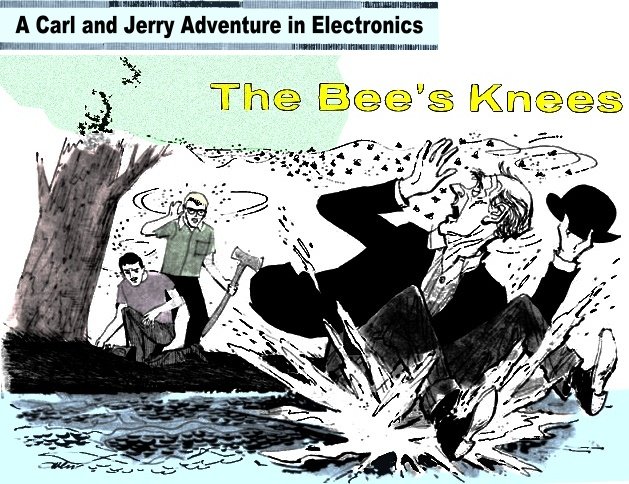
Carl and Jerry were sitting on Carl's back stoop enjoying the dew-washed freshness of the summer morning. Carl had Bosco, his dog, clamped firmly between his knees and was wooling the dog's ears affectionately while the animal growled in mock protest at this thoroughly enjoyed rough treatment. "Hey, there's Mr. Gruber heading this way," Jerry said. "Sure looks as though he has something on his mind." Carl turned to see his elderly neighbor coming across the back yards at such a lively clip that his cane barely touched the grass. The little man was a favorite with both boys. They admired and respected the way Mr. Gruber refused to bow to his advancing years, maintaining a deep interest in every- thing, and especially scientific progress. Most of all they liked his enthusiasm, the way he became all worked up over a new idea or project. "Good morning," he greeted them as he sat down on the bottom step and began to fan himself with his ancient battered derby. "I was hoping you two might be up already. You're invited to join me in performing a very interesting and rewarding experiment." "Good!" Carl exclaimed. "We were just wondering what we could do on a fine day like this. What have you got in mind ?" "Getting the honey out of a bee tree I've spotted!" Mr. Gruber announced triumphantly. "Yesterday when I was up Eel River fishing for goggle-eye, I noticed lots of bees flying around. I did some investigating, and found them going in and out of a hole in the side of a big old sycamore growing right on the bank of the river. Since the tree is growing between the road and the river, we don't have to ask anyone's permission to chop into it." "How about the bees' permission?" Jerry asked. "While it has been some time since I was stung, I can remember how it feels with no trouble." "We'll take care of that," Mr. Gruber said confidently. His blue eyes sparkled happily behind his steel -rimmed glasses as he went on. "Boys, you haven't really lived until you've helped cut a bee tree. It has everything: danger, mounting suspense, and finally a sweet reward. Best of all, it will give us a chance to try a new electronic method of keeping the bees quiet while we scoop out the honey. Just last week I read an article about it, and now we can try it. It seems like fate." "What is this new electronic method'?" Carl asked cautiously. "It was discovered by the entomology department of the University of Wisconsin's School of Agriculture along with the U. S. Department of Agriculture's Bee Culture Laboratory in Madison. The work was done by Mr. R. E. Showers, a teacher at the East High School in Green Bay, while holding a National Science Foundation fellowship and working under the supervision of Dr. F. E. Moeller. In fact, Mr. Showers and some of his high school students are still carrying on experiments. "Anyway, it was discovered that certain audio frequencies have a very profound effect on bees. Frequencies between two hundred and twelve hundred cycles seemed to produce a strong tranquilizing effect, with nine hundred and sixty cycles being the optimum frequency. Going either way from this frequency reduced the effect. When a scout bee you know, the one that comes back to the hive and does an interpretive dance to tell the others where the goodies are - was exposed to nine hundred and sixty cycle audio, lie danced out completely erroneous information as long as the sound was on! Investigators were able to work colonies of bees without being stung and without the protection of veils or smoke, using only the soporific effect of a small code-practice buzzer tuned to nine hundred and sixty cycles and fastened to the side of the hive. Even when the bees had been quieted for as long as a half hour with the audio, they returned to normal almost instantly when the sound was cut off." "Very interesting!" Jerry commented. "But how do we go about using this information?" "There's nothing to it!" Mr. Gruber said, getting to his feet. "You fellows have a little transistorized audio amplifier and a transistorized code-practice oscillator already built up. You set the oscillator on nine hundred and sixty cycles and feed it into the amplifier. The amplifier can feed out into a small speaker with which we can direct sound toward the hole in the tree. While the sound puts the bees to sleep, we can chop into the tree and take out the honey. A half-watt of audio should be plenty-the buzzer the entomologists used couldn't have put out more than that." "What do you think, Carl," Jerry asked, sounding more and more intrigued by the moment. "I say let's do it," Carl answered, already way ahead of him. "Time's a wastin'," Mr. Gruber broke in. "You two put the electronic gear we need into your car and drive around back in the alley. I'll get my axe and some dishpans and a dipper from Martha for collecting the honey. Boy oh boy! I can almost taste that fresh honey on hot biscuits right now!" He departed in a shuttling trot, and Carl and Jerry, grinning affectionately at his retreating figure, started obediently for their basement laboratory. Truth to tell, they also felt tugs of growing excitement. There was something infectious about the enthusiasm of the little man. Mr. Gruber was waiting for them when they stopped the car behind his garage, and they quickly loaded the pans and the axe into the trunk. Bosco, sensing that something was afoot, had followed them, and now he stood at the corner of the garage with drooping head and tail, looking the very picture of dejection as he saw they were preparing to leave without him. "Hold on!" Mr. Gruber called as Carl started the motor. "Look at that poor 'dog standing there sorrowing because he's being left out of the fun. Can't we take him?" "O.K.," Carl agreed. "An act such as that canine ham is putting on deserves an Oscar and should be rewarded. Come on, Bosco!" The animal's head and tail came up in a flash, and he leaped clear over the closed rear door of the car and landed in the seat with Mr. Gruber, shivering with delight at being permitted to go along. They soon reached the spot where Mr. Gruber had been fishing. The little-traveled road paralleled the river at this point, with only a narrow strip of sloping river bank separating the two. While Bosco frolicked about, sniffing at all sorts of exciting scents, Carl and Jerry, carrying the equipment, followed Mr. Gruber along a path through the low bushes until he reached the base of a big sycamore tree. There was a three-inch hole in the scaly trunk about a dozen feet from the ground, and bees were flying busily in and out. Jerry connected up the oscillator, speaker, and amplifier while Mr. Gruber stalked about the tree eying it with the intent concentration of a diamond cutter preparing to split the Great Koh-i-Noor. Finally he extended his cane and touched a spot on the trunk about shoulder high and directly beneath the bees' entrance. "We'll chop here," he said to Carl, who was leaning on the axe handle. "Are you ready with the 'bee -pacifier,' Jer- ?" For an answer, Jerry threw a switch. A pure, surprisingly loud tone came from the little speaker he held in his hand. "Point the speaker directly at the hole and stand out of the way of Carl's axe," Mr. Gruber directed. "Okay, Paul Bunyan, lay on the wood!" Carl spat on his hands in imitation of a professional lumberjack, swung the double-bitted axe back over his shoulder, and sank the blade deep into the green tree-trunk. He never had a chance to chop a second time. A tornado of angry insects boiled from the hole in the trunk and descended like a blanket, sparing no one. While Carl and Jerry were feeling the stabbing pain of multiple stings, they saw Mr. Gruber snatch off his derby and start flailing wildly with it, and yelps from Bosco revealed that he, too, was being stung. Suddenly Mr. Gruber turned and ran for the river with the speed and nimbleness of a sixteen-year-old, and the boys and the dog were right behind the galvanized little man as he gave a great leap out into the stream and disappeared beneath the surface. Fortunately, the water was only about three feet deep, and it was fairly easy to keep submerged simply by squatting down and coming up briefly now and then for air. After a few minutes the bees gave up the attack, and the three men cautiously surfaced and waded on out to a sand bar in the middle of the stream. Bosco was already there, whimpering and pawing at his muzzle which had received the most stings. That didn't work very well, did it?" Mr. Gruber said sheepishly, glancing out of the corner of his eye at the lumpy, swelling faces of his young friends. "That's the understatement of the year," Carl agreed, grinning crookedly as he started plucking stings from the back of his hand. "Don't do that!" Mr. Gruber said. "You're just squeezing venom from the little poison sacks down into the skin punctures. Scrape the stings off with a knife blade as I'm doing. That way they won't amount to much." "Mr. Gruber," Jerry asked, "are you sure you didn't overlook something in that article about the bee-tranquilizing?" "See for yourself," Mr. Gruber invited as he removed his derby, shook some water from it, and fished a soggy newspaper clipping from inside the sweatband. Jerry read the story and then carefully examined the clipping. Suddenly he used his fingernails to separate two layers of paper and peeled them apart until the clipping was twice its former length. He read the continuation of the story, and a smile creased his swollen face. "Mr. Gruber," he said gently, "I'm afraid you were in such a hurry to try out this bee-quieting business that you forgot one important point. The story goes on to say that the threshold limit for the reaction was 125 db of audio measured at the level of the bee. The figure is confusing since it gives the airborne energy which just serves to disturb the substrate. The actual sound energy we put into the substrate is much less, and it is substrate vibration that causes the reaction. In other words, there was enough energy from that little buzzer the researchers screwed to the side of the hive to quiet the bees perched on the hive or the comb, but to transmit the same amount of vibration to the hive by conduction through the air from a speaker, we would have to exceed the limit of human pain. The experimenters were never able to put out enough audio energy to quiet a bee while in flight." "If that doesn't beat everything!" Mr. Gruber exclaimed with a crestfallen air. "Now I remember I was interrupted by Martha's wanting me to go to the store while I was reading that article. I folded it and put it into my hat where it stuck together. I never finished reading it and even forgot that there was more to it. Does the story say anything else?" "There's one other thing. By amputating pairs of legs, the entomologists have found that the fore pair is about eighty-five per cent responsible for carrying the sound stimulus. The remaining fifteen per cent of conduction is about equally divided between the middle and hind pairs. Why are you grinning, Carl?" "I was just thinking about that business of the sound energy having to be conducted to the bee's body through his legs," Carl said. "We failed because our sound energy didn't pass through the bee's knees. Get it? 'The bee's knees-' " He was interrupted by handfuls of sand scooped in his direction by both Mr. Gruber and Jerry. Even Bosco barked and tried to nip his ankles as he ran away laughing.
|
|||||||||||||
 |
|||||||||||||
|
|||||||||||||




|
||||||||||||||||||||||||||||||||||||