|
|||||||||||||
 |
|||||||||||||
Carl and Jerry: Out of the Depths
|
|||||||||||||
Carl and Jerry stories are usually a good mixture of teenage curiosity, adventure, and electronics technology, but this "Out of the Depths" episode is a bit too far-fetched. The first ninety percent of this 1957 Popular Electronics magazine tale fulfills expectations, with the boys applying their shared interest in technology while attempting to learn and apply the technique of luring elusive fish from their safe dwelling places and onto the ends of their hooks. A car battery, DC-to-AC inverter, tape recorder, and high-gain microphone are the basis for the scheme. Things were going well, and I expected the normal hard-fought victory with big, fat bass in their creels - and then something only slightly more believable than finding a crashed alien spaceship at the bottom of the pit happened. I won't spoil it for you. I colorized the drawing since it was originally black and white.
Carl and Jerry - Out of the Depths
Carl and Jerry were stretched out flat on their stomachs on a grassy bank peering down into the clear depths of an abandoned gravel pit. Swimming lazily around in the limpid water below were bass that would go four or five pounds at least. Every now and then Jerry pinched a bit of bread from the sandwich he was munching and flipped it into the water. Huge fish would dart toward the descending bread from all directions, only to turn disdainfully away as they saw what it was. "These gravel-pit bass are the smartest fish in the world," Jerry said with conviction. "I've tried every lure in my tackle box on them, and I've even stooped to bait fishing; but I've never lifted one of those pot-bellied beauties out yet, nor have I seen anyone else do it." "It's funny how they come from all sides when that bread hits the water," Carl remarked, rolling over on his back and throwing an arm across his face to shield his eyes from the warm June sun. "You'd almost think they had some way of talking to one another." "Maybe they do. I was reading the other day where scientists - working with submarine detecting devices - had discovered that ocean-going fish, at least, are quite noisy. Croakers make grunting noises; shrimp make a noise like a Halloween rattle; other fish make barking noises. Maybe these fresh-water bass yell back and forth to one another down there when one of them spots something good to eat. Sound carries well in the water, you know; so a bass wouldn't have to holler 'come and get it' very loudly to be heard all over the pit." "Hey! I'm getting an idea!" Carl announced, as he sat bolt upright. "Just lie down and be quiet and maybe it will go away," Jerry suggested sleepily.
... By dunking the microphone in the water, they soon produced a recording which showed that the cat was heard only when the mike was immersed ... "No, listen: if we could get a recording of some of those bass telling their scaly chums that soup was on, and then if we played that recording back into the water where we were fishing -" "Hm-m-m-m," Jerry said. "You're getting through to me. I've read that commercial fishermen record the feeding sounds of a school of small fish and play them back into the water to attract larger fish into their nets. Of course, we'd have to have some way of powering the tape recorder -" "I can lick that one," Carl interrupted. "The junk yard where I help the fellow fix up his car radios recently took in a wreck that had an inverter for powering a tape recorder in the car. I can borrow the inverter and a 12-volt battery any time I want to." "So let's go!" Jerry said, scrambling to his feet. "The idea is just crazy enough to work; and even if it doesn't, it'll be fun trying." This pretty well stated the philosophy behind the boys' electronic experimenting. No idea was too outlandish for them to try, and the fun they got out of it was entirely independent of how the experiment turned out. What's more, they were steadily stockpiling electronic experience that would be invaluable to them in later years. In less than an hour they were back at the edge of the pit. The recorder, inverter, and storage battery had been transported in a wheelbarrow pushed by Carl and "steadied" by Jerry. "I'm not going to risk a good microphone on this experiment," Jerry announced, pulling a limp red rubber balloon from his pocket. "I think I can seal up the mike in this balloon so water can't get in, but you never know. This cheap crystal mike cartridge may not be perfectly flat in its response, but it has a very high output and it's expendable. I'll just slip it down into the balloon and tape the rubber neck very tightly around the mike cord with this thin plastic tape, like so. That does it. Let the mike down into the water so the fish can be getting used to it while I connect up the power for the recorder." It didn't take long to connect up the inverter so that it could change the 12 volts d.c. of the battery into 117 volts a.c. for powering the tape recorder. When the tape machine was switched on, the reels revolved in normal fashion. "Guess we're ready," Jerry announced. "I'll run the gain wide open; that way we'll get the faintest possible sounds down on the tape. You toss some bread crumbs in so they'll settle right down past the mike, and we'll see what the finny dwellers have to say." Carl did as directed. The fish came rushing toward the location of the microphone and then turned away just as before. "This tape is going to be a doozy to edit," Carl reflected as he stared down at the submerged microphone. "How are we going to know, by listening, when the fish stop saying : 'Oh looky; there's a goody;' and when they start saying: 'False alarm! It's just an old piece of bread'?" "You've got a point there," Jerry admitted; "but let's worry about that later. I'm going to rewind the tape now and see what we've got." When the beginning of the tape was played back, the results were disappointing. Only some very faint rubbing, swishing sounds could be heard. "All I've got to say," Carl remarked, "is that those bass may be large-mouthed, but they certainly aren't loud-mouthed." "Maybe we'd better try it again," Jerry suggested, reaching for the tape-movement knob. At the very instant he touched it, there came faintly from the speaker the unmistakable meowing of a cat. "Holy cow!" Carl exclaimed, shading his bulging eyes and looking down at the microphone still dangling in the water. "I didn't see any catfish down there." "Get hold of yourself!" Jerry commanded, although he was visibly shaken himself. "Catfish don't make sounds like cats - or at least I don't think they do. Maybe that sound was already on the tape and wasn't perfectly erased. Just a minute. I'm going to put this thing on 'Record' and switch the monitor speaker in so we can hear what's being put on the tape. That way we can tell if we are actually picking up the cat on the submerged mike. He did this, and sure enough, the meowing came from the speaker. When the volume control of the recorder was turned down, the sound disappeared, no matter how carefully the boys listened. Jerry turned the gain of the recorder amplifier back up and Carl carefully lifted the mike from the water. At the instant the microphone broke surface, the meowing sound in the speaker stopped, only to be followed quickly by a feedback howl. By switching off the monitor speaker and dunking the crystal microphone in and out of the water, they soon produced a recording which showed plainly that the sound of the cat was heard only when the microphone was immersed. "We've got to think this thing through," Jerry announced as he switched off the recorder to save the storage battery. "It simply must have a logical explanation - having nothing to do with cat-ghosts or meowing fish. That sound must be coming from a real cat, and that cat must somehow be alive down there in the water." "Nice reasoning so far," Carl applauded sarcastically; "now all you've got to do is explain how a cat can live under water." "While I'm thinking about it, let's try something else," Jerry suggested. "Let's load the recorder into that old boat down there and row around over the gravel pit while we listen. If we can tell what part of the pit the sound is coming from, that may help." It didn't take them long to set up the recorder and its power supply in the mossy old boat. They left the monitor speaker on while they slowly and quietly moved around the small pit. It only took a very short time to establish definitely that the sound was much louder when they were on the side next to the road. "Try letting the microphone down near that oil drum lying on the bottom," Carl suggested, using the oars to ease the boat into position directly over the drum. Jerry let the microphone down until it was actually resting on the top of the drum some eight or ten feet below the surface. As he did so, the sound of the meowing became very loud. "There's a cat inside that barrel!" Jerry said in amazement. Carl didn't say anything. He kicked off his shoes and socks, pulled the sweat shirt off ever his head, and then stood up, unbuckled his belt and stepped out of his trousers. Wearing only his shorts, he slid over the side of the boat and handed his glasses to Jerry as he said: "I'm going down and tie the anchor rope around the drum. Then I'll come back up and help you pull that thing out on the bank, and we'll see what gives. A cat can't last too long inside there." As he finished speaking, he let go of the side of the boat and started swimming down to the barrel with the anchor rope trailing behind him. It took two or three dives, though, before he was finally able to tie the rope around the middle of the drum. As soon as he was out on the bank, the boys started pulling on the rope. The metal barrel came up easily until it reached the surface, but then Carl and Jerry had to pull with all their might to get it out on the bank. They discovered it was really a grease drum with a tight press-on lid. Once the drum was out of the water, the boys could hear the distressed yowling of a cat inside very plainly, and they lost no time in prying off the lid. As they did so, a very black, very bedraggled cat shot out of the opening as though it were jet-propelled and sailed right up the trunk of the nearest tree. There it perched in the crotch of a limb, glaring down at its liberators with a pair of angry golden eyes. "I'll be darned," Jerry said, peering down into the drum. "This thing has a lot of old junk iron in it. No wonder it was so heavy. There's a hole punched in the bottom that let in enough water to allow it to sink. Fortunately for Mr. Cat, it sank with the hole down; so a pocket of air was trapped in the top of the drum. That, plus the fact that he could keep out of water on the old iron, was what saved him." "How on earth did he get in there in the first place ?" "Some poor excuse for a human being put him there," Jerry said, his normally good-natured round face solemn with anger. "The miserable joker was probably getting this barrel ready to haul out here to the pit, and he just picked up the cat, tossed him inside and clamped on the lid. He must have thrown the drum into the pit while we were getting the recorder." "I think I'll take that cat home with me," Carl announced. "I'd sort of like to prove to him that not everyone is as mean and ornery as the person who put him into that barrel. He doesn't look too friendly but maybe a little warm milk will win him over. Wonder what we should call him ?" "Well, considering that a cat is supposed to have nine lives, and thinking about what would have happened if we hadn't picked this precise spot at this exact time to make our underwater recording, why not call him Eight-to-Go ?" Jerry suggested.
|
|||||||||||||
|
|
|||||||||||||
|
|||||||||||||

 By John T. Frye W9EGV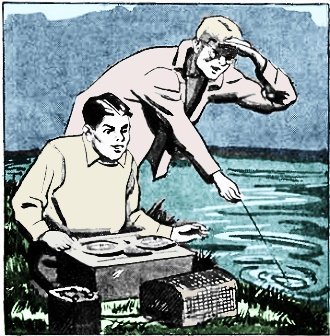



|
||||||||||||||||||||||||||||||||||||