|
|||||||||||||
 |
|||||||||||||
Carl and Jerry: First Case
|
|||||||||||||
When this Carl and Jerry episode appeared in Popular Electronics magazine in the spring of 1961, it told of the boys' lack of success in finding employment during the summer between high school graduation and college. As was typically the case with John Frye's technodramas, it reflected the state of the world at that time in history - in this case warm weather, and a job market in a slump following the post-Korean War hump, along with an unemployment rate at around 7% and an economic recession. Not ones for succumbing to circumstances, Carl and Jerry decided to start their own electronics service business. In a bad economy, people tended to have things repaired rather than replace them - which was usually way cheaper back before cheap goods from China were readily available. ...but I digress. "First Case" is actually an extremely good example of how Mr. Frye always integrates a valuable technical lesson into his plot. Without spoiling the story, I'll just say it involves the joy of PIMs (passive intermodulation) - although they are not called that. A comprehensive list of all the Carl & Jerry episodes posted on RF Cafe is at the bottom of the page. Carl & Jerry: First Case
It seemed odd. For years Carl and Jerry had dreamed of how "super" it was going to feel to be out of high school. Now, with graduation only a week behind them, they were bored and ill at ease in their new freedom. Playing with electronics and performing entertaining experiments, into which they had entered with such zest before, had suddenly become "kid stuff." The boys felt that they should be earning money to help with their college education. But since they were going to the university in the fall, there was no point in trying to get a regular job even if they could have found one. Business conditions were still slack in the community, and a week's search had convinced them that no part-time jobs were available.
C & J Electronic Laboratories On this bright June afternoon Carl and Jerry were sitting in their basement laboratory hopefully waiting for the world to beat a path to their door; but they were genuinely surprised when they heard light footsteps descending the outside stairs and a young slip of a girl - she could not have been more than twelve or thirteen - stood framed in the doorway. She was dressed in a white blouse and loud - checked tapered pants, and she leaned with studied casualness against the door jamb. Peering in at them with a pair of blue eyes beneath a Veronica Lake mop of blonde hair, she said in a voice pitched surprisingly low for a child : "Helooo, boys. I have a problem." She waited expectantly. Jerry recovered first from his astonishment and invited, "Won't you come in and tell us about it?" She minced over to the leather-covered couch in a walk that was a rather ludicrous imitation of the slinky gait of a 1930 movie vamp, then sat down and crossed her long thin legs. "Listen close, boys," she began in that strange, husky voice; "I'm expecting an important call and can't stay long. My name is Hall, Loree Hall, spelled L-o-r-e-e; we moved into that big brown house across the street in March. Now I get a real blast out of detective programs on TV, but lately something has been clobbering my favorite program, 'The Private Eye Playboy,' on Channel 6 every Monday night. This interference occurs only when PEP - that's what I call 'Private Eye' - is on, and it completely blacks out the picture. "At first I thought you two were causing the interference, since I'm told you noodle around with radio and stuff like that. But last Monday evening you were both out in front playing catch when it happened, so that gives you an air-tight alibi. What I want you to do is find out who or what is jamming my program and put a stop to it. No questions will be asked as to how you do it."
"Aw - we can't - I mean - professional ethics do not permit us to accept a retainer until we decide to take your case," Carl sputtered, backing away. "Very well," the little girl said as she stood up. "Suppose you come over tonight a little before 7:30 and see for yourself. I'll be expecting you, gentlemen." Just as she reached the door, the boys heard a woman's voice calling impatiently: "Laura, where are you ? You come here right now and finish straightening up your room!" "I'm coming, Mother," the girl answered, in a voice that suddenly rose to a normal childish treble. She forgot her siren-slink and took the steps two at a time. "Man, what a performance!" Carl chuckled. "I'd say that there is a little girl who has been over-exposed to TV dramas. What do we do?" "Help the maiden in distress," Jerry answered promptly. "After all, she's our first and only client; so we can't be choosy. Anyway, my curiosity is aroused. I'll meet you here about a quarter of seven. Bring along your portable TV." Mr. and Mrs. Hall, a pleasant-looking young couple, were sitting on their front-porch glider when Carl and Jerry walked across the street. "You must be the young men Laura says are going to help her with her television problem," Mr. Hall said as he shook hands with them. "I certainly hope you can. Her imagination scares me sometimes, but she's a good child and gets a lot of pleasure from her TV programs. Laura." he called, "you have company!" The little girl, wearing a sheath-like dress that looked a little old for her, ushered them up the stairs to her large, airy bedroom. As she snapped on her TV receiver, she turned to them and asked in the voice that had returned to its low-pitched huskiness: "Like a drink, fellows ? Coke ? Pepsi ? Lemonade ?" "No, thanks," Jerry replied without cracking a smile. "We never drink when we're on a case." Soon the station-break flurry of commercials was over, and "PEP" began with a long-shot of a pretty girl sunbathing on a lonely beach. At this instant the picture suddenly flashed and turned to a negative, the white and black tones reversing. The condition persisted long enough for Carl to turn on his portable receiver and find that the picture on it was about the same. When he moved over near the door, however, the interference was not quite so bad. He manipulated the fine-tuning control far to one side and heard a voice faintly giving some call letters; then both pictures snapped back to normal. "Hey, that's Eddy!" Carl exclaimed as he unplugged his portable TV. "He's a ham who lives right behind you, Loree. Let's go see him, Jer."
Her face lit up, and soon the three of them were sitting in Eddy's ham shack waiting for the teen-ager to finish his conversation with another ham in a neighboring town. When the QSO was over, they explained the reason for their visit. "My older brother and I have a ten-meter ground-wave sked every Monday night at this time," Eddy said, "but I've never had a TVI complaint before. The transmitter is thoroughly shielded; all leads coming out of it are filtered; the feed-line standing-wave ratio is 1/1 on this frequency; I have a very efficient ground; and the transmitter feeds the beam antenna through a low-pass filter that attenuates harmonic frequencies around 80 db. There's no TVI on my receiver. How does it look on that portable, Carl ?" With the transmitter running full power, not even faint cross-hatching could be seen on Carl's receiver. "Hm-m-m-m," Jerry mused; "Channel 6 interference is apparently coming from the third harmonic of your 28.7-megacycle transmitter frequency; yet no interference is picked up right here at your station. Something at Loree's house must be breaking some of your signal up into harmonics - all we have to do is find that 'something.' Carl, you go home and put your rig on 29.6-megacycle c.w. and start sending very long dashes in exactly ten minutes. Eddy, you start a continuous voice test on your present frequency at the same time. Both of you keep going until I call you on the phone. Loree, you come with me to pick up my transistor radio." Laura was obviously delighted to be included in these mysterious plans. She forgot her femme fatale role and skipped happily along beside Jerry to the lab, then back to her house. Promptly at the appointed time, the picture on her TV blacked out. Jerry turned down the TV sound, tuned his little radio to 900 kc., and began moving around the room. As he came close to a small wire entering the window and running along the wall to a drawer of a bedside table, Eddy's voice came faintly from the transistor radio. "One, two, three, test for TVI," he droned and gave his call letters. Every few seconds the sound disappeared for an instant, then came back.
The child turned red as she pulled open the drawer and revealed a little crystal radio receiver and a pair of earphones. "My folks won't let me listen to my clock radio after ten," she explained, "but that disc-jockey program on the local station at ten-thirty amuses me. You know-the one where silly girls request a number 'for Jack and Mary, who make a wonderful couple' and stupid stuff like that. Well, I listen to it on this little crystal set my uncle gave me for my birthday a month ago. The TV repairman fastened an aerial up on the TV antenna tower for me - that's it coming in the window. He called the wire going to the register a 'ground,' I think." Without replying, Jerry unfastened the wire from the antenna post of the crystal set. Instantly the voice disappeared from the radio and the interference from the TV picture. Replacing the wire brought it back. Jerry picked up the telephone on the bedside table and told Carl and Eddy they could shut down their transmitters. "Loree," he said, turning to the girl, "you saw for yourself that Eddy's transmitter was virtually free of TV-interfering signals, called harmonics. But often when a very strong signal near a transmitter encounters a device that passes current in only one direction we call this a nonlinear system - two things can happen: first, the clean signal can be broken up into harmonics that will cause interference near the nonlinear system; and second, two strong signals will be mixed in the system and produce two new frequencies representing the sum and difference of the frequencies of the strong signals." "My, you're smart to know all that," Loree sighed as she fluttered her eyelashes admiringly at Jerry. "Lots of things can constitute nonlinear systems besides man-made rectifiers," Jerry went on. "All you need is a couple of pieces of metal with a little oxide, such as rust or corrosion, separating them. Poor connections in TV antennas, tower and mast joints, lightning arrestors, gutters and roof drains, electrical conduit, clothes-line, guy wires - these are only a few examples. A bad case of TVI was once caused by a clean-out poker hanging from a furnace pipe. "The crystal detector in your little radio and that thirty-some-foot-long aerial wire were almost perfect for producing and radiating a ten-meter harmonic to black out Channel 6. When Carl and Eddy were both transmitting on frequencies 900 kc. apart, their signals were mixed in the detector and produced the difference frequency I picked up on my little broadcast receiver. That's how I hoped to find out what was causing the trouble, and it worked. I suggest you leave the aerial off your set when you're not listening to it." "I will," Laura promised. "Now I know an amateur transmitter never causes TV interference unless there's a nasty old 'system' near the receiver."
Well," Laura said briskly, picking up her purse, "what do I owe you two? Your service has been most satisfactory." "Oh-" Jerry began with a deprecating wave of his hand; but he stopped short as he saw Laura's father standing out in the hall shaking his head firmly from side to side. "Well, let's see, now: this case was very easily solved. We had no operating expense. Then there's our usual neighborhood discount. Our client was most charming and cooperative - I'd say two dollars would be fine." Later, out on the porch, Mr. Hall explained : "Boys, the cruelest thing you can do to a little girl is to treat her as a child when she is feeling very grown up. Don't worry about the two dollars. You more than earned it, and I can do a little juggling with her allowance. But whether you want it or not, I'm sure you two have earned something else: the hero-worship of a little girl. That's quite a responsibility."
|
|||||||||||||
 |
|||||||||||||
|
|||||||||||||

 By John T. Frye, W9EGV
 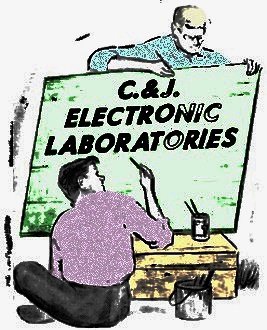 So they decided to go into business for themselves.
They spent a whole half-day carefully lettering a sign and neatly erecting it in
Jerry's front yard:
So they decided to go into business for themselves.
They spent a whole half-day carefully lettering a sign and neatly erecting it in
Jerry's front yard: 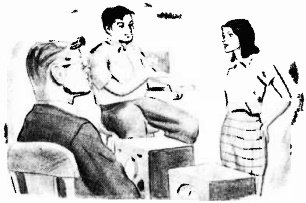 Carl and Jerry exchanged glances, trying to
conceal their amusement. The girl tugged a little coin purse out of her pocket and
extracted two limp dollar bills, holding them out to Carl. "I have a good income,
and I'm willing to pay any reasonable amount," she said with great dignity. "Please
consider this a retainer."
Carl and Jerry exchanged glances, trying to
conceal their amusement. The girl tugged a little coin purse out of her pocket and
extracted two limp dollar bills, holding them out to Carl. "I have a good income,
and I'm willing to pay any reasonable amount," she said with great dignity. "Please
consider this a retainer." 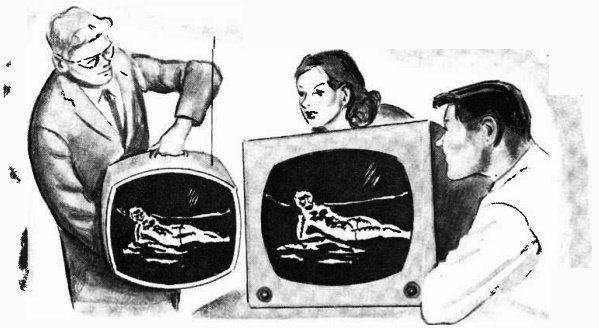
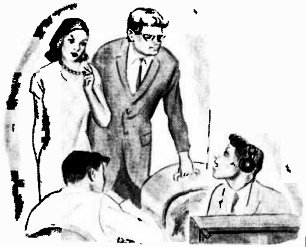 "Loree, where does this wire and that one coming
from the cold air register go?" Jerry asked excitedly.
"Loree, where does this wire and that one coming
from the cold air register go?" Jerry asked excitedly. 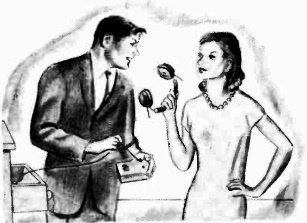 "Unfortunately, that's not quite the case, Loree,"
Carl admitted as he came through the door. "Unless the ham transmitter is carefully
shielded, filtered, and grounded, as Eddy's and mine are, it can send out harmonics
directly from the antenna; but there are cases, such as this one, where the ham
transmitter might be blamed without reason."
"Unfortunately, that's not quite the case, Loree,"
Carl admitted as he came through the door. "Unless the ham transmitter is carefully
shielded, filtered, and grounded, as Eddy's and mine are, it can send out harmonics
directly from the antenna; but there are cases, such as this one, where the ham
transmitter might be blamed without reason." 


|
||||||||||||||||||||||||||||||||||||