Search:                        
Please support my efforts by ADVERTISING!
Serving a Pleasant Blend of Yesterday,
Today, and Tomorrow™

Vintage Magazines

Electronics World
Popular Electronics
Radio & TV News
QST | Pop Science
Popular Mechanics
Radio-Craft
Radio-Electronics
Short Wave Craft
Electronics | OFA
Saturday Eve Post
Electronics Illustrated

Formulas | Data

Electronics | RF
Mathematics
Mechanics
Physics


Calvin & Phineas

Archive | Sitemap

kmblatt83@aol.com

Resources

Radar | AI
Cogitations
RF Museum
Videos | Pics |
Things | Logos
Radio Datashts
WJ Tech Notes
Day in History

Entertainment

Crosswords
Humor | Podcasts
Quotes | Quizzes
Tech Comics

Parts | Services

1000s of Listings


About RF Cafe

Software: RF Cascade Workbook | RF Symbols for Office | RF Symbols & Stencils for Visio | Espresso Workbook
Windfreak Technologies SynthHD PRO - RF Cafe Website

Bell Telephone Laboratories - Junction Diode Amplifier
November 1958 Radio News

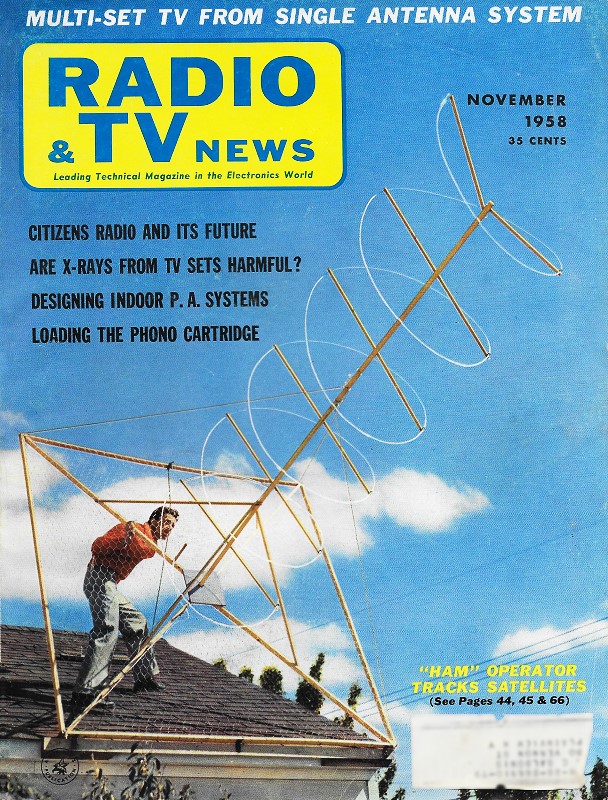
November 1958 Radio & TV News
November 1958 Radio & TV News Cover - RF Cafe Website[Table of Contents]

Wax nostalgic about and learn from the history of early electronics. See articles from Radio & Television News, published 1919-1959. All copyrights hereby acknowledged.

Rudolf Engelbrecht, an alum of Oregon state University, was inducted into the institution's Engineering Hall of Fame in 1998. As evidenced in this full-page advertisement in a 1958 issue of Radio & TV News magazine, Mr. Engelbrecht's work was instrumental in advancing the state of the art in communications electronics while an engineer at Bell Telephone Laboratories (aka Bell Labs). Here, he is show with the four-stage junction diode amplifier developed for military applications. It exploited the variable capacitance nature of a varactor type diode to effect amplification in the UHF and microwave bands. Engelbrecht went on to work at Radio Corporation of America (RCA) later in his career. BTW, if you are wondering what other kind of diode might there be other than a "junction" diode, the answer is that the earliest semiconductor diodes were "point contact" types which used a sharpened metal wire to make contact with the semiconductor substrate. Of course before that were vacuum tube diodes, but they're not semiconductor-based.

Bell Telephone Laboratories Ad

Junction Diode Amplifier, Bell Telephone Laboratories Ad, November 1958 Radio News - RF Cafe WebsiteNew amplifier battles "noise"

Four-stage junction diode amplifier was developed at Bell Telephone Laboratories by Rudolf Engelbrecht for military applications. Operates on the "varactor" principle, utilizing the variable capacitance of diodes. With 400-mc. signal, the gain is 10 db. over the 100-mc. band.

The tremendous possibilities of semiconductor science are again illustrated by a recent development from Bell Telephone Laboratories. The development began with research which Bell Laboratories scientists were conducting for the U. S. Army Signal Corps. The objective was to reduce the "noise" in UHF and microwave receivers and thus increase their ability to pick up weak signals.

Bell Telephone Laboratories Ad, Junction Diode Amplifier, November 1958 Radio News - RF Cafe WebsiteThe scientists attacked the problem by conducting a thorough study of the capabilities of semiconductor junction diodes. These studies led to the conclusion that junction diodes could be made to amplify efficiently at UHF and microwave frequencies. This was something that had never been done before. The theory indicated that such an amplifier would be exceptionally free of noise.

At Bell Laboratories, development engineers proved the point by developing a new kind of amplifier in which the active elements are junction diodes. As predicted, it is extremely low in noise and efficiently amplifies over a wide band of frequencies.

The new amplifier is now being developed for U. S. Army Ordnance radar equipment. But it has numerous other possibilities. In radio astronomy, for example, it could be used to detect weaker signals from outer space. In telephony, it offers a way to increase the distance between relay stations in line-of-sight or over-the-horizon communications.

Bell Telephone Laboratories World Center of Communications R&D - RF Cafe WebsiteBell Telephone Laboratories

World Center of Communications Research and Development


Posted April 8, 2024
(updated from original post on 12/31/2017)

Bell Telephone Laboratories Infomercials
Temwell RF Microwave Components - RF Cafe Website
Please Support My Advertisers!
Transcat | Axiom Test Equipment - RF Cafe Website
Aegis Power | Centric RF | RFCT
Empower RF | Reactel | SF Circuits

Alliance Test | Isotec
Tennode RF Connectors and Cables - RF Cafe Website

KR Electronics (RF Filters) - RF Cafe Website

Anritsu MA25211A P25 Radio Auto Test & Alignment System - RF Cafe Website
Espresso Engineering Workbook

Exodus Advanced Communications Best in Class RF Amplifier SSPAs

Modular Components - RF Cafe Website

Please Support RF Cafe by purchasing my ridiculously low-priced products, all of which I created.

RF Cascade Workbook for Excel

RF & Electronics Symbols for Visio

RF & Electronics Symbols for Office

RF & Electronics Stencils for Visio

RF Workbench

T-Shirts, Mugs, Cups, Ball Caps, Mouse Pads

These Are Available for Free

Espresso Engineering Workbook™

Smith Chart™ for Excel