|
|||||||||||||
 |
|||||||||||||
Navy Electricity and Electronics Training Series (NEETS)
|
|||||||||||||
|
Chapter 1
WAVE PROPAGATION
Learning Objectives
Learning objectives are stated at the beginning of each chapter. These learning objectives serve as a preview of the information you are expected to learn in the chapter. The comprehensive check questions are based on the objectives. By successfully completing the NRTC, you indicate that you have met the objectives and have learned the information. The learning objectives are listed below.
Upon completion of this chapter, you should be able to:
1. State what wave motion is, define the terms reflection, refraction, and diffraction, and describe the Doppler effect.
2. State what sound waves are and define a propagating medium.
3. List and define terms as applied to sound waves, such as cycle, frequency, wavelength, and velocity.
4. List the three requirements for sound.
5. Define pitch, intensity, loudness, and quality and their application to sound waves.
6. State the acoustical effects that echoes, reverberation, resonance, and noise have on sound waves.
7. Define light waves and list their characteristics.
8. List the various colors of light and define the terms reflection, refraction, diffusion, and absorption as applied to light waves.
9. State the difference between sound waves and light waves.
10. State the electromagnetic wave theory and list the components of the electromagnetic wave.
Introduction to WAVE PROPAGATION
Of the many technical subjects that naval personnel are expected to know, probably the one least susceptible to change is the theory of wave propagation. The basic principles that enable waves to be propagated (transmitted) through space are the same today as they were 70 years ago. One would think, then, that a thorough understanding of these principles is a relatively simple task. For the electrical engineer or the individual with a natural curiosity for the unknown, it is indeed a simple task. Most technicians, however, tend to view wave propagation as something complex and confusing, and would just as soon see this chapter completely disappear from training manuals. This attitude undoubtedly stems from the fact that wave propagation is an invisible force that cannot be detected by the sense of sight or touch. Understanding wave propagation requires the use of the imagination to visualize the associated concepts and how they are used in practical application. This manual was developed to help you visualize
1-1 and understand those concepts. Through ample use of illustrations and a step-by-step transition from the simple to the complex, we will help you develop a better understanding of wave propagation. In this chapter, we will discuss propagation theory on an introductory level, without going into the technical details that concern the engineer. However, you must still use thought and imagination to understand the new ideas and concepts as they are presented.
To understand radio wave propagation, you must first learn what wave propagation is and some of the basic physics or properties that affect propagation. Many of these properties are common everyday occurrences, with which you are already familiar.
What Is PROPAGATION?
Early man was quick to recognize the need to communicate beyond the range of the human voice. To satisfy this need, he developed alternate methods of communication, such as hand gestures, beating on a hollow log, and smoke signals. Although these methods were effective, they were still greatly limited in range. Eventually, the range limitations were overcome by the development of courier and postal systems; but there was then a problem of speed. For centuries the time required for the delivery of a message depended on the speed of a horse.
During the latter part of the 19th century, both distance and time limitations were largely overcome. The invention of the telegraph made possible instantaneous communication over long wires. Then a short time later, man discovered how to transmit messages in the form of Radio WAVES.
As you will learn in this chapter, radio waves are propagated. PROPAGATION means "movement through a medium." This is most easily illustrated by light rays. When a light is turned on in a darkened room, light rays travel from the light bulb throughout the room. When a flashlight is turned on, light rays also radiate from its bulb, but are focused into a narrow beam. You can use these examples to picture how radio waves propagate. Like the light in the room, radio waves may spread out in all directions. They can also be focused (concentrated) like the flashlight, depending upon the need. Radio waves are a form of radiant energy, similar to light and heat. Although they can neither be seen nor felt, their presence can be detected through the use of sensitive measuring devices. The speed at which both forms of waves travel is the same; they both travel at the speed of light.
You may wonder why you can see light but not radio waves, which consist of the same form of energy as light. The reason is that you can only "see" what your eyes can detect. Your eyes can detect radiant energy only within a fixed range of frequencies. Since the frequencies of radio waves are below the frequencies your eyes can detect, you cannot see radio waves.
The theory of wave propagation that we discuss in this module applies to Navy electronic equipment, such as radar, navigation, detection, and communication equipment. We will not discuss these individual systems in this module, but we will explain them in future modules.
Q1. What is propagation?
Principles of WAVE MOTION
All things on the earth - on the land, or in the water - are showered continually with waves of energy. Some of these waves stimulate our senses and can be seen, felt, or heard. For instance, we can see light, hear sound, and feel heat. However, there are some waves that do not stimulate our senses. For
1-2 example, radio waves, such as those received by our portable radio or television sets, cannot be seen, heard, or felt. a device must be used to convert radio waves into light (TV pictures) and sound (audio) for us to sense them.
A WAVE can be defined as a DIsTURBANCE (sound, light, radio waves) that moves through a MEDIUM (air, water, vacuum). To help you understand what is meant by "a disturbance which moves through a medium," picture the following illustration. You are standing in the middle of a wheat field. As the wind blows across the field toward you, you can see the wheat stalks bending and rising as the force of the wind moves into and across them. The wheat appears to be moving toward you, but it isn't. Instead, the stalks are actually moving back and forth. We can then say that the "medium" in this illustration is the wheat and the "disturbance" is the wind moving the stalks of wheat.
WAVE MOTION can be defined as a recurring disturbance advancing through space with or without the use of a physical medium. Wave motion, therefore, is a means of moving or transferring energy from one point to another point. For example, when sound waves strike a microphone, sound energy is converted into electrical energy. When light waves strike a phototransistor or radio waves strike an antenna, they are likewise converted into electrical energy. Therefore, sound, light, and radio waves are all forms of energy that are moved by wave motion. We will discuss sound waves, light waves, and radio waves later.
Q2. How is a wave defined as it applies to wave propagation?
Q3. What is wave motion?
Q4. What are some examples of wave motion?
WAVE MOTION IN WATER
A type of wave motion familiar to almost everyone is the movement of waves in water. We will explain these waves first to help you understand wave motion and the terms used to describe it.
Basic wave motion can be shown by dropping a stone into a pool of water (see figure 1-1). As the stone enters the water, a surface disturbance is created, resulting in an expanding series of circular waves. Figure 1-2 is a diagram of this action. View a shows the falling stone just an instant before it strikes the water. View B shows the action taking place at the instant the stone strikes the surface, pushing the water that is around it upward and outward. In view C, the stone has sunk deeper into the water, which has closed violently over it causing some spray, while the leading wave has moved outward. An instant later, the stone has sunk out of sight, leaving the water disturbed as shown in view D. Here the leading wave has continued to move outward and is followed by a series of waves gradually diminishing in amplitude. Meanwhile, the disturbance at the original point of contact has gradually subsided.
Figure 1-1. - Formation of waves in water.
Figure 1-2. - How a falling stone creates wave motion to the surface of water.
In this example, the water is not actually being moved outward by the motion of the waves, but up and down as the waves move outward. The up and down motion is transverse, or at right angles, to the outward motion of the waves. This type of wave motion is called TRANSVERSE WAVE MOTION.
Q5. What type of wave motion is represented by the motion of water?
TRANSVERSE WAVES
To explain transverse waves, we will again use our example of water waves. Figure 1-3 is a cross section diagram of waves viewed from the side. Notice that the waves are a succession of crests and troughs. The wavelength (one 360 degree cycle) is the distance from the crest of one wave to the crest of the next, or between any two similar points on adjacent waves. The amplitude of a transverse wave is half the distance measured vertically from the crest to the trough. Water waves are known as transverse waves because the motion of the water is up and down, or at right angles to the direction in which the waves are traveling. You can see this by observing a cork bobbing up and down on water as the waves pass by; the cork moves very little in a sideways direction. In figure 1-4, the small arrows show the up-and-down direction the cork moves as the transverse wave is set in motion. The direction the wave travels is shown by the large arrow. Radio waves, light waves, and heat waves are examples of transverse waves.
Figure 1-3. - Elements of a wave.
Figure 1-4. - Transverse wave.
LongITUDINAL WAVES
In the previous discussion, we listed radio waves, light waves, and heat waves as examples of transverse waves, but we did not mention sound waves. Why? Simply because sound waves are LongITUDINAL WAVES. Unlike transverse waves, which travel at right angles to the direction of propagation, sound waves travel back and forth in the same direction as the wave motion. Therefore, longitudinal waves are waves in which the disturbance takes place in the direction of propagation. Longitudinal waves are sometimes called COMPRESSION WAVES.
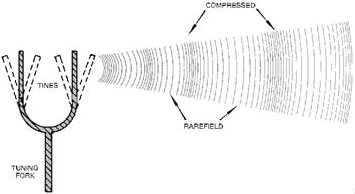
Waves that make up sound, such as those set up in the air by a vibrating tuning fork, are longitudinal waves. In figure 1-5, the tuning fork, when struck, sets up vibrations. As the tine moves in an outward direction, the air immediately in front of it is compressed (made more dense) so that its momentary
1-5 pressure is raised above that at other points in the surrounding medium (air). Because air is elastic, the disturbance is transmitted in an outward direction as a COMPRESSION WAVE. When the tine returns and moves in the inward direction, the air in front of the tine is rarefied (made less dense or expanded) so that its pressure is lowered below that of the other points in the surrounding air. The rarefied wave is propagated from the tuning fork and follows the compressed wave through the medium (air).
Figure 1-5. - Sound propagation by a tuning fork.
Q6. What are some examples of transverse waves?
Q7. What example of a longitudinal wave was given in the text?
MEDIUM
We have used the term medium in describing the motion of waves. Since medium is a term that is used frequently in discussing propagation, it needs to be defined so you will understand what a medium is and its application to propagation.
A MEDIUM is the vehicle through which the wave travels from one point to the next. The vehicle that carries a wave can be just about anything. An example of a medium, already mentioned, is air. Air, as defined by the dictionary, is the mixture of invisible, odorless, tasteless gases that surrounds the earth (the atmosphere). Air is made up of molecules of various gases (and impurities). We will call these molecules of air particles of air or simply particles.
Figure 1-6 will help you to understand how waves travel through air. The object producing the waves is called the SOURCE - a bell in this illustration. The object responding to the waves is called a DETECTOR or RECEIVER - in this case, the human ear. The medium is air, which is the means of conveying the waves from the source to the detector. The source, detector, and medium are all necessary for wave motion and wave propagation (except for electromagnetic waves which require no medium). The waves shown in figure 1-6 are sound waves. As the bell is rung, the particles of air around the bell are compressed and then expanded. This compression and expansion of particles of air set up a wave motion in the air. As the waves are produced, they carry energy from particle to particle through the medium (air) to the detector (ear).
1-6
Figure 1-6. - The three elements of sound.
Q8. What are the three requirements for a wave to be propagated?
TERMS useD IN WAVE MOTION
There are a number of special terms concerning waves that you should know. Many of the terms, such as Cycle, WAVELENGTH, Amplitude, and Frequency were introduced in previous NEETS modules. We will now discuss these terms in detail as they pertain to wave propagation. Before we begin our discussion, however, note that in the figure, wave 1 and wave 2 have equal frequency and wavelength but different amplitudes. The REFERENCE LINE (also known as REST POSITION or Point of ZERO DIsPLACEMENT) is the position that a particle of matter would have if it were not disturbed by wave motion. For example, in the case of the water wave, the reference line is the level of the water when no wave motion is present. With this in mind, let's go on to our discussion of the four terms, as shown in figure 1-7.
Figure 1-7. - Comparison of waves with different amplitudes.
Cycle
Refer to wave 1 in figure 1-7. Notice how similar it is to the sine wave you have already studied. All transverse waves appear as sine waves when viewed from the side. In figure 1-7, wave 1 has four complete cycles. Points ABCDE comprise one complete cycle having a maximum value above and a maximum value below the reference line. The portion above the reference line (between points a and C) is called a Positive ALTERNATION and the portion below the reference line (between points C and E) is known as a Negative ALTERNATION. The combination of one complete positive and one complete negative alternation represents one cycle of the wave. At point E, the wave begins to repeat itself with a second cycle completed at point I, a third at point M, etc. The peak of the positive alternation (maximum value above the line) is sometimes referred to as the TOP or CREST, and the peak of the negative alternation (maximum value below the line) is sometimes called the BOTTOM or TROUGH, as depicted in the figure. Therefore, one cycle has one crest and one trough.
Wavelength
a WAVELENGTH is the distance in space occupied by one cycle of a radio wave at any given instant. If the wave could be frozen in place and measured, the wavelength would be the distance from the leading edge of one cycle to the corresponding point on the next cycle. Wavelengths vary from a few hundredths of an inch at extremely high frequencies to many miles at extremely low frequencies; however, common practice is to express wavelengths in meters. Therefore, in figure 1-7 (wave 1), the distance between a and E, or B and F, etc., is one wavelength. The Greek letter lambda (λ) is used to signify wavelength. Why lambda and not "l" or "L"? This is because "L" is used conventionally as the
symbol for inductance, and "l" is used for dimensional length; therefore, λ; is used to indicate the length of waves.
Amplitude
Two waves may have the same wavelength, but the crest of one may rise higher above the reference line than the crest of the other. Compare wave 1 and wave 2 of figure 1-7 again. The height of a wave crest above the reference line is called the Amplitude of the wave. The amplitude of a wave gives a relative indication of the amount of energy the wave transmits. a continuous series of waves, such as a through Q, having the same amplitude and wavelength, is called a train of waves or WAVE TRAIN.
Frequency and Time
Time is an important factor in wave studies. When a wave train passes through a medium, a certain number of individual waves pass a given point in a specific unit of time. For example, if a cork on a water wave rises and falls once every second, the wave makes one complete up-and-down vibration every second. The number of vibrations, or cycles, of a wave train in a unit of time is called the Frequency of the wave train and is measured in Hertz. If 5 waves pass a point in one second, the frequency of the wave train is 5 cycles per second. In figure 1-7, the frequency of both wave 1 and wave 2 is four cycles per second (cycles per second is abbreviated as cps).
In 1967, in honor of the German physicist Heinrich Hertz, the term Hertz was designated for use in lieu of the term "cycle per second" when referring to the frequency of radio waves. It may seem confusing that in one place the term "cycle" is used to designate the positive and negative alternations of a wave, but in another instance the term "hertz" is used to designate what appears to be the same thing. The key is the time factor. The term cycle refers to any sequence of events, such as the positive and negative alternations, comprising one cycle of electrical current. The term hertz refers to the number of occurrences that take place in one second.
Q9. What is a cycle?
Q10. What is wavelength (λ)?
Characteristics of WAVE MOTION
The two types of wave motion, transverse and longitudinal, have many of the same characteristics, such as frequency, amplitude, and wavelength. Another important characteristic that these two types of wave motion share is VELOCITY. Velocity of propagation is the rate at which the disturbance travels through the medium, or the velocity with which the crest of the wave moves along. The velocity of the wave depends both on the type of wave (light, sound, or radio) and type of medium (air, water, or metal). If longitudinal waves are plotted as a graph, they appear as transverse waves. This fact is illustrated in figure 1-8.
1-9
Figure 1-8. - Longitudinal wave represented graphically by a transverse wave.
The frequency of a longitudinal wave, like that of a transverse wave, is the number of complete cycles the wave makes during a specific unit of time. The higher the frequency, the greater is the number of compressions and expansions per unit of time.
In the two types of wave motion described in the preceding discussion, the following quantities are of interest: a. The PERIOD, which is the time (T) in which one complete vibratory cycle of events occurs,
b. The Frequency of VIBRATION (f), which is the number of cycles taking place in one second, and
c. The WAVELENGTH, which is the distance the disturbance travels during one period of vibration.
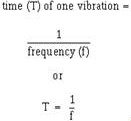
Now, consider the following concept. If a vibrating object makes a certain number of vibrations per second, then 1 second divided by the number of vibrations is equal to the period of time of 1 vibration. In other words, the period, or time, of 1 vibration is the reciprocal of the frequency; thus,
If you know the velocity of a wave, you can determine the wavelength by dividing the velocity by the frequency. As an equation: |
|||||||||||||
 |
|||||||||||||
|
|||||||||||||





|
||||||||||||||||||||||||||||||||||||