|
|||||||||||||
 |
|||||||||||||
Germanium (Ge) Semiconductor |
|||||||||||||
|
Electronics & High Technology Components
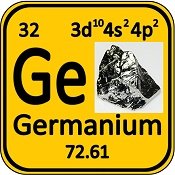 Germanium, a lustrous and brittle metalloid, was discovered in 1886 by the German chemist Clemens Winkler. Its discovery confirmed Dmitri Mendeleev's prediction of an element he called "eka-silicon" based on gaps in his periodic table. Winkler isolated germanium from the mineral argyrodite and named it after his homeland, Germany. Initially, germanium was regarded as a scientific curiosity with few practical applications. The rise of germanium as a crucial material in the electronics industry began in the mid-20th century. Its importance as a semiconductor emerged with the development of the first practical transistors. Germanium's ability to act as a semiconductor was initially explored during the late 1930s and 1940s, particularly during World War II, as researchers sought alternatives to vacuum tubes. Early experiments demonstrated that germanium's crystalline structure could support the controlled flow of electrical current when doped with impurities, a property essential for the creation of p-n junctions. In 1947, the Bell Laboratories team of John Bardeen, Walter Brattain, and William Shockley used germanium to create the first point-contact transistor, a groundbreaking invention that heralded the era of solid-state electronics. In the years following this achievement, germanium became the dominant material for semiconductor devices. Early germanium transistors and diodes were critical components in radios, hearing aids, and early computers, enabling miniaturization and energy efficiency far beyond what vacuum tubes could provide. The material's high electron and hole mobility made it well-suited for high-frequency applications, and its relatively low bandgap allowed for operation at low voltages. However, by the 1960s, germanium's dominance in the semiconductor industry began to wane as silicon emerged as a superior alternative. While germanium offered several advantages, it had limitations such as thermal instability and higher leakage currents. Silicon's abundance, superior thermal properties, and the ability to form a stable native oxide for use in integrated circuits made it the preferred material for the rapidly growing electronics industry. Nonetheless, germanium did not vanish from the technological landscape. Germanium was used as the primary semiconductor material in the early days of transistor development and solid-state electronics for several reasons, primarily tied to its material properties and the state of technology at the time.
Despite these advantages, germanium had significant drawbacks that led to its eventual replacement by silicon:
In contemporary applications, germanium plays a specialized role in high-performance and niche technologies. It is used in high-speed integrated circuits, particularly in heterojunction bipolar transistors (HBTs) and complementary metal-oxide-semiconductor (CMOS) devices, often as part of silicon-germanium (SiGe) alloys. These materials combine the advantages of both elements, improving speed and efficiency in devices such as radio-frequency (RF) amplifiers and mobile communications hardware. Germanium is also essential in fiber optic systems, where it is used as a doping agent in the manufacture of optical fibers. Its transparency to infrared radiation makes it valuable in thermal imaging systems, night-vision devices, and photovoltaic cells for space applications. Furthermore, germanium is employed in the production of specialized detectors for X-rays and gamma rays, particularly in medical and scientific research.
AI Technical Trustability Update While working on an update to my RF Cafe Espresso Engineering Workbook project to add a couple calculators about FM sidebands (available soon). The good news is that AI provided excellent VBA code to generate a set of Bessel function plots. The bad news is when I asked for a table showing at which modulation indices sidebands 0 (carrier) through 5 vanish, none of the agents got it right. Some were really bad. The AI agents typically explain their reason and method correctly, then go on to produces bad results. Even after pointing out errors, subsequent results are still wrong. I do a lot of AI work and see this often, even with subscribing to professional versions. I ultimately generated the table myself. There is going to be a lot of inaccurate information out there based on unverified AI queries, so beware. Electronics & High Tech Companies | Electronics & Tech Publications | Electronics & Tech Pioneers | Electronics & Tech Principles | Tech Standards Groups & Industry Associations | Societal Influences on Technology |
|||||||||||||
 |
|||||||||||||
|
|||||||||||||


|
||||||||||||||||||||||||||||||||||||