See Page 1 |
2 | of the July 2025 homepage archives.
 Here is the second of a two-part article
on
operational amplifiers (opamps). Part 1 appeared in the August
1971 issue of Popular Electronics, which I have and will post soon (it still needs
to be OCR'ed). Fortunately, you don't need it to find Part 2 useful. Barely
half a decade had passed since Bob Widlar introduced his μA709 integrated circuit
operational amplifier. Clunky attempts at vacuum tube operational amplifiers were
introduced in the 1950's, but they were not overly popular. Early bipolar junction
transistor opamps offered a significant reduction in size, weight, and power consumption
over tubes, but did not have as high of an input impedance, had a lower gain-bandwidth
product, and handled much lower power levels, which relegated their use to IF and
baseband circuits... Here is the second of a two-part article
on
operational amplifiers (opamps). Part 1 appeared in the August
1971 issue of Popular Electronics, which I have and will post soon (it still needs
to be OCR'ed). Fortunately, you don't need it to find Part 2 useful. Barely
half a decade had passed since Bob Widlar introduced his μA709 integrated circuit
operational amplifier. Clunky attempts at vacuum tube operational amplifiers were
introduced in the 1950's, but they were not overly popular. Early bipolar junction
transistor opamps offered a significant reduction in size, weight, and power consumption
over tubes, but did not have as high of an input impedance, had a lower gain-bandwidth
product, and handled much lower power levels, which relegated their use to IF and
baseband circuits...
 "Scientists at EPFL have created a revolutionary
biosensor that doesn't need a light source - it makes its own
glow using quantum tunneling. By guiding electrons through a nanostructure of
gold and aluminum oxide, the sensor emits light and detects molecules at astonishingly
small concentrations, down to a trillionth of a gram. With no bulky equipment, it
opens the door to powerful, compact diagnostic tools that could be used anywhere,
from hospitals to remote environments. Optical biosensors work by shining light
onto molecules and reading how that light changes. They are vital tools for pinpoint-accurate
medical tests, tailoring treatments to individuals, and checking..." "Scientists at EPFL have created a revolutionary
biosensor that doesn't need a light source - it makes its own
glow using quantum tunneling. By guiding electrons through a nanostructure of
gold and aluminum oxide, the sensor emits light and detects molecules at astonishingly
small concentrations, down to a trillionth of a gram. With no bulky equipment, it
opens the door to powerful, compact diagnostic tools that could be used anywhere,
from hospitals to remote environments. Optical biosensors work by shining light
onto molecules and reading how that light changes. They are vital tools for pinpoint-accurate
medical tests, tailoring treatments to individuals, and checking..."
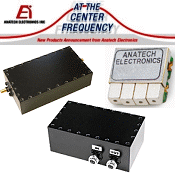 Anatech Electronics offers the industry's
largest portfolio of
high-performance standard and customized RF and microwave filters and filter-related
products for military, commercial, aerospace and defense, and industrial applications
up to 40 GHz. Three new filter models have been added to the product line in
late July, including a LC bandstop notch filter with a bandwidth frequency of 847-853 MHz
and a passband insertion loss of 4 dB maximum, a ceramic bandpass filter with
a bandwidth of 700 MHz and a passband insertion loss of 2.0 dB maximum,
and also a cavity bandpass filter with a 1.5 dB bandwidth of 5 MHz maximum
and an insertion loss of 3 dB maximum. Custom RF power filter... Anatech Electronics offers the industry's
largest portfolio of
high-performance standard and customized RF and microwave filters and filter-related
products for military, commercial, aerospace and defense, and industrial applications
up to 40 GHz. Three new filter models have been added to the product line in
late July, including a LC bandstop notch filter with a bandwidth frequency of 847-853 MHz
and a passband insertion loss of 4 dB maximum, a ceramic bandpass filter with
a bandwidth of 700 MHz and a passband insertion loss of 2.0 dB maximum,
and also a cavity bandpass filter with a 1.5 dB bandwidth of 5 MHz maximum
and an insertion loss of 3 dB maximum. Custom RF power filter...
 This advertisement for General Radio Company's
Recording Wave Analyzer caught my eye due to the chain-driven
interface between the upper Type 1900-A Wave Analyzer and lower Type 1521-B Graphic
Level Recorder chassis. Maybe that can be considered an early form of the GPIB -
General [Instruments] Physical Interface Bus. I wonder how many neckties, a rigidly-enforced
item of professional dress code of the era, got caught in those exposed gears? ...or
fingers for that matter? OSHA would condemn such a platform these days. It is not
apparent from the photograph whether there is also an electrical interface. The
quality of the printed chart output is phenomenally good for 1965 equipment - and
in color, no less. I also found it interesting that a reference was made to "M.
Fourier," as though maybe Fourier's first name began with an "M," but in fact his
full name is Jean-Baptiste Joseph Fourier (French)... This advertisement for General Radio Company's
Recording Wave Analyzer caught my eye due to the chain-driven
interface between the upper Type 1900-A Wave Analyzer and lower Type 1521-B Graphic
Level Recorder chassis. Maybe that can be considered an early form of the GPIB -
General [Instruments] Physical Interface Bus. I wonder how many neckties, a rigidly-enforced
item of professional dress code of the era, got caught in those exposed gears? ...or
fingers for that matter? OSHA would condemn such a platform these days. It is not
apparent from the photograph whether there is also an electrical interface. The
quality of the printed chart output is phenomenally good for 1965 equipment - and
in color, no less. I also found it interesting that a reference was made to "M.
Fourier," as though maybe Fourier's first name began with an "M," but in fact his
full name is Jean-Baptiste Joseph Fourier (French)...
 This is the electronics market prediction
for
Denmark, circa 1966. It was part of a comprehensive assessment
by the editors of Electronics magazine of the state of commercial, military,
and consumer electronics at the end of 1965. Unless you can find a news story on
the state of the industry, detailed reports must be purchased from research companies.
Their websites have a lot of charts on Denmark's current electronics market showing
revenue in the consumer electronics segment amounts of US$2.25B in 2025... This is the electronics market prediction
for
Denmark, circa 1966. It was part of a comprehensive assessment
by the editors of Electronics magazine of the state of commercial, military,
and consumer electronics at the end of 1965. Unless you can find a news story on
the state of the industry, detailed reports must be purchased from research companies.
Their websites have a lot of charts on Denmark's current electronics market showing
revenue in the consumer electronics segment amounts of US$2.25B in 2025...
 I keep looking back through issues of
Popular Electronics magazine for Robert Balin quizzes that I might have
missed, and fortunately this one was found. Unlike quizzes back in school, nobody
but you will ever know how you score on it - that's what makes it fun. Your challenge
is to determine the total resistance value between points A and B both before and
after inserting the
plug into the jack. Mercifully, Mr. Balin specifies that
all the resistors are the same value. The Before part is a piece of cake even for
someone in a first semester electronics course - just be sure to pay attention to
whether or not the contacts short out any of the paths. The phono plug is on the
left and the corresponding jack is on the right. Interpret the dual resistors plug
circuits in figures 5 through 8 as having one resistor connected... I keep looking back through issues of
Popular Electronics magazine for Robert Balin quizzes that I might have
missed, and fortunately this one was found. Unlike quizzes back in school, nobody
but you will ever know how you score on it - that's what makes it fun. Your challenge
is to determine the total resistance value between points A and B both before and
after inserting the
plug into the jack. Mercifully, Mr. Balin specifies that
all the resistors are the same value. The Before part is a piece of cake even for
someone in a first semester electronics course - just be sure to pay attention to
whether or not the contacts short out any of the paths. The phono plug is on the
left and the corresponding jack is on the right. Interpret the dual resistors plug
circuits in figures 5 through 8 as having one resistor connected...
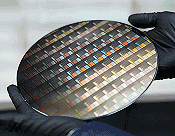 "Chipmaking
giants like Intel, Samsung, and TSMC see a future where key parts of silicon transistors
are replaced with semiconductors that are only a few atoms thick. Although they've
reported progress toward that goal, that future is generally thought to be more
than a decade away. Now, a startup spun out of MIT thinks it has cracked the code
for making commercial-scale
2D semiconductors
and expects chipmakers to have integrated them in advanced chips in half that time.
CDimension has developed a process for growing molybdenum disulfide (MoS2), a 2D
semiconductor, on silicon at a low enough temperature that it will not damage underlying
silicon circuits..." "Chipmaking
giants like Intel, Samsung, and TSMC see a future where key parts of silicon transistors
are replaced with semiconductors that are only a few atoms thick. Although they've
reported progress toward that goal, that future is generally thought to be more
than a decade away. Now, a startup spun out of MIT thinks it has cracked the code
for making commercial-scale
2D semiconductors
and expects chipmakers to have integrated them in advanced chips in half that time.
CDimension has developed a process for growing molybdenum disulfide (MoS2), a 2D
semiconductor, on silicon at a low enough temperature that it will not damage underlying
silicon circuits..."
 Here is an advertisement by
Emerson Radio and Television from the November 6, 1948, edition
of the The Saturday Evening Post. By 1948, America and the free world was
well into the conversion of wartime production back into commercial and consumer
products. After many long years of allocating factory space, personnel, and resources
to beating back the forces of Communism, Marxism, Socialism, and other evil forms
of 'isms," the good times were returning. FM radio broadcasting stations were increasing
rapidly in number, providing static-free listening even in areas of weak reception.
Television was still a relatively new phenomenon for most households. The tabletop
Model 571 "Image Perfection" television carried a price of $299.50 in 1948, which
is the equivalent of a whopping $4,076* in 2025!!! No wonder not many homes had
TV sets... Here is an advertisement by
Emerson Radio and Television from the November 6, 1948, edition
of the The Saturday Evening Post. By 1948, America and the free world was
well into the conversion of wartime production back into commercial and consumer
products. After many long years of allocating factory space, personnel, and resources
to beating back the forces of Communism, Marxism, Socialism, and other evil forms
of 'isms," the good times were returning. FM radio broadcasting stations were increasing
rapidly in number, providing static-free listening even in areas of weak reception.
Television was still a relatively new phenomenon for most households. The tabletop
Model 571 "Image Perfection" television carried a price of $299.50 in 1948, which
is the equivalent of a whopping $4,076* in 2025!!! No wonder not many homes had
TV sets...
 The decade of the 1960's was an exciting
and fast-moving time for electronics, being that it was the beginning of a major
paradigm change from vacuum tubes to transistors, from discrete circuit components
to integrated circuits, and from point-to-point wiring to printed circuit boards.
Computers were on the verge of moving out of university labs and corporate research
and development centers to small businesses and retail headquarters. Electronic
calculators were replacing mechanical calculators. Digital systems were replacing
analog systems.
Electronics training schools were in their collective heyday.
Training prospects lined up in droves and competed to gain acceptance into the institutes.
Home-study courses provided theory and hands-on building and troubleshooting... The decade of the 1960's was an exciting
and fast-moving time for electronics, being that it was the beginning of a major
paradigm change from vacuum tubes to transistors, from discrete circuit components
to integrated circuits, and from point-to-point wiring to printed circuit boards.
Computers were on the verge of moving out of university labs and corporate research
and development centers to small businesses and retail headquarters. Electronic
calculators were replacing mechanical calculators. Digital systems were replacing
analog systems.
Electronics training schools were in their collective heyday.
Training prospects lined up in droves and competed to gain acceptance into the institutes.
Home-study courses provided theory and hands-on building and troubleshooting...
 Since 1996, ISOTEC has designed, developed
and manufactured an extensive line of RF/microwave
connectors, between-series adapters, RF components and filters for wireless
service providers including non-magnetic connectors for quantum computing and MRI
equipments etc. ISOTEC's product line includes low-PIM RF connectors components
such as power dividers and directional couplers. Off-the-shelf and customized products
up to 40 GHz and our low-PIM products can meet -160 dBc with 2 tones and
20 W test. Quick prototyping, advanced in-house testing and high-performance.
Designs that are cost effective practical and repeatable. Since 1996, ISOTEC has designed, developed
and manufactured an extensive line of RF/microwave
connectors, between-series adapters, RF components and filters for wireless
service providers including non-magnetic connectors for quantum computing and MRI
equipments etc. ISOTEC's product line includes low-PIM RF connectors components
such as power dividers and directional couplers. Off-the-shelf and customized products
up to 40 GHz and our low-PIM products can meet -160 dBc with 2 tones and
20 W test. Quick prototyping, advanced in-house testing and high-performance.
Designs that are cost effective practical and repeatable.
 This is the electronics market prediction
for
Belgium, the land of Hercule Poirot, circa 1966. It was part of
a comprehensive assessment by the editors of Electronics magazine of the
state of commercial, military, and consumer electronics at the end of 1965. Military
systems for NATO and television sets were a big part of the picture. Unless you
can find a news story on the state of the industry, detailed reports must be purchased
from research companies. Their website has a lot of charts on Belgium's current
electronics market showing revenue in the consumer electronics segment amounts of
US$2.56B in 2025. The $346.4M reported in 1965 is the equivalent of $3.50B in 2025,
representing a drop of nearly 27%... This is the electronics market prediction
for
Belgium, the land of Hercule Poirot, circa 1966. It was part of
a comprehensive assessment by the editors of Electronics magazine of the
state of commercial, military, and consumer electronics at the end of 1965. Military
systems for NATO and television sets were a big part of the picture. Unless you
can find a news story on the state of the industry, detailed reports must be purchased
from research companies. Their website has a lot of charts on Belgium's current
electronics market showing revenue in the consumer electronics segment amounts of
US$2.56B in 2025. The $346.4M reported in 1965 is the equivalent of $3.50B in 2025,
representing a drop of nearly 27%...
 Exodus Advanced Communications, is a multinational
RF communication equipment and engineering service company serving both commercial
and government entities and their affiliates worldwide. Exodus'
AMP40051, 10.0 to 13.0 GHz solid-state high power amplifier (SSHPA) producing >400
watts of power with 56 dB of gain. Ideal for EMI/RFI, lab, CW/Pulse, and communications
applications. It is a rack-mounted system with wide bandwidth and built-in protection
circuits. Also available, extensive monitoring parameters for forward/reflected
power, voltages, currents and temperature with local LCD/remote interfaces in a
rugged reliable compact design... Exodus Advanced Communications, is a multinational
RF communication equipment and engineering service company serving both commercial
and government entities and their affiliates worldwide. Exodus'
AMP40051, 10.0 to 13.0 GHz solid-state high power amplifier (SSHPA) producing >400
watts of power with 56 dB of gain. Ideal for EMI/RFI, lab, CW/Pulse, and communications
applications. It is a rack-mounted system with wide bandwidth and built-in protection
circuits. Also available, extensive monitoring parameters for forward/reflected
power, voltages, currents and temperature with local LCD/remote interfaces in a
rugged reliable compact design...
 It's hard to imagine a time when
unlicensed radio frequency bands were not the norm, but early
in the history of radio, strict spectrum control was necessary in order to prevent
unintentional radiation from crappy equipment interfering with services. Remember
that even in the mid 1940s, many, if not most, casual users were cobbling together
their own transmitters and receivers from scratch. Transmitter powers were easily
high enough to interfere with nearby and distant receivers, but even improperly
shielded receiver oscillator ("exciters") could cause interference with a neighbor's
nightly Lone Ranger broadcast. Around 1945, the FCC began entertaining
the idea of allocating bandwidth for the use of the newfangled "walkie-talkies"
that were developed for field communications during World War II... It's hard to imagine a time when
unlicensed radio frequency bands were not the norm, but early
in the history of radio, strict spectrum control was necessary in order to prevent
unintentional radiation from crappy equipment interfering with services. Remember
that even in the mid 1940s, many, if not most, casual users were cobbling together
their own transmitters and receivers from scratch. Transmitter powers were easily
high enough to interfere with nearby and distant receivers, but even improperly
shielded receiver oscillator ("exciters") could cause interference with a neighbor's
nightly Lone Ranger broadcast. Around 1945, the FCC began entertaining
the idea of allocating bandwidth for the use of the newfangled "walkie-talkies"
that were developed for field communications during World War II...
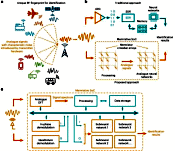 Hey
memristor-denier Tim H.,
you still out there? For a couple years, Tim H. liked to write to insult me
for posting info about "nonexistent" memristors. He's finally given up - too much
evidence that he is the moron. To wit: "Researchers at the UM Amherst, Texas A&M
U. and TetraMem recently introduced a promising new system for processing analog
radiofrequency systems, which is based on non-volatile memory devices known as
memristors integrated on a chip. Their proposed system ... was found to process
radiofrequency signals significantly faster and more energy-efficiently than existing
SDRs. Electronics engineers have thus been trying to develop alternative systems
that can directly manipulate signals in their original form, which would reduce
the movement of data and lower energy consumption..." Hey
memristor-denier Tim H.,
you still out there? For a couple years, Tim H. liked to write to insult me
for posting info about "nonexistent" memristors. He's finally given up - too much
evidence that he is the moron. To wit: "Researchers at the UM Amherst, Texas A&M
U. and TetraMem recently introduced a promising new system for processing analog
radiofrequency systems, which is based on non-volatile memory devices known as
memristors integrated on a chip. Their proposed system ... was found to process
radiofrequency signals significantly faster and more energy-efficiently than existing
SDRs. Electronics engineers have thus been trying to develop alternative systems
that can directly manipulate signals in their original form, which would reduce
the movement of data and lower energy consumption..."
 My Uncle Brian was a
radioman in the U.S. Navy during the end of the Korean War era.
A great story teller, he used to talk about his Navy experiences and later times
as a United Parcel Service (UPS) tandem semi trailer when he and others from my
Buffalo side of the family would come to visit during summers when I was a kid.
He spent most of his enlistment on a gravy assignment at the U.S. embassy in Australia,
relaying messages between self-important bureaucrats at the Pentagon and self-important
bureaucrats at the U.S. embassy in Down Under. His favorite saying about his time
in the service is, "I joined the Navy to see the world, and all I saw was the sea."
I laugh every time I hear it... My Uncle Brian was a
radioman in the U.S. Navy during the end of the Korean War era.
A great story teller, he used to talk about his Navy experiences and later times
as a United Parcel Service (UPS) tandem semi trailer when he and others from my
Buffalo side of the family would come to visit during summers when I was a kid.
He spent most of his enlistment on a gravy assignment at the U.S. embassy in Australia,
relaying messages between self-important bureaucrats at the Pentagon and self-important
bureaucrats at the U.S. embassy in Down Under. His favorite saying about his time
in the service is, "I joined the Navy to see the world, and all I saw was the sea."
I laugh every time I hear it...
 Amplifier Solutions Corporation (ASC) is
a manufacturer of amplifiers for commercial & military markets. ASC designs
and manufactures hybrid, surface mount flange, open carrier and connectorized amplifiers
for low, medium and high power applications using Gallium Nitride (GaN), Gallium
Arsenide (GaAs) and Silicon (Si) transistor technologies. ASC's thick film designs
operate in the frequency range of 300 kHz to 6 GHz. ASC offers thin film
designs that operate up to 20 GHz. ASC is located in an 8,000 sq.ft. facility
in the town of Telford, PA. We offer excellent customer support and take pride in
the ability to quickly react to evolving system design requirements. Amplifier Solutions Corporation (ASC) is
a manufacturer of amplifiers for commercial & military markets. ASC designs
and manufactures hybrid, surface mount flange, open carrier and connectorized amplifiers
for low, medium and high power applications using Gallium Nitride (GaN), Gallium
Arsenide (GaAs) and Silicon (Si) transistor technologies. ASC's thick film designs
operate in the frequency range of 300 kHz to 6 GHz. ASC offers thin film
designs that operate up to 20 GHz. ASC is located in an 8,000 sq.ft. facility
in the town of Telford, PA. We offer excellent customer support and take pride in
the ability to quickly react to evolving system design requirements.
 I love me some good "Mac's Service Shop"
episodes. In this saga, Barney got an earful from a customer who referred to all
electronics technicians as "robbers, crooks, and inefficient boobs."
During a bout of self-assessment as to whether the woman had a point, Mac makes
the following obvious and somewhat profound observation, "The manufacturer has to
daddy the first breakdown because it happened before any of us touched the receiver."
That statement is as true today as it was nearly six decades previous. It applies
to every product made, electronic or otherwise, provided the user hasn't been abusive
purposely or accidentally. Truth is that depending on the design and manufacturing
process, even subsequent breakdowns... I love me some good "Mac's Service Shop"
episodes. In this saga, Barney got an earful from a customer who referred to all
electronics technicians as "robbers, crooks, and inefficient boobs."
During a bout of self-assessment as to whether the woman had a point, Mac makes
the following obvious and somewhat profound observation, "The manufacturer has to
daddy the first breakdown because it happened before any of us touched the receiver."
That statement is as true today as it was nearly six decades previous. It applies
to every product made, electronic or otherwise, provided the user hasn't been abusive
purposely or accidentally. Truth is that depending on the design and manufacturing
process, even subsequent breakdowns...
 "Take part in
The Engineer's 2025 Top Employers Survey. What makes a top engineering employer?
Help us understand the concerns and expectations of the UK's engineering workforce
by taking part in The Engineer's 2025 Top Employers survey. What - in your view
- makes a top engineering employer? What benefits and qualities do you look for
when searching for a new job? What factors would prompt you to consider moving to
another company? And which engineering organisations do you most admire in this
regard? With skilled engineers in huge demand across all sectors of industry, companies
are having to work doubly hard..." "Take part in
The Engineer's 2025 Top Employers Survey. What makes a top engineering employer?
Help us understand the concerns and expectations of the UK's engineering workforce
by taking part in The Engineer's 2025 Top Employers survey. What - in your view
- makes a top engineering employer? What benefits and qualities do you look for
when searching for a new job? What factors would prompt you to consider moving to
another company? And which engineering organisations do you most admire in this
regard? With skilled engineers in huge demand across all sectors of industry, companies
are having to work doubly hard..."
 It is safe to say that all realms of semiconductor
technology have advanced significantly since the 1970s. Gate widths, wafer purity,
doping compounds, feature dimensions, layer stacking, power handling, operational
frequency, physical and ESD ruggedness, cost, reliability - like I said, all realms
- have improved. Laser diodes were a major development due to lower cost, compactness,
spectral purity, and lower operational voltage, as compared to lasers built from
rare earth elements and noble gases. Of course a solid state laser will never (probably)
be able to shoot an inbound ICBM out of the sky, but the vast majority of laser
applications today require only micro- or pico-power. Optical media read / write
devices alone comprise a huge fraction of the low power laser market. Modern laser
diodes are employed in, among other things, chemical analysis, range measurement,
motion / position sensors, and even play toys for cats and dogs... It is safe to say that all realms of semiconductor
technology have advanced significantly since the 1970s. Gate widths, wafer purity,
doping compounds, feature dimensions, layer stacking, power handling, operational
frequency, physical and ESD ruggedness, cost, reliability - like I said, all realms
- have improved. Laser diodes were a major development due to lower cost, compactness,
spectral purity, and lower operational voltage, as compared to lasers built from
rare earth elements and noble gases. Of course a solid state laser will never (probably)
be able to shoot an inbound ICBM out of the sky, but the vast majority of laser
applications today require only micro- or pico-power. Optical media read / write
devices alone comprise a huge fraction of the low power laser market. Modern laser
diodes are employed in, among other things, chemical analysis, range measurement,
motion / position sensors, and even play toys for cats and dogs...
 2001: A Space Odyssey, released
in 1968 and based at least in part on Arthur C. Clarke's 1948 novel The Sentinel,
was more than just a science fiction movie. It was a reflection on the
public's and even some of the scientific community's trepidation over the potential
power of run-amok computers to be used for or even themselves commit evil (e.g,
HAL 9000). Fear of the unknown is nothing new. Noted
mathematicians and computer scientists quoted in this 1950 article
from The Saturday Evening Post magazine worry about robots (aka computers)
"going insane" or being used by the likes of Hitler and Stalin to dominate the world
with totalitarian rule. Others, however, have a more optimistic outlook: "The men
who build the robots do not share these terrors. Far from destroying jobs, they
testify, they will create new ones by the hundreds of thousands... 2001: A Space Odyssey, released
in 1968 and based at least in part on Arthur C. Clarke's 1948 novel The Sentinel,
was more than just a science fiction movie. It was a reflection on the
public's and even some of the scientific community's trepidation over the potential
power of run-amok computers to be used for or even themselves commit evil (e.g,
HAL 9000). Fear of the unknown is nothing new. Noted
mathematicians and computer scientists quoted in this 1950 article
from The Saturday Evening Post magazine worry about robots (aka computers)
"going insane" or being used by the likes of Hitler and Stalin to dominate the world
with totalitarian rule. Others, however, have a more optimistic outlook: "The men
who build the robots do not share these terrors. Far from destroying jobs, they
testify, they will create new ones by the hundreds of thousands...
 Please take a few moments to visit the
everythingRF website to see how they can assist you with your
project. everythingRF is a product discovery platform for RF and microwave products
and services. They currently have 350,744 products from more than 2353 companies
across 480 categories in their database and enable engineers to search for them
using their customized parametric search tool. Amplifiers, test equipment, power
couplers and dividers, coaxial connectors, waveguide, antennas, filters, mixers,
power supplies, and everything else. Please visit everythingRF today to see how
they can help you. Please take a few moments to visit the
everythingRF website to see how they can assist you with your
project. everythingRF is a product discovery platform for RF and microwave products
and services. They currently have 350,744 products from more than 2353 companies
across 480 categories in their database and enable engineers to search for them
using their customized parametric search tool. Amplifiers, test equipment, power
couplers and dividers, coaxial connectors, waveguide, antennas, filters, mixers,
power supplies, and everything else. Please visit everythingRF today to see how
they can help you.
 Here is the very first episode of the "Carl & Jerry" series that ran for many years in Popular
Electronics magazine. In the manner of The Hardy Boys, Nancy Drew, et al, Carl
and Jerry are two teenage boys who, in their pursuit of their electronics hobby,
manage to get themselves involved in crime scene investigations, in odd situations
with friends and adults, and even while horsing around in their basement laboratory.
Every episode is an entertaining combination of mystery, teamwork, drama, and technical
discussion. Amateur radio was a key feature of many of their adventures. John T.
Frye authored every adventure as he developed his sleuthing buddies over time to
go from a frumpy Jerry Bishop with a "well-padded frame" and a Farside-esque bespectacled
Carl Anderson to a couple more stealthy, professional looking investigators who
sometimes employed MacGyver-like tactics during their antics... Here is the very first episode of the "Carl & Jerry" series that ran for many years in Popular
Electronics magazine. In the manner of The Hardy Boys, Nancy Drew, et al, Carl
and Jerry are two teenage boys who, in their pursuit of their electronics hobby,
manage to get themselves involved in crime scene investigations, in odd situations
with friends and adults, and even while horsing around in their basement laboratory.
Every episode is an entertaining combination of mystery, teamwork, drama, and technical
discussion. Amateur radio was a key feature of many of their adventures. John T.
Frye authored every adventure as he developed his sleuthing buddies over time to
go from a frumpy Jerry Bishop with a "well-padded frame" and a Farside-esque bespectacled
Carl Anderson to a couple more stealthy, professional looking investigators who
sometimes employed MacGyver-like tactics during their antics...
 1970 just doesn't seem all that long ago,
but holy moly that is going on half a century! This quiz appeared in Popular
Electronics to test the hobbyist's knowledge of the
whereabouts of some of the major components and products companies.
Many of the businesses have gone defunct, been bought and absorbed by other companies,
or if they do still exist, are in new locations. It will take a real old-timer to
score well on this quiz without resorting to lucky guesses. Still, there are a couple
stalwart manufacturers today that even a newcomer can get right. Most of the
Popular Electronics quizzes were created by Robert P. Balin, but this one was
dreamed up by Thomas Haskett... 1970 just doesn't seem all that long ago,
but holy moly that is going on half a century! This quiz appeared in Popular
Electronics to test the hobbyist's knowledge of the
whereabouts of some of the major components and products companies.
Many of the businesses have gone defunct, been bought and absorbed by other companies,
or if they do still exist, are in new locations. It will take a real old-timer to
score well on this quiz without resorting to lucky guesses. Still, there are a couple
stalwart manufacturers today that even a newcomer can get right. Most of the
Popular Electronics quizzes were created by Robert P. Balin, but this one was
dreamed up by Thomas Haskett...
• Huawei
Claims 1 Generation Behind U.S. Chip Tech
• China
Weaponizes Rare Earths
• Genesis of
European Semi Manufacturing Clean-up
• Senate
Confirms Olivia Trusty for FCC
• Smartphone
Production at 289M Units in Q1
 Across the American interior and on three
other continents, construction crews are already staking out square-mile slabs for
what will be the largest concentration of pure computing capacity ever assembled:
megascale cryptocurrency data centers, each designed to pull 500 MW to
3 GW of power from the grid around the clock. Investors like BlackRock have
locked in more than $50 billion for sites in the Texas Panhandle, North Dakota lignite
belts, Kazakhstan steppe, and Nordic hydro corridors - locations chosen less for
fiber latency than for cheap or energy. The ultimate plan is to migrate the world
off of a single currency standard - currently the U.S. dollar - and on to a global
digital currency based on computer calculations of a collection of cryptocurrency
brands. To be honest, I am not in favor of this scheme... Across the American interior and on three
other continents, construction crews are already staking out square-mile slabs for
what will be the largest concentration of pure computing capacity ever assembled:
megascale cryptocurrency data centers, each designed to pull 500 MW to
3 GW of power from the grid around the clock. Investors like BlackRock have
locked in more than $50 billion for sites in the Texas Panhandle, North Dakota lignite
belts, Kazakhstan steppe, and Nordic hydro corridors - locations chosen less for
fiber latency than for cheap or energy. The ultimate plan is to migrate the world
off of a single currency standard - currently the U.S. dollar - and on to a global
digital currency based on computer calculations of a collection of cryptocurrency
brands. To be honest, I am not in favor of this scheme...
 It is hard to imagine anyone who has not
heard of the
Dolby noise reduction process, even if he/she has no idea what
it is. Dr. Ray Dolby developed his process in 1965, although it was not patented
until 1969 - the year this article appeared in Radio-Electronics magazine.
At the time, "Dolbyized" audio systems were not available in the consumer marketplace
because the price was prohibitively high - $1,495* for a basic A301 system.
Only about 25 units per month were being produced, primarily for recording studios
and reproduction factories. Dolby's magic that can reduce noise by 15 dB works
on the companding (portmanteau of compression and expansion) principle, thereby
eliminating or greatly suppressing the discernable "hiss." Dolby B is still
the most common version in use after nearly half a century... It is hard to imagine anyone who has not
heard of the
Dolby noise reduction process, even if he/she has no idea what
it is. Dr. Ray Dolby developed his process in 1965, although it was not patented
until 1969 - the year this article appeared in Radio-Electronics magazine.
At the time, "Dolbyized" audio systems were not available in the consumer marketplace
because the price was prohibitively high - $1,495* for a basic A301 system.
Only about 25 units per month were being produced, primarily for recording studios
and reproduction factories. Dolby's magic that can reduce noise by 15 dB works
on the companding (portmanteau of compression and expansion) principle, thereby
eliminating or greatly suppressing the discernable "hiss." Dolby B is still
the most common version in use after nearly half a century...
 Copper Mountain Technologies develops innovative
and robust RF test and measurement solutions for engineers all over the world. Copper
Mountain's extensive line of unique form factor
Vector Network Analyzers
include an RF measurement module and a software application which runs on any Windows
PC, laptop or tablet, connecting to the measurement hardware via USB interface.
The result is a lower cost, faster, more effective test process that fits into the
modern workspace in lab, production, field and secure testing environments. 50 Ω
and 75 Ω models are available, along with a full line of precision calibration
and connector adaptors. Copper Mountain Technologies develops innovative
and robust RF test and measurement solutions for engineers all over the world. Copper
Mountain's extensive line of unique form factor
Vector Network Analyzers
include an RF measurement module and a software application which runs on any Windows
PC, laptop or tablet, connecting to the measurement hardware via USB interface.
The result is a lower cost, faster, more effective test process that fits into the
modern workspace in lab, production, field and secure testing environments. 50 Ω
and 75 Ω models are available, along with a full line of precision calibration
and connector adaptors.
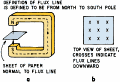 University of Southampton, England, professor
James Holbrook suggests in this 1968 Radio-Electronics magazine article
an "easy-to-follow substitute for the left- and right-hand rules," but I'm not so
sure that the good professor's "Electron Orbit Method" is any better or easier to remember. Admittedly,
it is hard to remember whether the use a left-hand rule or a right-hand rule for
the various physical laws - motor rotation direction, current induction, torque,
vector cross products, etc. Those involving current flow are made even more confounding
because you need to know whether the creator of the rule refers to conventional
current flow (positive-to-negative) of electron current flow (negative-to-positive). Note
in Figure 110 from the Electricity volume of Basic Navy Training Courses
how the generator rule is described as a left-hand rule with conventional current
flow... University of Southampton, England, professor
James Holbrook suggests in this 1968 Radio-Electronics magazine article
an "easy-to-follow substitute for the left- and right-hand rules," but I'm not so
sure that the good professor's "Electron Orbit Method" is any better or easier to remember. Admittedly,
it is hard to remember whether the use a left-hand rule or a right-hand rule for
the various physical laws - motor rotation direction, current induction, torque,
vector cross products, etc. Those involving current flow are made even more confounding
because you need to know whether the creator of the rule refers to conventional
current flow (positive-to-negative) of electron current flow (negative-to-positive). Note
in Figure 110 from the Electricity volume of Basic Navy Training Courses
how the generator rule is described as a left-hand rule with conventional current
flow...
 "everything RF, the leading online publication
for the RF and Microwave industry, has published an eBook titled -
Understanding RF Mixers. The eBook brings together a series of insightful whitepapers
and articles written by industry experts. Key contributors include
Copper Mountain Technologies, Mini-Circuits,
Farran, Marki Microwave, CML Micro, and Boston Micro Fabrication. RF mixers play
a pivotal role in modern communication systems, enabling the conversion of signals
from one frequency to another. These essential devices are at the heart of everything
from smartphone radios to advanced radar and satellite..." "everything RF, the leading online publication
for the RF and Microwave industry, has published an eBook titled -
Understanding RF Mixers. The eBook brings together a series of insightful whitepapers
and articles written by industry experts. Key contributors include
Copper Mountain Technologies, Mini-Circuits,
Farran, Marki Microwave, CML Micro, and Boston Micro Fabrication. RF mixers play
a pivotal role in modern communication systems, enabling the conversion of signals
from one frequency to another. These essential devices are at the heart of everything
from smartphone radios to advanced radar and satellite..."
 Each week, for the sake of all avid cruciverbalists
amongst us, I create a new
technology-themed crossword puzzle using only words from my custom-created
lexicon related to engineering, science, mathematics, chemistry, physics, astronomy,
etc. You will never find among the words names of politicians, mountain ranges,
exotic foods or plants, movie stars, or anything of the sort. You might, however,
see someone or something in the exclusion list who or that is directly related to
this puzzle's theme, such as Hedy Lamarr or the Bikini Atoll, respectively - Enjoy... Each week, for the sake of all avid cruciverbalists
amongst us, I create a new
technology-themed crossword puzzle using only words from my custom-created
lexicon related to engineering, science, mathematics, chemistry, physics, astronomy,
etc. You will never find among the words names of politicians, mountain ranges,
exotic foods or plants, movie stars, or anything of the sort. You might, however,
see someone or something in the exclusion list who or that is directly related to
this puzzle's theme, such as Hedy Lamarr or the Bikini Atoll, respectively - Enjoy...
 The
1933 "Century of Progress" World's Fair, held in Chicago, was
a big deal on many fronts. Life in America and around the world was changing rapidly
due to the widespread introduction into homes a decade earlier of electrical and
telephone service, indoor plumbing, and associated appliances. The state of the
art was a modern wonder. Transportation had been made affordable to many families,
and leisure time was becoming more abundant. If it were not for the advent of the
stock market crash in 1929, economies would be thriving because there was so much
cool stuff to be had. Many people had taken up the hobby and/or profession of wireless
communications, so a display was included on the fairgrounds for the craft. An interesting
consequence of a combination of noisy (electrically) electromechanical wonders being
promoted and the desire to demonstrate working amateur radio equipment was a necessity
to locate the two as far apart as possible... The
1933 "Century of Progress" World's Fair, held in Chicago, was
a big deal on many fronts. Life in America and around the world was changing rapidly
due to the widespread introduction into homes a decade earlier of electrical and
telephone service, indoor plumbing, and associated appliances. The state of the
art was a modern wonder. Transportation had been made affordable to many families,
and leisure time was becoming more abundant. If it were not for the advent of the
stock market crash in 1929, economies would be thriving because there was so much
cool stuff to be had. Many people had taken up the hobby and/or profession of wireless
communications, so a display was included on the fairgrounds for the craft. An interesting
consequence of a combination of noisy (electrically) electromechanical wonders being
promoted and the desire to demonstrate working amateur radio equipment was a necessity
to locate the two as far apart as possible...
 Someone
showed me this meme photo on
Pinterest: "Have
you ever noticed that all the instruments searching for intelligent life...are pointed
away from Earth?" There several versions of it out there. It struck me as really
funny. Since the image contains radio astronomy antenna array, it qualifies for
posting here on RF Cafe. It appears to be the Karl G. Jansky
Very Large Array (VLA),
located in New Mexico. I'm old enough to remember when it saw
first light (or, more
accurately, first radio). Many similar - and much bigger and more advanced - exist
today. The advantage of this configuration is that the effective aperture is roughly
equal to the distance between outer antennas, creating a smaller angular resolution.
The sensitivity is nowhere near that of a full-size antenna, though. Someone
showed me this meme photo on
Pinterest: "Have
you ever noticed that all the instruments searching for intelligent life...are pointed
away from Earth?" There several versions of it out there. It struck me as really
funny. Since the image contains radio astronomy antenna array, it qualifies for
posting here on RF Cafe. It appears to be the Karl G. Jansky
Very Large Array (VLA),
located in New Mexico. I'm old enough to remember when it saw
first light (or, more
accurately, first radio). Many similar - and much bigger and more advanced - exist
today. The advantage of this configuration is that the effective aperture is roughly
equal to the distance between outer antennas, creating a smaller angular resolution.
The sensitivity is nowhere near that of a full-size antenna, though.
 One of the major advantages of the age of
powerful personal computers - be they in the form of desktop systems, tablets, or
smartphone apps - is that for most
computation-intensive tasks there only needs to be one or maybe
at most a few people smart enough to know how to do them. Everyone else who has
to perform the task just needs to be able to input the proper parameters to ensure
a useful output. That is a significant statement, because in the days before ubiquitous
computer availability and incredible computing power, highly capable engineers,
scientists, analysts, and mathematicians either had to be on staff or an expert
external resource was used for difficult and/or time-intensive tasks. Over time,
fewer and fewer people are needed to produce very precise and reliable results.
In many ways, other than the creative intuition involved in concept, creation, and
execution, a large part of the product design and planning phases have been automated... One of the major advantages of the age of
powerful personal computers - be they in the form of desktop systems, tablets, or
smartphone apps - is that for most
computation-intensive tasks there only needs to be one or maybe
at most a few people smart enough to know how to do them. Everyone else who has
to perform the task just needs to be able to input the proper parameters to ensure
a useful output. That is a significant statement, because in the days before ubiquitous
computer availability and incredible computing power, highly capable engineers,
scientists, analysts, and mathematicians either had to be on staff or an expert
external resource was used for difficult and/or time-intensive tasks. Over time,
fewer and fewer people are needed to produce very precise and reliable results.
In many ways, other than the creative intuition involved in concept, creation, and
execution, a large part of the product design and planning phases have been automated...
 "The U.S. government is upping its probe
on Chinese telecommunications equipment, as the Federal Communications Commission
(FCC) sets its sights on
submarine cables. FCC Chairman Brendan Carr last week announced plans to vote
on measures that would 'protect submarine cables against foreign adversaries,' namely
referring to vendors like Huawei and ZTE. These companies already got the cold shoulder
from the U.S. wireless industry due to the government's rip and replace program,
which was established to help carriers take out Chinese..." "The U.S. government is upping its probe
on Chinese telecommunications equipment, as the Federal Communications Commission
(FCC) sets its sights on
submarine cables. FCC Chairman Brendan Carr last week announced plans to vote
on measures that would 'protect submarine cables against foreign adversaries,' namely
referring to vendors like Huawei and ZTE. These companies already got the cold shoulder
from the U.S. wireless industry due to the government's rip and replace program,
which was established to help carriers take out Chinese..."
 Here are a couple of
electronics-themed comics from vintage Radio-Electronics magazines
to bide the time. For anyone not old enough to remember when reel-to-reel magnetic
tape players (see example to the left) were the prized possession of every true
audiophile, the comic on the bottom might be a bit confusing. Recorded music quality
was better than other formats, and the machines had much finer control over play
speed accuracy. Buying factory-recorded song reels was very expensive, so just about
everyone I knew with a reel-to-reel recorded songs onto tape from the radio, cassette
tapes, or albums, so the quality was no better than the original inferior formats.
The advantage of a reel-to-reel, even with second-hand recordings, was that you
could get a couple hours of play time before having to change the reel. Of course
no self-respecting reel-to-reel tape deck owner would even consider recording from
an 8-track tape... Here are a couple of
electronics-themed comics from vintage Radio-Electronics magazines
to bide the time. For anyone not old enough to remember when reel-to-reel magnetic
tape players (see example to the left) were the prized possession of every true
audiophile, the comic on the bottom might be a bit confusing. Recorded music quality
was better than other formats, and the machines had much finer control over play
speed accuracy. Buying factory-recorded song reels was very expensive, so just about
everyone I knew with a reel-to-reel recorded songs onto tape from the radio, cassette
tapes, or albums, so the quality was no better than the original inferior formats.
The advantage of a reel-to-reel, even with second-hand recordings, was that you
could get a couple hours of play time before having to change the reel. Of course
no self-respecting reel-to-reel tape deck owner would even consider recording from
an 8-track tape...
 "One of the least orderly and most poorly
executed of NASA projects," was the description given to the
Surveyor program whose goal was to land on the moon and send back
images, both still and motion (in preparation for a manned landing). That, from
a congressional sub-committee. Yes, the very same Congress that famously cannot
balance its own budget or create successful programs of its own. It is a classic
case of "The pot calling the kettle black." NASA was and always has been at the
bleeding edge of new technology and as such lives in uncharted territory. Unexpected
pitfalls lurk everywhere - a minefield of "gotchas." Not that every organization
can't benefit from external oversight to prevent "blinders-on" engineering and management
teams from straying too far off the defined path, but having the notoriously pompous
and buffoonish bureaucrats... "One of the least orderly and most poorly
executed of NASA projects," was the description given to the
Surveyor program whose goal was to land on the moon and send back
images, both still and motion (in preparation for a manned landing). That, from
a congressional sub-committee. Yes, the very same Congress that famously cannot
balance its own budget or create successful programs of its own. It is a classic
case of "The pot calling the kettle black." NASA was and always has been at the
bleeding edge of new technology and as such lives in uncharted territory. Unexpected
pitfalls lurk everywhere - a minefield of "gotchas." Not that every organization
can't benefit from external oversight to prevent "blinders-on" engineering and management
teams from straying too far off the defined path, but having the notoriously pompous
and buffoonish bureaucrats...
Please take a few moments to visit the
everythingRF website to see how they can assist you with your
project. everythingRF is a product discovery platform for RF and microwave products
and services. They currently have 333,423 products from more than 2198 companies
across 460 categories in their database and enable engineers to search for them
using their customized parametric search tool. Amplifiers, test equipment, power
couplers and dividers, coaxial connectors, waveguide, antennas, filters, mixers,
power supplies, and everything else. Please visit everythingRF today to see how
they can help you.
 Don't let the title fool you. This is not
a "bees-birds-and-flowers routine" being provided to Barney by his boss, Mac. It
turns out to be a brief introduction into the fine art of
troubleshooting intermittent problems in radio and television
circuits. As is usually the case, while the specifics of the scenarios Mac describes
might not apply to your challenge at hand, the general philosophy always does. It
is basically the old process of elimination where after rapping components mechanically
and/or heating or cooling them in hopes of observing a tell-tale change in performance,
the next step is to divide the suspected circuit portion in half (electrically,
but sometimes also physically) and look in one direction. If the problem isn't there,
then... Don't let the title fool you. This is not
a "bees-birds-and-flowers routine" being provided to Barney by his boss, Mac. It
turns out to be a brief introduction into the fine art of
troubleshooting intermittent problems in radio and television
circuits. As is usually the case, while the specifics of the scenarios Mac describes
might not apply to your challenge at hand, the general philosophy always does. It
is basically the old process of elimination where after rapping components mechanically
and/or heating or cooling them in hopes of observing a tell-tale change in performance,
the next step is to divide the suspected circuit portion in half (electrically,
but sometimes also physically) and look in one direction. If the problem isn't there,
then...
 "ARRL The National Association for Amateur
Radio® has filed comments with the Federal Communications Commission (FCC) to oppose
part of an application that would impact the
70-centimeter amateur band for telemetry, tracking and command (TT&C) of
satellites. The application, from AST & Science, LLC (AST), requests 'unprecedented
authorization to 430-440 MHz for a constellation totaling 248 satellites to
communicate with five ground stations using up to five channels with up to 256 kHz
bandwidth.' The formal opposition, filed by ARRL's Washington Counsel, asserts that
the permission AST seeks to use the 430-440 MHz band 'should be denied because
AST does not demonstrate need for TT&C..." "ARRL The National Association for Amateur
Radio® has filed comments with the Federal Communications Commission (FCC) to oppose
part of an application that would impact the
70-centimeter amateur band for telemetry, tracking and command (TT&C) of
satellites. The application, from AST & Science, LLC (AST), requests 'unprecedented
authorization to 430-440 MHz for a constellation totaling 248 satellites to
communicate with five ground stations using up to five channels with up to 256 kHz
bandwidth.' The formal opposition, filed by ARRL's Washington Counsel, asserts that
the permission AST seeks to use the 430-440 MHz band 'should be denied because
AST does not demonstrate need for TT&C..."
 Wirewound inductors
(as most are) can be mysterious entities even when
you are familiar with their many interdependent physical and electrical properties.
Because of interwinding capacitance and a sometimes (when
a large number of turns are involved) rather significant series resistance,
the equivalent circuit model gets quite complex - literally in a mathematical sense.
If you have the luxury of staying far away from the self-resonant frequency
(SRF) of the coil, your component will behave very
much like an ideal inductor, that is, XL = 2πfL. This article
delves into what causes inductors to... Wirewound inductors
(as most are) can be mysterious entities even when
you are familiar with their many interdependent physical and electrical properties.
Because of interwinding capacitance and a sometimes (when
a large number of turns are involved) rather significant series resistance,
the equivalent circuit model gets quite complex - literally in a mathematical sense.
If you have the luxury of staying far away from the self-resonant frequency
(SRF) of the coil, your component will behave very
much like an ideal inductor, that is, XL = 2πfL. This article
delves into what causes inductors to...
 According to this 1972 article in Popular
Electronics magazine, cable television began around 1950. The system was very
different that what we have nearly 70 years later. The familiar acronym CATV does
not stand for CAble TeleVision, but rather
Community Access TeleVision. CATV, as originally implemented,
was a means of bringing broadcast TV to areas either too remote or too shielded
from over-the-air (OTA) RF signals to provide good signal reception. Depending on
the need, CATV could range from re-broadcasting of signals into targeted areas or
sending signals through cable (originally unshielded) to individual homes. As you
might expect, opponents of the new system predicted that such a scheme would eventually
be the kiss of death for local broadcasters since large, well-funded conglomerates
would be able to dominate programming selection and dry up... According to this 1972 article in Popular
Electronics magazine, cable television began around 1950. The system was very
different that what we have nearly 70 years later. The familiar acronym CATV does
not stand for CAble TeleVision, but rather
Community Access TeleVision. CATV, as originally implemented,
was a means of bringing broadcast TV to areas either too remote or too shielded
from over-the-air (OTA) RF signals to provide good signal reception. Depending on
the need, CATV could range from re-broadcasting of signals into targeted areas or
sending signals through cable (originally unshielded) to individual homes. As you
might expect, opponents of the new system predicted that such a scheme would eventually
be the kiss of death for local broadcasters since large, well-funded conglomerates
would be able to dominate programming selection and dry up...
 The leading website for the PCB industry.
PCB Directory is the largest directory of
Printed Circuit Board (PCB)
Manufacturers, Assembly houses, and Design Services on the Internet. We have listed
the leading printed circuit board manufacturers around the world and made them searchable
by their capabilities - Number of laminates used, Board thicknesses supported, Number
of layers supported, Types of substrates (FR-4, Rogers, flexible, rigid), Geographical
location (U.S., China), kinds of services (manufacturing, fabrication, assembly,
prototype), and more. Fast turn-around on quotations for PCB fabrication and assembly. The leading website for the PCB industry.
PCB Directory is the largest directory of
Printed Circuit Board (PCB)
Manufacturers, Assembly houses, and Design Services on the Internet. We have listed
the leading printed circuit board manufacturers around the world and made them searchable
by their capabilities - Number of laminates used, Board thicknesses supported, Number
of layers supported, Types of substrates (FR-4, Rogers, flexible, rigid), Geographical
location (U.S., China), kinds of services (manufacturing, fabrication, assembly,
prototype), and more. Fast turn-around on quotations for PCB fabrication and assembly.
 Decibels
always have been and always will be a daunting subject to a lot of people. For electronics
types, the issue of when to multiply the
logarithm of the ratio by 10 or by 20 seems to be the biggest
stumbling block. After many years of working with decibels, it becomes second nature.
There are still instances, though, where I see seasoned engineers and technicians
routinely confuse unreferenced decibel units (dB, the logarithm of a ratio) with
logs of ratios referred to some base value (dBm, dBV, etc.). The, etc.). The belnit
was originally created to quantitatively assign changes in perceived levels of sound
loudness...unit was originally created to quantitatively assign changes in perceived
levels of sound loudness... Decibels
always have been and always will be a daunting subject to a lot of people. For electronics
types, the issue of when to multiply the
logarithm of the ratio by 10 or by 20 seems to be the biggest
stumbling block. After many years of working with decibels, it becomes second nature.
There are still instances, though, where I see seasoned engineers and technicians
routinely confuse unreferenced decibel units (dB, the logarithm of a ratio) with
logs of ratios referred to some base value (dBm, dBV, etc.). The, etc.). The belnit
was originally created to quantitatively assign changes in perceived levels of sound
loudness...unit was originally created to quantitatively assign changes in perceived
levels of sound loudness...
 Were you at the 2025 International Microwave
Symposium (IMS) in San Francisco, either as a visitor, presenter, or display booth
host? If so, there is a chance you showed up in one of the
scores of videos produced by the staff at everythingRF. "We have added videos
on IMS 2025 from more than 100 companies in the RF & Microwave industry.
Our team is constantly looking for new and interesting videos on IMS 2025 to add
to this list." That last sentence is a call to anyone with unique (non-duplicate)
videos from IMS 2025 who would like to have it/them added to the collection.
IMS 2025 by the Numbers: >8,000 attendees from 55 countries, 504 exhibitors, >200
education sessions. Were you at the 2025 International Microwave
Symposium (IMS) in San Francisco, either as a visitor, presenter, or display booth
host? If so, there is a chance you showed up in one of the
scores of videos produced by the staff at everythingRF. "We have added videos
on IMS 2025 from more than 100 companies in the RF & Microwave industry.
Our team is constantly looking for new and interesting videos on IMS 2025 to add
to this list." That last sentence is a call to anyone with unique (non-duplicate)
videos from IMS 2025 who would like to have it/them added to the collection.
IMS 2025 by the Numbers: >8,000 attendees from 55 countries, 504 exhibitors, >200
education sessions.
 Spectrum crowding issues began almost as
soon as
wireless communications was started. Early spark transmitters spewed RF radiation
all over the place, and (nearly) filterless receivers picked it up to convert the
simple CW signals into dits and dahs from Morse code messages. As more people climbed
onto the radio bandwagon with ever increasing transmitter power levels and receiver
sensitivity levels, differentiating between desirable and undesirable signals became
a frustrating task - like trying to hold a conversation in a room full of yakking
people. Filters on transmitters and receivers provided much relief. User numbers
continued to grow and phone (voice) communications, which occupies a few kilohertz
of bandwidth instead of only a hundred or so Hz, started straining spectrum availability
yet again. Newer modulation techniques... Spectrum crowding issues began almost as
soon as
wireless communications was started. Early spark transmitters spewed RF radiation
all over the place, and (nearly) filterless receivers picked it up to convert the
simple CW signals into dits and dahs from Morse code messages. As more people climbed
onto the radio bandwagon with ever increasing transmitter power levels and receiver
sensitivity levels, differentiating between desirable and undesirable signals became
a frustrating task - like trying to hold a conversation in a room full of yakking
people. Filters on transmitters and receivers provided much relief. User numbers
continued to grow and phone (voice) communications, which occupies a few kilohertz
of bandwidth instead of only a hundred or so Hz, started straining spectrum availability
yet again. Newer modulation techniques...
 This "Linear
Scales Show Mixer Harmonics" article from a 1964 issue of Electronics
magazine got me wondering these days how many designers even do much in the way
of frequency planning in conversion systems? Are the RF, IF, and baseband frequencies
as so well defined for most of what is done in the wireless world that all the spurious
product issues have been solved and there are few people who need to calculate mixer
spurious product frequencies and powers? If there is a need, what methods are currently
being used? Do you still cobble together spreadsheets and/or MATLAB worksheets using
equations like those presented here, do you have a favorite smartphone app, a compact
program on your computer, or are you using one of the two or three uber sophisticated
and super expensive design engineering programs... This "Linear
Scales Show Mixer Harmonics" article from a 1964 issue of Electronics
magazine got me wondering these days how many designers even do much in the way
of frequency planning in conversion systems? Are the RF, IF, and baseband frequencies
as so well defined for most of what is done in the wireless world that all the spurious
product issues have been solved and there are few people who need to calculate mixer
spurious product frequencies and powers? If there is a need, what methods are currently
being used? Do you still cobble together spreadsheets and/or MATLAB worksheets using
equations like those presented here, do you have a favorite smartphone app, a compact
program on your computer, or are you using one of the two or three uber sophisticated
and super expensive design engineering programs...
 Modular Devices, Inc. (MDI) has manufactured
high reliability hybrid DC-DC converters for the space and military markets since
1984. MDI is best known for its advanced DC-DC power supplies, which are engineered
for use in applications that demand exceptional reliability and precise performance.
These power supplies are designed to operate in challenging environments such as
satellites, spacecraft, military vehicles, and missiles. MDI also manufactures EMI
filters, solid state relays, inrush limiters, power bus controllers, and active
"OR" modules for power supply redundancy. Custom designs and engineering assistance
available on request. Modular Devices, Inc. (MDI) has manufactured
high reliability hybrid DC-DC converters for the space and military markets since
1984. MDI is best known for its advanced DC-DC power supplies, which are engineered
for use in applications that demand exceptional reliability and precise performance.
These power supplies are designed to operate in challenging environments such as
satellites, spacecraft, military vehicles, and missiles. MDI also manufactures EMI
filters, solid state relays, inrush limiters, power bus controllers, and active
"OR" modules for power supply redundancy. Custom designs and engineering assistance
available on request.
 Here is a dose of high tech
POPULAR ELEComics levity
to help ease your workaday blues. This set of comics is from the December 1967 issue
of Popular Electronics magazine. As usual they represent issues of concern
to people in the day. Television set problems were always a good topic to make fun
of, because most people had a love-hate relationship with their sets. It drove them
crazy when the reception crapped out at a crucial moment during a sports event or
a war movie or a daytime soap opera tragedy. Dealing with home stereo systems also
presented many a frustration to a novice audiophile... Here is a dose of high tech
POPULAR ELEComics levity
to help ease your workaday blues. This set of comics is from the December 1967 issue
of Popular Electronics magazine. As usual they represent issues of concern
to people in the day. Television set problems were always a good topic to make fun
of, because most people had a love-hate relationship with their sets. It drove them
crazy when the reception crapped out at a crucial moment during a sports event or
a war movie or a daytime soap opera tragedy. Dealing with home stereo systems also
presented many a frustration to a novice audiophile...
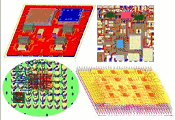 "Keysight
has combined it Electromagnetic Simulator with Synopsys'
AI-powered RF design migration flow for an integrated design flow to migrate
from TSMC's N6RF+ to N4P process technology. The migration workflow builds on the
foundry's Analog Design Migration (ADM) methodology to streamline the redesign of
passive devices and design components to the advanced RF process rules. The collaborative
migration workflow leverages the performance gain of the N4P process for the LNA
design migrated from N6RF+, said Keysight. Components include the Synopsys Custom
Compiler layout environment with Synopsys ASO.ai for rapid analogue and RF design
migration. Another components is Synopsys PrimeSim circuit simulator, and Keysight's
RF Circuit simulation tool, RFPro " "Keysight
has combined it Electromagnetic Simulator with Synopsys'
AI-powered RF design migration flow for an integrated design flow to migrate
from TSMC's N6RF+ to N4P process technology. The migration workflow builds on the
foundry's Analog Design Migration (ADM) methodology to streamline the redesign of
passive devices and design components to the advanced RF process rules. The collaborative
migration workflow leverages the performance gain of the N4P process for the LNA
design migrated from N6RF+, said Keysight. Components include the Synopsys Custom
Compiler layout environment with Synopsys ASO.ai for rapid analogue and RF design
migration. Another components is Synopsys PrimeSim circuit simulator, and Keysight's
RF Circuit simulation tool, RFPro "
 Meteor scatter (aka meteor burst) communications
is today largely the domain of amateur radio operators in their ongoing attempts
to set records for making long distance (DX) contacts with a minimum amount of transmit
power. When this article was written by U. California's Victor Latorre, transcontinental
fiber optic cables did not interconnect the world with high speed, phase stable
media that meets the exacting needs of precise time synchronization. Radio astronomy,
quantum physics experiments, and even stock market trading depends on microsecond
or finer timing. Mr. Latorre mentions here about using
meteor scatter communications' unique phase-stable characteristic
to send synchronization signals between scientific and navigation facilities. Of
course meteor scatter has the severe disadvantages... Meteor scatter (aka meteor burst) communications
is today largely the domain of amateur radio operators in their ongoing attempts
to set records for making long distance (DX) contacts with a minimum amount of transmit
power. When this article was written by U. California's Victor Latorre, transcontinental
fiber optic cables did not interconnect the world with high speed, phase stable
media that meets the exacting needs of precise time synchronization. Radio astronomy,
quantum physics experiments, and even stock market trading depends on microsecond
or finer timing. Mr. Latorre mentions here about using
meteor scatter communications' unique phase-stable characteristic
to send synchronization signals between scientific and navigation facilities. Of
course meteor scatter has the severe disadvantages...
• Broadband Access
Market Flat on China Weakness
• FCC
Builds Firewall Around U.S.-Bound Electronics
• Wi-Fi
7 Gains as WLAN Market Grows 11%
• imec Breaks New Ground in
GaN-on-Silicon RF Transistors
• AI Chip
Controls, Smuggling, and Geopolitics
Modular Devices, Inc. has manufactured high
reliability hybrid DC-DC converters for the space and military markets since 1984.
MDI is best known for its advanced DC-DC power supplies, which are engineered for
use in applications that demand exceptional reliability and precise performance.
These power supplies are designed to operate in challenging environments such as
satellites, spacecraft, military vehicles, and missiles. MDI also manufactures EMI
filters, solid state relays, inrush limiters, power bus controllers, and active
"OR" modules for power supply redundancy. Custom designs and engineering assistance
available on request.
 Congress was breathing hard down the neck
of NASA while
Ranger 6 was being prepared for its surveillance mission
to the lunar surface. In 1962, Ranger 3, the first to carry a TV camera, went
into orbit around the sun after missing the moon. Ranger 4 (dubbed "Brainless
I") impacted the moon but did not send back any data. And Ranger 5 lost power
after launch and missed the moon by about 450 miles. Time was running out to collect
data for use in fulfilling the challenge issues by President John F. Kennedy
on May 25, 1961, to "...commit itself to achieving the goal, before this decade
is out, of landing a man on the Moon and returning him safely to the Earth." That
challenge was successfully met by the Apollo 11 mission partially on July 21st,
1969 by landing Neil Armstrong and Buzz Aldrin on the moon... Congress was breathing hard down the neck
of NASA while
Ranger 6 was being prepared for its surveillance mission
to the lunar surface. In 1962, Ranger 3, the first to carry a TV camera, went
into orbit around the sun after missing the moon. Ranger 4 (dubbed "Brainless
I") impacted the moon but did not send back any data. And Ranger 5 lost power
after launch and missed the moon by about 450 miles. Time was running out to collect
data for use in fulfilling the challenge issues by President John F. Kennedy
on May 25, 1961, to "...commit itself to achieving the goal, before this decade
is out, of landing a man on the Moon and returning him safely to the Earth." That
challenge was successfully met by the Apollo 11 mission partially on July 21st,
1969 by landing Neil Armstrong and Buzz Aldrin on the moon...
 In all-too-typical style, the Federal Communications
Commission (FCC) decided to look for a scapegoat it could not just blame for but
strong-arm a solution for claimed problems plaguing
Citizen Band (CB) radio as it was rapidly becoming a popular hobby
in the 1960s. In the same manner in which bureaucrats blame gun and steak knife
manufacturers for the abusive actions of a minority of their products' users, the
FCC sought to curtail improper (maybe even illegal) operation of CB radios by imposing
type certification and feature restrictions on equipment manufacturers. To demonstrate
its magnanimity, though, the FCC offered to give companies half a year to deplete
their existing inventories. At the time and through 1977, CBs had 23 channels, after
which time 40 channels became the new mandate... In all-too-typical style, the Federal Communications
Commission (FCC) decided to look for a scapegoat it could not just blame for but
strong-arm a solution for claimed problems plaguing
Citizen Band (CB) radio as it was rapidly becoming a popular hobby
in the 1960s. In the same manner in which bureaucrats blame gun and steak knife
manufacturers for the abusive actions of a minority of their products' users, the
FCC sought to curtail improper (maybe even illegal) operation of CB radios by imposing
type certification and feature restrictions on equipment manufacturers. To demonstrate
its magnanimity, though, the FCC offered to give companies half a year to deplete
their existing inventories. At the time and through 1977, CBs had 23 channels, after
which time 40 channels became the new mandate...
 "In the electronics industry, where complexity
and speed are essential, artificial intelligence (AI) stands out as a transformative
force poised to revolutionize the field. Yet, despite significant investments and
high expectations, many organizations find themselves grappling with an uncomfortable
reality: the true value of
AI for supply chains remains elusive at scale. Great expectations, harsh realities
Gartner research found that 65% of CEOs in supply chain-intensive sectors believe
the next 'business era' will be defined by AI. An impressive 73% believe that AI
will emerge as the most transformative technology for their businesses..." "In the electronics industry, where complexity
and speed are essential, artificial intelligence (AI) stands out as a transformative
force poised to revolutionize the field. Yet, despite significant investments and
high expectations, many organizations find themselves grappling with an uncomfortable
reality: the true value of
AI for supply chains remains elusive at scale. Great expectations, harsh realities
Gartner research found that 65% of CEOs in supply chain-intensive sectors believe
the next 'business era' will be defined by AI. An impressive 73% believe that AI
will emerge as the most transformative technology for their businesses..."
 Pop Quiz: What is the contemporary name
we have given to the
voltage variable resistor (VDR)? Although VDRs are nowadays used
most familiarly for overvoltage protection due to spikes on a power or signal line,
they used to be functional parts of television display and power supply circuits.
They also made those newfangled field effect transistors - junction (JFET), and
enhancement mode and depletion mode insulated-gate (IGFET, aka MOSFET). Thermistors,
silicon-controlled rectifiers (SCRs), and varactor diodes are also discussed. Sylvania
was a prime user of all these devices back in the day as part of their effort to
modernize televisions and radio by abandoning vacuum tubes wherever possible... Pop Quiz: What is the contemporary name
we have given to the
voltage variable resistor (VDR)? Although VDRs are nowadays used
most familiarly for overvoltage protection due to spikes on a power or signal line,
they used to be functional parts of television display and power supply circuits.
They also made those newfangled field effect transistors - junction (JFET), and
enhancement mode and depletion mode insulated-gate (IGFET, aka MOSFET). Thermistors,
silicon-controlled rectifiers (SCRs), and varactor diodes are also discussed. Sylvania
was a prime user of all these devices back in the day as part of their effort to
modernize televisions and radio by abandoning vacuum tubes wherever possible...
 Sporadic E skip is an upper atmosphere
phenomenon whereby the "E" layer is ionized to where certain radio frequency (RF)
wavelengths are refracted to the degree that they are bent back down towards the
earth's surface rather than exiting into space. It facilitates long distance (DX)
communications to areas not normally available otherwise. Amateur radio operators
(Hams) have exploited sporadic E skip for nearly as long as there has been
Ham operators - even before anyone knew for certain that the upper atmosphere could
be ionized. Thus far there is no concrete correlation between sunspot activity and
sporadic E propagation, although sunspots definitely have other profound effects
on propagation when highly energetic electrons released from the sun's photosphere
interact with molecules in the ionosphere... Sporadic E skip is an upper atmosphere
phenomenon whereby the "E" layer is ionized to where certain radio frequency (RF)
wavelengths are refracted to the degree that they are bent back down towards the
earth's surface rather than exiting into space. It facilitates long distance (DX)
communications to areas not normally available otherwise. Amateur radio operators
(Hams) have exploited sporadic E skip for nearly as long as there has been
Ham operators - even before anyone knew for certain that the upper atmosphere could
be ionized. Thus far there is no concrete correlation between sunspot activity and
sporadic E propagation, although sunspots definitely have other profound effects
on propagation when highly energetic electrons released from the sun's photosphere
interact with molecules in the ionosphere...
 Werbel Microwave began as a consulting firm,
specializing in RF components design, with the ability to rapidly spin low volume
prototypes, and has quickly grown into a major designer and manufacturer with volume
production capacities. Werbel is proud to announce its
WMQH-0.5-1-S is a 90° hybrid designed for the 500-1000 MHz octave band.
It provides a 3 dB power split with tight 90° phase shift and low amplitude
unbalance. Key features include high isolation, typically 26 dB, and excellent
return loss of 24 dB typical, ensuring minimal signal reflection and optimal
performance across the band. Products are designed and manufactured in our Whippany,
New Jersey, location. "No Worries with Werbel!"... Werbel Microwave began as a consulting firm,
specializing in RF components design, with the ability to rapidly spin low volume
prototypes, and has quickly grown into a major designer and manufacturer with volume
production capacities. Werbel is proud to announce its
WMQH-0.5-1-S is a 90° hybrid designed for the 500-1000 MHz octave band.
It provides a 3 dB power split with tight 90° phase shift and low amplitude
unbalance. Key features include high isolation, typically 26 dB, and excellent
return loss of 24 dB typical, ensuring minimal signal reflection and optimal
performance across the band. Products are designed and manufactured in our Whippany,
New Jersey, location. "No Worries with Werbel!"...
 After reading both this article and "The Sarasota Mystery First Follow-Up" article in the April 1966
issue of Popular Electronics, I'm convinced that the inventor Wallace Minto
either did not understand the phenomenon he describes, or he's out to punk the reader.
If this initial article had been printed in the April issue rather than March, it
almost certainly would have to have been a Fool's scam. Minto believes he has discovered
a new form of electromagnetic propagation that exploits molecular / atomic properties
of water to transmit the signal - without attenuation and without picking up noise.
If it sounds too good to be true... After reading both this article and "The Sarasota Mystery First Follow-Up" article in the April 1966
issue of Popular Electronics, I'm convinced that the inventor Wallace Minto
either did not understand the phenomenon he describes, or he's out to punk the reader.
If this initial article had been printed in the April issue rather than March, it
almost certainly would have to have been a Fool's scam. Minto believes he has discovered
a new form of electromagnetic propagation that exploits molecular / atomic properties
of water to transmit the signal - without attenuation and without picking up noise.
If it sounds too good to be true...
 Robert Radford's (not to be confused with
Robert Redford) "Electromaze" is a unique - and weird - sort of word puzzle that
appeared in the April 1966 issue of Popular Electronics magazine. You will
probably want to print out the maze grid and find an old guy who should still have
a pencil stowed away somewhere you can borrow to use for filling in the boxes. Note
that in my opinion the answer given for clue number 2 is technically wrong. What
say you?... Robert Radford's (not to be confused with
Robert Redford) "Electromaze" is a unique - and weird - sort of word puzzle that
appeared in the April 1966 issue of Popular Electronics magazine. You will
probably want to print out the maze grid and find an old guy who should still have
a pencil stowed away somewhere you can borrow to use for filling in the boxes. Note
that in my opinion the answer given for clue number 2 is technically wrong. What
say you?...
 "Big tech is
redrawing the global manufacturing map. As Western technology giants strategically
pivot away from their longstanding reliance on China, a fundamental and likely irreversible
global technology supply chain recalibration is underway. What began as a shift
in the U.S.-China trade war from tariffs to the more intricate arena of export controls
is now a full-blown strategic imperative for major tech firms. The action has decisively
shifted to a 'China+N' manufacturing model, driven by persistent geopolitical tensions,
the erosion of China's cost advantage, and the stark operational vulnerabilities
exposed by the global COVID-19 pandemic..." "Big tech is
redrawing the global manufacturing map. As Western technology giants strategically
pivot away from their longstanding reliance on China, a fundamental and likely irreversible
global technology supply chain recalibration is underway. What began as a shift
in the U.S.-China trade war from tariffs to the more intricate arena of export controls
is now a full-blown strategic imperative for major tech firms. The action has decisively
shifted to a 'China+N' manufacturing model, driven by persistent geopolitical tensions,
the erosion of China's cost advantage, and the stark operational vulnerabilities
exposed by the global COVID-19 pandemic..."
 It appears that maybe Abraham Lincoln had
a son who was an electrical engineer working at Motorola Semiconductor back in the
1960's. Put glasses on Honest Abe (I did) and author Irwin Carroll's a spitting
image of the Great Emancipator. Seriously though, this article is a great introduction
to the fabrication and use of variable capacitance (aka varicap and varactor) diodes. They have
been - and still are - used widely for electrically tunable oscillator and filter
circuits. Topics such as temperature and figure of merit ("Q") are discussed as
well. This edition of Electronics World ran a series... It appears that maybe Abraham Lincoln had
a son who was an electrical engineer working at Motorola Semiconductor back in the
1960's. Put glasses on Honest Abe (I did) and author Irwin Carroll's a spitting
image of the Great Emancipator. Seriously though, this article is a great introduction
to the fabrication and use of variable capacitance (aka varicap and varactor) diodes. They have
been - and still are - used widely for electrically tunable oscillator and filter
circuits. Topics such as temperature and figure of merit ("Q") are discussed as
well. This edition of Electronics World ran a series...
 Sam Benzacar, of Anatech Electronics, an
RF and microwave filter company, has published his July 2025 Newsletter that, along
with timely news items, features his short op-ed titled "3GPP
Release 20 Gets Us Closer to 6G." In it, he states, "One of the most significant
areas of emphasis in Release 20 is integrating artificial intelligence (AI) and
machine learning into the radio access network (RAN) and the core network." I have
seen numerous news items in the last few months reporting on the melding of AI and
network communications. This type of AI "intelligently" controls the global and
local systems by optimizing traffic flow via real-time tower and control center
analysis. A major feature is device-to-device (D2D) communications that can bypass
the network... Sam Benzacar, of Anatech Electronics, an
RF and microwave filter company, has published his July 2025 Newsletter that, along
with timely news items, features his short op-ed titled "3GPP
Release 20 Gets Us Closer to 6G." In it, he states, "One of the most significant
areas of emphasis in Release 20 is integrating artificial intelligence (AI) and
machine learning into the radio access network (RAN) and the core network." I have
seen numerous news items in the last few months reporting on the melding of AI and
network communications. This type of AI "intelligently" controls the global and
local systems by optimizing traffic flow via real-time tower and control center
analysis. A major feature is device-to-device (D2D) communications that can bypass
the network...
 It is hard to imagine a time when integrated
circuit (IC)
comparators were a big deal, but as recently as 1973 when this
article appeared in Popular Electronics, they were new to a designer's
bag of tricks. Prior to an IC solution, comparators needed to be constructed from
opamps and a handful of peripheral biasing components. As with other integrated
circuits, not only does the overall price go down, but so does circuit board real
estate, cost, temperature variability, and electrical parameter variance between
devices. The first comparator circuit I remember designing was a temperature sensor
that went in an oven used for curing the potting... It is hard to imagine a time when integrated
circuit (IC)
comparators were a big deal, but as recently as 1973 when this
article appeared in Popular Electronics, they were new to a designer's
bag of tricks. Prior to an IC solution, comparators needed to be constructed from
opamps and a handful of peripheral biasing components. As with other integrated
circuits, not only does the overall price go down, but so does circuit board real
estate, cost, temperature variability, and electrical parameter variance between
devices. The first comparator circuit I remember designing was a temperature sensor
that went in an oven used for curing the potting...
These archive pages are provided in order to make it easier for you to find items
that you remember seeing on the RF Cafe homepage. Of course probably the easiest
way to find anything on the website is to use the "Search
RF Cafe" box at the top of every page. Some quoted items have been shortened
to save space. About RF Cafe.
Homepage Archive Pages
2026:
Jan |
Feb |
Mar |
Apr |
May |
Jun |
Jul | Aug
| Sep | Oct | Nov | Dec
2025:
Jan |
Feb |
Mar |
Apr |
May |
Jun |
Jul |
Aug |
Sep |
Oct |
Nov |
Dec
2024:
Jan |
Feb |
Mar |
Apr |
May |
Jun |
Jul |
Aug |
Sep |
Oct |
Nov |
Dec
2023:
Jan |
Feb |
Mar |
Apr |
May |
Jun |
Jul |
Aug |
Sep |
Oct |
Nov |
Dec
2022:
Jan |
Feb |
Mar |
Apr |
May |
Jun |
Jul |
Aug |
Sep |
Oct |
Nov |
Dec
2021:
Jan |
Feb |
Mar |
Apr |
May |
Jun |
Jul |
Aug |
Sep |
Oct |
Nov |
Dec
2020:
Jan |
Feb |
Mar |
Apr |
May |
Jun |
Jul |
Aug |
Sep |
Oct |
Nov |
Dec
2019:
Jan |
Feb |
Mar |
Apr |
May |
Jun |
Jul |
Aug |
Sep |
Oct |
Nov |
Dec
2018:
Jan |
Feb |
Mar |
Apr |
May |
Jun |
Jul |
Aug |
Sep |
Oct |
Nov |
Dec
2017:
Jan | Feb |
Mar |
Apr |
May |
Jun |
Jul |
Aug |
Sep |
Oct |
Nov |
Dec
2016:
Jan | Feb |
Mar |
Apr |
May |
Jun |
Jul |
Aug |
Sep |
Oct |
Nov |
Dec
2015:
Jan | Feb |
Mar |
Apr |
May |
Jun |
Jul |
Aug | Sep |
Oct |
Nov |
Dec
2014:
Jan | Feb |
Mar |
Apr |
May |
Jun |
Jul |
Aug |
Sep |
Oct |
Nov |
Dec
2013:
Jan | Feb |
Mar |
Apr |
May |
Jun |
Jul |
Aug |
Sep |
Oct |
Nov |
Dec
2012: 1 |
2 | 3
| 4 | 5
| 6 | 7
| 8 | 9
| 10 | 11
| 12 | 13
(no archives before 2012)
- Christmas-themed
items
|