See Page 1 |
2 | of the August 2025 homepage archives. Friday the 29th
 Back in my days of doing electrical work,
prior to entering the USAF, I seriously considered training as a lineman. At some
point I decided I rather pursue electronics rather than high voltage electrical
networks. This 1949 Popular Electronics magazine article does a great job
of presenting the kinds of skills and risks that go along with being a lineman.
Today's
high-tension linemen benefit from advanced equipment like two-way radios, mechanical
augers, and specialized tools that streamline repairs and improve safety. Rubber
gloves, sleeves, and protective gear are rigorously tested, while "line hoses" and
insulator hoods shield workers from live wires. Despite these advancements, the
job remains perilous, demanding unwavering adherence to safety protocols, especially
during inclement weather... Back in my days of doing electrical work,
prior to entering the USAF, I seriously considered training as a lineman. At some
point I decided I rather pursue electronics rather than high voltage electrical
networks. This 1949 Popular Electronics magazine article does a great job
of presenting the kinds of skills and risks that go along with being a lineman.
Today's
high-tension linemen benefit from advanced equipment like two-way radios, mechanical
augers, and specialized tools that streamline repairs and improve safety. Rubber
gloves, sleeves, and protective gear are rigorously tested, while "line hoses" and
insulator hoods shield workers from live wires. Despite these advancements, the
job remains perilous, demanding unwavering adherence to safety protocols, especially
during inclement weather...
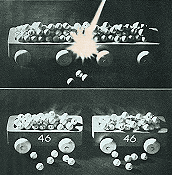 In 1949 Westinghouse revealed the first
U.S.
nuclear-reactor built to drive a propeller (on a submarine - airplanes would
come later, supposedly), to be tested at the AEC's Idaho "Reactor Farm." This 1949
Popular Science magazine article explains fission using simple word pictures:
a single extra neutron cracks a heavy uranium-235 nucleus into two smaller, neutron-bloated
fragments (actual modern alchemy); these "delayed" neutrons emerge slowly, giving
time to insert control rods made of neutron-absorbing material - like a "spoon in
the cup" damping a coffee slosh - so heat is produced continuously yet safely. The
excess neutrons also trigger a second trick: "breeders" capture them in a blanket
of ordinary uranium, coaxing it to produce fresh plutonium as the reactor generates
power... In 1949 Westinghouse revealed the first
U.S.
nuclear-reactor built to drive a propeller (on a submarine - airplanes would
come later, supposedly), to be tested at the AEC's Idaho "Reactor Farm." This 1949
Popular Science magazine article explains fission using simple word pictures:
a single extra neutron cracks a heavy uranium-235 nucleus into two smaller, neutron-bloated
fragments (actual modern alchemy); these "delayed" neutrons emerge slowly, giving
time to insert control rods made of neutron-absorbing material - like a "spoon in
the cup" damping a coffee slosh - so heat is produced continuously yet safely. The
excess neutrons also trigger a second trick: "breeders" capture them in a blanket
of ordinary uranium, coaxing it to produce fresh plutonium as the reactor generates
power...
• NGMN Intros
Common Language for Base Station Antennas
• FCC
Notice of Unlicensed Radio and Harmful Interference
• Cloud Giants Raking in
$100B Per Quarter
• Reasons to Deploy
Private 5G Network
• 1st
Female Astronomer Royal Appointed by UK
 Charter Engineering Inc. (CEI) has earned
the
AS9100D certification, joining parent company dB Control and sister companies
Paciwave and TTT-Cubed in meeting this internationally recognized aerospace quality
management standard. This milestone underscores Charter Engineering's ongoing commitment
to excellence in aerospace and defense manufacturing. AS9100D is the global benchmark
for aerospace quality, requiring organizations to meet rigorous criteria in reliability,
risk management, and continuous improvement. By achieving this certification, Charter
Engineering now joins a select group of manufacturers whose processes and quality
systems... Charter Engineering Inc. (CEI) has earned
the
AS9100D certification, joining parent company dB Control and sister companies
Paciwave and TTT-Cubed in meeting this internationally recognized aerospace quality
management standard. This milestone underscores Charter Engineering's ongoing commitment
to excellence in aerospace and defense manufacturing. AS9100D is the global benchmark
for aerospace quality, requiring organizations to meet rigorous criteria in reliability,
risk management, and continuous improvement. By achieving this certification, Charter
Engineering now joins a select group of manufacturers whose processes and quality
systems...
 QST, the American Radio Relay League's
flagship monthly publication, has been around since December of 1915. It has for
decades included
Fools' articles in the April editions, as do many other magazines.
Each year I peruse April issues with a bit of trepidation for fear that I will not
be savvy enough to spot the phony article. Usually there is some aspect that is
clearly not right, thereby giving up the scam. This year's April QST arrived a week
ago and a quick scan has not revealed to me anything suspicious. Maybe this one
requires the knowledge of a seasoned, practicing Ham for detection; book knowledge
alone might not cut it this time... QST, the American Radio Relay League's
flagship monthly publication, has been around since December of 1915. It has for
decades included
Fools' articles in the April editions, as do many other magazines.
Each year I peruse April issues with a bit of trepidation for fear that I will not
be savvy enough to spot the phony article. Usually there is some aspect that is
clearly not right, thereby giving up the scam. This year's April QST arrived a week
ago and a quick scan has not revealed to me anything suspicious. Maybe this one
requires the knowledge of a seasoned, practicing Ham for detection; book knowledge
alone might not cut it this time...
Thursday the 28th
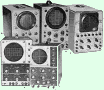 High quality
test equipment (TE) typically costs more than the knockoff stuff,
but a lot more of the former is still around in regular use compared to the latter.
The retained value of vintage TE can be quantitatively measured on eBay - as can
most things for that matter. An item is worth what the market will bear. Hewlett
Packard (HP), Tektronix, Bird, Simpson, B&K, Triplett, even Heathkit, typically
sell for often surprisingly high prices when in working order. Accordingly, a lot
of people are looking for specifications on the older equipment as well as schematics
and alignment manuals. A Google search almost always turns up what you want. The
information presented in this 1966 article from Popular Electronics magazine
will probably be found by someone doing just such a search... High quality
test equipment (TE) typically costs more than the knockoff stuff,
but a lot more of the former is still around in regular use compared to the latter.
The retained value of vintage TE can be quantitatively measured on eBay - as can
most things for that matter. An item is worth what the market will bear. Hewlett
Packard (HP), Tektronix, Bird, Simpson, B&K, Triplett, even Heathkit, typically
sell for often surprisingly high prices when in working order. Accordingly, a lot
of people are looking for specifications on the older equipment as well as schematics
and alignment manuals. A Google search almost always turns up what you want. The
information presented in this 1966 article from Popular Electronics magazine
will probably be found by someone doing just such a search...
 On his 65th birthday,
the inventor of the vacuum tube which made modern radio possible, looks back down
the years and comments: "I seldom tune in ... The programs, all swing and croon,
are not only poor, but the interruptions for commercial announcements are maddening
... Isn't it sickening? It isn't at all as I imagined it would be." -
Dr. Lee de Forest, in Time magazine, as reported in the February
1966 issue of Radio Craft magazine... On his 65th birthday,
the inventor of the vacuum tube which made modern radio possible, looks back down
the years and comments: "I seldom tune in ... The programs, all swing and croon,
are not only poor, but the interruptions for commercial announcements are maddening
... Isn't it sickening? It isn't at all as I imagined it would be." -
Dr. Lee de Forest, in Time magazine, as reported in the February
1966 issue of Radio Craft magazine...
 In a move reminiscent of Microsoft announcing
skipping from Windows 8.1 directly to Windows 10 in order to emphasize
the significant step in functionality, the NexGen Mobile Network Alliance circulated
a press release detailing plans to skip past the in-process
5G standard (originally slated for a 2020
release date) and proceed with
6G. Unanticipated advances in breakthrough quantum computing algorithms,
terabit data rates over dilithium optical cables, and transmutational hypercubic
encoding schemes has prompted regulators to abandon work on 5G after hardware manufacturers
including both phone and tower equipment companies petitioned the standards body
to save them the engineering and production costs that would be involved in supporting
what would certainly be a very short term compliance requirement... In a move reminiscent of Microsoft announcing
skipping from Windows 8.1 directly to Windows 10 in order to emphasize
the significant step in functionality, the NexGen Mobile Network Alliance circulated
a press release detailing plans to skip past the in-process
5G standard (originally slated for a 2020
release date) and proceed with
6G. Unanticipated advances in breakthrough quantum computing algorithms,
terabit data rates over dilithium optical cables, and transmutational hypercubic
encoding schemes has prompted regulators to abandon work on 5G after hardware manufacturers
including both phone and tower equipment companies petitioned the standards body
to save them the engineering and production costs that would be involved in supporting
what would certainly be a very short term compliance requirement...
 "The
Federal Communications Commission is updating its rules on
subsea communications cables, aiming to streamline regulations and add more
protections to the increasingly important underwater infrastructure that connects
the world. All three current commissioners voted in favor of new proposed rules,
and the FCC will take public input on further rule updates that are meant to help
accelerate deployment of the expensive infrastructure - which can cost between $30,000
to $50,000 per kilometer to deploy. The global subsea cable network is made up of
about 450 cable systems spanning more than 1.5 million kilometers..." "The
Federal Communications Commission is updating its rules on
subsea communications cables, aiming to streamline regulations and add more
protections to the increasingly important underwater infrastructure that connects
the world. All three current commissioners voted in favor of new proposed rules,
and the FCC will take public input on further rule updates that are meant to help
accelerate deployment of the expensive infrastructure - which can cost between $30,000
to $50,000 per kilometer to deploy. The global subsea cable network is made up of
about 450 cable systems spanning more than 1.5 million kilometers..."
 Moral standards seem to rigidly obey the
second law of thermodynamics, which states that entropy (disorder) increases in
a closed system. Most people would say society is more rude and corrupt today than
in days gone by - count me among them. However, believing so does not obviate or
excuse acts of deviance in the past. Indeed, even esteemed organizations like the
ARRL seems to have been guilty of promoting dishonest acts. To
wit, consider this offer appearing in the "Strayed" column of the April 1933 issue
of QST magazine, "For Sale: QSL Cards of any country. Win your WAC..." Moral standards seem to rigidly obey the
second law of thermodynamics, which states that entropy (disorder) increases in
a closed system. Most people would say society is more rude and corrupt today than
in days gone by - count me among them. However, believing so does not obviate or
excuse acts of deviance in the past. Indeed, even esteemed organizations like the
ARRL seems to have been guilty of promoting dishonest acts. To
wit, consider this offer appearing in the "Strayed" column of the April 1933 issue
of QST magazine, "For Sale: QSL Cards of any country. Win your WAC..."
 The September 1932 issue of Radio Craft
contained an article titled, "Radio a la Cortlandt Street!," the original "Radio Row" located at the corner of Cortlandt and Washington Streets
in Manhattan. It was a mecca of new and used electronics components and assemblies.
After World War II there was a huge supply of surplus parts and equipment made
available to the public as a means to clear out inventory and also as a "thank you"
to the citizens who voluntarily donated critically needed panel meters, tuning capacitors,
connectors, and other items to the War Department. That really helped the market
boom. Post-war electronics magazines were chock full of ads by dealers selling surplus
electronic and mechanical supplies... The September 1932 issue of Radio Craft
contained an article titled, "Radio a la Cortlandt Street!," the original "Radio Row" located at the corner of Cortlandt and Washington Streets
in Manhattan. It was a mecca of new and used electronics components and assemblies.
After World War II there was a huge supply of surplus parts and equipment made
available to the public as a means to clear out inventory and also as a "thank you"
to the citizens who voluntarily donated critically needed panel meters, tuning capacitors,
connectors, and other items to the War Department. That really helped the market
boom. Post-war electronics magazines were chock full of ads by dealers selling surplus
electronic and mechanical supplies...
 Established in 1990,
dB Control supplies mission-critical,
often sole-source, products worldwide to military organizations, as well as to major
defense contractors and commercial manufacturers. dB Control designs and manufactures
high-power TWT amplifiers, microwave power modules, transmitters, high- and low-voltage
power supplies, and modulators for radar, ECM, and data link applications. Modularity
enables rapid configuration of custom products for a variety of platforms, including
ground-based and high-altitude military manned and unmanned aircraft. Custom RF
sources and receivers, components and integrated microwave subsystems as well as
precision electromechanical switches. dB Control also offers specialized contract
manufacturing and repair depot services. Established in 1990,
dB Control supplies mission-critical,
often sole-source, products worldwide to military organizations, as well as to major
defense contractors and commercial manufacturers. dB Control designs and manufactures
high-power TWT amplifiers, microwave power modules, transmitters, high- and low-voltage
power supplies, and modulators for radar, ECM, and data link applications. Modularity
enables rapid configuration of custom products for a variety of platforms, including
ground-based and high-altitude military manned and unmanned aircraft. Custom RF
sources and receivers, components and integrated microwave subsystems as well as
precision electromechanical switches. dB Control also offers specialized contract
manufacturing and repair depot services.
Wednesday the 27th
 Mac and Barney discuss with some degree
of trepidation the alarmingly increasing rate at which new
electronics technology is being developed and marketed. As service
shop owner and technician, respectively, they needed to constantly educate themselves
on new components and circuits in order to stay current and be efficient enough
to turn a profit. Mac recounts his lengthy background beginning with the days of
mainly battery-powered AM radios, and progressing through AC-DC, FM and all-band
(shortwave) radio, B&W television and the color TV, CB radios, and a new breed
of appliances with electronic controls... Mac and Barney discuss with some degree
of trepidation the alarmingly increasing rate at which new
electronics technology is being developed and marketed. As service
shop owner and technician, respectively, they needed to constantly educate themselves
on new components and circuits in order to stay current and be efficient enough
to turn a profit. Mac recounts his lengthy background beginning with the days of
mainly battery-powered AM radios, and progressing through AC-DC, FM and all-band
(shortwave) radio, B&W television and the color TV, CB radios, and a new breed
of appliances with electronic controls...
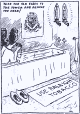 If you think the title of this piece has
anything to do with the story, think again, or at least as far as I can reckon.
Keeping in mind that this mini-novel appeared in the
April 1933 issue of QST magazine, wherewith the past
couple days of Fools' pieces accompanied it, I read with caution. The image of Queen
Elizabeth cradling a vacuum valve (not tube!) under her arm like a rugby football
(to continue the Eurocentric theme) in the comic certainly grabs one's attention,
as do the "250-watter lights" on the the royal bathroom wall. You need to switch
into a early twentieth century mindset while perusing the story in order to appreciate
the humor... If you think the title of this piece has
anything to do with the story, think again, or at least as far as I can reckon.
Keeping in mind that this mini-novel appeared in the
April 1933 issue of QST magazine, wherewith the past
couple days of Fools' pieces accompanied it, I read with caution. The image of Queen
Elizabeth cradling a vacuum valve (not tube!) under her arm like a rugby football
(to continue the Eurocentric theme) in the comic certainly grabs one's attention,
as do the "250-watter lights" on the the royal bathroom wall. You need to switch
into a early twentieth century mindset while perusing the story in order to appreciate
the humor...
 "A mysterious new job listings website recently
went live, solely showing roles companies want to offer to their H-1B holders seeking
Green Cards in an attempt to get Americans into the jobs instead.
Jobs.Now works by scouring corporate listings for positions attached to foreign
workers, which employers are obliged to try to fill with American workers before
seeking permanent residency for an immigrant employee. 'Many people have complained
about the trend of companies recruiting immigrants to fill jobs while Americans
face unemployment, but few people have taken action to provide resources to help
Americans get the first look they are legally entitled to for jobs in their own
country,' the team behind the website..." "A mysterious new job listings website recently
went live, solely showing roles companies want to offer to their H-1B holders seeking
Green Cards in an attempt to get Americans into the jobs instead.
Jobs.Now works by scouring corporate listings for positions attached to foreign
workers, which employers are obliged to try to fill with American workers before
seeking permanent residency for an immigrant employee. 'Many people have complained
about the trend of companies recruiting immigrants to fill jobs while Americans
face unemployment, but few people have taken action to provide resources to help
Americans get the first look they are legally entitled to for jobs in their own
country,' the team behind the website..."
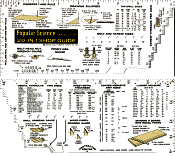 In the days before phone apps could instantly
calculate just about anything, many people relied on handy cardboard calculators
designed for specific tasks. One example is this two-sided "20-in-1 Shop Guide,"
provided in 1966 by the Popular Science Book Club. More elaborate cardboard
calculators and cross-reference guides featured a sliding element between the two
outer pieces, similar to a slide rule. In many ways, these devices are more convenient
than phone apps because all the information is visible at a glance, so you immediately
know what they can calculate. The images below can be printed and glued to cardboard,
but be sure to scale them correctly so the measurement marks remain accurate. I
keep a few of these taped to the undersides of my toolbox lids. In the days before phone apps could instantly
calculate just about anything, many people relied on handy cardboard calculators
designed for specific tasks. One example is this two-sided "20-in-1 Shop Guide,"
provided in 1966 by the Popular Science Book Club. More elaborate cardboard
calculators and cross-reference guides featured a sliding element between the two
outer pieces, similar to a slide rule. In many ways, these devices are more convenient
than phone apps because all the information is visible at a glance, so you immediately
know what they can calculate. The images below can be printed and glued to cardboard,
but be sure to scale them correctly so the measurement marks remain accurate. I
keep a few of these taped to the undersides of my toolbox lids.
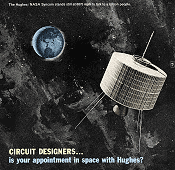 Hughes Aerospace has many openings for qualified
design engineers in Culver City, California. High power airborne
transmitters, low noise receivers using parametric amplifiers, solid state maser
component development, radar processing systems, crystal oscillators, telemetering,
and high efficiency spaceborne power supplies are among the kinds of specialties
needed by Hughes to support military and civilian projects. If you have been looking
for just such an opportunity, then the wait is finally over... provided you happened
to see this advertisement in Electronics magazine back in the fall of 1965.
Quiz question: What is the difference between a geosynchronous orbit and a geostationary
orbit? Hughes Aerospace has many openings for qualified
design engineers in Culver City, California. High power airborne
transmitters, low noise receivers using parametric amplifiers, solid state maser
component development, radar processing systems, crystal oscillators, telemetering,
and high efficiency spaceborne power supplies are among the kinds of specialties
needed by Hughes to support military and civilian projects. If you have been looking
for just such an opportunity, then the wait is finally over... provided you happened
to see this advertisement in Electronics magazine back in the fall of 1965.
Quiz question: What is the difference between a geosynchronous orbit and a geostationary
orbit?
 The initial part of this article, The Sarasota
Mystery, appeared in the previous issue (March). "Mr. Minto is still scratching
his head over hydronic communications. Things have not been standing still in the
mysterious world of Hydronics and Wallace Minto. Scientists do not have a 'pat'
answer for the unusual underwater transmission capabilities of Hydronics. As reported
in this magazine last month (page 50), a retired inventor-scientist-experimenter,
Wallace L. Minto, has discovered a new method of communications, similar to sonar
and radio waves, but actually identical to neither. Minto has labeled his through-water
communications "Hydronics," and a somewhat similar phenomenon that seemingly defies
resistance and insulation Plasmonics..." The initial part of this article, The Sarasota
Mystery, appeared in the previous issue (March). "Mr. Minto is still scratching
his head over hydronic communications. Things have not been standing still in the
mysterious world of Hydronics and Wallace Minto. Scientists do not have a 'pat'
answer for the unusual underwater transmission capabilities of Hydronics. As reported
in this magazine last month (page 50), a retired inventor-scientist-experimenter,
Wallace L. Minto, has discovered a new method of communications, similar to sonar
and radio waves, but actually identical to neither. Minto has labeled his through-water
communications "Hydronics," and a somewhat similar phenomenon that seemingly defies
resistance and insulation Plasmonics..."
Tuesday the 26th
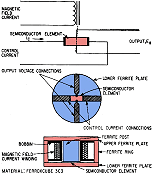 According to author Albert Hilbinger, dynamic
range down to DC and circuit simplicity offset the low efficiency of
Hall-effect modulators. The mixer circuit output has a suppressed
carrier signal, making it a true product of the two inputs (fLO ± IF in the frequency
domain). Evidently the scheme never gained wide acceptance in the industry because
a search of the term does not produce much - other than this 1964 Electronics
magazine article. Achieving a suppressed carrier with standard diode mixers requires
a quadrature arrangement using two mixers and a pair of 90° power splitters, which
nowadays is done handily within a single integrated circuit. Sensors are the main
exploitation for the Hall effect these days... According to author Albert Hilbinger, dynamic
range down to DC and circuit simplicity offset the low efficiency of
Hall-effect modulators. The mixer circuit output has a suppressed
carrier signal, making it a true product of the two inputs (fLO ± IF in the frequency
domain). Evidently the scheme never gained wide acceptance in the industry because
a search of the term does not produce much - other than this 1964 Electronics
magazine article. Achieving a suppressed carrier with standard diode mixers requires
a quadrature arrangement using two mixers and a pair of 90° power splitters, which
nowadays is done handily within a single integrated circuit. Sensors are the main
exploitation for the Hall effect these days...
 "For
decades, China has held near-total dominance over the Democratic Republic of Congo's
(DRC)
vast mineral wealth - cobalt, copper and lithium - resources that power everything
from electric vehicles to advanced military technology. But now, the United States
is mounting a fierce counteroffensive, leveraging political pressure, corporate
muscle, and military-linked deals to claw back control. This high-stakes battle
isn't just about profits; it's a fight for national security, technological supremacy,
and the future of global energy. And as Washington pushes forward, Beijing..." "For
decades, China has held near-total dominance over the Democratic Republic of Congo's
(DRC)
vast mineral wealth - cobalt, copper and lithium - resources that power everything
from electric vehicles to advanced military technology. But now, the United States
is mounting a fierce counteroffensive, leveraging political pressure, corporate
muscle, and military-linked deals to claw back control. This high-stakes battle
isn't just about profits; it's a fight for national security, technological supremacy,
and the future of global energy. And as Washington pushes forward, Beijing..."
 At
launch in 1962 when this article appeared in Popular Science magazine,
Mariner 2's planners imagined Venus cloaked by benign oceans or lush swamps
- temperatures perhaps only "hot-house Earth" elevated. Microwave echoes from Earth
hinted at a 600 °F surface, yet editors clung to hope that dense clouds concealed
cooler seas and maybe biology. Infrared spectra were interpreted as carbon-dioxide
greenhouse gases in a thin, relatively clear layer; the idea of surface pressures
a hundred times Earth, sulfuric-acid rain, and global 860 °F basalt plains
lay outside anyone's paradigm. A magnetosphere like Earth's was expected; Venus
instead proved geologically inert and wind-scoured, with sluggish super-rotation.
Fifty years later, radar from Magellan and Earth-borne interferometry have overwritten
1962 optimism with images of barren basalt plains and scorching CO₂ night... At
launch in 1962 when this article appeared in Popular Science magazine,
Mariner 2's planners imagined Venus cloaked by benign oceans or lush swamps
- temperatures perhaps only "hot-house Earth" elevated. Microwave echoes from Earth
hinted at a 600 °F surface, yet editors clung to hope that dense clouds concealed
cooler seas and maybe biology. Infrared spectra were interpreted as carbon-dioxide
greenhouse gases in a thin, relatively clear layer; the idea of surface pressures
a hundred times Earth, sulfuric-acid rain, and global 860 °F basalt plains
lay outside anyone's paradigm. A magnetosphere like Earth's was expected; Venus
instead proved geologically inert and wind-scoured, with sluggish super-rotation.
Fifty years later, radar from Magellan and Earth-borne interferometry have overwritten
1962 optimism with images of barren basalt plains and scorching CO₂ night...
 Werbel Microwave is proud to announce its
WMC-0.5-2-30dB-S, a 30 dB directional coupler that covers 500 MHz
to 2 GHz with broadband flat coupling response, high directivity, and excellent
return loss performance. The L-band applications for military radio are covered,
as well as cellular 800-900 MHz and the upper portion of UHF. The high coupling
value allows for accurate measurements with minimal power diversion from the system.
Return loss is typically better than 1.15:1, making it almost electrically invisible
in your system. USA assembled, design and tested. The device is RoHS compliant,
but lead solder is available on special order for military applications. "No Worries
with Werbel!" Werbel Microwave is proud to announce its
WMC-0.5-2-30dB-S, a 30 dB directional coupler that covers 500 MHz
to 2 GHz with broadband flat coupling response, high directivity, and excellent
return loss performance. The L-band applications for military radio are covered,
as well as cellular 800-900 MHz and the upper portion of UHF. The high coupling
value allows for accurate measurements with minimal power diversion from the system.
Return loss is typically better than 1.15:1, making it almost electrically invisible
in your system. USA assembled, design and tested. The device is RoHS compliant,
but lead solder is available on special order for military applications. "No Worries
with Werbel!"
 At the end of 1965, Electronics
magazine printed an analysis of the state of the
electronics markets in Europe (before there was a formal EU).
The authors predicted a whopping 10% increase to $7.8B for the combined consumer,
commercial, and military markets. Separate reports are included for West Germany
(the Berlin Wall was still up then), the UK, France, and Italy are covered in separate
sections. Figures are included on a chart for the Netherlands, Sweden, and Belgium
/ Luxemburg. The Soviet Union, although obviously not part of Europe, is also covered.
As a comparison of then versus now, Statistica claims a 2018 consumer electronics
market of $59B ($64B in 2019), and EE Times reports a $15B defense electronics
market for 2018 (~$79B total)... At the end of 1965, Electronics
magazine printed an analysis of the state of the
electronics markets in Europe (before there was a formal EU).
The authors predicted a whopping 10% increase to $7.8B for the combined consumer,
commercial, and military markets. Separate reports are included for West Germany
(the Berlin Wall was still up then), the UK, France, and Italy are covered in separate
sections. Figures are included on a chart for the Netherlands, Sweden, and Belgium
/ Luxemburg. The Soviet Union, although obviously not part of Europe, is also covered.
As a comparison of then versus now, Statistica claims a 2018 consumer electronics
market of $59B ($64B in 2019), and EE Times reports a $15B defense electronics
market for 2018 (~$79B total)...
Monday the 25th
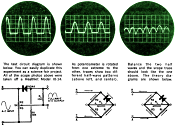 Can a single diode be used to constitute
a
full-wave rectifier circuit? The short answer is yes, it can,
as is demonstrated by an actual circuit built by Messrs. Duffy and Olesky. The real
question is can a single-diode full-wave rectifier be used in a practical circuit?
Under certain controlled instances it can as long as component values and tolerances
for both the power supply and the load can be controlled acceptably. High impedance,
ultra low current circuits in today's marketplace are more likely to be able to
support the single-diode rectifier, but then so many products are composed of a
single integrated circuit that can easily include an internal two- or four-diode
full-wave bridge that such a money- and space-saving scheme is not necessary. Still,
it is an interesting theoretical study... Can a single diode be used to constitute
a
full-wave rectifier circuit? The short answer is yes, it can,
as is demonstrated by an actual circuit built by Messrs. Duffy and Olesky. The real
question is can a single-diode full-wave rectifier be used in a practical circuit?
Under certain controlled instances it can as long as component values and tolerances
for both the power supply and the load can be controlled acceptably. High impedance,
ultra low current circuits in today's marketplace are more likely to be able to
support the single-diode rectifier, but then so many products are composed of a
single integrated circuit that can easily include an internal two- or four-diode
full-wave bridge that such a money- and space-saving scheme is not necessary. Still,
it is an interesting theoretical study...
 "About a week ago, a viral post declared
that on July 19, China had 'killed
the silicon wafer.' The claim was explosive: a breakthrough in a new semiconductor
material called indium selenide (InSe) had supposedly rendered the entire Western
chip ecosystem - from Intel's fabs to TSMC's foundries and America's sanctions -
obsolete overnight. China, the post argued, had not just won the chip war; it had
'exited the battlefield' by mastering a new law of atomic physics. Like many things
on the internet, this narrative was a dramatic oversimplification..." Good luck
getting enough Se and In to slay the Si market. "About a week ago, a viral post declared
that on July 19, China had 'killed
the silicon wafer.' The claim was explosive: a breakthrough in a new semiconductor
material called indium selenide (InSe) had supposedly rendered the entire Western
chip ecosystem - from Intel's fabs to TSMC's foundries and America's sanctions -
obsolete overnight. China, the post argued, had not just won the chip war; it had
'exited the battlefield' by mastering a new law of atomic physics. Like many things
on the internet, this narrative was a dramatic oversimplification..." Good luck
getting enough Se and In to slay the Si market.
 In this final installment of an All about
IC's trilogy that appeared in Radio-Electronics magazine in 1969, author
Bob Hibberd discusses how
passive components are fabricated in silicon as part of an integrated
circuit. MOS and junction capacitors and diffusion resistors were cutting edge technology
in the day. Although not discussed here, small value inductors could be made with
printed metal on the die. The relatively low frequencies of IC's (a few MHz at best)
meant that most inductive components had to be realized in the form of a gyrator
because there was not enough area available to print a useful wire inductor. Hibberd
also describes the dicing process, aka singulation, for breaking individual IC's
off the composite wafer. Processes have changed fairly significantly, but the fundamentals
are still the same... In this final installment of an All about
IC's trilogy that appeared in Radio-Electronics magazine in 1969, author
Bob Hibberd discusses how
passive components are fabricated in silicon as part of an integrated
circuit. MOS and junction capacitors and diffusion resistors were cutting edge technology
in the day. Although not discussed here, small value inductors could be made with
printed metal on the die. The relatively low frequencies of IC's (a few MHz at best)
meant that most inductive components had to be realized in the form of a gyrator
because there was not enough area available to print a useful wire inductor. Hibberd
also describes the dicing process, aka singulation, for breaking individual IC's
off the composite wafer. Processes have changed fairly significantly, but the fundamentals
are still the same...
 This is the electronics market prediction
for the
Netherlands, circa 1966. It was part of a comprehensive assessment
by the editors of Electronics magazine of the state of commercial, military,
and consumer electronics at the end of 1965. Philips, headquartered in Amsterdam,
was singled out as a prime mover for the country. Established in 1891, Philips is
still today a major economic contributor for the Netherlands. Electronics'
end-of-year issue published its prognostication for Europe as a whole as well as
for many individual countries. It also attempted to assess the Soviet Union's (USSR)
electronics industry... This is the electronics market prediction
for the
Netherlands, circa 1966. It was part of a comprehensive assessment
by the editors of Electronics magazine of the state of commercial, military,
and consumer electronics at the end of 1965. Philips, headquartered in Amsterdam,
was singled out as a prime mover for the country. Established in 1891, Philips is
still today a major economic contributor for the Netherlands. Electronics'
end-of-year issue published its prognostication for Europe as a whole as well as
for many individual countries. It also attempted to assess the Soviet Union's (USSR)
electronics industry...
 Exodus Advanced Communications, is a multinational
RF communication equipment and engineering service company serving both commercial
and government entities and their affiliates worldwide. Exodus'
AMP20052 is designed for EW/ECM, EMI/RFI, lab, and general communications applications.
A Class A/AB linear design, 1000 W minimum with 60 dB gain over the 20
to 500 MHz band. Features high-power advanced technology devices for instantaneous
bandwidth. Optional monitoring for forward/reflected/VSWR indication as well as
voltages and currents. High efficiency, with unprecedented reliability and ruggedness
in a 6U chassis... Exodus Advanced Communications, is a multinational
RF communication equipment and engineering service company serving both commercial
and government entities and their affiliates worldwide. Exodus'
AMP20052 is designed for EW/ECM, EMI/RFI, lab, and general communications applications.
A Class A/AB linear design, 1000 W minimum with 60 dB gain over the 20
to 500 MHz band. Features high-power advanced technology devices for instantaneous
bandwidth. Optional monitoring for forward/reflected/VSWR indication as well as
voltages and currents. High efficiency, with unprecedented reliability and ruggedness
in a 6U chassis...
Friday the 22nd
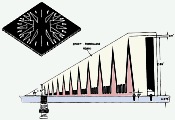 I would love to see a modern electromagnetic
(EM) field software simulation of this antenna design. Imagine attempting a ray-tracing
model of the symmetrical combination of multiple linear and circular radiating elements
of the antenna shown in this 1964 article that appeared in Electronics
magazine. Doing so would have required hours of expensive time on an ENIAC or weeks
from a team of woman "computers" such as the kind NASA used for plotting Apollo
trajectories (see Hidden Figures). I'd like to see Joel Hallas (W1ZR) model
it in EZNEC. Supposedly, at least one working WARLA (Wide Aperture Radio Location Array) system was built and tested,
but details of the results are not provided (probably classified at the time)... I would love to see a modern electromagnetic
(EM) field software simulation of this antenna design. Imagine attempting a ray-tracing
model of the symmetrical combination of multiple linear and circular radiating elements
of the antenna shown in this 1964 article that appeared in Electronics
magazine. Doing so would have required hours of expensive time on an ENIAC or weeks
from a team of woman "computers" such as the kind NASA used for plotting Apollo
trajectories (see Hidden Figures). I'd like to see Joel Hallas (W1ZR) model
it in EZNEC. Supposedly, at least one working WARLA (Wide Aperture Radio Location Array) system was built and tested,
but details of the results are not provided (probably classified at the time)...
 "In the
6G era, AI agents
will issue requests, negotiate prices, and buy and sell network slices or compute,
connectivity, and energy in real time We live in a world dominated by digital services.
From a technological perspective, we've never innovated at this pace or scale before,
and networks are racing to keep up. Like laying a track in front of a moving train,
networks are scrambling to be ready for the next era of telecommunications, but
from now on, there'll be one key difference: Humans are no longer the main customers.
More than 74% of new webpages contain AI content. As of November 2024, 70% of Fortune
500 companies..." "In the
6G era, AI agents
will issue requests, negotiate prices, and buy and sell network slices or compute,
connectivity, and energy in real time We live in a world dominated by digital services.
From a technological perspective, we've never innovated at this pace or scale before,
and networks are racing to keep up. Like laying a track in front of a moving train,
networks are scrambling to be ready for the next era of telecommunications, but
from now on, there'll be one key difference: Humans are no longer the main customers.
More than 74% of new webpages contain AI content. As of November 2024, 70% of Fortune
500 companies..."
 As with a lot of things, when you have been
around test equipment for a long time and new equipment with new features evolve
over time, you might forget how things used to be as you come to take the modern
stuff for granted. Displaying more than one channel's trace at a time is a good
example. When Tektronix introduced the "Automated Display Switching" feature on their model 547 oscilloscope
with the 1A1 time base plug-in, its ability to show two sweeps simultaneously was
ground-breaking. Prior to that, the user needed to manually switch between input
time base units to get the waveform displayed. Monitoring two waveforms at a time
required separate oscilloscopes, which, given the massive size of their vacuum tube-based
electronics, meant occupying a lot of lab space... As with a lot of things, when you have been
around test equipment for a long time and new equipment with new features evolve
over time, you might forget how things used to be as you come to take the modern
stuff for granted. Displaying more than one channel's trace at a time is a good
example. When Tektronix introduced the "Automated Display Switching" feature on their model 547 oscilloscope
with the 1A1 time base plug-in, its ability to show two sweeps simultaneously was
ground-breaking. Prior to that, the user needed to manually switch between input
time base units to get the waveform displayed. Monitoring two waveforms at a time
required separate oscilloscopes, which, given the massive size of their vacuum tube-based
electronics, meant occupying a lot of lab space...
• €631B
"Made for Germany" Investment Initiative
• 5G
Core Network to Grow 6%
• FCC Seeks to
Expand Satellite Spectrum
• Cadence Guilty of
Illegally Supplying China Military
• High Labour Costs & Skills Shortages
Crippling UK Growth
 Sam Benzacar, of Anatech Electronics, an
RF and microwave filter company, has published his August 2025 Newsletter that,
along with timely news items, features his short op-ed titled "Trump's
Golden Dome: Star Wars Revisited." In it, he paints President Trump's "Golden
Dome" as the newest episode in a 60-year saga of grand missile-defense dreams. From
Nike Zeus to Nike-X, Safeguard, and President Reagan's SDI (aka "Star Wars"), each
plan promised an invincible shield and each collapsed under technical hurdles, ballooning
budgets, and political reality - no politics there, just harsh reality (although
subsystems like the Patriot Missile System, THAAD, Brilliant Pebbles, GMD, et al).
Safeguard, the only system ever fully deployed, guarded one North Dakota site for
mere months before dismantlement. The pattern is repetitive... Sam Benzacar, of Anatech Electronics, an
RF and microwave filter company, has published his August 2025 Newsletter that,
along with timely news items, features his short op-ed titled "Trump's
Golden Dome: Star Wars Revisited." In it, he paints President Trump's "Golden
Dome" as the newest episode in a 60-year saga of grand missile-defense dreams. From
Nike Zeus to Nike-X, Safeguard, and President Reagan's SDI (aka "Star Wars"), each
plan promised an invincible shield and each collapsed under technical hurdles, ballooning
budgets, and political reality - no politics there, just harsh reality (although
subsystems like the Patriot Missile System, THAAD, Brilliant Pebbles, GMD, et al).
Safeguard, the only system ever fully deployed, guarded one North Dakota site for
mere months before dismantlement. The pattern is repetitive...
Thursday the 21st
 Here for your almost-Friday enjoyment is
a collection of
radio-themed comics from a 1964 issue of Popular Electronics
magazine. The scenario in the first comic is one that an owner of an antiques store
told me happens often with cunning customers. Now that eBay has been around for
so long, shop owners, yard/garage sale holders, Craigslist sellers, and even places
like Goodwill know what their items are really worth and price accordingly. In fact,
about the only things you can find at those venues anymore is utter junk or stuff
too big to sell and ship on eBay - like an area rug or a night stand. Every once
in a while you'll come across a good deal when the person is not Internet savvy,
but not often. We hardly even look anymore... Here for your almost-Friday enjoyment is
a collection of
radio-themed comics from a 1964 issue of Popular Electronics
magazine. The scenario in the first comic is one that an owner of an antiques store
told me happens often with cunning customers. Now that eBay has been around for
so long, shop owners, yard/garage sale holders, Craigslist sellers, and even places
like Goodwill know what their items are really worth and price accordingly. In fact,
about the only things you can find at those venues anymore is utter junk or stuff
too big to sell and ship on eBay - like an area rug or a night stand. Every once
in a while you'll come across a good deal when the person is not Internet savvy,
but not often. We hardly even look anymore...
 "The Kopernik Observatory put out a call
last week for
hams to receive and decode transmissions from a launch by its High Altitude
Balloon Camp. Amateur radio delivered! Social media was abuzz with images decoded
from the K2ZRO-9 transmitters. The balloon was launched from Vestal, New York, and
ascended over the Catskill Mountains. A crowd gathered at W1AW, the Hiram Percy
Maxim Memorial Station at ARRL Headquarters in Newington, Connecticut, where Station
Manager Joe Carcia, NJ1Q, was tracking it. The decoded slow scan television (SSTV)
signals showed black skies above, and cumulonimbus build ups below the balloon..." "The Kopernik Observatory put out a call
last week for
hams to receive and decode transmissions from a launch by its High Altitude
Balloon Camp. Amateur radio delivered! Social media was abuzz with images decoded
from the K2ZRO-9 transmitters. The balloon was launched from Vestal, New York, and
ascended over the Catskill Mountains. A crowd gathered at W1AW, the Hiram Percy
Maxim Memorial Station at ARRL Headquarters in Newington, Connecticut, where Station
Manager Joe Carcia, NJ1Q, was tracking it. The decoded slow scan television (SSTV)
signals showed black skies above, and cumulonimbus build ups below the balloon..."
 France's A-1 (aka "Astérix") satellite launch in November of 1965 made it the sixth
country to place a satellite in orbit - behind Russia, USA, the UK, Canada, and
Italy, respectively. Astérix's primary mission was to test the booster rocket, and
verify the ground tracking networks. Onboard were a radar transponder, a tracking
beacon, and a telemetry transmitter. Due to a presumed damaged antenna, received
signals from the beacon were very weak and only lasted for two days. Although initially
France relied on U.S. contractors for much of its hardware (mechanical and electronic),
it endeavored to develop and produce the majority of the required technology in-country... France's A-1 (aka "Astérix") satellite launch in November of 1965 made it the sixth
country to place a satellite in orbit - behind Russia, USA, the UK, Canada, and
Italy, respectively. Astérix's primary mission was to test the booster rocket, and
verify the ground tracking networks. Onboard were a radar transponder, a tracking
beacon, and a telemetry transmitter. Due to a presumed damaged antenna, received
signals from the beacon were very weak and only lasted for two days. Although initially
France relied on U.S. contractors for much of its hardware (mechanical and electronic),
it endeavored to develop and produce the majority of the required technology in-country...
 Although less than a decade had passed since
NASA launched its first satellite (Explorer 1), planners there were already
dreaming of the day when direct satellite-to-home and
satellite-to-car signals would be broadcast on a commercial basis.
This 1965 issue of Electronics magazine notes an intention to begin with FM radio
station airing akin to what we know today as satellite radio. Then, by 1977 the
country would be treated to satellite-to-home television programming powered by
a space-borne SNAP-8 (Space Nuclear Auxiliary Power) generator. Sirius XM Radio
made its debut in 2001, while home satellite TV service began in 1976. Also mentioned
is the USSR's fourth failed attempt to safely land an instrument package (Luna 8,
aka Lunik 8) on the Moon... Although less than a decade had passed since
NASA launched its first satellite (Explorer 1), planners there were already
dreaming of the day when direct satellite-to-home and
satellite-to-car signals would be broadcast on a commercial basis.
This 1965 issue of Electronics magazine notes an intention to begin with FM radio
station airing akin to what we know today as satellite radio. Then, by 1977 the
country would be treated to satellite-to-home television programming powered by
a space-borne SNAP-8 (Space Nuclear Auxiliary Power) generator. Sirius XM Radio
made its debut in 2001, while home satellite TV service began in 1976. Also mentioned
is the USSR's fourth failed attempt to safely land an instrument package (Luna 8,
aka Lunik 8) on the Moon...
 Werbel Microwave is a manufacturer of RF
directional and bidirectional couplers (6 dB to 50 dB) and RF power dividers
/ combiners (2- to 16-way) with select models operating up to 26.5 GHz and
100 W of CW power (3 kW peak). All are RoHS and REACH compliant and are
designed and manufactured in our Whippany, NJ, location. Custom products and private
label service available. Please take a couple minutes to visit their website and
see how Werbel Microwave can help you today. Werbel Microwave is a manufacturer of RF
directional and bidirectional couplers (6 dB to 50 dB) and RF power dividers
/ combiners (2- to 16-way) with select models operating up to 26.5 GHz and
100 W of CW power (3 kW peak). All are RoHS and REACH compliant and are
designed and manufactured in our Whippany, NJ, location. Custom products and private
label service available. Please take a couple minutes to visit their website and
see how Werbel Microwave can help you today.
Wednesday the 20th
 The introduction of
field-effect transistors (FET's) into the electronics world was
a major benefit to designers needing lower power consumption and perhaps more importantly,
high input impedances for active circuits. The two most fundamentally distinct type
of FET's are the metal-oxide-semiconductor field-effect transistor (MOSFET) and
the junction field-effect transistor (JFET). Both FET types are voltage-controlled
devices and do not require a bias current (hence the high input impedance) like
a bipolar junction transistor (BJT) does. Neither FET type has a PN junction. A
JFET uses a high resistance semiconductor channel region between the source and
drain with an ohmic contact to the gate, whereas the MOSFET has a insulative oxide
layer... The introduction of
field-effect transistors (FET's) into the electronics world was
a major benefit to designers needing lower power consumption and perhaps more importantly,
high input impedances for active circuits. The two most fundamentally distinct type
of FET's are the metal-oxide-semiconductor field-effect transistor (MOSFET) and
the junction field-effect transistor (JFET). Both FET types are voltage-controlled
devices and do not require a bias current (hence the high input impedance) like
a bipolar junction transistor (BJT) does. Neither FET type has a PN junction. A
JFET uses a high resistance semiconductor channel region between the source and
drain with an ohmic contact to the gate, whereas the MOSFET has a insulative oxide
layer...
 "Electromagnetic
compatibility (EMC) is crucial to industrial equipment design and operation.
In industrial environments, where numerous electronic devices and systems coexist,
the potential for electromagnetic interference (EMI) is significant. Ensuring EMC
compliance is essential for industrial equipment's reliable and safe operation,
preventing disruptions and maintaining productivity. This article explores the unique
EMC challenges in industrial settings, discusses strategies to achieve EMC compliance,
and provides real-world examples of successful implementations. Challenges in Industrial
Settings Industrial environments pose unique EMC challenges due to several factors:
High Electromagnetic Noise..." "Electromagnetic
compatibility (EMC) is crucial to industrial equipment design and operation.
In industrial environments, where numerous electronic devices and systems coexist,
the potential for electromagnetic interference (EMI) is significant. Ensuring EMC
compliance is essential for industrial equipment's reliable and safe operation,
preventing disruptions and maintaining productivity. This article explores the unique
EMC challenges in industrial settings, discusses strategies to achieve EMC compliance,
and provides real-world examples of successful implementations. Challenges in Industrial
Settings Industrial environments pose unique EMC challenges due to several factors:
High Electromagnetic Noise..."
 Pardon my gallows humor, but when I first
saw this photo from a 1965 issue of Electronics magazine of this manufacturing
plant being built in Hong Kong, my thought was that maybe those scaffolds in front
of the windows were actually there to prevent despondent, hopeless employees from
jumping onto the sidewalks below. These days, more stylish and
socially acceptable nets are used. The take-away from this story is that while it
might seem the shifting of manufacturing to and/or sourcing of foreign-made products
by U.S. firms from China is not a recent phenomenon. This was half a century ago
before the fall of the Berlin Wall, before the breakup of the U.S.S.R., the mowing
down of student protestors in Tiananmen Square, and other high profile... Pardon my gallows humor, but when I first
saw this photo from a 1965 issue of Electronics magazine of this manufacturing
plant being built in Hong Kong, my thought was that maybe those scaffolds in front
of the windows were actually there to prevent despondent, hopeless employees from
jumping onto the sidewalks below. These days, more stylish and
socially acceptable nets are used. The take-away from this story is that while it
might seem the shifting of manufacturing to and/or sourcing of foreign-made products
by U.S. firms from China is not a recent phenomenon. This was half a century ago
before the fall of the Berlin Wall, before the breakup of the U.S.S.R., the mowing
down of student protestors in Tiananmen Square, and other high profile...
 San Francisco Circuits has launched a new
PCB Stackup Calculator / Design Tool. San Francisco Circuits' free PCB Stackup
Calculator helps engineers and designers quickly configure and visualize multilayer
PCB stackups from 4 to 14 layers. Users can select copper weights, dielectric materials,
and vias, then instantly view a detailed layer-by-layer breakdown with IPC 6012
manufacturing guidelines. Key Benefits: Layer Flexibility - Design stackups for
4 to 14 layers, Material Guidance - Typical copper foil and prepreg thicknesses,
Via Options - Blind and buried, Instant Visualization - Clear stackup tables for
easy review... San Francisco Circuits has launched a new
PCB Stackup Calculator / Design Tool. San Francisco Circuits' free PCB Stackup
Calculator helps engineers and designers quickly configure and visualize multilayer
PCB stackups from 4 to 14 layers. Users can select copper weights, dielectric materials,
and vias, then instantly view a detailed layer-by-layer breakdown with IPC 6012
manufacturing guidelines. Key Benefits: Layer Flexibility - Design stackups for
4 to 14 layers, Material Guidance - Typical copper foil and prepreg thicknesses,
Via Options - Blind and buried, Instant Visualization - Clear stackup tables for
easy review...
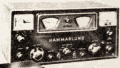 Citizens' Band (CB) radio began in 1945,
just after World War II, in order to provide common folks with a means of both
fixed and mobile radio communications that required only paying a fee to operate.
Amateur radio (Ham radio) did and still does require that the operator pass a written
test to gain transmitting privileges (anyone may receive a signal). CB was and is
used for both fixed base and mobile communications. Evidently, by 1964 there was
enough use and misuse of the airwaves that the Federal Communications Commission
(FCC) found it necessary to publish and enforce a new set of rules for users. CB
radio began operations in the 460-470 MHz UHF band, then moved to 27 MHz
in 1958 since equipment could be manufactured in a manner more affordable to a wider
segment of the public... Citizens' Band (CB) radio began in 1945,
just after World War II, in order to provide common folks with a means of both
fixed and mobile radio communications that required only paying a fee to operate.
Amateur radio (Ham radio) did and still does require that the operator pass a written
test to gain transmitting privileges (anyone may receive a signal). CB was and is
used for both fixed base and mobile communications. Evidently, by 1964 there was
enough use and misuse of the airwaves that the Federal Communications Commission
(FCC) found it necessary to publish and enforce a new set of rules for users. CB
radio began operations in the 460-470 MHz UHF band, then moved to 27 MHz
in 1958 since equipment could be manufactured in a manner more affordable to a wider
segment of the public...
Tuesday the 19th
 Lots of old-time sci-fi movies and TV shows
liked to display
Lissajous patterns on oscilloscopes when an authentic high tech
look was needed in a scene. Every engineer, technician, and physicist in the world
- me included - roll his or her eyes at the sight of such a lame attempt to impress
the public. Of course the truth is the first time I saw a Lissajous pattern gyrating
on an o-scope screen, I was mesmerized. The need to crank on the signal generator
knobs and take control of the electroluminescent object d'art was overwhelming.
Now, in the same manner that watching the first couple Space Shuttle launches was
a thrill not to be missed and then became just another launch, so, too, is watching
a live Lissajous pattern on a scope - it's just another Lissajous. Except, well,
that's not quite so - at least for me. I always eagerly viewed Shuttle launches... Lots of old-time sci-fi movies and TV shows
liked to display
Lissajous patterns on oscilloscopes when an authentic high tech
look was needed in a scene. Every engineer, technician, and physicist in the world
- me included - roll his or her eyes at the sight of such a lame attempt to impress
the public. Of course the truth is the first time I saw a Lissajous pattern gyrating
on an o-scope screen, I was mesmerized. The need to crank on the signal generator
knobs and take control of the electroluminescent object d'art was overwhelming.
Now, in the same manner that watching the first couple Space Shuttle launches was
a thrill not to be missed and then became just another launch, so, too, is watching
a live Lissajous pattern on a scope - it's just another Lissajous. Except, well,
that's not quite so - at least for me. I always eagerly viewed Shuttle launches...
 "Integrating an electronic material that
exhibits a strange property called negative capacitance can help high-power
gallium
nitride transistors break through a performance barrier, say scientists in California.
Research published in Science suggests that negative capacitance helps sidestep
a physical limit that typically enforces tradeoffs between how well a transistor
performs in the 'on' state versus how well it does in the 'off' state. The researchers
behind the project say this shows that negative capacitance, which has been extensively
studied in silicon, may have broader applications than previously..." "Integrating an electronic material that
exhibits a strange property called negative capacitance can help high-power
gallium
nitride transistors break through a performance barrier, say scientists in California.
Research published in Science suggests that negative capacitance helps sidestep
a physical limit that typically enforces tradeoffs between how well a transistor
performs in the 'on' state versus how well it does in the 'off' state. The researchers
behind the project say this shows that negative capacitance, which has been extensively
studied in silicon, may have broader applications than previously..."
 "Squegging" - Now there's a word you don't
hear every day. It is a shortened version of "self-quenching." As is often the case
in these "Mac's Service Shop" sagas, we get a primer on certain circuit
functions and how to troubleshoot and resolve the issue. You can also usually count
on learning more than one lesson per reading. After replacing the failed component
in Barney's exasperatingly elusive receiver, Mac turns to record changer mechanisms
and their bewildering nature, but the real message being given is the value of well-written
troubleshooting guides from manufacturers. Even with today's no-user-serviceable-parts-inside
products, there are many times a troubleshooting guide is included as part of the
user's manual. That goes for both electronic and mechanical products. You might
laugh at the first step that tells the owner to check to make sure the electric
cord is plugged in or batteries are installed with the proper polarity... "Squegging" - Now there's a word you don't
hear every day. It is a shortened version of "self-quenching." As is often the case
in these "Mac's Service Shop" sagas, we get a primer on certain circuit
functions and how to troubleshoot and resolve the issue. You can also usually count
on learning more than one lesson per reading. After replacing the failed component
in Barney's exasperatingly elusive receiver, Mac turns to record changer mechanisms
and their bewildering nature, but the real message being given is the value of well-written
troubleshooting guides from manufacturers. Even with today's no-user-serviceable-parts-inside
products, there are many times a troubleshooting guide is included as part of the
user's manual. That goes for both electronic and mechanical products. You might
laugh at the first step that tells the owner to check to make sure the electric
cord is plugged in or batteries are installed with the proper polarity...
 Electronically steered phased arrays have
largely replaced
mechanically steered antennas in the last couple decades. In an
effort to eliminate the need for a waveguide rotary joint, which is both expensive
and complex when built for high reliability under harsh operating conditions, Japanese
engineers developed an alternative where a small subreflector is orbited about a
central axis to produce a small scanning angle. The measured half power bandwidth
of the central beam was about 7.5°, while the half power scan width about the main
axis boresight appears per one of the plots to be around 30° or so (if I interpret
it correctly). I assume this scheme was never pursued much beyond the experimental
phase... Electronically steered phased arrays have
largely replaced
mechanically steered antennas in the last couple decades. In an
effort to eliminate the need for a waveguide rotary joint, which is both expensive
and complex when built for high reliability under harsh operating conditions, Japanese
engineers developed an alternative where a small subreflector is orbited about a
central axis to produce a small scanning angle. The measured half power bandwidth
of the central beam was about 7.5°, while the half power scan width about the main
axis boresight appears per one of the plots to be around 30° or so (if I interpret
it correctly). I assume this scheme was never pursued much beyond the experimental
phase...
Monday the 18th
 These three
electronics-themed comics appeared in the February 1953 issue
of Radio-Electronics magazine. The first one showing the television repairman
employing contortionist technique in order to tweak the picture is pretty good.
I have seen an advertisement in one of these magazines that offered a deflection
coil alignment signal generator box that had a mirror mounted inside the cover specifically
for doing the job that tech is doing in the comic. Another comic no doubt hit home
with in-home servicemen of the day; at least the owner was honest. The other plays
off a brand of humor common in the day that demonstrated the public's fascination
with all the newfangled technology showing up every day... These three
electronics-themed comics appeared in the February 1953 issue
of Radio-Electronics magazine. The first one showing the television repairman
employing contortionist technique in order to tweak the picture is pretty good.
I have seen an advertisement in one of these magazines that offered a deflection
coil alignment signal generator box that had a mirror mounted inside the cover specifically
for doing the job that tech is doing in the comic. Another comic no doubt hit home
with in-home servicemen of the day; at least the owner was honest. The other plays
off a brand of humor common in the day that demonstrated the public's fascination
with all the newfangled technology showing up every day...
 "The dark
cloud of uncertainty hanging over EchoStar doesn't appear to be going away anytime
soon. FCC Chairman Brendan Carr said his agency continues to take a close look at
whether
EchoStar,
via its Dish business, complied with the FCC's 5G network buildout obligations.
'Dish obviously says that they did,' he said during a press conference after the
commission's open meeting Thursday. 'Concerns have been raised. We've been working
through the data on that. That work continues.' Separately, the FCC opened a proceeding..." "The dark
cloud of uncertainty hanging over EchoStar doesn't appear to be going away anytime
soon. FCC Chairman Brendan Carr said his agency continues to take a close look at
whether
EchoStar,
via its Dish business, complied with the FCC's 5G network buildout obligations.
'Dish obviously says that they did,' he said during a press conference after the
commission's open meeting Thursday. 'Concerns have been raised. We've been working
through the data on that. That work continues.' Separately, the FCC opened a proceeding..."
 Part 1 of this "All About IC's" trilogy
titled, "What Makes Them Tick," author Bob Hibberd introduced the concept of semiconductor
physics and doped PN junctions. In Part 2, he discusses methods used to
fabricate monolithic, integrated circuits (IC's) on silicon chips.
Transistors, diodes, resistor, capacitors, and to some extent, inductors, can be
built using a combination of variously doped junction regions, metallization, and
oxidation (insulators). Technology has come a long way since 1969, including mask
techniques, 3-D structures, doping gradients, feature size, dielectric breakdown
strength, current leakage, circuit density, mixed analog, RF, and digital circuitry,
and other things. Part 3, covered in the August issue, goes into more detail about
how passive components are realized in silicon... Part 1 of this "All About IC's" trilogy
titled, "What Makes Them Tick," author Bob Hibberd introduced the concept of semiconductor
physics and doped PN junctions. In Part 2, he discusses methods used to
fabricate monolithic, integrated circuits (IC's) on silicon chips.
Transistors, diodes, resistor, capacitors, and to some extent, inductors, can be
built using a combination of variously doped junction regions, metallization, and
oxidation (insulators). Technology has come a long way since 1969, including mask
techniques, 3-D structures, doping gradients, feature size, dielectric breakdown
strength, current leakage, circuit density, mixed analog, RF, and digital circuitry,
and other things. Part 3, covered in the August issue, goes into more detail about
how passive components are realized in silicon...
 Note the byline in this 1953 Radio-Electronics
magazine article - Juliette Drut (she's on the cover). Not often were articles in
electronics trade magazines penned by a dame or damsel back in the day. For that
matter, it's still pretty rare today... hmmm... but I digress. If you thumb through
any electronics magazines from the middle of the last century, you find that the
pages are filled with advertisements offering courses to train prospects in the
field of
television and radio repair, with promises of a potential to make
big money. Both institutional and home-study courses abounded. The costs never appeared,
but hey, with the money a fellow would be making soon, surely the price would be
inconsequential. Interestingly, in those same issues would be articles such as this
one addressing the reality of electronics servicing... Note the byline in this 1953 Radio-Electronics
magazine article - Juliette Drut (she's on the cover). Not often were articles in
electronics trade magazines penned by a dame or damsel back in the day. For that
matter, it's still pretty rare today... hmmm... but I digress. If you thumb through
any electronics magazines from the middle of the last century, you find that the
pages are filled with advertisements offering courses to train prospects in the
field of
television and radio repair, with promises of a potential to make
big money. Both institutional and home-study courses abounded. The costs never appeared,
but hey, with the money a fellow would be making soon, surely the price would be
inconsequential. Interestingly, in those same issues would be articles such as this
one addressing the reality of electronics servicing...
 Anritsu has been a global provider of innovative
communications test and measurement solutions for more than 120 years. Anritsu manufactures
a full line of innovative components and accessories for
RF and Microwave Test and Measurement
Equipment including attenuators & terminations; coaxial cables, connectors &
adapters; o-scopes; power meters & sensors; signal generators; antenna, signal,
spectrum, & vector network analyzers (VNAs); calibration kits; Bluetooth &
WLAN testers; PIM testers; amplifiers; power dividers; antennas. "We've Got You
Covered." Anritsu has been a global provider of innovative
communications test and measurement solutions for more than 120 years. Anritsu manufactures
a full line of innovative components and accessories for
RF and Microwave Test and Measurement
Equipment including attenuators & terminations; coaxial cables, connectors &
adapters; o-scopes; power meters & sensors; signal generators; antenna, signal,
spectrum, & vector network analyzers (VNAs); calibration kits; Bluetooth &
WLAN testers; PIM testers; amplifiers; power dividers; antennas. "We've Got You
Covered."
These archive pages are provided in order to make it easier for you to find items
that you remember seeing on the RF Cafe homepage. Of course probably the easiest
way to find anything on the website is to use the "Search
RF Cafe" box at the top of every page. Some quoted items have been shortened
to save space. About RF Cafe.
Homepage Archive Pages
2026:
Jan |
Feb | Mar | Apr | May | Jun | Jul | Aug
| Sep | Oct | Nov | Dec
2025:
Jan |
Feb |
Mar |
Apr |
May |
Jun |
Jul |
Aug |
Sep |
Oct |
Nov |
Dec
2024:
Jan |
Feb |
Mar |
Apr |
May |
Jun |
Jul |
Aug |
Sep |
Oct |
Nov |
Dec
2023:
Jan |
Feb |
Mar |
Apr |
May |
Jun |
Jul |
Aug |
Sep |
Oct |
Nov |
Dec
2022:
Jan |
Feb |
Mar |
Apr |
May |
Jun |
Jul |
Aug |
Sep |
Oct |
Nov |
Dec
2021:
Jan |
Feb |
Mar |
Apr |
May |
Jun |
Jul |
Aug |
Sep |
Oct |
Nov |
Dec
2020:
Jan |
Feb |
Mar |
Apr |
May |
Jun |
Jul |
Aug |
Sep |
Oct |
Nov |
Dec
2019:
Jan |
Feb |
Mar |
Apr |
May |
Jun |
Jul |
Aug |
Sep |
Oct |
Nov |
Dec
2018:
Jan |
Feb |
Mar |
Apr |
May |
Jun |
Jul |
Aug |
Sep |
Oct |
Nov |
Dec
2017:
Jan | Feb |
Mar |
Apr |
May |
Jun |
Jul |
Aug |
Sep |
Oct |
Nov |
Dec
2016:
Jan | Feb |
Mar |
Apr |
May |
Jun |
Jul |
Aug |
Sep |
Oct |
Nov |
Dec
2015:
Jan | Feb |
Mar |
Apr |
May |
Jun |
Jul |
Aug | Sep |
Oct |
Nov |
Dec
2014:
Jan | Feb |
Mar |
Apr |
May |
Jun |
Jul |
Aug |
Sep |
Oct |
Nov |
Dec
2013:
Jan | Feb |
Mar |
Apr |
May |
Jun |
Jul |
Aug |
Sep |
Oct |
Nov |
Dec
2012: 1 |
2 | 3
| 4 | 5
| 6 | 7
| 8 | 9
| 10 | 11
| 12 | 13
(no archives before 2012)
- Christmas-themed
items
|