See Page 1 |
2 | of the January 2026
homepage archives.
 Bill Woodbury, president of Sprague Products
Company, addressed the National Electronics Association's (NEA) National Convention
in 1969, praising his firm's commitment to high-quality replacement components for
electronic service technicians while flipping the topic to solicit their input on
manufacturer support. He candidly criticized the independent service industry for
failing to unite, with only 15-25% of 125,000 technicians in
fragmented trade associations that waste energy fighting each other. Woodbury
urged forming one powerful national body like NEA through mergers, warning that
disunity has cost billions in missed opportunities like garage doors... Bill Woodbury, president of Sprague Products
Company, addressed the National Electronics Association's (NEA) National Convention
in 1969, praising his firm's commitment to high-quality replacement components for
electronic service technicians while flipping the topic to solicit their input on
manufacturer support. He candidly criticized the independent service industry for
failing to unite, with only 15-25% of 125,000 technicians in
fragmented trade associations that waste energy fighting each other. Woodbury
urged forming one powerful national body like NEA through mergers, warning that
disunity has cost billions in missed opportunities like garage doors...
 While reading through this article on
copper-oxide rectifiers, I am once again reminded of how much
we take for granted the conveniences of electrical test equipment on today's shop
benches. The advent of FET-input multimeters was a huge step forward because the
meter input impedance is so high that it has practically no impact on the circuit
being measured. Prior to that, most simple meters drew their power from the circuit
under test, thereby altering the true value of current or voltage being measured.
Of course there were vacuum tube voltmeters (VTVM)
with high input impedances, but few hobbyists or laymen could afford them. This
piece reports on how the advent of a non-tube-based rectifier permitted AC measurements
to be made by DC-driven d'Arsonval meter movements so as to not excessively... While reading through this article on
copper-oxide rectifiers, I am once again reminded of how much
we take for granted the conveniences of electrical test equipment on today's shop
benches. The advent of FET-input multimeters was a huge step forward because the
meter input impedance is so high that it has practically no impact on the circuit
being measured. Prior to that, most simple meters drew their power from the circuit
under test, thereby altering the true value of current or voltage being measured.
Of course there were vacuum tube voltmeters (VTVM)
with high input impedances, but few hobbyists or laymen could afford them. This
piece reports on how the advent of a non-tube-based rectifier permitted AC measurements
to be made by DC-driven d'Arsonval meter movements so as to not excessively...
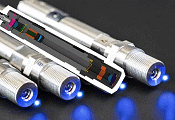 "[Bill
Schweber has] always been interested in innovations that are pursued for years without
wide adoption, yet proponents keep working on them. Sometimes, these advances just
fade away. Other times, they contribute to progress in a more-general way and, in
some cases, the necessary pieces -- technologies, manufacturing, market needs --
finally converge, and the years of laboring in semi-obscurity final pay off. That's
one of the reasons [he has] been following the efforts to use
laser-based spark plugs in place of the classic spark plug as the igniter of
gasoline and other volatile fuels in the internal combustion engine (ICE). There
have been innovations in the plug itself over the years... "[Bill
Schweber has] always been interested in innovations that are pursued for years without
wide adoption, yet proponents keep working on them. Sometimes, these advances just
fade away. Other times, they contribute to progress in a more-general way and, in
some cases, the necessary pieces -- technologies, manufacturing, market needs --
finally converge, and the years of laboring in semi-obscurity final pay off. That's
one of the reasons [he has] been following the efforts to use
laser-based spark plugs in place of the classic spark plug as the igniter of
gasoline and other volatile fuels in the internal combustion engine (ICE). There
have been innovations in the plug itself over the years...
 The basics of
power transistor specification and selection have not changed
much since they became widely commercially available in the 1960s. Although available
package shapes, power handling, cutoff frequencies, and other parameter options
have been greatly expanded, still the most important aspect is not just selecting
a power transistor but properly mounting it to ensure that the rated heat dissipation
capacity will be realized. This article touches on some of those considerations
and how to effectively deal with them... The basics of
power transistor specification and selection have not changed
much since they became widely commercially available in the 1960s. Although available
package shapes, power handling, cutoff frequencies, and other parameter options
have been greatly expanded, still the most important aspect is not just selecting
a power transistor but properly mounting it to ensure that the rated heat dissipation
capacity will be realized. This article touches on some of those considerations
and how to effectively deal with them...
 Fellow cruciverbalists, here from a 1963
edition of Electronics World is an
electronics-themed crossword puzzle for your end-of-the week enjoyment.
You can click on the grid for a larger, printable, write-on-able paper version.
If you are an avid worker of crosswords and don't already know it, I have created
hundreds over the last decade+ that are available
here. Unlike this
crossword from Electronics World magazine (and most others for that matter),
my puzzles have only hand-picked words related to engineering and science... Fellow cruciverbalists, here from a 1963
edition of Electronics World is an
electronics-themed crossword puzzle for your end-of-the week enjoyment.
You can click on the grid for a larger, printable, write-on-able paper version.
If you are an avid worker of crosswords and don't already know it, I have created
hundreds over the last decade+ that are available
here. Unlike this
crossword from Electronics World magazine (and most others for that matter),
my puzzles have only hand-picked words related to engineering and science...
 Boonton, Holzworth, and Noisecom brands
are part of Maury Microwave (formerly WTG), a global designer and manufacturer of
advanced RF and microwave components, modules, systems, and instruments. Serving
the wireless, telecommunication, satellite, military, aerospace, semiconductor and
medical industries, Wireless Telecom Group products enable innovation across a wide
range of traditional and emerging wireless technologies. A unique set of high-performance
products including peak power meters, signal generators, phase noise analyzers,
signal processing modules, 5G and LTE PHY/stack software, noise sources, and programmable
noise generators. Boonton, Holzworth, and Noisecom brands
are part of Maury Microwave (formerly WTG), a global designer and manufacturer of
advanced RF and microwave components, modules, systems, and instruments. Serving
the wireless, telecommunication, satellite, military, aerospace, semiconductor and
medical industries, Wireless Telecom Group products enable innovation across a wide
range of traditional and emerging wireless technologies. A unique set of high-performance
products including peak power meters, signal generators, phase noise analyzers,
signal processing modules, 5G and LTE PHY/stack software, noise sources, and programmable
noise generators.
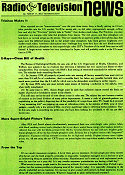 The monthly "Radio &
Television News" column in Electronics World magazine always contained
an interesting mish-mash of industry happenings. As mentioned many times before,
the 1960s was an era of huge transitions in the electronics and communications fields,
in all aspects including military, automotive, aerospace, domestic, commercial,
industrial, and hobby. It was a heyday for just about all involved - designers,
manufacturers, customers - except the poor service guys who had to keep everything
working. Homeowners with problematic television sets - particularly the expensive,
newfangled color sets - notoriously made technicians' lives Heck. Some outfits deserved
the grief, but most could barely turn a profit because if the manufacturer wasn't
cheating the serviceman out of payment for warranty work, housewives and husbands
would try... The monthly "Radio &
Television News" column in Electronics World magazine always contained
an interesting mish-mash of industry happenings. As mentioned many times before,
the 1960s was an era of huge transitions in the electronics and communications fields,
in all aspects including military, automotive, aerospace, domestic, commercial,
industrial, and hobby. It was a heyday for just about all involved - designers,
manufacturers, customers - except the poor service guys who had to keep everything
working. Homeowners with problematic television sets - particularly the expensive,
newfangled color sets - notoriously made technicians' lives Heck. Some outfits deserved
the grief, but most could barely turn a profit because if the manufacturer wasn't
cheating the serviceman out of payment for warranty work, housewives and husbands
would try...
 Benjamin Franklin is famous for his kite-flying
experiment whereby he "discovered" not electricity (as many people believe), but
that lightning is a form of electricity (most people thought it was a jet of gas).
A lesser known fact about Mr. Franklin is that he invented the
lightning rod after realizing the electrical nature of lightning.
His understanding of electric fields facilitated a implementation whereby hefty
iron cabling interconnected a tall, pointed rod installed at the tallest point on
a building and a spike driven into the ground. Lightning typically strikes the object
that is the shortest distance (in terms of electrical field strength) from it because
the discharge can begin at the lowest voltage. The presence of the grounded lightning
rod above the highest point on a structure effectively brings that point all the... Benjamin Franklin is famous for his kite-flying
experiment whereby he "discovered" not electricity (as many people believe), but
that lightning is a form of electricity (most people thought it was a jet of gas).
A lesser known fact about Mr. Franklin is that he invented the
lightning rod after realizing the electrical nature of lightning.
His understanding of electric fields facilitated a implementation whereby hefty
iron cabling interconnected a tall, pointed rod installed at the tallest point on
a building and a spike driven into the ground. Lightning typically strikes the object
that is the shortest distance (in terms of electrical field strength) from it because
the discharge can begin at the lowest voltage. The presence of the grounded lightning
rod above the highest point on a structure effectively brings that point all the...
 Tiny molecules that can think, remember,
and learn may be the missing link between electronics and the brain. For more than
half a century, researchers have looked for ways to move past silicon by
building electronics from molecules. The idea sounded simple and beautiful,
but real devices turned out to be messy. Inside a working component, molecules do
not act like neat, isolated pieces from a textbook. Instead, they form crowded,
interactive networks where electrons move, ions shift position, interfaces change
over time, and even tiny differences in structure can trigger strongly nonlinear
behavior. The potential was exciting, but reliably predicting and controlling what
a molecular device would do remained out of reach. Tiny molecules that can think, remember,
and learn may be the missing link between electronics and the brain. For more than
half a century, researchers have looked for ways to move past silicon by
building electronics from molecules. The idea sounded simple and beautiful,
but real devices turned out to be messy. Inside a working component, molecules do
not act like neat, isolated pieces from a textbook. Instead, they form crowded,
interactive networks where electrons move, ions shift position, interfaces change
over time, and even tiny differences in structure can trigger strongly nonlinear
behavior. The potential was exciting, but reliably predicting and controlling what
a molecular device would do remained out of reach.
 What better way is there to resuscitate
a challenging work day than to kick back and enjoy these electronics-themed comics
from a vintage edition of Radio & Television News magazine? Seeing
a comic panel in any modern technical magazine these days is rare, if for no other
reason than a fear amongst publishers (and their lawyers) that somebody, somewhere
might be offended. You have my invitation to create a good-humored cartoon about
me or RF Cafe anytime you wish, and I promise not to sue you. I'll even post it
here on the website if you like. BTW, these comics make great fodder for the front
page of your technical presentations... What better way is there to resuscitate
a challenging work day than to kick back and enjoy these electronics-themed comics
from a vintage edition of Radio & Television News magazine? Seeing
a comic panel in any modern technical magazine these days is rare, if for no other
reason than a fear amongst publishers (and their lawyers) that somebody, somewhere
might be offended. You have my invitation to create a good-humored cartoon about
me or RF Cafe anytime you wish, and I promise not to sue you. I'll even post it
here on the website if you like. BTW, these comics make great fodder for the front
page of your technical presentations...
 Potassium sodium tartrate (Rochelle salt) was used in commercial speakers for a while in
place of electromagnetic driver coils. The relatively large mechanical deformation
produced when subject to an electric field made them attractive as coil alternatives
because a separate energization circuit was not required. The drawback, at least
early on, was unavailability of crystals large enough to drive anything other than
a headphone size speaker cone. This article tells of the time when a process was
created to grow large crystals from a seed, similar to how silicon, gallium-arsenide,
and other modern semiconductors are grown... Potassium sodium tartrate (Rochelle salt) was used in commercial speakers for a while in
place of electromagnetic driver coils. The relatively large mechanical deformation
produced when subject to an electric field made them attractive as coil alternatives
because a separate energization circuit was not required. The drawback, at least
early on, was unavailability of crystals large enough to drive anything other than
a headphone size speaker cone. This article tells of the time when a process was
created to grow large crystals from a seed, similar to how silicon, gallium-arsenide,
and other modern semiconductors are grown...
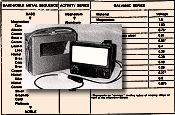 Galvanic corrosion is a potential problem
(get it - potential?) for just about any scenario where two metals of differing
nobility (position the galvanic table) come into contact with each other. This 1969
Electronics World magazine article explains corrosion as an electrochemical process
akin to electronics, involving anodes, cathodes, electrolytes, and electron flow,
particularly in marine environments. Galvanic corrosion occurs with dissimilar metals
like zinc (anode) and copper (cathode) in water, accelerated by oxygen depolarizing
the cathode. Factors include galvanic/activity series rankings, electrolyte pH,
chloride content, humidity, and oxygen differentials... Galvanic corrosion is a potential problem
(get it - potential?) for just about any scenario where two metals of differing
nobility (position the galvanic table) come into contact with each other. This 1969
Electronics World magazine article explains corrosion as an electrochemical process
akin to electronics, involving anodes, cathodes, electrolytes, and electron flow,
particularly in marine environments. Galvanic corrosion occurs with dissimilar metals
like zinc (anode) and copper (cathode) in water, accelerated by oxygen depolarizing
the cathode. Factors include galvanic/activity series rankings, electrolyte pH,
chloride content, humidity, and oxygen differentials...
 GeAs was the semiconductor substrate material
of choice long before the III-V series like GaN and GaAs came along. GeAs would
be considered a III-IV semiconductor since Ge is in group IV of the
periodic
table (Ga is group III, As is group V). It is actually know simply as germanium.
1954, when this advertisement from Bell Telephone Laboratories appeared in Radio &
Television News magazine, was the same year that Texas Instruments (TI) introduced
the world's first commercially available silicon (Si) transistor. The GeAs boule
photo in the ad was printed "life size," which makes it around 2" in diameter. Compare
that to 12" diameter wafers standard today for Si. Gallium nitride GaN), a more... GeAs was the semiconductor substrate material
of choice long before the III-V series like GaN and GaAs came along. GeAs would
be considered a III-IV semiconductor since Ge is in group IV of the
periodic
table (Ga is group III, As is group V). It is actually know simply as germanium.
1954, when this advertisement from Bell Telephone Laboratories appeared in Radio &
Television News magazine, was the same year that Texas Instruments (TI) introduced
the world's first commercially available silicon (Si) transistor. The GeAs boule
photo in the ad was printed "life size," which makes it around 2" in diameter. Compare
that to 12" diameter wafers standard today for Si. Gallium nitride GaN), a more...
 "Induction is a hazard that occurs when
an electric or magnetic field causes current to flow through equipment whose intended
power supply has been cut off. Safety practices seek to prevent such induction shocks
by grounding all conductive objects in a work zone, giving electricity alternative
paths. But accidents happen. In [one lineman's] case, his platform unexpectedly
swung into the line before it could be grounded. Adding a layer of defense against
induction injuries is the motivation behind Budapest-based Electrostatics' specialized
conductive jumpsuits,
which are designed to protect against burns, cardiac fibrillation, and other ills.
'If my boy had been wearing one, I know he'd be alive today,' says the elder Kropp,
who purchased a line-worker safety training business..." "Induction is a hazard that occurs when
an electric or magnetic field causes current to flow through equipment whose intended
power supply has been cut off. Safety practices seek to prevent such induction shocks
by grounding all conductive objects in a work zone, giving electricity alternative
paths. But accidents happen. In [one lineman's] case, his platform unexpectedly
swung into the line before it could be grounded. Adding a layer of defense against
induction injuries is the motivation behind Budapest-based Electrostatics' specialized
conductive jumpsuits,
which are designed to protect against burns, cardiac fibrillation, and other ills.
'If my boy had been wearing one, I know he'd be alive today,' says the elder Kropp,
who purchased a line-worker safety training business..."
 This article was written in 1932, before
anyone had in-situ empirical measurements of the
ionosphere, since suitable instrumented sounding rockets were
not yet available. It had only been 30 years since Oliver Heaviside and Arthur Kennelly
first proposed their theory of the ionized layer that encompasses the Earth. It
turned out that the ionosphere is composed of multiple layers of ionized regions
whose intensities are dependent on solar surface activity, time of day and night,
time of year, and even on terrestrial events like large volcanoes. Large network
communications have been built so as not to be held hostage by atmospheric conditions
by utilizing... This article was written in 1932, before
anyone had in-situ empirical measurements of the
ionosphere, since suitable instrumented sounding rockets were
not yet available. It had only been 30 years since Oliver Heaviside and Arthur Kennelly
first proposed their theory of the ionized layer that encompasses the Earth. It
turned out that the ionosphere is composed of multiple layers of ionized regions
whose intensities are dependent on solar surface activity, time of day and night,
time of year, and even on terrestrial events like large volcanoes. Large network
communications have been built so as not to be held hostage by atmospheric conditions
by utilizing...
 In this episode of John T. Frye's "Carl & Jerry" series, the intrepid pair of teenage electronics
hobbyists and Ham radio operators are experimenting with an audio amplifier rig
that uses a parabolic dish for concentrating sound waves at a focal point where
they have a microphone mounted. Aside from picking up bird noises and a neighbor
lady scolding her husband for not properly washing the windows during a round of
Spring cleaning, Carl imposes upon Jerry for a lesson in
feedback techniques - both positive and negative - and the reasons
one is preferred over the other. The story winds up with a clever double entendre
comment referring to "osculation..." In this episode of John T. Frye's "Carl & Jerry" series, the intrepid pair of teenage electronics
hobbyists and Ham radio operators are experimenting with an audio amplifier rig
that uses a parabolic dish for concentrating sound waves at a focal point where
they have a microphone mounted. Aside from picking up bird noises and a neighbor
lady scolding her husband for not properly washing the windows during a round of
Spring cleaning, Carl imposes upon Jerry for a lesson in
feedback techniques - both positive and negative - and the reasons
one is preferred over the other. The story winds up with a clever double entendre
comment referring to "osculation..."
 Temwell is a manufacturer of 5G wireless communications filters
for aerospace, satellite communication, AIoT, 5G networking, IoV, drone, mining
transmission, IoT, medical, military, laboratory, transportation, energy, broadcasting
(CATV), and etc. An RF helical bandpass specialist since 1994, we have posted >5,000
completed spec sheets online for all kinds of RF filters including helical, cavity,
LC, and SMD. Standard highpass, lowpass, bandpass, and bandstop, as well as duplexer/diplexer,
multiplexer. Also RF combiners, splitters, power dividers, attenuators, circulators,
couplers, PA, LNA, and obsolete coil & inductor solutions. Temwell is a manufacturer of 5G wireless communications filters
for aerospace, satellite communication, AIoT, 5G networking, IoV, drone, mining
transmission, IoT, medical, military, laboratory, transportation, energy, broadcasting
(CATV), and etc. An RF helical bandpass specialist since 1994, we have posted >5,000
completed spec sheets online for all kinds of RF filters including helical, cavity,
LC, and SMD. Standard highpass, lowpass, bandpass, and bandstop, as well as duplexer/diplexer,
multiplexer. Also RF combiners, splitters, power dividers, attenuators, circulators,
couplers, PA, LNA, and obsolete coil & inductor solutions.
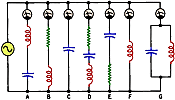 After learning the fundaments of Ohm's law,
for calculating simple relationships between voltage, current, power, and resistance,
the next area of study is capacitors and inductors. Anyone who might have had trouble
grasping the concepts of Ohm's law will certainly be considering another career
line when encountering these two components. Fortunately, an introductory course
does not immediately deal with complex math -- involving real and imaginary parts.
Rather tidy equations relating common
combinations of L's (inductors), R's (resistors), and C's (capacitors)... After learning the fundaments of Ohm's law,
for calculating simple relationships between voltage, current, power, and resistance,
the next area of study is capacitors and inductors. Anyone who might have had trouble
grasping the concepts of Ohm's law will certainly be considering another career
line when encountering these two components. Fortunately, an introductory course
does not immediately deal with complex math -- involving real and imaginary parts.
Rather tidy equations relating common
combinations of L's (inductors), R's (resistors), and C's (capacitors)...
 In 2015 we would hardly think of electromagnetic
radiation in the 5 cm wavelength realm as being "quasi-optical" as far as circuit-based manipulation is concerned.
Optical wavelengths begin at around 6,300 Å for red light, which is 6.3x10⁻⁵ cm,
or 630 nm. The 5 cm wavelength used an example in a 1932 article in
Short Wave Craft magazine is equivalent to 6 GHz. 6 GHz was an
extraordinarily high frequency to be using for communications back then, and the
author did not intend to liken it to anywhere near visible light. Instead, his terming
its properties as "quasi-optical" referred to how the waves interacted with physical
objects; e.g., reflection, refraction, absorption, and scattering. Barkhausen
oscillations were a popular subject of the era... In 2015 we would hardly think of electromagnetic
radiation in the 5 cm wavelength realm as being "quasi-optical" as far as circuit-based manipulation is concerned.
Optical wavelengths begin at around 6,300 Å for red light, which is 6.3x10⁻⁵ cm,
or 630 nm. The 5 cm wavelength used an example in a 1932 article in
Short Wave Craft magazine is equivalent to 6 GHz. 6 GHz was an
extraordinarily high frequency to be using for communications back then, and the
author did not intend to liken it to anywhere near visible light. Instead, his terming
its properties as "quasi-optical" referred to how the waves interacted with physical
objects; e.g., reflection, refraction, absorption, and scattering. Barkhausen
oscillations were a popular subject of the era...
 "On a blustery November day, a Cessna turboprop
flew over Pennsylvania at 5,000 meters, in crosswinds of up to 70 knots -- nearly
as fast as the little plane was flying. But the bumpy conditions didn't thwart its
mission: to wirelessly beam power down to receivers on the ground as it flew by.
The test flight marked the first time
power has been
beamed from a moving aircraft. It was conducted by Overview Energy, which emerged
from stealth mode in December by announcing the feat. But the greater purpose of
the flight was to demonstrate the feasibility of a much grander ambition: to beam
power from space to Earth..." "On a blustery November day, a Cessna turboprop
flew over Pennsylvania at 5,000 meters, in crosswinds of up to 70 knots -- nearly
as fast as the little plane was flying. But the bumpy conditions didn't thwart its
mission: to wirelessly beam power down to receivers on the ground as it flew by.
The test flight marked the first time
power has been
beamed from a moving aircraft. It was conducted by Overview Energy, which emerged
from stealth mode in December by announcing the feat. But the greater purpose of
the flight was to demonstrate the feasibility of a much grander ambition: to beam
power from space to Earth..."
 Before there were electric generators onboard
airplanes to power communications equipment, aviators relied on storage batteries
to operate their radios. Before that, there were no radios at all aboard airplanes.
Although Wilbur and Orville Wright first piloted their Wright Flyer in 1903, by
the end of the decade airplanes were becoming a common sight across the country
and across the civilized world. By the middle of the second decade experiments were
being done with airborne radio. They were heavy vacuum tube units with heavy
lead-acid batteries. Antennas sometimes hundreds of feet long
needed to be reeled out and in once at altitude. The earliest transmitter (for 2-way
communications) were spark gap types, meaning of course Morse code was the medium... Before there were electric generators onboard
airplanes to power communications equipment, aviators relied on storage batteries
to operate their radios. Before that, there were no radios at all aboard airplanes.
Although Wilbur and Orville Wright first piloted their Wright Flyer in 1903, by
the end of the decade airplanes were becoming a common sight across the country
and across the civilized world. By the middle of the second decade experiments were
being done with airborne radio. They were heavy vacuum tube units with heavy
lead-acid batteries. Antennas sometimes hundreds of feet long
needed to be reeled out and in once at altitude. The earliest transmitter (for 2-way
communications) were spark gap types, meaning of course Morse code was the medium...
 Werbel Microwave began as a consulting firm,
specializing in RF components design, with the ability to rapidly spin low volume
prototypes, and has quickly grown into a major designer and manufacturer with volume
production capacities. The
WMHPC-80-520M-6dB-N is a high-power coupler that operates over the 80 to 520 MHz
band, covering FM radio, upper VHF and lower UHF applications. Conservatively rated
for 100 watts CW. Useful for amplification and signal distribution applications
including radio and television broadcasting, public safety and emergency broadcasting
and distributed antenna systems. Mainline loss 1.2 dB typical, directivity
24.5 dB. Assembled and tested in USA. "No Worries with Werbel!" Werbel Microwave began as a consulting firm,
specializing in RF components design, with the ability to rapidly spin low volume
prototypes, and has quickly grown into a major designer and manufacturer with volume
production capacities. The
WMHPC-80-520M-6dB-N is a high-power coupler that operates over the 80 to 520 MHz
band, covering FM radio, upper VHF and lower UHF applications. Conservatively rated
for 100 watts CW. Useful for amplification and signal distribution applications
including radio and television broadcasting, public safety and emergency broadcasting
and distributed antenna systems. Mainline loss 1.2 dB typical, directivity
24.5 dB. Assembled and tested in USA. "No Worries with Werbel!"
 Whoa, it's a good thing I read these articles
prior to publishing them, lest some uninitiated soul be lead to the wrong conclusion!
Keep in mind that this article was written in 1932, prior to the development of
the quantum mechanical model of the atom, but on the other hand, Ernest Rutherford
and Niels Bohr developed their model in 1913, so the information was available.
The
Rutherford-Bohr model of the atom suggested a nucleus comprised
of positive masses called protons, each of which carries a charge of +1 unit, and
neutrons with no net charge. Surrounding the nucleus were orbiting masses called
electrons, each of which carries a charge of -1 units. Accordingly, the net charge
of an atom was the sum of protons and electrons, with unionized atoms having a net... Whoa, it's a good thing I read these articles
prior to publishing them, lest some uninitiated soul be lead to the wrong conclusion!
Keep in mind that this article was written in 1932, prior to the development of
the quantum mechanical model of the atom, but on the other hand, Ernest Rutherford
and Niels Bohr developed their model in 1913, so the information was available.
The
Rutherford-Bohr model of the atom suggested a nucleus comprised
of positive masses called protons, each of which carries a charge of +1 unit, and
neutrons with no net charge. Surrounding the nucleus were orbiting masses called
electrons, each of which carries a charge of -1 units. Accordingly, the net charge
of an atom was the sum of protons and electrons, with unionized atoms having a net...
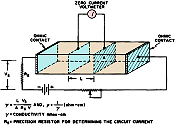 I have always found it annoying when an
author uses a symbol or subscript in an article without explaining or somehow making
obvious what it is. In this "Resistivity:
Some Definitions" piece from a 1969 issue of Electronics World magazine,
the author's stated purpose is to define terms related to resistivity, which he
does well, but there are a couple instances where subscripts for resistivity, rho
(ρ), are left for the reader to figure out.
ρsp, ρs,
and ρv have been replaced with
ρspecific, ρsheet,
and ρvolume , respectively, where needed.
Sure, a careful reading of the surrounding content clarified the intent, but you
are not supposed to work that hard. Otherwise... I have always found it annoying when an
author uses a symbol or subscript in an article without explaining or somehow making
obvious what it is. In this "Resistivity:
Some Definitions" piece from a 1969 issue of Electronics World magazine,
the author's stated purpose is to define terms related to resistivity, which he
does well, but there are a couple instances where subscripts for resistivity, rho
(ρ), are left for the reader to figure out.
ρsp, ρs,
and ρv have been replaced with
ρspecific, ρsheet,
and ρvolume , respectively, where needed.
Sure, a careful reading of the surrounding content clarified the intent, but you
are not supposed to work that hard. Otherwise...
 Carl and Jerry found the appearance and
construction of 2400 megacycle transmitters and receivers to be quite odd compared
to the equipment they were used to dealing with. It's sometimes hard to believe
such an attitude of wonder when our world today is utterly filled with wireless
devices operating in the 2.4 GHz ISM band. Author John T. Frye could never
have imagined that such a reality would would exist half a century after his story
of the pair of teenage electronics sleuths. Unlike our postage stamp size integrated
assemblies that cost a few dollars, they speak of "special ultra-high-frequency
"light-house" tubes with... Carl and Jerry found the appearance and
construction of 2400 megacycle transmitters and receivers to be quite odd compared
to the equipment they were used to dealing with. It's sometimes hard to believe
such an attitude of wonder when our world today is utterly filled with wireless
devices operating in the 2.4 GHz ISM band. Author John T. Frye could never
have imagined that such a reality would would exist half a century after his story
of the pair of teenage electronics sleuths. Unlike our postage stamp size integrated
assemblies that cost a few dollars, they speak of "special ultra-high-frequency
"light-house" tubes with...
 Say goodbye to Earth-based astronomy if
this trend continues! Elon Musk's Starlink 10,000-satellite constellation pales
in comparison to this ambitious, dominating system. Isn't it amazing how Green warrior
funders are willing to ignore things like and nuclear power plants when it serves
their financial and influence purposes? "China
files to launch 193,448 satellites. The CTC-1 filing is for a single notional
Non-Geostationary Orbit (NGSO) system. The CTC-2 filing is still at the Advanced
Publication Information stage. CTC-1 and CTC-2 are early-stage ITU regulatory filings
but don't authorize launches. [They] form part of a single strategic effort to secure
spectrum and orbital priority for a future next-generation Chinese megaconstellation..." Say goodbye to Earth-based astronomy if
this trend continues! Elon Musk's Starlink 10,000-satellite constellation pales
in comparison to this ambitious, dominating system. Isn't it amazing how Green warrior
funders are willing to ignore things like and nuclear power plants when it serves
their financial and influence purposes? "China
files to launch 193,448 satellites. The CTC-1 filing is for a single notional
Non-Geostationary Orbit (NGSO) system. The CTC-2 filing is still at the Advanced
Publication Information stage. CTC-1 and CTC-2 are early-stage ITU regulatory filings
but don't authorize launches. [They] form part of a single strategic effort to secure
spectrum and orbital priority for a future next-generation Chinese megaconstellation..."
 In an effort to promote entry of women and
girls into the amateur radio hobby, Short Wave Craft magazine ran a few
contests for Best "YL" Photos. Amazingly - and maybe there are still instances
of it today - many (if not most) of the YLs featured had built their own equipment.
In 1935, most people built their own equipment, so that is not too surprising. The
winner for this month was a 16-year-old young lady i.e., "YL") who in fact built
her rig. Another winner was an 83-year-old grandma who was born before Marconi,
Maxwell, and Hertz did their best work! The third winner was a girl who earned her
Ham license at age 6, which back in the day required sending and receiving 5 words
per minute (WPM) in Morse code... In an effort to promote entry of women and
girls into the amateur radio hobby, Short Wave Craft magazine ran a few
contests for Best "YL" Photos. Amazingly - and maybe there are still instances
of it today - many (if not most) of the YLs featured had built their own equipment.
In 1935, most people built their own equipment, so that is not too surprising. The
winner for this month was a 16-year-old young lady i.e., "YL") who in fact built
her rig. Another winner was an 83-year-old grandma who was born before Marconi,
Maxwell, and Hertz did their best work! The third winner was a girl who earned her
Ham license at age 6, which back in the day required sending and receiving 5 words
per minute (WPM) in Morse code...
 Coaxial cable is the most familiar form
of
RF transmission line for most people these days. Up until 2009
when the U.S. switched to digital television (DTV), there were still a fairly large
number of people who had the old 300 Ω twin lead cable running from roof-top
antennas to TV sets. Over-the-air reception has petered off precipitously since
then. Coaxial cable is undoubtedly more convenient and forgiving regarding routing
since proximity to structures - particularly metallic components - than twin lead.
Good quality 300 Ω twin lead cable (~30¢/foot today)... Coaxial cable is the most familiar form
of
RF transmission line for most people these days. Up until 2009
when the U.S. switched to digital television (DTV), there were still a fairly large
number of people who had the old 300 Ω twin lead cable running from roof-top
antennas to TV sets. Over-the-air reception has petered off precipitously since
then. Coaxial cable is undoubtedly more convenient and forgiving regarding routing
since proximity to structures - particularly metallic components - than twin lead.
Good quality 300 Ω twin lead cable (~30¢/foot today)...
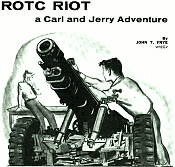 Certainly my high school, Southern Senior
High (class of '76), in Harwood, Maryland, had a JROTC program in the 1970s, but
I have no recollection of it. Maybe because of the Vietnam War, not as many ROTC
groups were being formed. In fact, I don't think there was anything about ROTC in
my yearbook. This 1962 Carl and Jerry adventure titled "ROTC
Riot" took place at the semi-fictional Parvoo University, where the electronics
and technology pair was attending for electrical engineering. ROTC upperclassmen
were famously difficult to tolerate due to their attitude of superiority -- and
desire to do unto others as was done unto them... Certainly my high school, Southern Senior
High (class of '76), in Harwood, Maryland, had a JROTC program in the 1970s, but
I have no recollection of it. Maybe because of the Vietnam War, not as many ROTC
groups were being formed. In fact, I don't think there was anything about ROTC in
my yearbook. This 1962 Carl and Jerry adventure titled "ROTC
Riot" took place at the semi-fictional Parvoo University, where the electronics
and technology pair was attending for electrical engineering. ROTC upperclassmen
were famously difficult to tolerate due to their attitude of superiority -- and
desire to do unto others as was done unto them...
 Mrs. Helen McKee knew exactly what she was
signing up for when she agreed to marry Mr. McKee. After all, she met and got familiar
with the guy over the air during some rag chewing sessions. This story is a humorous
(and true) account of what life can be like for the spouses of enthusiastic Ham
radio operators. We all hope for such an understanding "significant other." Melanie
has certainly endured and supported a lot of
my pastime endeavors
over the past 32 years. It's a short read, so take a break and put a smile on your
face... Mrs. Helen McKee knew exactly what she was
signing up for when she agreed to marry Mr. McKee. After all, she met and got familiar
with the guy over the air during some rag chewing sessions. This story is a humorous
(and true) account of what life can be like for the spouses of enthusiastic Ham
radio operators. We all hope for such an understanding "significant other." Melanie
has certainly endured and supported a lot of
my pastime endeavors
over the past 32 years. It's a short read, so take a break and put a smile on your
face...
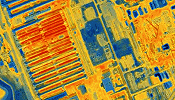 "SatVu has released a 3.5m high-resolution
thermal image revealing near-real-time activity inside one of the USA's largest
data centres. The image provides a heat-based look at cooling systems, substations
and high-load infrastructure of the data centre of a bitcoin mining company in Rockdale,
Texas. Demand for AI, cloud computing and crypto mining has made data centres some
of the world's most energy-intensive facilities. They are expanding fast, often
outpacing the ability of regulators, grid operators, analysts and communities..." "SatVu has released a 3.5m high-resolution
thermal image revealing near-real-time activity inside one of the USA's largest
data centres. The image provides a heat-based look at cooling systems, substations
and high-load infrastructure of the data centre of a bitcoin mining company in Rockdale,
Texas. Demand for AI, cloud computing and crypto mining has made data centres some
of the world's most energy-intensive facilities. They are expanding fast, often
outpacing the ability of regulators, grid operators, analysts and communities..."
 As mentioned many times in the past, some
things never change regarding the
basics of electricity and electronics. Resistance, inductance,
and capacitance are examples. When first starting out in this science, an effective
introduction to the fundamentals can often determine whether a person sticks with
it or finds another area of interest to pursue as a hobby and/or vocation. Analogous
examples of voltage and water pressure, resistance and the diameter of a water hose,
inertia in a spinning mass opposing a change in rate and an inductor opposing a
change in current, etc., are presented along with some good sketches of... As mentioned many times in the past, some
things never change regarding the
basics of electricity and electronics. Resistance, inductance,
and capacitance are examples. When first starting out in this science, an effective
introduction to the fundamentals can often determine whether a person sticks with
it or finds another area of interest to pursue as a hobby and/or vocation. Analogous
examples of voltage and water pressure, resistance and the diameter of a water hose,
inertia in a spinning mass opposing a change in rate and an inductor opposing a
change in current, etc., are presented along with some good sketches of...
 How is this for a prescient prediction from
the early 1960s? "As a result of modular and
integrated circuitry techniques, all future circuit design work,
regardless of degree, will become the responsibility of the component manufacturer
instead of the equipment producer." Texas Instruments' (TI) Jack Kilby is credited
with designing the first integrated circuit in 1958. The first commercial IC, Ti's
Type 502 flip-flop, had just hit the market in early 1960, and already pundits were
prognosticating and ruing the disappearance of circuit designers. Maybe it was concerns
over job security that they seem to favor forever building every circuit... How is this for a prescient prediction from
the early 1960s? "As a result of modular and
integrated circuitry techniques, all future circuit design work,
regardless of degree, will become the responsibility of the component manufacturer
instead of the equipment producer." Texas Instruments' (TI) Jack Kilby is credited
with designing the first integrated circuit in 1958. The first commercial IC, Ti's
Type 502 flip-flop, had just hit the market in early 1960, and already pundits were
prognosticating and ruing the disappearance of circuit designers. Maybe it was concerns
over job security that they seem to favor forever building every circuit...
 Werbel Microwave is a manufacturer of RF
directional and bidirectional couplers (6 dB to 50 dB) and RF power dividers
/ combiners (2- to 16-way) with select models operating up to 26.5 GHz and
100 W of CW power (3 kW peak). All are RoHS and REACH compliant and are
designed and manufactured in our Whippany, NJ, location. Custom products and private
label service available. Please take a couple minutes to visit their website and
see how Werbel Microwave can help you today. Werbel Microwave is a manufacturer of RF
directional and bidirectional couplers (6 dB to 50 dB) and RF power dividers
/ combiners (2- to 16-way) with select models operating up to 26.5 GHz and
100 W of CW power (3 kW peak). All are RoHS and REACH compliant and are
designed and manufactured in our Whippany, NJ, location. Custom products and private
label service available. Please take a couple minutes to visit their website and
see how Werbel Microwave can help you today.
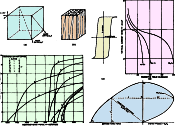 John R. Collins' 1967 Electronics World
magazine "Advances
in Magnetic Materials" article captures the essence of magnetic materials leaping
from incremental tweaks to revolutionary shifts, like grain-oriented steels that
aligned crystals to slash transformer losses and shrink massive power gear for aviation
and grids. Alnico alloys ditched bulky speakers for sleek permanent magnets, while
ferrites -- ceramic wonders -- tamed high frequencies with non-conductive ease,
spawning compact motors, tools, and early computer memories. Superconductors, then
lab novelties generating intense fields with zero resistance, hinted at sci-fi applications
from particle physics to space. Fast-forward to today, and they've exploded, proving
Collins' "quantum jumps" birthed today's... John R. Collins' 1967 Electronics World
magazine "Advances
in Magnetic Materials" article captures the essence of magnetic materials leaping
from incremental tweaks to revolutionary shifts, like grain-oriented steels that
aligned crystals to slash transformer losses and shrink massive power gear for aviation
and grids. Alnico alloys ditched bulky speakers for sleek permanent magnets, while
ferrites -- ceramic wonders -- tamed high frequencies with non-conductive ease,
spawning compact motors, tools, and early computer memories. Superconductors, then
lab novelties generating intense fields with zero resistance, hinted at sci-fi applications
from particle physics to space. Fast-forward to today, and they've exploded, proving
Collins' "quantum jumps" birthed today's...
 Crowded frequency bands have been a problem
since the beginning of radio because technology is constantly not only filling available
bandwidth, but also pushing the frontiers higher. The advantage of going higher
in frequency is that required bandwidths for existing modulation schemes represent
a smaller percentage of the center frequency. For example, an 802.11b WiFi signal's
22 MHz bandwidth represents roughly 1% of its 2.4 MHz center frequency.
802.11a does 20 MHz at 5 GHz for 0.4%. Extend that center frequency up
to 50 GHz and the channel occupancy is a mere 0.04%. That means for the same
total band occupancy of 1% as with 802.11b, you can fit in 25 equivalent slots.
The problem with going higher in frequency is that components... Crowded frequency bands have been a problem
since the beginning of radio because technology is constantly not only filling available
bandwidth, but also pushing the frontiers higher. The advantage of going higher
in frequency is that required bandwidths for existing modulation schemes represent
a smaller percentage of the center frequency. For example, an 802.11b WiFi signal's
22 MHz bandwidth represents roughly 1% of its 2.4 MHz center frequency.
802.11a does 20 MHz at 5 GHz for 0.4%. Extend that center frequency up
to 50 GHz and the channel occupancy is a mere 0.04%. That means for the same
total band occupancy of 1% as with 802.11b, you can fit in 25 equivalent slots.
The problem with going higher in frequency is that components...
 "Researchers have used a new nanowire fabrication
technique to produce flexible electronics virtually impervious to electromagnetic
interference. Developed at Glasgow University [that's "UoG" in the image], the method
involves imprinting ultra-thin nanowires onto bendable and transparent polymer substrates.
A process called
interfacial-dielectrophoresis (i-DEP) uses electrical fields to arrange the
nanoscale materials with high accuracy, enabling the creation of precise patterns.
The Glasgow team used i-DEP to create gaps in the nanowire network that act as capacitors..." "Researchers have used a new nanowire fabrication
technique to produce flexible electronics virtually impervious to electromagnetic
interference. Developed at Glasgow University [that's "UoG" in the image], the method
involves imprinting ultra-thin nanowires onto bendable and transparent polymer substrates.
A process called
interfacial-dielectrophoresis (i-DEP) uses electrical fields to arrange the
nanoscale materials with high accuracy, enabling the creation of precise patterns.
The Glasgow team used i-DEP to create gaps in the nanowire network that act as capacitors..."
 For the sake of avid cruciverbalists amongst
us, each week I create a new
crossword puzzle that has a theme related to engineering, mathematics,
chemistry, physics, and other technical words. You will never be asked the name
of a movie star unless he/she was involved in a technical endeavor(e.g., Hedy Lamar).
Enjoy... For the sake of avid cruciverbalists amongst
us, each week I create a new
crossword puzzle that has a theme related to engineering, mathematics,
chemistry, physics, and other technical words. You will never be asked the name
of a movie star unless he/she was involved in a technical endeavor(e.g., Hedy Lamar).
Enjoy...
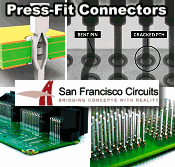 San Francisco Circuits (SFC) has been a
trusted U.S. provider of advanced PCB manufacturing and assembly solutions for R&D
innovators, prime contractors, and integration experts. SFC has published a white
paper entitled, "PCBA
Press Fit Connector Reliability: Strain Thresholds and Best Practices," to help
inform you on issues that can mean the difference between success and failure. "Press
fit connectors are common in high-density PCB designs - powering 5G infrastructure,
electric vehicles, aerospace systems, and advanced medical devices. Their ability
to deliver high I/O counts without the heat risks of soldering makes them indispensable
for modern electronics. But here's a hidden risk: If strain during insertion isn't
properly managed, it can lead to latent solder joint..." San Francisco Circuits (SFC) has been a
trusted U.S. provider of advanced PCB manufacturing and assembly solutions for R&D
innovators, prime contractors, and integration experts. SFC has published a white
paper entitled, "PCBA
Press Fit Connector Reliability: Strain Thresholds and Best Practices," to help
inform you on issues that can mean the difference between success and failure. "Press
fit connectors are common in high-density PCB designs - powering 5G infrastructure,
electric vehicles, aerospace systems, and advanced medical devices. Their ability
to deliver high I/O counts without the heat risks of soldering makes them indispensable
for modern electronics. But here's a hidden risk: If strain during insertion isn't
properly managed, it can lead to latent solder joint..."
 As a case in point about my claim with today's
earlier post featuring Bob Berman's factoids on astronomy, this article from a 1956 edition
of Popular Electronics illustrates how vital electronics are in the various
fields of science. It has only been fairly recently that astronomers have been 'looking'
at stars and planets outside of the visible wavelengths. Renditions of the sky in
both shorter and longer wavelengths show in some regions a vastly different universe.
Earlier this year, a comprehensive mapping of the entire known universe in the microwave
realm revealed the largest contiguous feature ever detected - dubbed "The Cold Spot"... As a case in point about my claim with today's
earlier post featuring Bob Berman's factoids on astronomy, this article from a 1956 edition
of Popular Electronics illustrates how vital electronics are in the various
fields of science. It has only been fairly recently that astronomers have been 'looking'
at stars and planets outside of the visible wavelengths. Renditions of the sky in
both shorter and longer wavelengths show in some regions a vastly different universe.
Earlier this year, a comprehensive mapping of the entire known universe in the microwave
realm revealed the largest contiguous feature ever detected - dubbed "The Cold Spot"...
 Of the scores of Mac's Service Shop stories
I have read and posted here on RF Cafe, this is the first that deals with a subject
near and dear to author John Frye - the plight of handicapped people. If you don't
know, Mr. Frye had been confined to a wheelchair for most of his life. "Electronics
and the Handicapped" is essentially the story of his life, though he does not
say so. Mac: "When I was a kid growing up in a little Arkansas town, I knew a crippled
boy whose dad ran the local garage." Guess where John grew up? His father owned
a machine shop, and made gadgets to help his crippled son. "I had never heard the
term 'respo' until you told me about a month ago it was the nickname for a victim
of respiratory polio." He had polio at 18 months old... Of the scores of Mac's Service Shop stories
I have read and posted here on RF Cafe, this is the first that deals with a subject
near and dear to author John Frye - the plight of handicapped people. If you don't
know, Mr. Frye had been confined to a wheelchair for most of his life. "Electronics
and the Handicapped" is essentially the story of his life, though he does not
say so. Mac: "When I was a kid growing up in a little Arkansas town, I knew a crippled
boy whose dad ran the local garage." Guess where John grew up? His father owned
a machine shop, and made gadgets to help his crippled son. "I had never heard the
term 'respo' until you told me about a month ago it was the nickname for a victim
of respiratory polio." He had polio at 18 months old...
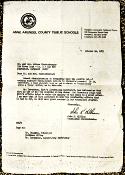 Very few items from my early days here on
Earth have escaped destruction or disposal. A couple dozen household moves in the
last half century have been responsible for some of it. Oddly, one thing that survived
is a box full of old letters and greeting cards - dating back to the late 1960s.
Melanie has been scanning her and my items for a more permanent record, and ran
across this letter of praise written from the administrator of the
Annapolis Vocational Technical Center, where I studied for the electrical trade
in high school. The linked page has information on the AVTC and my time there... Very few items from my early days here on
Earth have escaped destruction or disposal. A couple dozen household moves in the
last half century have been responsible for some of it. Oddly, one thing that survived
is a box full of old letters and greeting cards - dating back to the late 1960s.
Melanie has been scanning her and my items for a more permanent record, and ran
across this letter of praise written from the administrator of the
Annapolis Vocational Technical Center, where I studied for the electrical trade
in high school. The linked page has information on the AVTC and my time there...
 "With $800 of off-the-shelf equipment and
months' worth of patience, a team of U.S. computer scientists set out to find out
how well geostationary satellite communications are encrypted. And what they found
was shocking. Close to half of the communications beamed from satellites to the
ground that the researchers were
able to listen in on were not encrypted. This included sensitive data including
cellular text messages, voice calls, as well as sensitive military information,
data from internal corporate and bank networks, and the in-flight online activity
of airline passengers. The research team, led by Aaron Schulman and Nadia Heninger,
then set out to find out which companies and government agencies were failing to
encrypt data in order to contact them and disclose the vulnerabilities..." "With $800 of off-the-shelf equipment and
months' worth of patience, a team of U.S. computer scientists set out to find out
how well geostationary satellite communications are encrypted. And what they found
was shocking. Close to half of the communications beamed from satellites to the
ground that the researchers were
able to listen in on were not encrypted. This included sensitive data including
cellular text messages, voice calls, as well as sensitive military information,
data from internal corporate and bank networks, and the in-flight online activity
of airline passengers. The research team, led by Aaron Schulman and Nadia Heninger,
then set out to find out which companies and government agencies were failing to
encrypt data in order to contact them and disclose the vulnerabilities..."
 This is one of the earliest examples I have
seen (and I've seen many) of an electronics article that was written in a conversational
tone rather than in the heretothen[sic] stoic, all-business type prose. In fact,
you would be hard pressed to discern it from a contemporary article in QST
magazine. Author Davis describes his process of interfacing 52 Ω coaxial
cable to his multi-element beam antenna. The
gamma match has the advantage in such an application of being
usable when the center of a driven element is directly grounded to the antenna boom. Most
other types of feed systems... This is one of the earliest examples I have
seen (and I've seen many) of an electronics article that was written in a conversational
tone rather than in the heretothen[sic] stoic, all-business type prose. In fact,
you would be hard pressed to discern it from a contemporary article in QST
magazine. Author Davis describes his process of interfacing 52 Ω coaxial
cable to his multi-element beam antenna. The
gamma match has the advantage in such an application of being
usable when the center of a driven element is directly grounded to the antenna boom. Most
other types of feed systems...
 According to the
RadioMuseum.com website, B.F. Goodrich manufactured the
Mantola line of radio receivers. It was evidently a low quality,
low price, short-lived run of models. The simplicity of the schematic shows the
low parts count. A lack of multipole filter circuits likely means selectivity was
fairly marginal. One good feature is that unlike many earlier radios and TVs, the
AC line connection to the chassis is DC-isolated through a 150 kΩ resistor.
Look at the schematics of older sets and it is not uncommon to see one line of the
AC supply tied directly to the metal electronics chassis. An isolation transformer
right at the input is the safest way to do it... According to the
RadioMuseum.com website, B.F. Goodrich manufactured the
Mantola line of radio receivers. It was evidently a low quality,
low price, short-lived run of models. The simplicity of the schematic shows the
low parts count. A lack of multipole filter circuits likely means selectivity was
fairly marginal. One good feature is that unlike many earlier radios and TVs, the
AC line connection to the chassis is DC-isolated through a 150 kΩ resistor.
Look at the schematics of older sets and it is not uncommon to see one line of the
AC supply tied directly to the metal electronics chassis. An isolation transformer
right at the input is the safest way to do it...
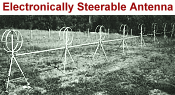 This article describes an
electronically steerable aperiodic loop antenna developed that claims superior
beam pinpointing on targets with high gain in minimal space for high-frequency signals
(2-32 MHz) via ionosphere, akin to linear arrays. Comprising 36 untuned balanced
loops, each about 1 meter in diameter with transistorized preamplifiers, arranged
on a 150-foot circular perimeter, the system weighs roughly 12 pounds per element
and withstands 100 mph winds. Phase shifts enable simultaneous beams every 10° through
360°, or commutator scanning for direction finding, equating to 18 rhombic antennas
at 10° intervals... This article describes an
electronically steerable aperiodic loop antenna developed that claims superior
beam pinpointing on targets with high gain in minimal space for high-frequency signals
(2-32 MHz) via ionosphere, akin to linear arrays. Comprising 36 untuned balanced
loops, each about 1 meter in diameter with transistorized preamplifiers, arranged
on a 150-foot circular perimeter, the system weighs roughly 12 pounds per element
and withstands 100 mph winds. Phase shifts enable simultaneous beams every 10° through
360°, or commutator scanning for direction finding, equating to 18 rhombic antennas
at 10° intervals...
 Although this "Algebra
in Electronic Design" article in the February 1952 issue of Radio-Electronics
magazine does not claim to be the second part of author Edmund Berkeley's "Light
Sensitive Electronic Beast" article from the previous December's issue, it does
help to know that the "Squee" mentioned here came from there. Squee is a Robot Squirrel
which has four sensing organs, three acting organs, and a small electronic and relay
brain. "Although Squee is not a very clever robot, he does have a small amount of
memory and of reasoning ability." Boolean logic (aka Boolean algrbra), a common
part of modern electronic circuits and systems... Although this "Algebra
in Electronic Design" article in the February 1952 issue of Radio-Electronics
magazine does not claim to be the second part of author Edmund Berkeley's "Light
Sensitive Electronic Beast" article from the previous December's issue, it does
help to know that the "Squee" mentioned here came from there. Squee is a Robot Squirrel
which has four sensing organs, three acting organs, and a small electronic and relay
brain. "Although Squee is not a very clever robot, he does have a small amount of
memory and of reasoning ability." Boolean logic (aka Boolean algrbra), a common
part of modern electronic circuits and systems...
 Sam Benzacar, of Anatech Electronics, an
RF and microwave filter company, has published his January 2026 Newsletter that,
along with timely news items, features his short op-ed titled "The
Internet of Things Has Finally Grown Up." Sam points out how the expectations
of wireless connectivity to all aspects of our everyday lives have transitioned
from a science fiction daydream to a reality that now constitutes a critical aspect
of modern-day existence. The Dick Tracy wristwatch is no longer a comic prop; it
is reality. In fact, so commonplace are such technological wonders that young kids
even wear them to school - not just super cops. Factory automation no longer relies
on massive bundles of wires, but on high-speed, ultra-reliable wireless... Sam Benzacar, of Anatech Electronics, an
RF and microwave filter company, has published his January 2026 Newsletter that,
along with timely news items, features his short op-ed titled "The
Internet of Things Has Finally Grown Up." Sam points out how the expectations
of wireless connectivity to all aspects of our everyday lives have transitioned
from a science fiction daydream to a reality that now constitutes a critical aspect
of modern-day existence. The Dick Tracy wristwatch is no longer a comic prop; it
is reality. In fact, so commonplace are such technological wonders that young kids
even wear them to school - not just super cops. Factory automation no longer relies
on massive bundles of wires, but on high-speed, ultra-reliable wireless...
 Technological prescience refers to the rare
ability to accurately foresee or anticipate future technological developments, inventions,
or trends well in advance of their realization. It combines deep technical insight,
pattern recognition from historical precedents, and intuitive leaps about scientific
trajectories. In practice, it's undervalued today amid hype cycles (e.g., metaverse
flops vs. steady AI progress). True prescience demands skepticism of short-term
trends and focus on exponential laws like computing power doubling. Few possess
it; most "futurists" recycle buzzwords. The comic artist who drew this comic for
a 1968 issue of Electronics World magazine probably had no idea how spot-on
he was. Technological prescience refers to the rare
ability to accurately foresee or anticipate future technological developments, inventions,
or trends well in advance of their realization. It combines deep technical insight,
pattern recognition from historical precedents, and intuitive leaps about scientific
trajectories. In practice, it's undervalued today amid hype cycles (e.g., metaverse
flops vs. steady AI progress). True prescience demands skepticism of short-term
trends and focus on exponential laws like computing power doubling. Few possess
it; most "futurists" recycle buzzwords. The comic artist who drew this comic for
a 1968 issue of Electronics World magazine probably had no idea how spot-on
he was.
 Anritsu has just released an application
note entitled, "Basics of Eye Pattern
Analysis." It is available as a free download on their website, but you do have
register for it. "Eye pattern analysis using the sampling oscilloscope is an effective
method for evaluating signal quality in the physical layer of high-speed digital
systems. This application note explains the basic terms used for eye pattern analysis
and methods for evaluating the performance of optical modules... Anritsu has just released an application
note entitled, "Basics of Eye Pattern
Analysis." It is available as a free download on their website, but you do have
register for it. "Eye pattern analysis using the sampling oscilloscope is an effective
method for evaluating signal quality in the physical layer of high-speed digital
systems. This application note explains the basic terms used for eye pattern analysis
and methods for evaluating the performance of optical modules...
 Belmont Radio Corporation was located in
Chicago, Illinois. Founded independently sometime the 1920s, it became a subsidiary
of Raytheon Manufacturing after World War II in an effort to quickly launch
the Raytheon into nascent consumer FM radio and television markets. Belmont advertisements
were prominent in electronics trade magazines throughout the 1940s to promote their
war efforts. A schematic and parts list for this
Belmont Model 5240 receiver appeared in the July 1948 edition
of Radio News magazine... Belmont Radio Corporation was located in
Chicago, Illinois. Founded independently sometime the 1920s, it became a subsidiary
of Raytheon Manufacturing after World War II in an effort to quickly launch
the Raytheon into nascent consumer FM radio and television markets. Belmont advertisements
were prominent in electronics trade magazines throughout the 1940s to promote their
war efforts. A schematic and parts list for this
Belmont Model 5240 receiver appeared in the July 1948 edition
of Radio News magazine...
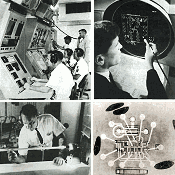 Recent in 1967, that is. These half dozen
developments made the headlines in Electronics World magazine in February
of the year. Solid-state electronics was rapidly gaining on the traditional vacuum
tube, and the
new technologies were glomming onto the trend. Lasers, integrated circuits,
computer-aided design, superconductors, and similar technologies were moving from
the realm of science fiction to reality. Operational power levels were still relatively
low, and physical sizes were still rather large and heavy, but as history has shown,
incremental improvements happen quickly. More than half a century later, compare
these news items to their modern equivalents or descendants. ICs have... Recent in 1967, that is. These half dozen
developments made the headlines in Electronics World magazine in February
of the year. Solid-state electronics was rapidly gaining on the traditional vacuum
tube, and the
new technologies were glomming onto the trend. Lasers, integrated circuits,
computer-aided design, superconductors, and similar technologies were moving from
the realm of science fiction to reality. Operational power levels were still relatively
low, and physical sizes were still rather large and heavy, but as history has shown,
incremental improvements happen quickly. More than half a century later, compare
these news items to their modern equivalents or descendants. ICs have...
 Did you know that some radio service equipment
can be financed by the Federal Housing Administration (FHA)?
That's right, if your business needs a new tube tester or maybe an oscilloscope,
Uncle Sam is there to help. That was in 1936, anyway, per this
Radio-Craft news blurb. Today, of course, the FHA no longer
makes loans for business equipment - the Small Business Administration (SBA) takes
care of that. Nowadays the FHA restricts itself to home loans - including to illegal
residents and otherwise traditionally unqualified. Also reported, among lots of
other interesting stuff, is some early instances of RFI (radio frequency interference)
emanating from... Did you know that some radio service equipment
can be financed by the Federal Housing Administration (FHA)?
That's right, if your business needs a new tube tester or maybe an oscilloscope,
Uncle Sam is there to help. That was in 1936, anyway, per this
Radio-Craft news blurb. Today, of course, the FHA no longer
makes loans for business equipment - the Small Business Administration (SBA) takes
care of that. Nowadays the FHA restricts itself to home loans - including to illegal
residents and otherwise traditionally unqualified. Also reported, among lots of
other interesting stuff, is some early instances of RFI (radio frequency interference)
emanating from...
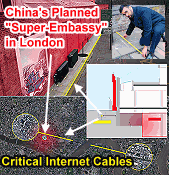 Nothing to see here, folks; conspiracy theorists
just move along. This article appeared in the UK Telegraph on 1/12/2026.
"Uncovered: Secret room beneath Chinese embassy that poses threat to City Telegraph
obtains unredacted plans showing how close the underground complex will come to
cables carrying sensitive British financial data. China is to build a hidden chamber
alongside Britain's most sensitive communication cables as part of a
network of 208 secret
rooms beneath its new London 'super-embassy.' This newspaper has uncovered detailed
plans for an underground complex below the vast diplomatic site in central London.
Despite the apparent security risk, Sir Keir Starmer is expected to approve the
embassy..." Nothing to see here, folks; conspiracy theorists
just move along. This article appeared in the UK Telegraph on 1/12/2026.
"Uncovered: Secret room beneath Chinese embassy that poses threat to City Telegraph
obtains unredacted plans showing how close the underground complex will come to
cables carrying sensitive British financial data. China is to build a hidden chamber
alongside Britain's most sensitive communication cables as part of a
network of 208 secret
rooms beneath its new London 'super-embassy.' This newspaper has uncovered detailed
plans for an underground complex below the vast diplomatic site in central London.
Despite the apparent security risk, Sir Keir Starmer is expected to approve the
embassy..."
 How often have we all mistaken "spooks"
for
Barkhausen oscillations? Yeah, it's embarrassing, but we've all
done it. I can't tell you how many times as a kid I saw the tell-tale effects on
our old black and white TV and said, "Mom, can you remind Dad to do something about
those dang Barkhausen oscillations when he gets home from the newspaper office?"
If you believe that line of bull hockey, I've got some waterfront property in the
Sahara Desert to sell you. The only thing close to 'Barkhausen' I might have known
back then was the name of a German beer house on Hogan's Heroes. Anyway, this article,
written in the days of over-the-air television broadcasts, presents a solution to... How often have we all mistaken "spooks"
for
Barkhausen oscillations? Yeah, it's embarrassing, but we've all
done it. I can't tell you how many times as a kid I saw the tell-tale effects on
our old black and white TV and said, "Mom, can you remind Dad to do something about
those dang Barkhausen oscillations when he gets home from the newspaper office?"
If you believe that line of bull hockey, I've got some waterfront property in the
Sahara Desert to sell you. The only thing close to 'Barkhausen' I might have known
back then was the name of a German beer house on Hogan's Heroes. Anyway, this article,
written in the days of over-the-air television broadcasts, presents a solution to...
 Exodus Advanced Communications, is a multinational
RF communication equipment and engineering service company serving both commercial
and government entities and their affiliates worldwide. Exodus'
AMP20175 pulse amplifier is designed for Pulse/HIRF, EMC/EMI Mil-Std 461/464,
and Radar applications. Providing superb pulse fidelity 4.0-8.0 GHz, 6 kW
typical, and up to 150 µsec pulse widths. Duty cycles to 10% with a minimum
68 dB gain. Available monitoring parameters for Forward/Reflected power in
watts and dBm, VSWR, voltage, current, and temperature sensing for outstanding reliability
and ruggedness in a compact configuration... Exodus Advanced Communications, is a multinational
RF communication equipment and engineering service company serving both commercial
and government entities and their affiliates worldwide. Exodus'
AMP20175 pulse amplifier is designed for Pulse/HIRF, EMC/EMI Mil-Std 461/464,
and Radar applications. Providing superb pulse fidelity 4.0-8.0 GHz, 6 kW
typical, and up to 150 µsec pulse widths. Duty cycles to 10% with a minimum
68 dB gain. Available monitoring parameters for Forward/Reflected power in
watts and dBm, VSWR, voltage, current, and temperature sensing for outstanding reliability
and ruggedness in a compact configuration...
 Arthur Collins founded the
Collins Radio Company in 1933 to enter the fledgling domestic
AM broadcast market. His equipment instantly became renowned for high quality and
reliability. Collins gained early notoriety as the result of being selected by Admiral
Richard Byrd for his South Pole expedition. The U.S. military took notice and the
company quickly earned a reputation as a preferred supplier of aviation communications
equipment both for commercial and military aviation. As seen in this 1946 advertisement
in Radio News, Trans World Airlines proudly employed Collins radio equipment
in its fleet of Lockheed Constellation (aka "Connie")... Arthur Collins founded the
Collins Radio Company in 1933 to enter the fledgling domestic
AM broadcast market. His equipment instantly became renowned for high quality and
reliability. Collins gained early notoriety as the result of being selected by Admiral
Richard Byrd for his South Pole expedition. The U.S. military took notice and the
company quickly earned a reputation as a preferred supplier of aviation communications
equipment both for commercial and military aviation. As seen in this 1946 advertisement
in Radio News, Trans World Airlines proudly employed Collins radio equipment
in its fleet of Lockheed Constellation (aka "Connie")...
 Alliance Test Equipment sells
used / refurbished test
equipment and offers short- and long-term rentals. They also offer repair, maintenance
and calibration. Prices discounted up to 80% off list price. Agilent/HP, Tektronix,
Anritsu, Fluke, R&S and other major brands. A global organization with ability
to source hard to find equipment through our network of suppliers. Alliance Test
will purchase your excess test equipment in large or small lots. Blog posts offer
advice on application and use of a wide range of test equipment. Please visit Allied
Test Equipment today to see how they can help your project. Alliance Test Equipment sells
used / refurbished test
equipment and offers short- and long-term rentals. They also offer repair, maintenance
and calibration. Prices discounted up to 80% off list price. Agilent/HP, Tektronix,
Anritsu, Fluke, R&S and other major brands. A global organization with ability
to source hard to find equipment through our network of suppliers. Alliance Test
will purchase your excess test equipment in large or small lots. Blog posts offer
advice on application and use of a wide range of test equipment. Please visit Allied
Test Equipment today to see how they can help your project.
 In this 1968 "Macs Service Shop" entitled
"The
Laser - Toy or Tool?," Mac educates Barney on lasers, from Einstein's 1917 stimulated
emission theory and Townes & Schawlow's 1958 optical maser to Maiman's 1960
ruby crystal laser using a mirrored rod pumped by flash tubes for coherent, narrow-beam
red light. He highlights properties like focusability (1/10,000th cm spot), minimal
divergence (200 ft at 25 miles), and applications: surgery (retina welding, scalpels),
metal cutting, ICBM/satellite defense, precise ranging, gyroscopes, altimeters,
auto modeling, 118-mile / 10-TV-channel communications, high-speed... In this 1968 "Macs Service Shop" entitled
"The
Laser - Toy or Tool?," Mac educates Barney on lasers, from Einstein's 1917 stimulated
emission theory and Townes & Schawlow's 1958 optical maser to Maiman's 1960
ruby crystal laser using a mirrored rod pumped by flash tubes for coherent, narrow-beam
red light. He highlights properties like focusability (1/10,000th cm spot), minimal
divergence (200 ft at 25 miles), and applications: surgery (retina welding, scalpels),
metal cutting, ICBM/satellite defense, precise ranging, gyroscopes, altimeters,
auto modeling, 118-mile / 10-TV-channel communications, high-speed...
 "2025 saw telecom giants accelerate their
integration efforts of non-terrestrial networks (NTNs) to bridge connectivity gaps
and future-proof the sector. As the industry further shifts from viewing satellites
as standalone solutions to critical components of
hybrid terrestrial-NTN architectures, here we look back at some of the top stories
and key developments over this past year. Satellite and terrestrial integration
A 2025 survey showed that NTNs are viewed by the telecom industry as reinforcing
service reliability and adding an extra layer of network redundancy to 5G. This
view increasingly makes the convergence of satellites..." "2025 saw telecom giants accelerate their
integration efforts of non-terrestrial networks (NTNs) to bridge connectivity gaps
and future-proof the sector. As the industry further shifts from viewing satellites
as standalone solutions to critical components of
hybrid terrestrial-NTN architectures, here we look back at some of the top stories
and key developments over this past year. Satellite and terrestrial integration
A 2025 survey showed that NTNs are viewed by the telecom industry as reinforcing
service reliability and adding an extra layer of network redundancy to 5G. This
view increasingly makes the convergence of satellites..."
 Before the current generation began destroying
its hearing with smartphone earbuds, their parents and grandparents (that includes
me) destroyed our hearing* with ridiculously powerful loudspeakers, often in boom
boxes perched on shoulders right next to the ears (not me). The "concert hall" -
or concert auditorium - experience has been long sought-after since recorded music
has been available, which has only been about a century. As evidenced by the sudden
increase in articles and advertisements in my growing collection of
vintage electronics magazines, the early and mid 1950s saw a sudden
swell of articles promoting the equally swelling supply of high fidelity (hifi)
recording and playback... Before the current generation began destroying
its hearing with smartphone earbuds, their parents and grandparents (that includes
me) destroyed our hearing* with ridiculously powerful loudspeakers, often in boom
boxes perched on shoulders right next to the ears (not me). The "concert hall" -
or concert auditorium - experience has been long sought-after since recorded music
has been available, which has only been about a century. As evidenced by the sudden
increase in articles and advertisements in my growing collection of
vintage electronics magazines, the early and mid 1950s saw a sudden
swell of articles promoting the equally swelling supply of high fidelity (hifi)
recording and playback...
 As with most things of consumer, commercial,
and industrial nature, the battery - more correctly "cell" - science has come a
long way in a relatively short time. Alessandro Volta invented the eponymous
voltaic pile in 1799; it consisted of zinc and copper electrodes
immersed in a sulfuric acid electrolyte, thereby being a wet cell. The first dry
cell was the zinc-carbon type invented by Guiseppe Zamboni (not the guy who invented
the ice rink resurfacer) in 1812. Rechargeable dry cells of the NiCad variety hit
the scene in 1899. Then, it wasn't until 1991 - a century later - that Sony commercialized
the Li-Ion cell (and varieties thereof) that now dominates... As with most things of consumer, commercial,
and industrial nature, the battery - more correctly "cell" - science has come a
long way in a relatively short time. Alessandro Volta invented the eponymous
voltaic pile in 1799; it consisted of zinc and copper electrodes
immersed in a sulfuric acid electrolyte, thereby being a wet cell. The first dry
cell was the zinc-carbon type invented by Guiseppe Zamboni (not the guy who invented
the ice rink resurfacer) in 1812. Rechargeable dry cells of the NiCad variety hit
the scene in 1899. Then, it wasn't until 1991 - a century later - that Sony commercialized
the Li-Ion cell (and varieties thereof) that now dominates...
These archive pages are provided in order to make it easier for you to find items
that you remember seeing on the RF Cafe homepage. Of course probably the easiest
way to find anything on the website is to use the "Search
RF Cafe" box at the top of every page. Some quoted items have been shortened
to save space. About RF Cafe.
Homepage Archive Pages
2026:
Jan |
Feb |
Mar |
Apr |
May | Jun | Jul | Aug
| Sep | Oct | Nov | Dec
2025:
Jan |
Feb |
Mar |
Apr |
May |
Jun |
Jul |
Aug |
Sep |
Oct |
Nov |
Dec
2024:
Jan |
Feb |
Mar |
Apr |
May |
Jun |
Jul |
Aug |
Sep |
Oct |
Nov |
Dec
2023:
Jan |
Feb |
Mar |
Apr |
May |
Jun |
Jul |
Aug |
Sep |
Oct |
Nov |
Dec
2022:
Jan |
Feb |
Mar |
Apr |
May |
Jun |
Jul |
Aug |
Sep |
Oct |
Nov |
Dec
2021:
Jan |
Feb |
Mar |
Apr |
May |
Jun |
Jul |
Aug |
Sep |
Oct |
Nov |
Dec
2020:
Jan |
Feb |
Mar |
Apr |
May |
Jun |
Jul |
Aug |
Sep |
Oct |
Nov |
Dec
2019:
Jan |
Feb |
Mar |
Apr |
May |
Jun |
Jul |
Aug |
Sep |
Oct |
Nov |
Dec
2018:
Jan |
Feb |
Mar |
Apr |
May |
Jun |
Jul |
Aug |
Sep |
Oct |
Nov |
Dec
2017:
Jan | Feb |
Mar |
Apr |
May |
Jun |
Jul |
Aug |
Sep |
Oct |
Nov |
Dec
2016:
Jan | Feb |
Mar |
Apr |
May |
Jun |
Jul |
Aug |
Sep |
Oct |
Nov |
Dec
2015:
Jan | Feb |
Mar |
Apr |
May |
Jun |
Jul |
Aug | Sep |
Oct |
Nov |
Dec
2014:
Jan | Feb |
Mar |
Apr |
May |
Jun |
Jul |
Aug |
Sep |
Oct |
Nov |
Dec
2013:
Jan | Feb |
Mar |
Apr |
May |
Jun |
Jul |
Aug |
Sep |
Oct |
Nov |
Dec
2012: 1 |
2 | 3
| 4 | 5
| 6 | 7
| 8 | 9
| 10 | 11
| 12 | 13
(no archives before 2012)
- Christmas-themed
items
|