Current State of Nuclear Power Generation Technology: New Construction, Restart, Fission, Fusion, Regulation, Risk, Fuel, Waste, and Political Economy
 This report synthesizes public information from official agencies, academic and
technical sources, industry reports, and news/press releases available through mid-2026
where widely reported. Some fast-moving project details, especially data-center
nuclear deals and reactor restart timelines, remain subject to regulatory approval
and financing.
This report synthesizes public information from official agencies, academic and
technical sources, industry reports, and news/press releases available through mid-2026
where widely reported. Some fast-moving project details, especially data-center
nuclear deals and reactor restart timelines, remain subject to regulatory approval
and financing.
Summary
Nuclear power is undergoing a significant but uneven revival. The renewed interest is driven by climate policy, energy-security concerns after Russia's invasion of Ukraine, rising electricity demand, industrial decarbonization, and especially the rapid growth of data centers and artificial-intelligence computing loads. However, "revival" does not yet mean a construction boom in most Western countries. China, Russia, India, South Korea, the United Arab Emirates, and some Eastern European states are building or planning reactors more actively than the United States and Western Europe, where cost, schedule, regulatory, waste, and public-acceptance barriers remain substantial.
For fission, the main near-term technology is still large light-water reactors: pressurized-water reactors and boiling-water reactors, typically "Generation III+" designs with improved passive safety and severe-accident mitigation. The most important recent Western example is the completion of Vogtle Units 3 and 4 in Georgia using Westinghouse AP1000 technology, the first newly built U.S. reactors in decades. Vogtle demonstrated that new large reactors can be completed under modern regulation, but also highlighted the core problem: massive cost overruns and long construction schedules. China has had much greater success building AP1000-derived and domestic designs at scale.
Small modular reactors and advanced reactors are the center of policy attention, but most are not yet commercially proven. NuScale became the first design certified by the U.S. Nuclear Regulatory Commission, but its flagship Utah project was canceled due to rising costs. TerraPower's sodium-cooled Natrium reactor, GE Hitachi's BWRX-300, X-energy's high-temperature gas reactor, Kairos Power's fluoride-salt-cooled test reactor, and several microreactor concepts are advancing, but commercial deployment remains mostly prospective. The key question is whether factory production and simplified design can overcome nuclear's history of bespoke construction, licensing delay, and financing risk.
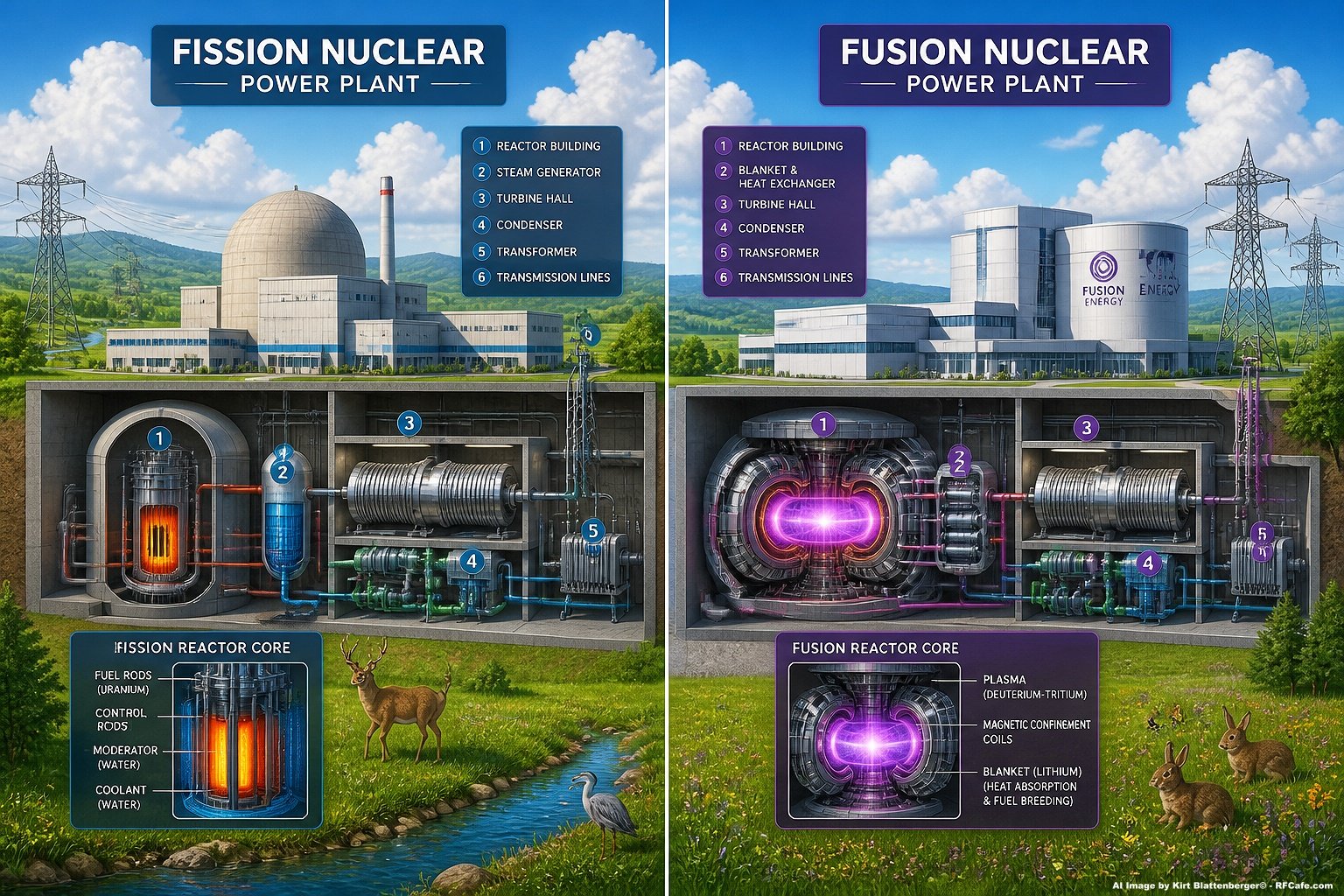
Fusion is scientifically advancing but is not yet a commercial electricity technology. The U.S. National Ignition Facility achieved repeated fusion ignition in laser-driven inertial-confinement experiments, a major scientific milestone, but not a power-plant demonstration. ITER remains the largest magnetic-confinement project, but has faced delays and cost increases. Private fusion firms such as Commonwealth Fusion Systems, Helion, TAE Technologies, General Fusion, Tokamak Energy, Zap Energy, Type One Energy, and others have attracted billions of dollars, but no company has yet delivered net electricity to the grid. Fusion's safety profile is generally more favorable than fission because there is no self-sustaining chain reaction and no large inventory of long-lived fission products, but fusion still presents risks: tritium handling, neutron activation, high-energy materials damage, lithium fire/chemical hazards, radioactive waste streams, and security/regulatory uncertainty.
Regulation is trending more favorable to nuclear construction in many jurisdictions. In the United States, Congress passed the ADVANCE Act in 2024 to modernize licensing, reduce some fees, and direct the NRC to prepare for advanced reactors. The NRC is developing a risk-informed licensing framework known as 10 CFR Part 53. The Inflation Reduction Act created production tax credits and investment credits that can support existing and new nuclear. The European Union included nuclear under its sustainable-finance taxonomy under conditions. France, the United Kingdom, Poland, Sweden, South Korea, Japan, Canada, and several Eastern European countries have moved toward preserving, expanding, or reintroducing nuclear. Germany remains the most prominent large economy to have shut down its nuclear fleet.
Environmental regulation has not generally been "waived" for nuclear power, but permitting is being streamlined in some places. Climate policy has made low-carbon dispatchable generation more valuable. Regulators are increasingly asked to weigh local environmental impacts, water use, thermal discharge, and waste against system-wide decarbonization and reliability benefits. Nuclear projects still face strict safety, environmental-impact, water-permit, emergency-planning, and security requirements.
On water: nuclear plants do not inherently require vast freshwater supplies, but thermal power plants need a heat sink. Most conventional nuclear plants use large amounts of water for cooling if built with once-through or wet-recirculating systems. They can use seawater, cooling towers, reclaimed water, hybrid cooling, or dry cooling, but dry cooling can reduce efficiency and raise cost, especially in hot climates. Future siting will favor existing nuclear sites, retiring coal-plant sites with transmission and cooling infrastructure, coastal sites, large rivers/lakes, industrial clusters, and data-center or hydrogen-production hubs.
The danger of nuclear energy has often been exaggerated in public discourse relative to measured deaths per unit of electricity, especially compared with coal and oil. But it would be wrong to call the danger imaginary. Chernobyl caused major health, environmental, political, and social damage; Fukushima caused large evacuation and economic damage even though radiation deaths were far lower than initially feared; Three Mile Island damaged public trust even though offsite health effects were minimal. Nuclear risk is low-probability but high-consequence, and public distrust has often been intensified by secrecy, poor communication, cost overruns, and institutional failures. Anti-nuclear groups have sometimes used worst-case risk politically, while nuclear promoters have sometimes minimized cost, waste, accident, and proliferation issues.
The clearest financial beneficiaries of renewed nuclear interest are reactor vendors, engineering and construction firms, utilities with nuclear assets, uranium miners, enrichment companies, fuel fabricators, nuclear-service firms, host communities, and data-center companies seeking firm low-carbon power. Political beneficiaries include governments seeking energy security, climate credibility, industrial policy wins, and national-security supply chains. Social beneficiaries may include regions receiving high-wage jobs and grids receiving reliable low-carbon capacity. The costs and risks are borne by ratepayers, taxpayers, local communities, and future waste-management institutions.
2. Key Findings
- Fission is commercially mature; fusion is not. Fission provides about 9–10% of global electricity and roughly a quarter of global low-carbon electricity, while fusion has not yet produced commercial grid power. See IAEA PRIS and IEA nuclear analysis.
- New nuclear construction is geographically concentrated. China leads in new reactor construction. Russia remains a major exporter. India, South Korea, the UAE, Turkey, Egypt, the UK, France, Poland, and several Eastern European countries are active or planning. The U.S. has few large-reactor projects after Vogtle, but many advanced-reactor demonstrations.
- Large reactors remain the only proven near-term option at scale. AP1000, EPR, APR1400, VVER, Hualong One, CANDU-derived, and similar designs dominate current construction. SMRs may matter later, but their cost and manufacturability are still unproven.
- SMRs are politically attractive but commercially uncertain. NuScale's U.S. project cancellation showed that smaller size does not automatically mean cheaper electricity. First-of-a-kind reactors may be expensive before factory learning appears.
- Regulatory trends are becoming more permissive, not deregulatory in the safety sense. The U.S. ADVANCE Act, NRC Part 53 rulemaking, EU taxonomy, UK nuclear financing reforms, Canadian SMR roadmaps, and French nuclear relaunch all point toward streamlined permission. However, nuclear remains among the most regulated industrial sectors.
- Environmental rules are being streamlined selectively. Nuclear projects still need environmental reviews, water permits, waste plans, and emergency preparedness. But climate policy, clean-energy credits, and permitting reform increasingly favor nuclear as a low-carbon resource.
- Data centers are now a major driver of nuclear demand. Microsoft, Google, Amazon, Oracle, and Meta have pursued or explored nuclear-backed electricity, including restarts, SMRs, and advanced reactors. This is less a case of traditional environmental groups reversing themselves for data centers than of technology companies and pro-climate policy coalitions embracing nuclear as firm clean power.
- Claims of "hypocrisy" should be handled carefully. Major anti-nuclear groups such as Greenpeace and many local anti-nuclear organizations generally remain opposed. Some environmental thinkers and climate advocates have changed position, but documented cases of formerly anti-nuclear institutions promoting nuclear specifically for data centers are limited.
- Water is important but not always prohibitive. Nuclear plants need heat rejection like coal, gas, geothermal, solar-thermal, and fusion plants. Cooling can be once-through, wet-tower, dry, hybrid, seawater, or reclaimed-water based. Water constraints affect siting and cost more than basic feasibility.
- Spent nuclear fuel is technically manageable but politically unresolved in many countries. Dry-cask storage has operated safely for decades. Deep geological disposal is the scientific consensus for final disposal. Finland's Onkalo repository is the leading real-world example. The U.S. has no operating permanent repository for commercial spent fuel.
- Fuel supply is a strategic bottleneck. Conventional reactors use low-enriched uranium. Many advanced reactors require HALEU, for which commercial non-Russian supply is currently limited. Uranium mining is concentrated in Kazakhstan, Canada, Australia, Namibia, Uzbekistan, and a few others; enrichment has historically depended heavily on Russia and Europe.
- Restarting closed reactors is becoming thinkable. Palisades in Michigan and Three Mile Island Unit 1 in Pennsylvania are the most prominent U.S. restart efforts. Japan has restarted numerous reactors after Fukushima shutdowns. Germany's restart prospects remain politically remote.
3. Detailed Analysis
3.1 Nuclear Power's Present Role
Commercial nuclear power is dominated by fission reactors. As of the mid-2020s, roughly 400 power reactors operate worldwide, with more than 50 under construction, although exact counts change as units connect, retire, or enter long-term outage. The IAEA Power Reactor Information System is the standard official database.
Nuclear's importance varies sharply by country. France has historically generated most of its electricity from nuclear; the United States has the world's largest nuclear fleet by output; China has the fastest-growing program; Russia is a dominant exporter; South Korea has strong industrial capability; Canada uses CANDU heavy-water reactors; Japan is slowly restarting reactors after Fukushima; Germany shut down its last reactors in 2023.
The International Energy Agency has argued that nuclear can contribute to secure low-emissions electricity systems because it supplies dispatchable, high-capacity-factor power. See IEA, Nuclear Power and Secure Energy Transitions. The IPCC also treats nuclear as a low-carbon mitigation option, while noting cost, safety, waste, and social-acceptance constraints. See IPCC AR6 Working Group III.
3.2 Fission Technology: What Is Being Built Now
Most new reactors being built today are not radically new. They are evolutionary light-water reactors with better control systems, stronger containment, passive safety features, and severe-accident mitigation. Major designs include:
| Design | Developer/Country | Status/Significance |
|---|---|---|
| AP1000 | Westinghouse / U.S. | Gen III+ passive-safety PWR. Built at Vogtle in Georgia and Sanmen/Haiyang in China. U.S. Vogtle completion proved feasibility but exposed cost/schedule risk. See NRC Vogtle page. |
| EPR / EPR2 | Framatome / EDF / France | Large Gen III+ PWR. Projects at Olkiluoto 3, Flamanville 3, Taishan, Hinkley Point C. Strong safety design but severe Western cost/schedule overruns. |
| APR1400 | KHNP / South Korea | Successful deployment at Barakah in UAE and in South Korea. Often cited as one of the more successful recent export programs. |
| VVER-1200 | Rosatom / Russia | Russian Gen III+ PWR family exported to Turkey, Egypt, Bangladesh, Hungary, and elsewhere. Geopolitical sanctions complicate supply chains. |
| Hualong One / HPR1000 | CNNC / CGN / China | China's domestic Gen III PWR export design. China is the leading builder of new nuclear capacity. |
| CANDU / Enhanced CANDU | Canada / AtkinsRéalis and partners | Heavy-water reactor using natural uranium or alternative fuels. Canada is refurbishing CANDU units and considering new builds. |
3.3 Large Reactor Construction: Successes and Failures
Vogtle Units 3 and 4 in Georgia are historically significant because they are the first newly constructed U.S. reactors completed in decades. Their successful entry into commercial operation restored some confidence in U.S. nuclear construction capability. But the project cost more than twice early estimates and arrived years late. Its lesson is mixed: nuclear can be built, but first-of-a-kind or restarted supply-chain projects in liberalized economies can be financially punishing.
Olkiluoto 3 in Finland and Flamanville 3 in France had similar problems: delays, welding and quality-control issues, regulatory friction, and cost escalation. Yet once complete, such reactors can operate for 60 to 80 years, producing large volumes of low-carbon electricity.
Barakah in the United Arab Emirates is one of the best recent examples of a successful large-reactor program. Built by a South Korean-led consortium using APR1400 technology, it demonstrated that standardized design, centralized decision-making, strong project management, and stable financing can produce a more predictable program than many Western megaprojects.
China has built the most reactors recently, benefiting from state-backed financing, standardized fleets, experienced supply chains, and national industrial policy. Its record suggests nuclear construction cost and schedule are not fixed physical constants; they depend heavily on institutional capacity.
3.4 Small Modular Reactors and Advanced Fission
Small modular reactors, or SMRs, are generally reactors producing less than about 300 MWe per module. Their promise is not merely that they are small; it is that they might be factory-built, standardized, easier to finance incrementally, and deployable at retiring coal plants, remote mines, industrial sites, military bases, and data centers.
| Project/Design | Type | Status and Issues |
|---|---|---|
| NuScale VOYGR | Integral light-water SMR | First NRC-certified SMR design. Utah Associated Municipal Power Systems project canceled in 2023 due to cost and subscriber concerns. See NRC NuScale page. |
| GE Hitachi BWRX-300 | Boiling-water SMR | Selected by Ontario Power Generation for Darlington; considered by TVA and others. One of the leading near-term Western SMR candidates. |
| TerraPower Natrium | Sodium-cooled fast reactor with molten-salt energy storage | Planned in Kemmerer, Wyoming, at a retiring coal-plant site. Supported by DOE Advanced Reactor Demonstration Program. HALEU fuel supply is a major bottleneck. |
| X-energy Xe-100 | High-temperature gas reactor using TRISO fuel | Selected for DOE demonstration support; pursued for industrial heat and electricity. Amazon announced investment and power-related plans with X-energy in 2024. |
| Kairos Power Hermes | Fluoride-salt-cooled high-temperature test reactor | Received NRC construction permit for a non-power demonstration reactor in Tennessee. Google announced a power-purchase arrangement for future Kairos reactors. See Google announcement. |
| Oklo Aurora | Fast microreactor | Targeted at remote, industrial, and data-center loads. NRC previously denied an application without prejudice for insufficient information; company continues pursuing licensing. |
Advanced fission includes sodium-cooled fast reactors, molten-salt reactors, gas-cooled reactors, lead-cooled reactors, microreactors, and thorium-related systems. Many claim improved safety or fuel efficiency, but most remain unproven at commercial scale. A central problem is that advanced reactors often require HALEU fuel, enriched between 5% and 20% U-235, for which Western supply is limited. The U.S. Department of Energy has programs to establish domestic HALEU supply. See DOE HALEU program.
3.5 Breakthrough Technologies That Could Make Fission Safer
- Passive safety systems: AP1000-style gravity, natural circulation, and passive containment cooling can operate without pumps or operator action for a period after shutdown.
- Accident-tolerant fuels: Improved cladding and fuel forms aim to reduce hydrogen production and fuel damage under severe accidents. See DOE accident-tolerant fuel overview.
- TRISO fuel: Tiny ceramic-coated fuel particles can retain fission products at very high temperatures, especially useful for high-temperature gas reactors.
- Negative temperature coefficients: Many modern designs are engineered so that rising temperature naturally reduces reactivity.
- Underground or hardened siting: Some SMR concepts use below-grade reactor buildings to improve protection against aircraft impact or attack.
- Digital monitoring and probabilistic risk assessment: Better sensors, modeling, and inspection can identify degradation earlier.
- Molten-salt and low-pressure coolants: Some designs avoid high-pressure water systems, reducing certain loss-of-coolant accident modes.
3.6 Technologies or Trends That Could Make Fission More Dangerous
- HALEU proliferation and security concerns: HALEU below 20% is not weapons-grade, but it is closer to weapons-usable enrichment than conventional LEU. More transport and processing increases safeguards complexity.
- Fast reactors and separated plutonium: Some fuel cycles involve plutonium separation or breeding, raising proliferation concerns if not tightly safeguarded.
- Novel coolants: Sodium burns in air and reacts with water; molten salts can be chemically corrosive; lead coolant has materials challenges.
- Overconfidence in "walk-away safe" claims: Even inherently safer reactors require security, maintenance, decay-heat management, emergency planning, and competent operators.
- Cybersecurity exposure: Digital instrumentation must be protected from intrusion. NRC and IAEA guidance treats cyber as a core nuclear-security issue.
- War-zone risk: Russia's occupation of Ukraine's Zaporizhzhia nuclear plant showed that military conflict creates scenarios beyond normal civilian safety analysis. See IAEA Ukraine updates.
3.7 Fusion: Scientific Status and Commercial Reality
Fusion seeks to release energy by combining light nuclei, most commonly deuterium and tritium. The leading power-plant concept is D-T fusion because it has the lowest ignition temperature among plausible fuels. Fusion's appeal is enormous: abundant deuterium, no runaway chain reaction, no carbon emissions during operation, and no long-lived fission products. But the engineering challenge is extreme.
The most important recent fusion milestones include:
- NIF ignition: Lawrence Livermore National Laboratory's National Ignition Facility achieved fusion ignition in 2022 and repeated high-yield shots afterward. This means the fusion fuel produced more fusion energy than laser energy delivered to the target, not that the facility produced net electricity. See LLNL announcement.
- JET records: The Joint European Torus produced record D-T fusion energy pulses before ending operations, providing data for ITER.
- ITER: The international ITER tokamak in France remains the largest magnetic-confinement experiment, intended to produce 500 MW of fusion heat from 50 MW of input heating, though not electricity. It has experienced major delays. See ITER.
- High-temperature superconducting magnets: Commonwealth Fusion Systems and MIT demonstrated high-field HTS magnet technology relevant to compact tokamaks. See MIT PSFC SPARC.
- Private capital surge: Fusion Industry Association surveys report billions in private investment, though timelines remain uncertain. See Fusion Industry Association.
Commercial fusion remains uncertain because a power plant must solve all of the following simultaneously: sustained plasma confinement, net plant electricity, tritium breeding, neutron-resistant materials, heat extraction, remote maintenance, reliable high-duty-cycle operation, regulatory licensing, and competitive cost.
3.8 Fusion Safety
Fusion is often safer than fission in the most important public-risk dimension: a D-T fusion plant cannot undergo a runaway chain reaction. If confinement fails, the plasma cools and the reaction stops. Fuel inventory in the plasma is tiny. However, a commercial fusion plant is not risk-free.
- Tritium: Radioactive hydrogen can leak, contaminate water, and is biologically mobile. Tritium management is one of fusion's most important safety and regulatory issues.
- Neutron activation: D-T fusion produces 14.1 MeV neutrons that activate structural materials. Fusion waste is expected to be shorter-lived than fission waste if low-activation materials are used, but it is still radioactive.
- Lithium blankets: Many designs require lithium to breed tritium. Lithium presents chemical fire and reactivity hazards.
- Magnets and stored energy: Superconducting magnets store enormous energy and require cryogenic systems. Quench events can be dangerous.
- Maintenance dose: Neutron damage requires remote handling and replacement of internal components.
- Regulatory uncertainty: In the U.S., the NRC has moved toward regulating many fusion systems under a byproduct-materials framework rather than as fission reactors. See NRC fusion energy regulation.
3.9 Dangers of Nuclear Power: What History Shows
Three Mile Island, 1979
The partial meltdown at Three Mile Island Unit 2 in Pennsylvania was caused by equipment failure, poor instrumentation, and operator confusion. It produced limited offsite radiation release and no confirmed radiation deaths, but it devastated public confidence and reshaped U.S. nuclear regulation, training, human-factors engineering, control-room design, emergency planning, and industry oversight. The Institute of Nuclear Power Operations was created after TMI. See NRC TMI fact sheet.
Chernobyl, 1986
Chernobyl Unit 4 was an RBMK reactor with serious design flaws, including a positive void coefficient and no Western-style containment, compounded by a reckless safety test and Soviet secrecy. The explosion and graphite fire released large quantities of radionuclides across Europe. Acute radiation syndrome killed plant workers and firefighters. Thyroid cancers increased among exposed children, largely due to iodine-131. Estimates of long-term cancer mortality vary and are politically contested. See UNSCEAR Chernobyl assessments and WHO Chernobyl Forum report.
Fukushima Daiichi, 2011
Fukushima was triggered by a massive earthquake and tsunami that exceeded site protections, flooding backup generators and causing station blackout. Three reactor cores melted; hydrogen explosions damaged buildings. Radiation health impacts were much lower than feared, but evacuation stress, disruption, cleanup cost, ocean-release controversy, and loss of public trust were enormous. See UNSCEAR Fukushima assessments and IAEA Fukushima report.
Other Historical Incidents
Windscale in the UK, SL-1 in Idaho, Kyshtym in the Soviet Union, Tokaimura in Japan, and numerous military fuel-cycle accidents show that nuclear risk is not limited to commercial power reactors. They also show why safety culture, transparency, containment, and independent regulation matter.
3.10 Has Nuclear Danger Been Exaggerated?
Partly Yes, But Not Simply. Public fear of radiation and nuclear accidents is often disproportionate to measured mortality per unit of electricity. Comparative studies commonly find nuclear power among the lowest-death and lowest-carbon major energy sources, especially compared with coal. See Our World in Data, safest energy sources.
However, statistical fatality comparisons do not capture every relevant harm. Nuclear accidents can contaminate land, force evacuation, destroy local economies, create intergenerational anxiety, impose huge cleanup costs, and damage democratic trust. Waste stewardship lasts longer than ordinary political time horizons. Nuclear weapons and civilian nuclear technology are distinct, but fuel-cycle knowledge and materials can overlap.
Anti-nuclear organizations, politicians, and movements have at times emphasized worst-case scenarios for political gain or fundraising. At the same time, nuclear operators and governments have sometimes concealed failures, understated costs, or overpromised safety. A fair conclusion is that nuclear's routine health and climate risks are often overstated, while its institutional, accident-consequence, cost, waste, and proliferation risks should not be dismissed.
3.11 Safeguards and Defense-in-Depth
Nuclear safety uses layered protection:
- Fuel matrix: ceramic uranium dioxide or advanced fuel retains many fission products.
- Fuel cladding: metal or advanced cladding contains fuel.
- Reactor coolant boundary: pressure vessel and piping retain coolant.
- Containment: reinforced concrete and steel structure designed to confine releases.
- Emergency core cooling: active or passive systems remove decay heat.
- Severe-accident management: hydrogen recombiners, filtered vents, core catchers in some designs, and emergency procedures.
- Independent regulation: licensing, inspection, enforcement, operator qualification.
- Security: physical protection, cyber controls, insider-threat programs, material accounting.
- International safeguards: IAEA monitoring of nuclear materials to deter diversion to weapons. See IAEA safeguards.
3.12 Regulation: Permission and Denial Trends
Regulatory trends differ by country, but the broad tendency since 2022 has been more favorable to nuclear power.
| Jurisdiction | Trend |
|---|---|
| United States | More supportive. ADVANCE Act, DOE demonstrations, clean-energy tax credits, HALEU program, NRC Part 53 advanced-reactor rulemaking. Safety regulation remains strict. See NRC Part 53 and ADVANCE Act bill page. |
| European Union | Mixed but more accepting. Nuclear included in EU sustainable-finance taxonomy under conditions; Germany and Austria oppose nuclear, France and Eastern Europe support it. See EU taxonomy. |
| France | Strong reversal toward new nuclear after earlier reduction targets. EPR2 program planned, lifetime extensions pursued. |
| United Kingdom | Supportive. Hinkley Point C under construction; Sizewell C planned; Great British Nuclear established; SMR competition ongoing. |
| Canada | Supportive, especially Ontario. Darlington BWRX-300 planned; CANDU refurbishments; Saskatchewan and Alberta studying SMRs. |
| Japan | Gradual restarts after Fukushima under stricter regulation. Public acceptance remains uneven. |
| South Korea | Policy shifted from phase-down to renewed support under conservative government; strong export focus. |
| Germany | Completed nuclear phaseout in 2023. Restart remains politically and technically difficult. |
| China | Strongly supportive. Largest pipeline of new reactors. |
| Russia | Strong state support and export financing through Rosatom, though sanctions and geopolitics affect projects. |
3.13 Are Environmental Regulations Being Eased?
The answer is yes in some procedural and policy senses, no in core radiological-safety senses.
- Permitting reform: Governments are trying to reduce duplicative review and shorten licensing timelines for clean-energy infrastructure, including nuclear.
- Climate classification: Nuclear increasingly qualifies for clean-energy credits, sustainable finance, or zero-emission standards.
- Existing-site preference: Regulators may allow easier review for reactors at already characterized nuclear or coal sites.
- License extensions: Environmental review for license renewal has become more standardized in some jurisdictions.
- Water and thermal discharge: These rules still matter. During heat waves, some reactors have had to reduce output or receive temporary thermal-discharge waivers, notably in France.
- Waste and decommissioning: Requirements have not disappeared; financial assurance and waste-management plans remain core licensing issues.
In short: nuclear is being favored by climate and energy-security policy, but it is not being exempted wholesale from environmental law.
3.14 Nuclear Power and Data Centers
Data centers increasingly need reliable, 24/7 electricity. Wind and solar can supply much annual energy but require storage, transmission, or firm backup to match around-the-clock demand. Nuclear is attractive because it is high-capacity-factor, low-carbon, land-efficient, and capable of large block power.
Notable data-center-related nuclear developments include:
- Microsoft and Three Mile Island Unit 1: Constellation announced plans to restart TMI Unit 1 as the Crane Clean Energy Center, with Microsoft purchasing power under a long-term agreement. TMI Unit 1 is distinct from Unit 2, the reactor damaged in 1979. Restart requires NRC review, technical work, fuel procurement, grid arrangements, and economics. See Constellation announcement.
- Amazon and Susquehanna: Amazon Web Services acquired or contracted around a data-center campus associated with Talen Energy's Susquehanna nuclear plant in Pennsylvania. The arrangement drew attention because co-located data centers may affect grid cost allocation and transmission policy.
- Google and Kairos Power: Google announced an agreement to purchase power from future Kairos advanced reactors, targeting deployment in the 2030s. See Google/Kairos announcement.
- Amazon and X-energy: Amazon announced investments and agreements related to X-energy SMRs as part of its clean-power strategy. See Amazon nuclear announcement.
- Meta and other hyperscalers: Meta, Oracle, and others have explored nuclear procurement, SMRs, or co-location. Some claims are aspirational and should be treated as early-stage until tied to licensed projects.
Are former anti-nuclear groups now promoting nuclear for data centers? The evidence is limited. Major anti-nuclear environmental organizations generally remain anti-nuclear. What has changed is that some climate advocates, philanthropies, policy groups, and technology companies now accept or support nuclear because of decarbonization and reliability needs. The "hypocrisy" charge is politically common, but it should not be overstated unless a specific organization can be shown to have changed its position while concealing the reason.
3.15 Environmental Groups and the Shift in Nuclear Politics
Historically, nuclear opposition came from anti-weapons movements, environmental groups, local siting opponents, public-health activists, and some fossil-fuel-linked political interests. Arguments included accident risk, waste, secrecy, cost, thermal pollution, uranium mining, Indigenous land impacts, and proliferation.
Several prominent individuals and organizations have shifted toward pro-nuclear or nuclear-inclusive climate policy:
- James Hansen and other climate scientists have argued nuclear is necessary for deep decarbonization.
- Stewart Brand and Mark Lynas publicly reversed earlier anti-nuclear views.
- Clean Air Task Force, Third Way, Breakthrough Institute, and some ecomodernist groups support advanced nuclear as a climate tool.
- Mothers for Nuclear and similar groups advocate nuclear from climate and public-health perspectives.
Groups that generally remain opposed or highly skeptical include Greenpeace, many Friends of the Earth chapters, Beyond Nuclear, and numerous local anti-nuclear organizations. The Sierra Club has historically opposed nuclear and has not become a general nuclear promoter.
The most accurate characterization is not that the environmental movement as a whole has flipped, but that climate urgency has fractured the old anti-nuclear consensus. Some activists now see nuclear as a necessary low-carbon tool; others see it as an expensive distraction from renewables and efficiency.
3.16 Who Leads Fission Efforts?
Government and international institutions
- U.S. Department of Energy Office of Nuclear Energy: advanced reactor demonstrations, HALEU, national labs, fuel-cycle R&D. See DOE Nuclear Energy.
- Nuclear Regulatory Commission: U.S. licensing and safety regulation. See NRC.
- Idaho National Laboratory: leading U.S. nuclear demonstration and test site. See INL.
- Oak Ridge, Argonne, Los Alamos, Sandia, Pacific Northwest national laboratories: materials, fuels, modeling, safeguards, isotope and reactor research.
- IAEA: safety standards, safeguards, international cooperation.
- NEA/OECD: nuclear policy, economics, safety cooperation. See OECD NEA.
- CEA France, UK National Nuclear Laboratory, Canadian Nuclear Laboratories, JAEA Japan, KAERI South Korea, CNNC/CAEA China, Rosatom institutes: national nuclear R&D.
Academic leaders
- MIT Department of Nuclear Science and Engineering and Plasma Science and Fusion Center.
- University of Wisconsin–Madison.
- University of California, Berkeley.
- University of Michigan.
- Texas A&M.
- University of Illinois Urbana-Champaign.
- North Carolina State University.
- Purdue University.
- Imperial College London, Oxford, Cambridge, University of Manchester.
Private and state-owned industry
- Westinghouse, GE Hitachi, Framatome, EDF, KHNP, Rosatom, CNNC, CGN, AtkinsRéalis/CANDU, Rolls-Royce SMR.
- TerraPower, X-energy, Kairos Power, NuScale, Holtec, Oklo, Ultra Safe Nuclear, BWXT, General Atomics.
- Utilities: Constellation, Duke Energy, Southern Company, TVA, Ontario Power Generation, Bruce Power, EDF, KHNP, ENEC, CEZ, PGE Poland, Energoatom Ukraine.
3.17 Who Leads Fusion Efforts?
Government and international
- ITER Organization: international tokamak project in France.
- U.S. DOE Fusion Energy Sciences: magnetic fusion, materials, plasma science. See DOE Fusion Energy Sciences.
- Lawrence Livermore National Laboratory: inertial-confinement fusion and NIF.
- Princeton Plasma Physics Laboratory: tokamaks, stellarators, plasma theory. See PPPL.
- UK Atomic Energy Authority: JET legacy, STEP prototype program. See UKAEA.
- EUROfusion: European fusion research consortium. See EUROfusion.
- China's EAST and CFETR programs: major magnetic-fusion research pathway.
- Japan's JT-60SA: major superconducting tokamak project with Europe and Japan.
Private fusion companies
- Commonwealth Fusion Systems: compact high-field tokamak, SPARC/ARC path.
- Helion Energy: pulsed field-reversed configuration; announced a power-purchase agreement with Microsoft, widely viewed as highly ambitious.
- TAE Technologies: field-reversed configuration, long-term interest in aneutronic fuels.
- General Fusion: magnetized target fusion.
- Tokamak Energy: compact spherical tokamak.
- Zap Energy: sheared-flow-stabilized Z-pinch.
- Type One Energy: stellarator commercialization.
- First Light Fusion, Focused Energy, Xcimer, Kyoto Fusioneering, Renaissance Fusion, Proxima Fusion: various inertial, laser, stellarator, and enabling-technology approaches.
3.18 Where Future Facilities Are Likely to Be Built
Future nuclear facilities will likely cluster in places with some combination of existing nuclear expertise, transmission access, cooling options, supportive regulation, industrial demand, and local tax/job benefits.
- Existing nuclear sites: easiest from a licensing, workforce, emergency-planning, grid, and public-acceptance standpoint.
- Retiring coal plants: attractive for SMRs because they already have transmission, cooling water, industrial zoning, and skilled workers. DOE found many coal sites technically suitable for nuclear conversion. See DOE coal-to-nuclear report summary.
- Data-center corridors: Pennsylvania, Virginia, Ohio, Texas, Arizona, Georgia, Illinois, and the Pacific Northwest in the U.S.; also Ireland, the Nordics, and parts of Asia, though local grid and water constraints matter.
- Industrial heat users: chemical plants, refineries, steel, hydrogen, synthetic fuels, district heating.
- Coastal sites: useful for seawater cooling and large reactors; sea-level rise and storm surge must be considered.
- Eastern Europe: Poland, Romania, Czech Republic, Slovakia, Hungary, Bulgaria, Ukraine reconstruction, and Baltic-region energy-security projects.
- Canada: Ontario first, then possibly Saskatchewan and Alberta.
- Middle East and North Africa: UAE operating, Turkey and Egypt building, Saudi Arabia considering.
- Asia: China, India, South Korea, Japan restarts, Bangladesh, Pakistan.
3.19 Is a Vast Water Supply Required?
Nuclear plants are thermal power plants. Fission heats water or another working fluid, creating steam or driving a heat engine. The unused heat must be rejected. That requires a heat sink: river, lake, ocean, cooling tower, air-cooled condenser, or industrial heat customer.
Water withdrawal and water consumption are different. Once-through cooling withdraws enormous volumes but returns most water warmer. Recirculating cooling towers withdraw less but consume more through evaporation. Dry cooling uses far less water but costs more and reduces efficiency, especially in hot weather.
| Cooling Method | Water Implications | Tradeoffs |
|---|---|---|
| Once-through | High withdrawal, low consumption | Thermal discharge and aquatic impacts; often harder to permit now. |
| Wet cooling towers | Lower withdrawal, higher consumption | Visible plumes; evaporative losses; common for inland plants. |
| Dry cooling | Very low water use | Higher cost and lower efficiency; challenging for large baseload plants in hot climates. |
| Hybrid cooling | Reduced water use | Complexity and cost but useful in water-stressed regions. |
| Seawater cooling | Avoids freshwater demand | Corrosion, marine impacts, coastal hazards. |
Fusion power plants, if commercialized, would also need substantial cooling because they convert heat into electricity. Fusion does not eliminate thermal-cycle physics.
3.20 Fuel Sources for Fission
Most reactors use uranium. The fuel chain includes mining, milling, conversion to uranium hexafluoride, enrichment, fuel fabrication, reactor irradiation, cooling/storage, and final disposal or reprocessing.
- Natural uranium: about 0.7% U-235, mostly U-238.
- Low-enriched uranium: typically 3–5% U-235 for conventional light-water reactors.
- HALEU: 5–20% U-235, needed by many advanced reactors.
- MOX fuel: mixed uranium-plutonium oxide used in some countries, especially France and Japan's planned cycle.
- Thorium: fertile material that can breed U-233. Technically interesting but not a major commercial fuel today.
Major uranium producers include Kazakhstan, Canada, Australia, Namibia, Uzbekistan, and Niger. Kazakhstan's Kazatomprom and Canada's Cameco are major suppliers. Enrichment capacity is strategically important; Russia's Rosatom/Tenex has historically held a large share of global enrichment, creating energy-security concerns after 2022. See EIA nuclear fuel cycle.
3.21 Fuel Sources for Fusion
The leading fusion fuel is deuterium-tritium.
- Deuterium: stable isotope of hydrogen, abundant in water.
- Tritium: radioactive isotope with a 12.3-year half-life. Naturally scarce. Current supplies come mainly from heavy-water reactors and specialized production.
- Lithium breeding: Commercial D-T fusion would need to breed tritium from lithium blankets using fusion neutrons.
- Helium-3, proton-boron, D-D: attractive in theory but much harder to ignite or sustain; not near-term commercial options.
Tritium breeding is one of the hardest unsolved fusion commercialization problems. A plant must breed more tritium than it consumes, extract it safely, limit leakage, and manage regulatory controls.
3.22 Spent Fuel and Waste Disposal
Spent nuclear fuel is intensely radioactive and thermally hot when removed from a reactor. It contains unused uranium, plutonium, fission products, and minor actinides. The standard management sequence is:
- Spent-fuel pool: fuel cools underwater for several years. Water provides cooling and radiation shielding.
- Dry-cask storage: fuel is sealed in steel and concrete casks after heat declines. Dry casks are passive and have been used safely for decades. See NRC dry-cask storage.
- Interim consolidated storage: politically contested in the U.S.; some countries pursue centralized interim storage.
- Deep geological repository: scientific consensus solution for final isolation over very long time periods.
Finland's Onkalo repository is the world's leading commercial spent-fuel geological repository project and is expected to become the first operating facility of its kind. See Posiva Onkalo. Sweden has approved a repository at Forsmark. France is pursuing Cigéo. Canada's Nuclear Waste Management Organization is selecting a site. Switzerland has selected a preferred region.
The United States remains politically stuck. Yucca Mountain was designated by Congress but effectively halted after Nevada opposition and federal political decisions. U.S. commercial spent fuel remains mostly at reactor sites in pools and dry casks. This is technically safe in the medium term, but institutionally unsatisfactory because it leaves the federal government without a final disposal path despite collecting fees for decades.
Reprocessing can recover plutonium and uranium from spent fuel, reducing volume of high-level waste and enabling MOX fuel, but it does not eliminate waste. It also raises cost and proliferation concerns because separated plutonium requires stringent safeguards. France reprocesses at La Hague; Russia and Japan have programs; the U.S. largely does not reprocess commercial fuel.
3.23 Recommissioning and Restarting Reactors
Restarting a closed reactor is unusual but increasingly discussed because existing nuclear sites have valuable grid interconnections, trained regional workforces, and public familiarity.
| Reactor/Site | Country | Status/Significance |
|---|---|---|
| Three Mile Island Unit 1 / Crane Clean Energy Center | United States | Proposed restart by Constellation with Microsoft power agreement. Unit 1 was not the damaged 1979 reactor. Requires NRC and technical approvals. |
| Palisades, Michigan | United States | Holtec pursuing restart with state and federal support, including DOE loan activity. If successful, it would be a landmark U.S. restart. |
| Diablo Canyon | United States | Not a restart, but a life-extension reversal. California moved to keep it operating longer for reliability and carbon reasons. |
| Japan post-Fukushima reactors | Japan | Many reactors shut after Fukushima have restarted after upgrades and regulator approval. Others remain idle or face local opposition. |
| Germany's closed fleet | Germany | Restart discussed politically by some parties but considered difficult due to staffing, fuel, licensing, legal, and political barriers. |
Other U.S. retired reactors such as Duane Arnold, Kewaunee, Indian Point, Pilgrim, and San Onofre are sometimes mentioned in political or industry speculation, but credible restart paths vary widely and many face severe technical, ownership, local, or decommissioning barriers.
3.24 Historical Significance: Successes, Failures, and Lessons
Successes:
- Shippingport: first full-scale U.S. commercial nuclear power plant, symbol of Atoms for Peace.
- France's Messmer Plan: rapid post-oil-crisis nuclear buildout that created one of the world's lowest-carbon major electricity systems.
- U.S. fleet performance improvement: after TMI, U.S. capacity factors rose dramatically due to better operations and industry oversight.
- Canada's CANDU program: successful heavy-water technology and refurbishment capability.
- Barakah UAE: modern example of successful export construction.
- China's program: shows that repeated construction and industrial policy can reduce schedule risk.
Failures or cautionary examples:
- TMI: relatively low health impact but enormous institutional shock.
- Chernobyl: catastrophic design, culture, and secrecy failure.
- Fukushima: natural-hazard underestimation and station-blackout failure.
- U.S. 1970s–1980s cancellations: many reactors canceled due to demand overestimation, inflation, regulatory changes, and financing risk.
- Olkiluoto and Flamanville: loss of Western construction expertise and quality-control failures.
- NuScale UAMPS cancellation: warning that SMRs must prove cost, not just safety.
- Yucca Mountain: technical repository planning can be defeated by political legitimacy failure.
3.25 Who Benefits from Renewed Nuclear Interest?
| Beneficiary | Benefits |
|---|---|
| Utilities with nuclear fleets | Higher asset value, clean-energy credits, long-term power contracts, life extensions. |
| Reactor vendors | New orders, licensing credibility, export markets. |
| Engineering and construction firms | Large, long-duration infrastructure contracts. |
| Uranium miners and enrichers | Higher uranium prices, new fuel-cycle investment, HALEU demand. |
| Data-center companies | Firm low-carbon electricity, reputational climate benefits, energy-security hedge. |
| Host communities | High-wage jobs, tax base, reuse of coal or nuclear sites. |
| Governments | Energy security, climate targets, industrial policy, national-security supply chains. |
| Military and national-security institutions | Domestic fuel supply, microreactor resilience, nuclear workforce preservation. |
Potential losers or risk-bearers include ratepayers exposed to cost overruns, taxpayers funding subsidies or loan guarantees, communities near poorly managed facilities, renewable/storage competitors in some markets, and future generations if waste institutions fail.
4. Open Questions and Debates in the Field
- Can Western countries build large reactors on time and on budget? Vogtle, Olkiluoto, Flamanville, and Hinkley Point C raise doubts; Barakah and China suggest it is possible under different institutional conditions.
- Will SMRs actually be cheaper? Smaller reactors lose economies of scale. They must gain factory-learning, modularity, simplified licensing, and lower financing risk to compete.
- Can advanced reactors get enough HALEU? Fuel supply may delay deployment more than reactor physics.
- Should nuclear receive the same policy support as renewables? Supporters argue nuclear is firm low-carbon power; critics argue subsidies divert money from cheaper wind, solar, storage, efficiency, and transmission.
- How much emergency planning should SMRs require? Developers seek smaller emergency-planning zones based on lower source terms; critics worry about underestimating novel risks.
- Is reprocessing worth it? It can reduce waste volume and recover energy value, but increases cost and plutonium safeguards burdens.
- Can the U.S. solve spent-fuel disposal politically? Consent-based siting is favored, but no permanent repository exists.
- Will fusion arrive in time to affect climate goals? Fusion may be important after 2040–2050, but it is not a substitute for near-term decarbonization.
- Will data centers crowd out public grid needs? Co-located nuclear-data-center deals raise questions about who pays for transmission, reliability services, and grid upgrades.
- Are nuclear risks fairly compared with fossil-fuel risks? Fossil fuels cause ongoing air-pollution and climate harms; nuclear has rare but dramatic accidents and unresolved waste politics.
- Can nuclear coexist with high-renewables grids? Technically yes, but economics depend on flexibility, storage, market design, and whether nuclear plants can profit when renewables set low prices.
- Does nuclear expansion increase weapons risk? Civil nuclear power under safeguards is not equivalent to weapons programs, but enrichment, reprocessing, and geopolitical instability matter.
5. Sources Cited and Further Reading
- IAEA Power Reactor Information System: https://pris.iaea.org/PRIS/
- IAEA nuclear safety, safeguards, and Ukraine updates: https://www.iaea.org/
- IEA, Nuclear Power and Secure Energy Transitions: https://www.iea.org/reports/nuclear-power-and-secure-energy-transitions
- IPCC AR6 Working Group III: https://www.ipcc.ch/report/ar6/wg3/
- U.S. NRC main site: https://www.nrc.gov/
- NRC Vogtle AP1000 licensing page: https://www.nrc.gov/reactors/new-reactors/large-lwr/col/vogtle.html
- NRC NuScale SMR page: https://www.nrc.gov/reactors/new-reactors/smr/nuscale.html
- NRC Part 53 advanced-reactor rulemaking: https://www.nrc.gov/reactors/new-reactors/advanced/rulemaking-and-guidance/part-53.html
- NRC dry-cask spent-fuel storage: https://www.nrc.gov/waste/spent-fuel-storage/dry-cask-storage.html
- NRC fusion regulation: https://www.nrc.gov/materials/fusion-energy.html
- DOE Office of Nuclear Energy: https://www.energy.gov/ne/office-nuclear-energy
- DOE HALEU program: https://www.energy.gov/ne/high-assay-low-enriched-uranium
- DOE coal-to-nuclear report summary: https://www.energy.gov/ne/articles/doe-report-finds-hundreds-us-coal-power-plant-sites-could-convert-nuclear
- DOE accident-tolerant fuels: https://www.energy.gov/ne/accident-tolerant-fuels
- EIA nuclear fuel cycle: https://www.eia.gov/energyexplained/nuclear/the-nuclear-fuel-cycle.php
- EU sustainable-finance taxonomy: https://finance.ec.europa.eu/sustainable-finance/tools-and-standards/eu-taxonomy-sustainable-activities_en
- UNSCEAR Chernobyl assessments: https://www.unscear.org/unscear/en/chernobyl.html
- UNSCEAR Fukushima assessments: https://www.unscear.org/unscear/en/fukushima.html
- IAEA Fukushima Daiichi accident report: https://www.iaea.org/publications/10962/the-fukushima-daiichi-accident
- WHO Chernobyl Forum report: https://www.who.int/publications/i/item/9789241594172
- National Academies BEIR VII radiation-risk report: https://nap.nationalacademies.org/catalog/11340/health-risks-from-exposure-to-low-levels-of-ionizing-radiation
- Our World in Data, safest energy sources: https://ourworldindata.org/safest-sources-of-energy
- Posiva Onkalo final disposal: https://www.posiva.fi/en/index/finaldisposal.html
- OECD Nuclear Energy Agency: https://www.oecd-nea.org/
- LLNL NIF ignition announcement: https://www.llnl.gov/news/national-ignition-facility-achieves-fusion-ignition
- ITER: https://www.iter.org/
- DOE Fusion Energy Sciences: https://science.osti.gov/fes
- Princeton Plasma Physics Laboratory: https://www.pppl.gov/
- MIT PSFC SPARC: https://www.psfc.mit.edu/sparc
- EUROfusion: https://www.euro-fusion.org/
- Fusion Industry Association: https://www.fusionindustryassociation.org/
- Constellation, Crane Clean Energy Center / Three Mile Island Unit 1 announcement: https://www.constellationenergy.com/newsroom/articles/announcing-crane-clean-energy-center.html
- Google and Kairos Power nuclear announcement: https://blog.google/outreach-initiatives/sustainability/google-kairos-power-nuclear-energy/
- Amazon nuclear / SMR announcement: https://www.aboutamazon.com/news/sustainability/amazon-nuclear-small-modular-reactor-net-carbon-zero